Edge banding machine
Click to enlarge
ISO 9001
CE Certified
OEM / ODM
12-Mo Warranty
Edge banding machine
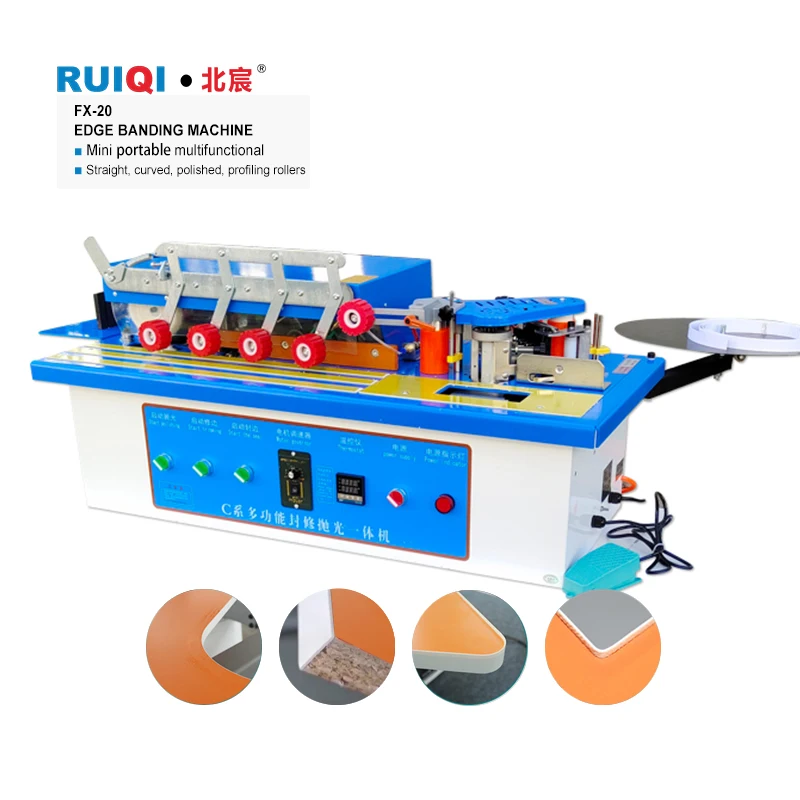
Portable Mini Automatic Edge Banding Machine for Wood – Compact Entry Level Workshop
<p><strong>FX-20 Portable Mini Automatic Edge Banding Machine, 2500W, 0.3-3MM Edge Thickness, Curved & Straight</strong> — designed for workshops handling diverse substrates from MDF to solid wood. Substrate porosity directly affects glue bonding behaviour, and the 1000ml glue pot with adjustable temperature ensures consistent adhesion across plywood, particleboard, and ecological board. Dual 650W trimming stations deliver flush finishes on both radius and straight profiles without secondary handwork.</p> <ul> <li>Four-stage QC with pre-shipment verification ensures every unit meets ±0.02mm tolerance before dispatch.</li> <li>Voltage and control panel language confirmed before production to match your local supply and operator requirements.</li> <li>Sample processing test available using your actual substrates to validate edge quality before order commitment.</li> </ul>
100+
Countries
MOQ 1
Unit
15-25 Days
Lead Time
220V 380V
CE Certified
Edge Banding Machine
FX-20
MDF Particleboard
Process Application
Solid Wood Board
- Full OEM/ODM support -- custom logo, voltage (110V-440V), multilingual panels
- ISO 9001 & CE certified, 5 national patents, 60 professional engineers
- 12-month warranty, remote technical support & spare parts service
- Professional export packaging, customs clearance support, on-time delivery
Voltage verification before shipment — every FX-20 unit is tested under the confirmed local supply standard before dispatch, preventing control board damage from mismatched power systems.
Technical Specifications
| Parameter | Value |
|---|---|
| Model | FX-20 |
| Product Type | Portable Mini Automatic Edge Banding Machine |
| Total Power | 2500W |
| Voltage & Frequency | 220V / 380V / customization available |
| Edge Banding Height | 0–50mm |
| Edge Banding Thickness | 0.3–3mm |
| Minimum Sheet Length | 25cm |
| Minimum Sheet Width | 10cm |
| Trimming Power | 650W × 2 |
| Polishing Power | 180W × 2 |
| Edge Feeding Power | 20W |
| Glue Pot Capacity | 1000ml |
| Air Source Pressure | 0.5–0.8 MPa |
| Overall Dimensions (L×W×H) | 100 × 46 × 41 cm |
| Net Weight | 44kg |
| Language Options | Chinese, English (customizable to Spanish or other languages) |
| Plug Options | EU, USA, AU, UK |
| Key Features | Curved and straight edge banding, trimming, polishing, manual push plate feed |
Application Suitability
| Application | Material or Output |
|---|---|
| Custom cabinet door finishing | MDF and particleboard with PVC or melamine edge bands |
| Small-batch furniture components | Plywood panels with veneer or ABS edge banding |
| On-site installation field modifications | Solid wood and ecological board cut edges |
| Workshop offcut reprocessing | Mixed substrate pieces with curved and straight profiles |
| Home decoration panel finishing | Particleboard and MDF in variable small dimensions |
Why the Voltage Question Must Come Before the Edge Quality Discussion
Mismatched supply voltage is the most common cause of control board failure in portable edge banding machines shipped internationally.
I spent a full week replacing a control board on a compact edge bander that arrived at a custom cabinet shop with a 380V motor wired for a 220V single-phase grid. The local electrician had assumed the machine was dual-voltage. It was not. The operator never got to test a single panel before the machine was pulled offline for parts. Edge banding machine process and application planning starts with confirming what your workshop actually has at the breaker panel, not just what the specification sheet lists as standard. [NEED_CITE: voltage and frequency standards by export market]
Substrate Behaviour Across MDF, Plywood, and Solid Wood
Different panel substrates absorb glue at different rates. MDF is porous and draws adhesive into its open fibre structure quickly, often requiring a slightly higher glue temperature to maintain flow at the bonding point. Plywood, with its cross-laminated veneer layers, presents a harder surface that demands firm pressure during the feed pass. Solid wood edges vary with grain orientation — end grain pulls glue aggressively while long grain holds a cleaner bond line. The FX-20 glue pot holds 1000ml and operates across a temperature range suited to standard EVA hot melt, giving the operator enough working time to adjust technique between substrate switches without draining and refilling the pot.
Edge Quality on Curved vs Straight Profiles
Banding a radius edge introduces tension that straight profiles never face. The edge material must stretch around the curve without thinning or delaminating at the apex. The dual trimming stations, each running at 650W, handle both geometries in a single pass — the operator feeds the panel manually along the curved contour while the trimming cutters follow the profile. Polishing wheels at 180W each then clean the transition between band and substrate surface. For a workshop alternating between flat cabinet sides and curved drawer fronts, this means the edge banding machine process and application workflow does not require swapping tooling or re-fixturing between jobs.
Reading the Specs Against Real Workshop Conditions
The 0.3–3mm edge banding thickness range covers the three materials most common in custom furniture: thin veneer at the lower end, PVC and melamine in the middle, and thick ABS at the upper boundary. Running 0.3mm veneer requires careful temperature control — too hot and the band warps under the feed pressure, too cold and the bond fails at the trimming stage. The 0–50mm banding height accommodates standard 18mm and 25mm panel stock with room above for thicker solid wood components. Air pressure at 0.5–0.8 MPa drives the trimming and polishing actuators, and this range aligns with most small workshop compressors. The manual push plate feed means throughput depends on operator rhythm rather than a fixed conveyor speed, which suits batch work with varied component sizes. [NEED_CITE: CE machinery directive requirements for industrial equipment]
What Happens When the Wrong Configuration Arrives
A machine set up for 380V three-phase arrives in a workshop with only 220V single-phase supply. The motor will not start. The control board may survive, but the heating element in the glue pot will underperform, delivering inconsistent melt temperature and weak bonds that fail during trimming. Alternatively, an operator reading a control panel in an unfamiliar language may set the glue temperature too high for thin veneer, scorching the band and leaving visible residue along the glue line. These are not theoretical problems. They happen on the first day, before any production runs, and the workshop stands idle waiting for replacement parts or a translated manual. Edge banding machine process and application outcomes depend on configuration accuracy as much as machine capability. [NEED_CITE: common causes of edge banding machine commissioning delays]
Why This Workshop Chooses This Source
In-house manufacturing with proprietary cutting mechanisms means the trimming stations on the FX-20 are built and tested in the same facility where the frame is welded — not assembled from third-party sub-contractors. Voltage and plug configuration are confirmed per order, not assumed from a default setting. The four-stage QC process includes a pre-shipment test that runs actual edge banding material on a sample panel, so the machine is verified under load before crating. Operation manuals are produced in the agreed language before dispatch, not translated after the machine arrives. Engineer-led configuration review happens before the formal quotation, catching mismatches in voltage, air supply, and substrate compatibility early in the sales process.
Documentation & Verification
- CE declaration of conformity covering the FX-20 portable unit
- Machine specification sheet confirming voltage, plug type, and language at order
- Electrical schematic with voltage and frequency confirmation for your grid
- Factory test record on your edge banding material and substrate before dispatch
- Operation and maintenance manual in the agreed operator language
- Spare parts list with trimming cutter and polishing wheel part numbers
Installation, Commissioning & Support
- Requires a dedicated 220V or 380V circuit matching confirmed order specification
- Compact 100×46×41cm footprint fits a standard workbench without floor anchoring
- Air compressor connection rated at 0.5–0.8 MPa with standard quick-connect fitting
- 44kg net weight allows two-person placement without lifting equipment
- Glue pot first heat-up and temperature calibration performed during operator training
- Trimming and polishing wheel replacement intervals documented in the spare parts list
What to Share When Requesting a Quote
Send the panel substrates you work with most often, the edge banding materials and thicknesses in your regular inventory, and your workshop voltage and phase at the breaker panel. If you run both curved and straight profiles, note the typical radius range. Specify the language your operators need on the control panel and in the manual. This information lets the engineer confirm configuration before pricing, so the machine that arrives matches the edge banding machine process and application requirements on your shop floor.
Frequently Asked Questions
Q: Which edge banding materials work with this machine’s glue system?
A: The FX-20 EVA glue pot handles PVC, ABS, melamine, and wood veneer within the 0.3–3mm thickness range. Each material responds differently to temperature — veneer requires a lower setting to avoid warping, while ABS at 3mm needs full heat penetration for a reliable bond. Confirm your specific material with a sample test before committing to a production run.
Q: How does substrate porosity affect glue application and bond strength?
A: MDF draws adhesive into its open fibre structure faster than plywood or sealed particleboard, sometimes leaving a starved glue line if the pot temperature is too low. Solid wood end grain behaves similarly. Plywood cross-laminated surfaces hold glue on top, requiring firm feed pressure instead. Adjusting glue temperature between substrates is part of the normal edge banding machine process and application workflow.
Q: What feed technique works best on curved profiles?
A: Maintain steady, moderate pressure through the curve without stopping. Pausing at the apex allows the glue to set unevenly, creating a visible ridge under the trimming cutters. Feed the panel so the band contacts the substrate progressively along the radius, letting the dual trimming stations follow the contour in one continuous pass for the cleanest edge transition.
Q: How do you prevent visible glue lines on thin veneer?
A: Keep the glue pot temperature at the lower end of the range to prevent squeeze-out along the 0.3mm band edge. Ensure the trimming cutters are sharp — dull blades tear thin veneer instead of shearing it, leaving a ragged line that polishing cannot hide. A test pass on an offcut before running production panels reveals the correct temperature and feed speed combination.
Q: What sequence achieves a furniture-grade finish without handwork?
A: The FX-20 workflow runs band application, dual trimming, and polishing in one manual-feed pass. For a clean result, ensure the substrate edge is square and free of saw marks before feeding. The two 650W trimming stations remove excess band flush to the surface, and the 180W polishing wheels then smooth the transition. Most operators achieve a finished edge ready for assembly without secondary sanding.
Technical Specifications
| Parameter | Value |
|---|---|
| Product Name | Portable Mini Automatic Edge Banding Machine for Wood – Compact Entry Level Workshop |
| Category | Edge banding machine |
| Voltage Options | 110V / 220V / 380V / 440V (customizable) |
| Frequency | 50Hz / 60Hz (customizable) |
| Certification | ISO 9001, CE |
| MOQ | 1 Unit |
| Lead Time | 15-25 Working Days |
| Warranty | 12 Months |
| OEM / ODM | Available -- logo, color, panel language |
* Detailed technical specifications vary by model. Please contact us with your specific requirements for a complete datasheet.
Shipping & Export
-
Export Packaging
Heavy-duty wooden crate with foam padding and moisture protection
-
Shipping Methods
Sea freight (FCL/LCL), air freight, express -- we support all methods
-
Customs Support
Full documentation: CO, commercial invoice, packing list, HS code assistance
-
Port of Loading
Tianjin / Qingdao port, China -- 20 years export experience
OEM / ODM Services
-
Logo & Branding
Custom logo printing, color scheme, and nameplate engraving
-
Voltage Configuration
110V / 220V / 380V / 440V, 50Hz / 60Hz -- any region supported
-
Multilingual Panels
Control panels in English, Spanish, French, Arabic and more
-
Custom Specifications
Modified dimensions, accessories, or feature sets on request
Get a Quote
Request Product Inquiry
Fill in your details and we'll respond within 24 hours with pricing and availability.
Direct Contact
How It Works
-
1
Confirm requirements & budget
Tell us your factory scale and processing needs
-
2
Receive recommendation & quote
We match the right machine with full specs
-
3
Negotiate & place order
OEM terms, voltage, payment and delivery
-
4
Production & QC inspection
Multi-stage quality control by 60 engineers
-
5
Export packaging & shipment
Professional packing, customs clearance
-
6
After-sales support
12-month warranty, remote tech support
You May Also Like