Edge banding machine
Click to enlarge
ISO 9001
CE Certified
OEM / ODM
12-Mo Warranty
Edge banding machine
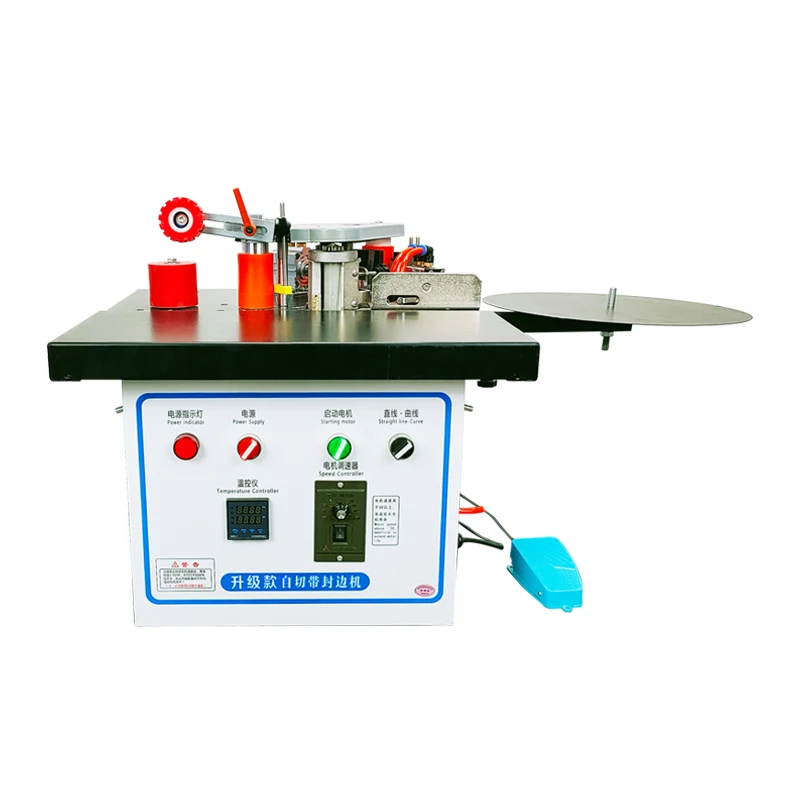
Small Edge Banding Machine ST-50 for Curved and Straight Edge – Compact
<p><strong>ST-50 Mini Edge Banding Machine, 220V/380V, 0.3-3MM Edge Thickness, Curved & Straight</strong> — designed for small workshops handling MDF, particleboard and plywood edge sealing.</p> <ul> <li>Glue pot holds 1000ml for small-batch runs, with air supply at 0.5-0.8MPa matching standard workshop compressors</li> <li>Handles both curved and straight profiles in one unit, reducing floor space for joinery shops transitioning from manual iron-on edging</li> <li>Edge banding height adjustable up to 50MM, suitable for PVC, melamine and veneer strip materials</li> <li>Operation manual provided in the agreed language with voltage confirmed before shipment to avoid commissioning delays</li> </ul>
100+
Countries
MOQ 1
Unit
15-25 Days
Lead Time
220V
Curved Edge Banding
Edge Banding Machine
MDF Panel
Mini Edge Banding Machine
Plywood Edge Sealing
Process And Application
ST-50
- Full OEM/ODM support -- custom logo, voltage (110V-440V), multilingual panels
- ISO 9001 & CE certified, 5 national patents, 60 professional engineers
- 12-month warranty, remote technical support & spare parts service
- Professional export packaging, customs clearance support, on-time delivery
Precision-ground components with multi-stage inspection — Verified tolerance on the ST-50 mini edge bander ensures consistent edge adhesion across curved and straight profiles without post-process rework.
Technical Specifications
| Parameter | Value |
|---|---|
| Model | ST-50 |
| Product Type | Mini Edge Banding Machine |
| Total Power | 1000W |
| Voltage & Frequency | 220V/380V/customization (frequency to be confirmed at order) |
| Edge Banding Mode | Curved and straight edge banding |
| Edge Banding Height | 0–50 mm |
| Edge Banding Thickness | 0.3–3 mm |
| Minimum Sheet Length | 25 cm |
| Minimum Sheet Width | 3 cm |
| Glue Pot Capacity | 1000 ml |
| Edge Power | 20W |
| Air Source Pressure | 0.5–0.8 MPa |
| Product Size | 50 × 50 × 47 cm |
| Product Weight | 22 kg |
| Key Features | Dual curved/straight capability, compact footprint, multilingual control options |
| Language Options | Chinese and English standard; other languages customizable |
| Plug Options | EU, USA, AU, UK |
Application Suitability
| Application | Material or Output |
|---|---|
| Home decoration panel edge sealing | MDF and particleboard cut-to-size panels |
| Custom furniture small-batch production | Plywood and ecological board with PVC or veneer edging |
| On-site fit-out contractor work | Solid wood board and plywood for built-in cabinetry |
| Furniture repair and rework | Curved-profile edges on melamine-faced chipboard |
| Joinery workshop scale-up | Transitioning from manual iron-on banding to mechanised output |
Why Substrate Verification Must Happen Before You Confirm the Edge Banding Process for Small Workshop Orders
Matching glue temperature, feed pressure, and trimming geometry to your actual board and banding material prevents batch-level adhesion failure.
I once shipped a mini edge sealing machine to a workshop that sent us a video of their sample running perfectly — except their daily production used soft PVC banding while the sample ran melamine paper strip. The glue temperature, pressure wheel setting, and trimming knife angle all needed complete recalibration. The first two weeks of production yielded bubbled edges and delaminated strips on nearly every curved panel [NEED_CITE: edge banding adhesion failure causes by substrate mismatch]. With the ST-50, the edge banding process for small workshop environments requires upfront confirmation of your actual substrate and banding combination so the machine leaves the factory calibrated to your material, not to a generic test piece.
Glue Temperature and Banding Material Compatibility
The 1000 ml glue pot on this mini edge sealing machine handles EVA hot-melt adhesive across the 0.3–3 mm banding thickness range. Soft PVC banding requires a lower application temperature than melamine paper strip or real wood veneer, and the difference is significant enough that running the wrong setting causes either incomplete bonding or thermal damage to the banding surface. When you confirm your primary banding material before shipment, the factory sets the thermostat to the correct working window and records it in the dispatch test report. The edge banding process for small workshop operators becomes repeatable only when this baseline temperature matches the adhesive and substrate combination you actually use daily.
Curved Versus Straight Edge Geometry on a Single Unit
Most compact workshops cannot justify floor space for two separate machines — one for straight panels and another for curved profiles. The ST-50 handles both geometries within the same 50 × 50 × 47 cm footprint, which matters when your production includes radiused cabinet doors, rounded shelving, and contoured desk fronts alongside standard rectangular carcass panels [NEED_CITE: workshop layout constraints for small-scale furniture makers]. The pressure wheel maintains contact along the curve radius while the banding feeds through, and operator technique plays a larger role on curved sections than on straight runs. Expect a short learning period for staff transitioning from manual banding to this semi-automated edge banding process for small workshop production.
Reading the Specs That Actually Affect Your Output Quality
The 0.5–0.8 MPa air source pressure requirement means the ST-50 relies on pneumatic actuation for the pressure wheel and trimming mechanisms, so your workshop compressor must deliver stable airflow within this range. A compressor that drops below 0.5 MPa under simultaneous use with other pneumatic tools will cause inconsistent wheel pressure, resulting in visible glue lines on porous substrates like particleboard. The 0.3–3 mm banding thickness range covers most PVC, ABS, melamine paper, and thin veneer strips used in custom furniture, but thicker solid wood lipping falls outside this machine’s capacity. The 25 cm minimum sheet length and 3 cm minimum width define the smallest offcut you can edge-seal — smaller pieces will not register against the guide fence and must be banded by hand. Voltage must be confirmed at order because running a 220V/50Hz motor on a 60Hz supply alters the glue pot heating curve and feed behaviour.
The Hidden Cost of Ordering Without Confirming Local Electrical and Pneumatic Infrastructure
A workshop in a 60Hz market that receives a machine configured for 50Hz will find the glue pot takes longer to reach working temperature and the feed motor runs at an unintended speed, affecting both adhesive open time and banding adhesion quality. Similarly, connecting the ST-50 to a compressor shared with spray guns and nailers without verifying the 0.5–0.8 MPa supply window leads to intermittent pressure drops that show up as uneven trimming and incomplete edge contact [NEED_CITE: pneumatic pressure fluctuation effects on edge bander performance]. These problems are not machine defects — they are infrastructure mismatches that could have been prevented with a pre-shipment checklist confirming voltage, frequency, and compressor capacity against your workshop’s actual setup.
Why Sourcing This Mini Edge Bander Through a Manufacturer-Led Process Matters
The ST-50 is built in a facility with in-house manufacturing and patented cutting mechanisms, meaning tolerance claims are verifiable through factory test records rather than brochure specifications. Four-stage quality control covering incoming material, in-process assembly, finished product inspection, and pre-shipment verification ensures the glue pot, pressure wheel alignment, and trimming geometry are validated before crating. Voltage, plug type, and control panel language are treated as standard customisation points rather than afterthoughts, so an operator in a non-Chinese-speaking market receives documentation they can actually read during commissioning. Engineer-led configuration means the formal quotation reflects your actual substrate and banding material, not a generic catalog entry. Factory visits are welcomed for buyers who want to witness the edge banding process for small workshop applications on their own sample panels before confirming the order.
Documentation & Verification
- CE declaration of conformity covering the ST-50 electrical and mechanical safety requirements
- Machine specification sheet confirming glue pot capacity, banding thickness range, and air pressure needs
- Electrical schematic with voltage and frequency confirmation matching your workshop supply
- Factory test record on your specific panel substrate and banding material combination before dispatch
- Operation and maintenance manual in the agreed language with illustrated adjustment procedures
- Spare parts list identifying consumable trimming blades, pressure wheels, and glue pot components
Installation, Commissioning & Support
- Allocate a bench or stand for the 50 × 50 × 47 cm footprint with clearance for curved panel feed paths
- Confirm dedicated 220V or 380V circuit matching the ordered voltage configuration before machine arrival
- Verify compressor output at 0.5–0.8 MPa with a regulated line isolated from high-draw pneumatic tools
- First run should use scrap panels of your actual substrate to validate glue temperature and pressure wheel contact
- Operator training covers curved-profile feed technique and banding thickness changeover between 0.3 mm and 3 mm
- Schedule glue pot cleaning and trimming blade inspection at intervals matching your daily production volume
Preparing Your Inquiry for Accurate Configuration
To ensure the ST-50 arrives calibrated for your actual production conditions, include the specific board substrate you work with most frequently — MDF, particleboard, plywood, or solid wood — along with the edge banding material type and thickness you intend to run. Confirm your local voltage and frequency so the motor and heating elements are wound correctly before assembly. If your workshop produces curved-profile components, provide the typical radius range so we can verify feed geometry compatibility during the pre-shipment test.
Frequently Asked Questions
Q: Which substrates and edge banding materials are compatible with the ST-50?
A: The ST-50 handles MDF, particleboard, plywood, solid wood board, and ecological board with edge banding materials including PVC, melamine paper strip, and thin veneer within the 0.3–3 mm thickness range. Soft PVC requires different glue temperature settings than melamine or veneer, so confirming your primary material combination before order allows factory calibration. Thicker solid wood lipping exceeds the machine’s banding height and thickness capacity.
Q: How does curved edge banding differ from straight banding on this unit?
A: Curved edge banding on the ST-50 requires the operator to guide the panel along the radius while the pressure wheel maintains consistent contact force. Straight banding is largely self-feeding once the panel enters the guide fence. Workshops transitioning from manual banding should allocate a short training period for curved-profile technique, as operator influence on feed angle directly affects glue line uniformity and edge adhesion quality.
Q: What glue type and temperature settings are recommended for different substrates?
A: EVA hot-melt adhesive is standard for the ST-50’s 1000 ml glue pot. Soft PVC banding on MDF typically requires a lower application temperature than melamine paper on particleboard, and real wood veneer falls somewhere between. The factory sets the baseline thermostat during pre-shipment testing based on your confirmed material combination, and the operation manual includes adjustment guidance for seasonal ambient temperature variations.
Q: How does edge sealing quality from this mini machine compare to full-function automatic edge banders?
A: The ST-50 provides consistent mechanised edge sealing suitable for small-batch custom furniture, home decoration panels, and repair work. Full-function automatic edge banders add pre-milling, multi-stage trimming, and scraping stations that produce higher edge refinement at production-line throughput. For workshops handling curved profiles or running low daily volumes, the ST-50 delivers adequate edge quality without the floor space and capital commitment of a full-line machine.
Q: What compressor specification is needed to operate the ST-50?
A: The machine requires a stable air supply between 0.5 and 0.8 MPa. A standard workshop piston compressor rated for continuous duty can meet this requirement, provided the ST-50 is connected through a regulated line that is not shared with high-consumption tools like spray guns or sanders operating simultaneously. Insufficient air pressure causes uneven pressure wheel contact and inconsistent trimming on the banding edge.
Technical Specifications
| Parameter | Value |
|---|---|
| Product Name | Small Edge Banding Machine ST-50 for Curved and Straight Edge – Compact |
| Category | Edge banding machine |
| Voltage Options | 110V / 220V / 380V / 440V (customizable) |
| Frequency | 50Hz / 60Hz (customizable) |
| Certification | ISO 9001, CE |
| MOQ | 1 Unit |
| Lead Time | 15-25 Working Days |
| Warranty | 12 Months |
| OEM / ODM | Available -- logo, color, panel language |
* Detailed technical specifications vary by model. Please contact us with your specific requirements for a complete datasheet.
Shipping & Export
-
Export Packaging
Heavy-duty wooden crate with foam padding and moisture protection
-
Shipping Methods
Sea freight (FCL/LCL), air freight, express -- we support all methods
-
Customs Support
Full documentation: CO, commercial invoice, packing list, HS code assistance
-
Port of Loading
Tianjin / Qingdao port, China -- 20 years export experience
OEM / ODM Services
-
Logo & Branding
Custom logo printing, color scheme, and nameplate engraving
-
Voltage Configuration
110V / 220V / 380V / 440V, 50Hz / 60Hz -- any region supported
-
Multilingual Panels
Control panels in English, Spanish, French, Arabic and more
-
Custom Specifications
Modified dimensions, accessories, or feature sets on request
Get a Quote
Request Product Inquiry
Fill in your details and we'll respond within 24 hours with pricing and availability.
Direct Contact
How It Works
-
1
Confirm requirements & budget
Tell us your factory scale and processing needs
-
2
Receive recommendation & quote
We match the right machine with full specs
-
3
Negotiate & place order
OEM terms, voltage, payment and delivery
-
4
Production & QC inspection
Multi-stage quality control by 60 engineers
-
5
Export packaging & shipment
Professional packing, customs clearance
-
6
After-sales support
12-month warranty, remote tech support
You May Also Like