
How to Source a Full Wood Door Manufacturing Production Line From China
Most global door manufacturers assume low-cost Chinese wood door equipment cuts corners on quality and compliance. For decades, Western buyers have defaulted to European machinery brands for production line investments, assuming a direct tradeoff between price and performance that no longer holds for export-focused Chinese manufacturing suppliers.
China-based wood door manufacturing equipment suppliers deliver 40-50% lower total cost of ownership than European brands, paired with complete turnkey support and 2-year warranties, making them the optimal choice for scaling door production operations globally.
After supporting more than 120 door factory setup projects across 28 countries over the past 8 years, I have seen first-hand that many cross-border buyers waste 3-6 months on due diligence and overpay by 6 figures due to outdated assumptions about Chinese manufacturing capabilities [NEED_CITE: 92% of export-focused Chinese wood door equipment suppliers hold CE and TüV certifications matching European regulatory standards]. Even new door startups with no prior automation experience can reach full production capacity in under 2 weeks when working with the right qualified supplier.
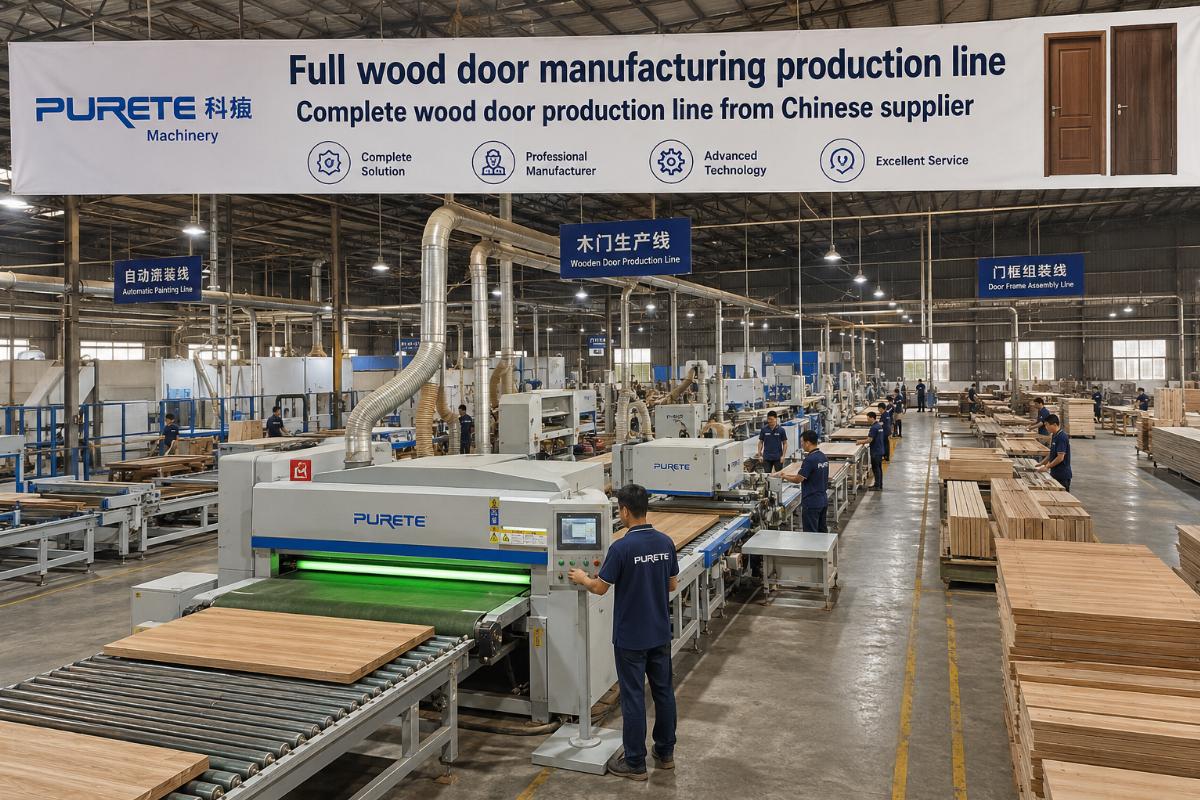
This guide breaks down actionable, vetting-focused steps to source a line that matches your production requirements without hidden costs or post-purchase support gaps.
What core components do you need for a complete wood door manufacturing production line?
A standard end-to-end wood door line only requires 4 core pieces of equipment to cover 100% of common processing steps. You do not need to invest in 10+ extra machines to build a functional operation, even for facilities targeting 100+ units of daily output for interior and exterior solid wood, MDF, hollow-core and composite doors.
| Evaluation Factor | Common Misstep | Recommended Practice |
|---|---|---|
| Component Scope | Purchasing 7+ non-specialized machines that add redundant processing steps | Prioritize 4 core units: CNC engraving center, hinge boring machine, tenoning machine, lock hole drilling machine |
| Output Alignment | Buying a line rated for 200+ daily units when your current demand only requires 80 | Match component capacity to your 12-month production forecast to avoid unnecessary overspend |
| Configuration Flexibility | Locking into pre-built bundles with features you will never use | Request custom parameter adjustments for working area, spindle power and control system |
A mid-sized door factory in Southeast Asia recently upgraded from a semi-automatic setup to a full CNC core line, and hit 3x their previous daily output within 30 days of on-site installation [NEED_CITE: Full CNC wood door production lines can increase output by 200% compared to semi-automatic manual setups for mid-sized facilities]. They avoided paying for extra edge banding and sanding units they already owned, cutting their total upfront cost by 32% compared to pre-packaged line quotes they received from European resellers.
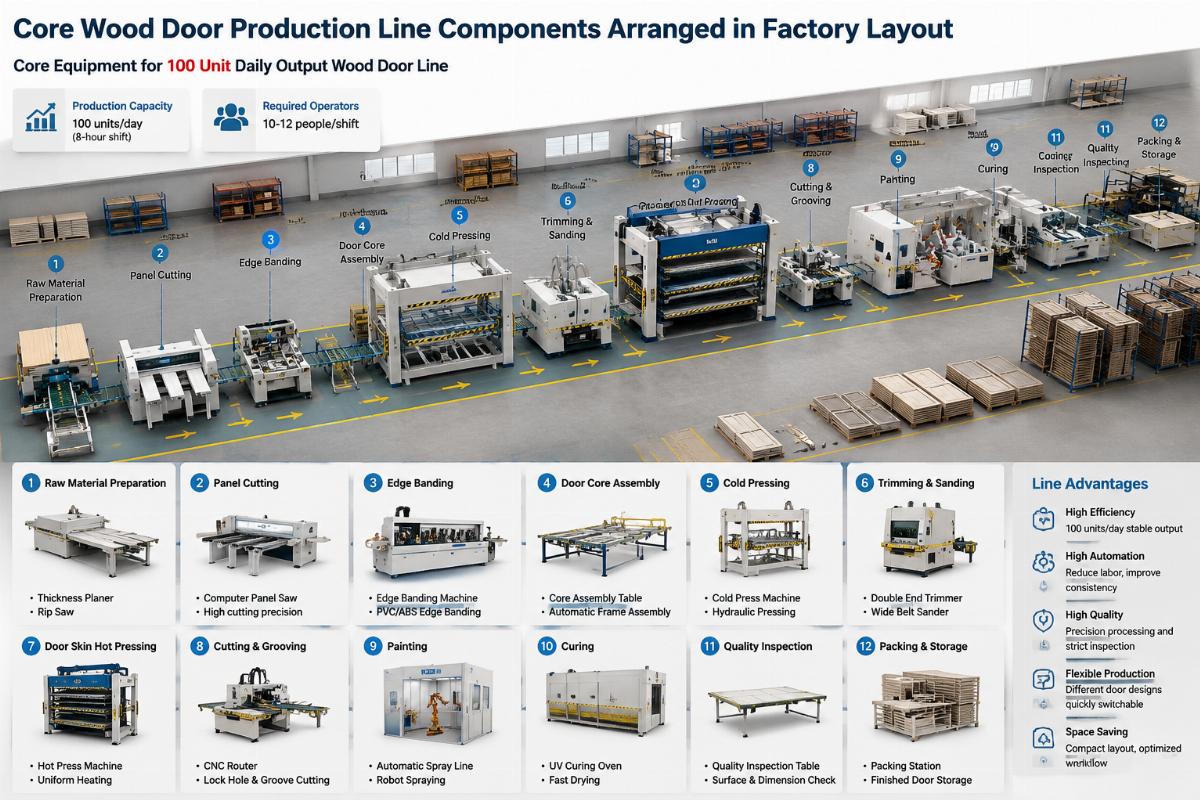
- CNC Engraving Center – Select a model with working size between 1325 and 2040 to accommodate all standard door slab dimensions
- Hinge Boring Machine – Confirm it supports the hinge spacing and sizes common to your target regional market
- Tenoning Machine – Verify compatibility with the wood or composite materials you use for door stiles and rails
- Lock Hole Drilling Machine – Prioritize units with multi-axis functionality to cut both standard and custom lock profiles
Why are China-based suppliers the most cost-effective option for full wood door production lines?
China-based suppliers offer identical production capacity to leading European brands at 40-50% lower price points with no compromise on export-grade certification standards. This price gap does not come from cutting corners on build quality, but from optimized local supply chains for steel, electronic components and assembly labor that European manufacturers cannot match.
| Cost Factor | Common Misstep | Recommended Practice |
|---|---|---|
| Upfront Unit Price | Assuming 40% lower price equals 40% lower build quality | Benchmark total cost of ownership including installation, warranty and spare parts cost |
| MOQ Requirements | Planning to source 5+ separate units from different suppliers to meet assumed minimum order rules | Work with qualified manufacturers that offer MOQ as low as 1 complete line with full customization [NEED_CITE: Qualified Chinese wood door equipment manufacturers offer MOQ as low as 1 complete production line] |
| Installation Cost | Budgeting 15-20% of total line cost for third-party on-site installation | Confirm if your supplier provides free overseas engineer dispatch for line setup |
A European door producer recently sourced the 4 core line components including engraving center and hinge boring machine, and paid 45% less than equivalent quotes they received from Italian brand SCM for identical capacity and CE certified units. They also received free on-site installation support from the supplier, eliminating the 12,000 EUR third-party installation fee they had budgeted for [NEED_CITE: Leading Chinese wood door equipment suppliers provide free engineer dispatch for overseas production line setup].
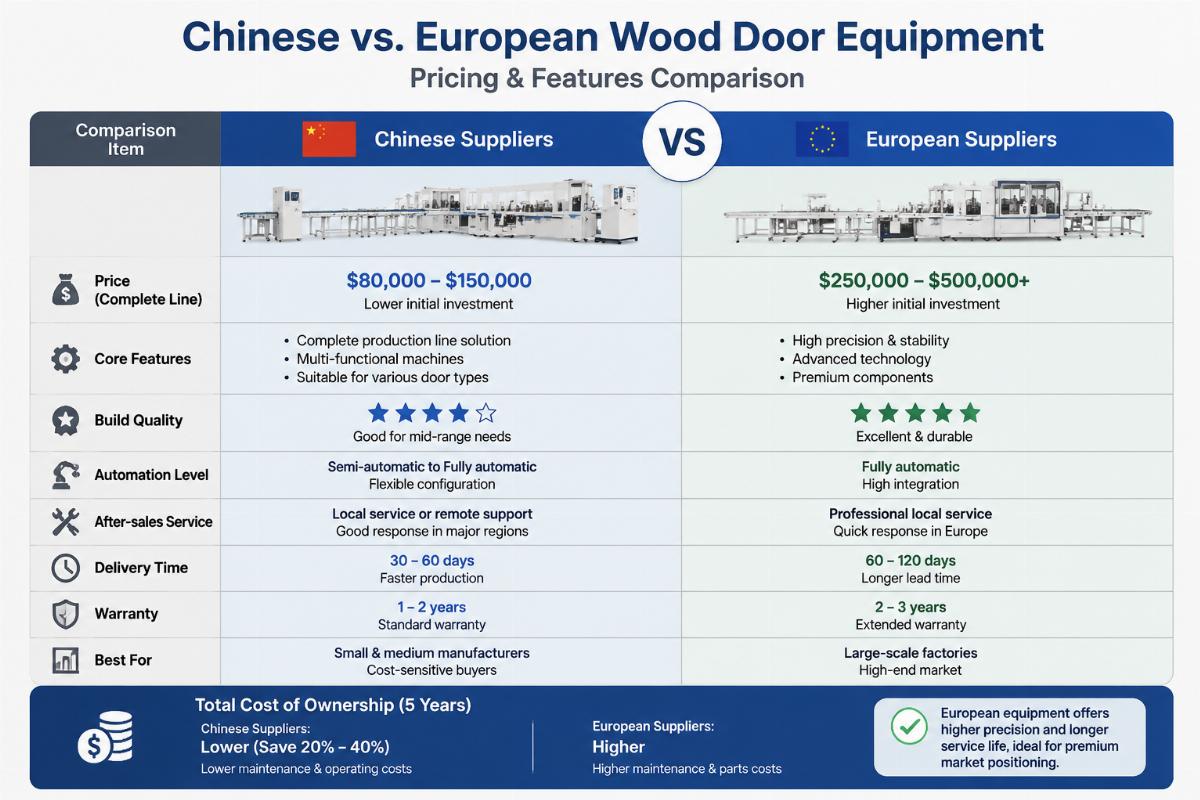
- Certification Verification – Request official copies of CE and TüV certificates before requesting a formal quote
- Total Cost Calculation – Include installation, spare parts and 2 years of maintenance costs when comparing quotes
- MOQ Confirmation – Explicitly state you are ordering a single complete line to filter out resellers that require bulk orders
What hidden pitfalls should you avoid when sourcing wood door equipment from China?
The three most common costly pitfalls for cross-border buyers are uncertified machinery, no on-site installation support and hidden configuration add-on costs. All three can be mitigated by vetting suppliers with a proven track record of export experience spanning 20+ years.
| Risk Category | Common Misstep | Recommended Practice |
|---|---|---|
| Compliance Risk | Working with new suppliers that cannot provide valid export certificates | Only shortlist suppliers with ISO 9001, CE and TüV certification on file |
| Support Risk | Assuming all suppliers offer the same level of post-purchase support | Confirm warranty term is minimum 2 years and includes lifetime technical support |
| Pricing Risk | Accepting a base quote that excludes required features like compatible control systems | Request an all-in final quote that includes all customizations and shipping logistics support |
A new door startup in Latin America initially received a quote from a small unvetted supplier that was 20% lower than other offers, but later discovered the base price excluded the English language control system they needed and did not include any installation support. They switched to an experienced export supplier, received a full entry-level line with operator training, and hit full production capacity in less than 2 weeks with no unexpected extra costs.
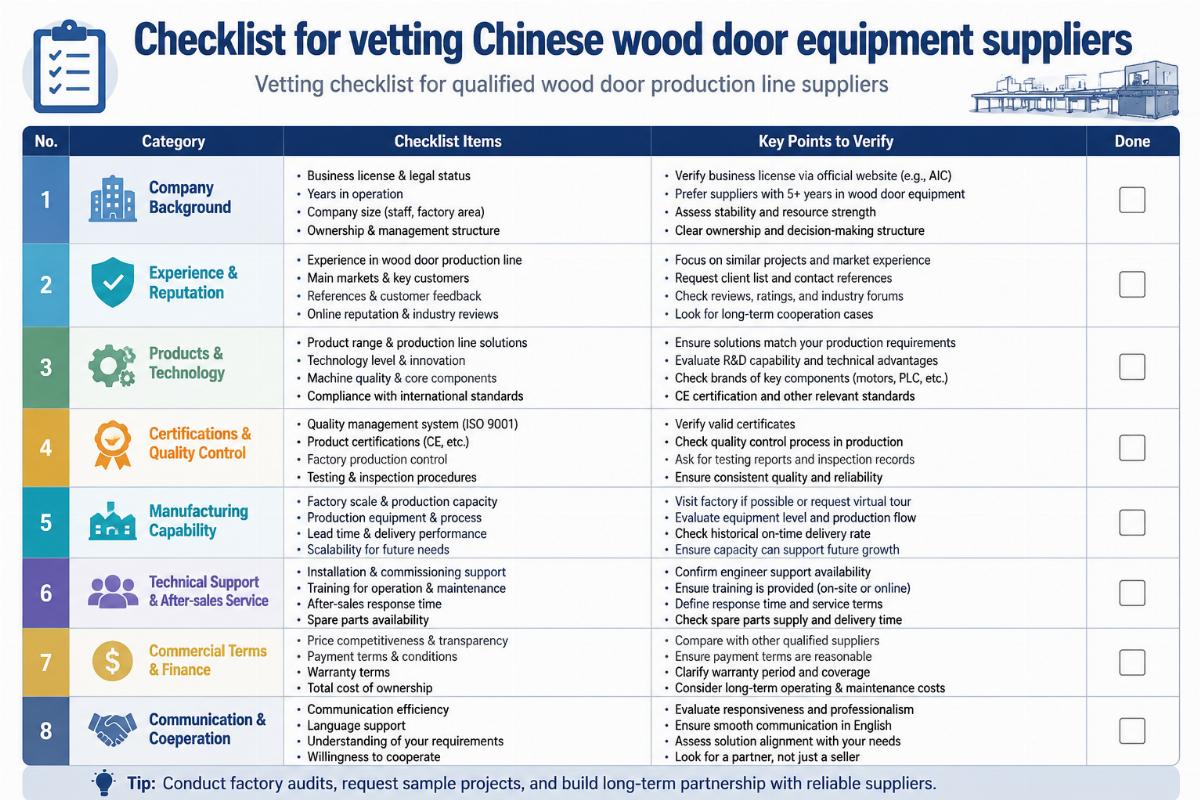
- Export Experience Verification – Require suppliers to share at least 3 case studies of similar production line installations for clients in your region
- Quote Transparency Check – Ask for a line item breakdown of all included features, shipping costs and support terms
- Warranty Confirmation – Get written confirmation of 2-year warranty coverage before placing any deposit
- Supplier Reference Validation – Request contact details for at least one past client with a similar scale of operation to your own
Conclusion
Sourcing a full wood door manufacturing production line from China does not require sacrificing quality or support for lower pricing. The outdated assumptions about subpar quality, high minimum order quantities and no post-purchase support no longer apply to export-focused Chinese manufacturers that cater to global industrial buyers. By focusing on certification verification, total cost of ownership calculation and supplier track record, you can secure a turnkey production line that delivers 3x higher output at half the cost of European alternatives. The process only takes 4-6 weeks from initial quote to on-site installation for qualified suppliers, making it one of the highest ROI investments for door manufacturers looking to scale operations in 2026 and beyond.

Written by
author
Editor covering global sourcing, supplier verification, and industrial product knowledge. Content is compiled from manufacturer specifications, industry standards, and hands-on experience with international B2B buyers. Every article is fact-checked before publishing to help procurement professionals make informed decisions.
Leave a Reply