Edge banding machine
Click to enlarge
ISO 9001
CE Certified
OEM / ODM
12-Mo Warranty
Edge banding machine
Automatic Bevel Edge Banding Machine for MDF and Plywood Panels
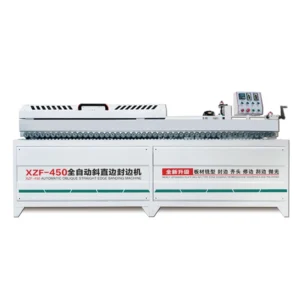
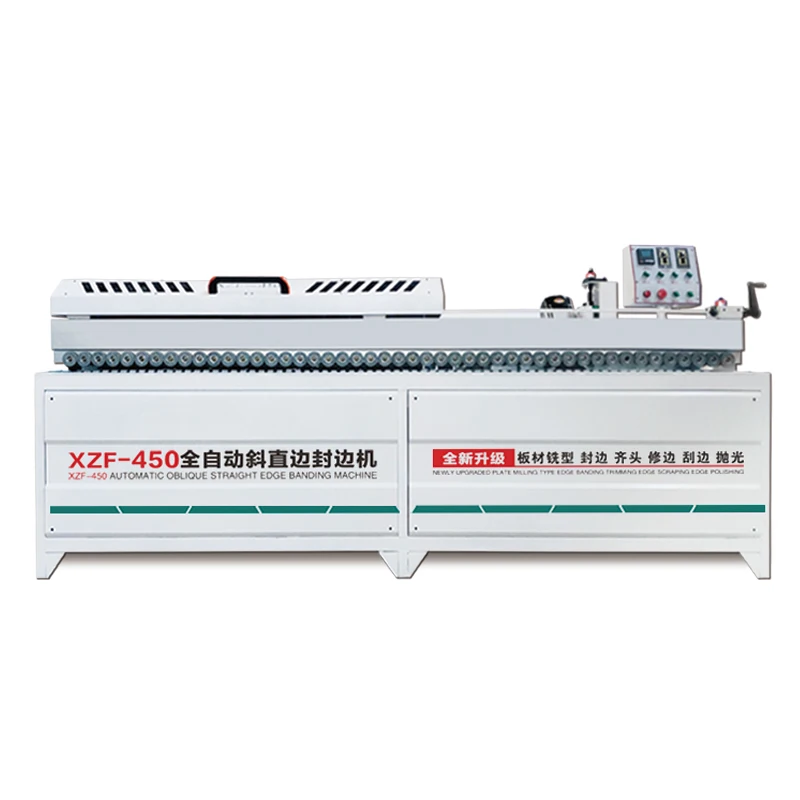
<p><strong>XZF450 Automatic Bevel Edge Banding Machine, 9.5 kW, 0–12 m/min Feed</strong> — delivers a complete 7-station process from pre-milling through polishing in one pass.</p> <ul> <li>4 kW pre-milling station removes saw marks for consistent glue adhesion on MDF, plywood and particleboard</li> <li>Handles 30°, 45°, 60° bevel and 90° straight edges with 0.3–3 mm banding thickness</li> <li>Variable feed speed lets operators match throughput to substrate and edge complexity</li> </ul> <p>Backed by four-stage QC with pre-shipment verification, engineer-led configuration within 24 hours, and full voltage and language customization to your workshop requirements.</p>
100+
Countries
MOQ 1
Unit
15-25 Days
Lead Time
380V
Edge Banding Machine
MDF Panel
Plywood Panel
Pre-milling
Process Application
XZF-450
- Full OEM/ODM support -- custom logo, voltage (110V-440V), multilingual panels
- ISO 9001 & CE certified, 5 national patents, 60 professional engineers
- 12-month warranty, remote technical support & spare parts service
- Professional export packaging, customs clearance support, on-time delivery
Precision-milled edge preparation — a 4 kW pre-milling station on the XZF450 removes saw marks before gluing, producing consistent bond lines on MDF and plywood substrates.
Technical Specifications
| Parameter | Value |
|---|---|
| Model | XZF-450 |
| Product Type | Automatic Bevel Edge Banding Machine |
| Total Power | 9.5 kW |
| Voltage | 380V / 415V (configurable frequency and plug type) |
| Pre-milling Motor | 4 kW |
| Trimming Power | 2.2 kW × 2 |
| Polishing Power | 0.4 kW × 2 |
| Vacuum Power | 550 W |
| Transmission Power | 180 W |
| Feed Speed | 0–12 m/min |
| Glue Pot Capacity | 4000 ml |
| Edge Banding Height | 0–50 mm |
| Edge Banding Thickness | 0.3–3 mm |
| Minimum Sheet Length | 30 cm |
| Minimum Sheet Width | 15 cm |
| Air Source Pressure | 0.5–0.7 MPa |
| Standard Functions | Pre-milling, 30°/45°/60° bevel banding, end trimming, rough trimming, fine trimming, scraping, polishing |
| Overall Dimensions (L×W×H) | 300 × 65 × 135 cm |
| Net Weight | 430 kg |
| Language Options | Chinese/English standard; other languages customizable |
| Plug Options | EU, USA, AU, UK |
Application Suitability
| Application | Material or Output |
|---|---|
| Cabinet and wardrobe panel edging | MDF, melamine-faced board, particleboard with PVC or veneer banding |
| Door frame bevel assembly | Polymer panels, blockboard, plywood requiring 45° edge joints |
| Mixed-substrate custom furniture | Solid wood panels alternating with composite boards on the same line |
| Medium-volume production environments | Straight and bevel edge profiles without machine changeover |
Why Glue Lines Fail on MDF and How Pre-milling Changes the Outcome
Surface irregularities on cut panels are the primary cause of visible glue seams, not the banding material itself.
When a sliding table saw or beam saw scores MDF or particleboard, it leaves micro-ridges along the cut edge. Applying adhesive directly over these ridges produces uneven pressure distribution during the pressing stage, resulting in white stress marks or hollow spots along the band [NEED_CITE: woodworking substrate preparation standards for adhesive bonding]. The XZF450 automatic bevel edge banding machine process application addresses this by placing a 4 kW pre-milling cutter ahead of the glue station, removing up to a millimeter of material to expose a true flat surface. I have commissioned lines where switching on the pre-milling station eliminated rework that the factory had attributed to low-quality PVC banding for months.
How Substrate Behavior Dictates Feed Speed Selection
Feed speed on the XZF450 ranges from 0 to 12 m/min, but the optimal setting depends entirely on what the panel is made of and what edge profile you are running. Melamine-faced particleboard tolerates higher feed rates because the substrate density is relatively uniform. Solid wood panels with grain variations require slower feeding so the trimming cutters can follow density changes without tear-out. When processing plywood with alternating grain directions in each veneer layer, a moderate feed rate keeps the fine trimming and scraping stations in control of the edge geometry.
Bevel Angle Selection for Assembly Integrity
The multi-angle capability — 30°, 45°, and 60° in addition to standard 90° straight edges — matters most in door and frame manufacturing where miter joints must close tightly under clamping pressure. A 45° bevel edge on blockboard door stiles allows the banding to wrap around the joint face, producing a clean sight line when two rails meet at a corner. The angle must match the joinery drawing exactly; a half-degree deviation across a long edge compounds into visible gaps at the joint [NEED_CITE: woodworking joint tolerance standards in cabinet and door assembly]. Operators select the angle before the run and verify with a test piece.
Reading the Spec Sheet Against Your Production Requirements
The 4 kW pre-milling motor is sized to handle dense substrates like high-pressure MDF and moisture-resistant particleboard without stalling under load. Lower-powered pre-milling units in this class struggle when feed rate increases because the cutter cannot maintain chip evacuation at depth. The dual 2.2 kW trimming motors provide sufficient torque for both rough and fine trimming in a single pass, which matters when banding thickness reaches the upper 3 mm limit. The 4000 ml glue pot capacity supports extended production runs without refill interruption on standard PVC and ABS materials. Air source pressure between 0.5 and 0.7 MPa must be stable; pressure fluctuation causes inconsistent clamping force at the pressing rollers, directly visible as waviness in the finished edge.
The Cost of Ignoring Voltage and Language at Order Stage
Machines shipped with a control panel the operator cannot read stall at commissioning while translated manuals are sourced locally. Beyond the delay, incorrect parameter entry from mislabeled menus produces scrap panels before the error is caught. Voltage mismatch is more destructive — a machine wired for 50 Hz running on a 60 Hz supply spins motors faster than designed, accelerating bearing wear and throwing off feed synchronization between stations [NEED_CITE: industrial machinery voltage and frequency compatibility requirements]. Confirming these details before production begins prevents problems that no amount of on-site adjustment can correct after the fact.
Why Production Managers Choose This Configuration
The seven-station layout keeps pre-milling, gluing, trimming, scraping, and polishing in one continuous pass, eliminating intermediate handling that damages freshly banded edges. Voltage and plug configuration are confirmed at order stage rather than discovered at unloading, matching the local supply whether the factory runs 380V or 415V. Factory test records are generated on the buyer’s actual substrate before dispatch, providing documented evidence of edge quality and glue line consistency on MDF, plywood, or solid wood. The control panel language is specified and locked in during the quotation phase, so the operator reads instructions in their working language from first power-on.
Documentation & Verification
- CE declaration of conformity covering the complete seven-station assembly
- Factory test record processed on your specified panel material and thickness before shipment
- Electrical schematic confirming voltage, frequency, and plug type as ordered
- Operation and maintenance manual written in the agreed control panel language
- Spare parts list identifying wear items for each station with reorder codes
Installation, Commissioning & Support
- Requires a dedicated 380V/415V circuit rated for the 9.5 kW total load with proper grounding
- Overall 300 cm length requires clear floor space for material infeed and outfeed on both ends
- Arrives fully assembled; positioning and leveling are the primary on-site mechanical tasks
- Air compressor delivering stable 0.5–0.7 MPa must be connected before first test cycle
- Glue pot temperature calibration runs on your specific PVC or veneer banding stock during commissioning
- Pre-milling depth and trimming cutter offsets are set and verified against your panel thickness range
What to Include in Your Inquiry
Provide the panel materials you run most frequently — MDF, plywood, solid wood, or a mix — along with typical board thickness and the edge banding materials in use. State your local voltage and frequency, the preferred control panel language, and whether bevel angles beyond 90° are required for your assembly methods. If you need sample panels processed before order confirmation, send representative board stock for a factory test run.
Frequently Asked Questions
Q: How does the pre-milling station improve edge banding quality on MDF and particleboard?
A: The 4 kW pre-milling cutter removes saw marks and surface unevenness from the panel edge before adhesive is applied. This exposes a flat substrate that allows uniform glue distribution and consistent pressing pressure, eliminating the hollow spots and white stress lines that appear when banding is applied directly over an irregular cut surface.
Q: What panel and edge banding thickness range does the XZF450 support?
A: The machine handles edge banding heights from 0 to 50 mm and banding thickness between 0.3 mm and 3 mm. Minimum panel dimensions are 30 cm in length and 15 cm in width. This range covers standard PVC, ABS, melamine, and thin wood veneer banding materials used in cabinet and furniture production.
Q: How do I choose between 30°, 45°, and 60° bevel angles for furniture assembly?
A: The correct angle is determined by your joinery design. Door frames and mitered cabinet components typically require 45° bevels so banding wraps the joint face cleanly. Straight 90° edges serve standard panel edging. Confirm the angle from your assembly drawings and verify with a test piece before running production stock.
Q: What glue temperature settings work best for PVC compared to wood veneer banding?
A: PVC and ABS banding generally require a glue pot temperature suited to standard EVA hot melt adhesives, while wood veneer may need adjusted temperature and feed rate to prevent the porous material from absorbing excess adhesive. The 4000 ml glue pot maintains stable temperature across extended runs, and settings should be validated on your specific banding stock during commissioning.
Technical Specifications
| Parameter | Value |
|---|---|
| Product Name | Automatic Bevel Edge Banding Machine for MDF and Plywood Panels |
| Category | Edge banding machine |
| Voltage Options | 110V / 220V / 380V / 440V (customizable) |
| Frequency | 50Hz / 60Hz (customizable) |
| Certification | ISO 9001, CE |
| MOQ | 1 Unit |
| Lead Time | 15-25 Working Days |
| Warranty | 12 Months |
| OEM / ODM | Available -- logo, color, panel language |
* Detailed technical specifications vary by model. Please contact us with your specific requirements for a complete datasheet.
Shipping & Export
-
Export Packaging
Heavy-duty wooden crate with foam padding and moisture protection
-
Shipping Methods
Sea freight (FCL/LCL), air freight, express -- we support all methods
-
Customs Support
Full documentation: CO, commercial invoice, packing list, HS code assistance
-
Port of Loading
Tianjin / Qingdao port, China -- 20 years export experience
OEM / ODM Services
-
Logo & Branding
Custom logo printing, color scheme, and nameplate engraving
-
Voltage Configuration
110V / 220V / 380V / 440V, 50Hz / 60Hz -- any region supported
-
Multilingual Panels
Control panels in English, Spanish, French, Arabic and more
-
Custom Specifications
Modified dimensions, accessories, or feature sets on request
Get a Quote
Request Product Inquiry
Fill in your details and we'll respond within 24 hours with pricing and availability.
Direct Contact
How It Works
-
1
Confirm requirements & budget
Tell us your factory scale and processing needs
-
2
Receive recommendation & quote
We match the right machine with full specs
-
3
Negotiate & place order
OEM terms, voltage, payment and delivery
-
4
Production & QC inspection
Multi-stage quality control by 60 engineers
-
5
Export packaging & shipment
Professional packing, customs clearance
-
6
After-sales support
12-month warranty, remote tech support
You May Also Like