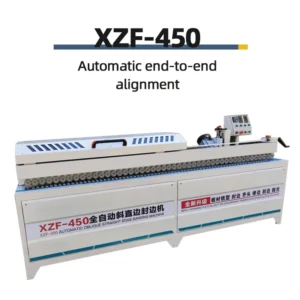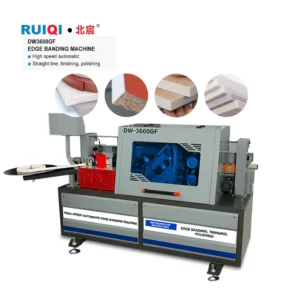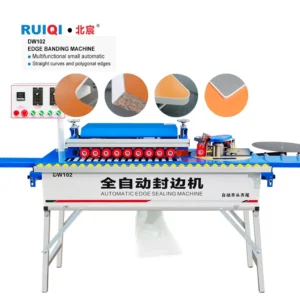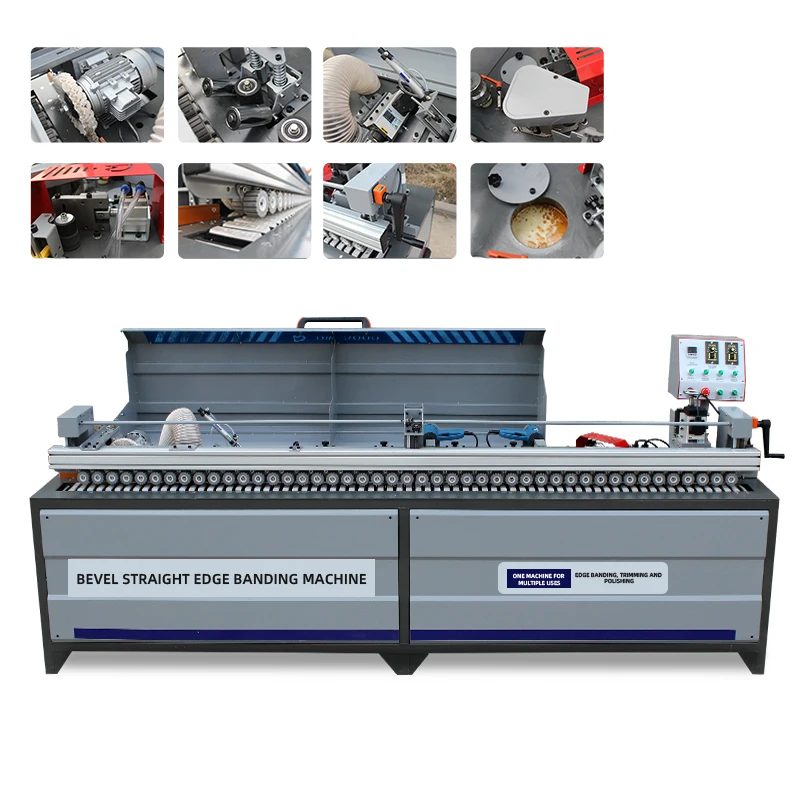
Edge banding machine
Click to enlarge
ISO 9001
CE Certified
OEM / ODM
12-Mo Warranty
Edge banding machine
Automatic Edge Banding Machine for Straight and 45 Degree Bevel with Polishing – Industrial Application
<p><strong>DW3000 Fully Automatic Edge Banding Machine, 11KW, 0.3-3mm Edge Thickness</strong> — engineered for consistent edge finishing across MDF, particleboard, and plywood substrates.</p> <ul> <li>Double heat gun design (2.2KW×2) ensures thorough glue activation on varying material densities</li> <li>30-90 degree adjustable bevel with 8 oblique pressure wheels for straight and 45-degree profiles</li> <li>3 spindle trimming motors plus flexible scraper minimize visible glue lines before polishing</li> </ul> <p>Production managers evaluating edge quality and downstream assembly accuracy benefit from the DW3000's controllable thermal profile and multi-stage trimming. Backed by four-stage QC with pre-shipment verification, engineer-led configuration within 24 hours, and full voltage customization to match your facility requirements.</p>
100+
Countries
MOQ 1
Unit
15-25 Days
Lead Time
11KW Motor
45 Degree Bevel
DW3000
Edge Banding Machine
Furniture Factory
MDF Panel
Process Application
- Full OEM/ODM support -- custom logo, voltage (110V-440V), multilingual panels
- ISO 9001 & CE certified, 5 national patents, 60 professional engineers
- 12-month warranty, remote technical support & spare parts service
- Professional export packaging, customs clearance support, on-time delivery
Verified Process Stability — the DW3000 delivers repeatable edge finish quality across MDF, particleboard, and plywood substrates, confirmed through four-stage QC and pre-shipment testing on your specific material mix.
Technical Specifications
| Parameter | Value |
|---|---|
| Product Type | Fully Automatic Edge Banding Machine |
| Total Power | 11 kW |
| Voltage | 380V / 415V |
| Pre-milling Motor | 2.2 kW |
| Heating Power | 2.2 kW × 2 (double heat gun) |
| Edge Feed Power / Speed | 160 W / 0–12 m/min |
| Transmission Power / Speed | 180 W / 0–12 m/min |
| Trimming Power | 2.2 kW × 2 (3 spindle trimming motors total) |
| Polishing Power | 0.4 kW × 2 |
| Vacuum Power | 550 W |
| Glue Pot Capacity | 4000 ml |
| Air Source Pressure | 0.5–0.7 MPa |
| Edge Banding Height | 0–50 mm |
| Edge Banding Thickness | 0.3–3 mm |
| Minimum Sheet Length | 300 mm |
| Minimum Sheet Width | 150 mm |
| Machine Dimensions | 2990 × 650 × 1300 mm |
| Machine Weight | 430 kg |
| Bevel Capability | 30°–90° adjustable |
| Key Features | Pre-milling, edge band slotting, flexible edge scraper, 8 sets oblique pressure wheels, high-power vacuuming |
| Control Panel Language | Chinese and English standard; Spanish, French, and others available on request |
| Plug Options | EU, USA, AU, UK |
Application Suitability
| Application | Material or Output |
|---|---|
| Custom cabinet straight-edge banding | MDF and particleboard with PVC edge banding 0.4–2 mm |
| Furniture 45-degree bevel edge profiles | Plywood and MDF panels with veneer or PVC banding |
| Mixed-substrate production runs | MDF, particleboard, and plywood processed on the same shift |
| Small-batch joinery components | Solid wood panels with 0.3–3 mm edge banding |
| Panel edge slotting for assembly lines | Particleboard and MDF shelving and carcass panels |
Why Substrate Density Changes Everything About Glue Activation
The edge banding machine process application outcome depends far more on glue temperature uniformity than on feed speed alone.
I once spent three days at a panel board plant where the same machine settings produced perfect edges on MDF but left visible glue lines on denser particleboard. The single heat gun simply could not maintain thermal consistency when the substrate absorbed heat at different rates. That kind of inconsistency only shows up when you run a mixed batch, and by then the panels are already cut. The DW3000 uses a double heat gun design rated at 2.2 kW each, which keeps the adhesive at working temperature regardless of whether the next panel is lightweight MDF or high-density particleboard. [NEED_CITE: adhesive activation temperature ranges for PVC and veneer edge banding on engineered wood substrates]
Thermal Profile and Pressure Distribution Across Substrates
The edge banding machine process application starts with glue activation, but the actual bond quality is determined by the pressure wheels that follow. Eight sets of oblique pressure wheels on this machine distribute force across the edge profile, which matters when switching between a soft plywood edge and a rigid MDF core. Each wheel set can be adjusted independently, so operators can fine-tune contact pressure for the specific panel density and edge banding thickness they are running that shift.
Bevel Flexibility Without Machine Changeover
A 45-degree bevel edge requires the entire pressure and trimming sequence to track an angled surface rather than a flat one. The 30–90 degree adjustable bevel system on the DW3000 lets a cabinet shop run straight-edge carcass panels in the morning and bevelled door fronts in the afternoon on the same machine. [NEED_CITE: geometric tolerance requirements for 45-degree bevel edge banding in cabinet assembly] The three spindle trimming motors follow the bevel angle to clean the edge, and the flexible scraper removes residual adhesive before the twin polishing wheels finish the surface.
What the Spec Numbers Mean on the Shop Floor
The 11 kW total power rating reflects a machine designed to run all stations simultaneously — pre-milling, double heating, trimming, scraping, polishing, and vacuum extraction — without circuit overload concerns. Pre-milling at 2.2 kW removes saw marks from the panel edge before glue application, which is critical when cutting quality varies between the sliding table saw and the edge bander. The 0.3–3 mm edge banding thickness range covers thin PVC through to thick veneer and ABS, and the edge band slotting device helps thicker stock conform to the panel edge without lifting at the corners. The 4000 ml glue pot provides enough adhesive volume to maintain stable temperature during continuous runs, since smaller pots cycle their heating elements more frequently and create hot spots that degrade adhesive chemistry over time.
The Cost of Skipping Substrate-Specific Testing
I have seen factories receive an edge bander, run their first batch on particleboard, and discover the glue line is visible on every panel because the factory test was done on MDF only. The machine works perfectly — on the wrong material. [NEED_CITE: common edge banding defects caused by substrate and adhesive mismatch] Reworking those panels means stripping the banding, re-cleaning the edge, and re-running the entire batch through the machine, which doubles the handling time and wastes edge banding material. When a production manager discovers this problem during commissioning, the line stops until settings are dialed in for their actual substrate, and that downtime falls squarely on the procurement decision.
Why Procurement Teams Source This Machine Here
In-house manufacturing with patented cutting mechanisms means the pre-milling station is designed and built at the same facility that assembles the rest of the machine, so tolerance stacking between stations is controlled rather than left to component suppliers. The full product family ranges from entry-level to full-function models, so a workshop that starts with the DW3000 can add upstream and downstream equipment from the same supplier as volume grows. Voltage, plug type, and control panel language are confirmed before production rather than discovered at commissioning. Four-stage QC with pre-shipment verification includes a factory test record documenting actual edge banding results, and configuration recommendations come from engineers who review your panel specifications before issuing a formal quotation.
Documentation & Verification
- CE declaration of conformity for the DW3000 edge banding machine
- Machine specification sheet with thermal profile data for glue pot temperature range
- Electrical schematic and voltage confirmation matched to your facility supply
- Factory test record showing edge banding results on your specific substrate and banding material
- Operation and maintenance manual in the operator’s confirmed language
- Spare parts list with part numbers for trimming motors, pressure wheels, and heating elements
Installation, Commissioning & Support
- 380V/415V three-phase dedicated circuit required; confirm frequency with your local supply before order
- 2990 × 650 mm footprint with minimum 1300 mm overhead clearance for panel feed
- Machine ships assembled; connect air supply at 0.5–0.7 MPa and power on arrival
- First-run commissioning includes glue temperature calibration for your substrate and edge banding material
- Operator training covers bevel angle adjustment across the 30–90 degree range and pressure wheel tuning
- Daily maintenance focuses on glue pot cleaning and vacuum extraction filter inspection
What to Include With Your Inquiry
When requesting a configuration proposal, specify the panel substrates you process most frequently — MDF, particleboard, plywood, or a mix — along with the edge banding materials and thicknesses you run. Confirm your facility voltage and frequency, and state the control panel language your operators require. If you are running 45-degree bevel panels, indicate the bevel angle and the downstream assembly tolerances your product demands so the trimming station can be verified accordingly.
Frequently Asked Questions
Q: How does edge banding quality differ between MDF, particleboard, and plywood on this machine?
A: Each substrate absorbs heat differently, which affects glue activation. The DW3000’s double heat gun design maintains consistent adhesive temperature across all three materials. The eight adjustable pressure wheel sets allow operators to tune contact pressure for each substrate density, reducing visible glue lines on denser particleboard while preventing edge crushing on softer plywood cores.
Q: What glue temperature and pressure settings are recommended for PVC vs. veneer edge banding?
A: PVC typically requires lower activation temperatures than natural veneer, which needs higher heat to bond effectively to engineered wood cores. The 4000 ml glue pot maintains stable temperature across both materials. Pressure wheel adjustment compensates for the different stiffness of PVC and veneer, and the factory test record documents the recommended settings for your specific combination.
Q: How does the 45-degree bevel function affect feed speed and edge finish quality?
A: Bevel edge banding requires the trimming and scraping stations to track an angled surface, which means the feed speed may need adjustment compared to straight-edge runs. The three spindle trimming motors follow the bevel profile, and the flexible scraper cleans adhesive residue at the angle. The edge banding machine process application on bevel panels should always be verified with a sample run before committing to a production batch.
Q: Can the machine handle edge banding thickness from 0.3 mm to 3 mm without mechanical adjustment?
A: The 0.3–3 mm range is handled through the edge band slotting device and adjustable pressure wheels rather than a single fixed setting. Thicker banding requires the slotting device to help the material conform to the panel edge, while thinner banding needs lighter pressure to avoid surface marking. Operators adjust these stations based on the banding thickness loaded for each run.
Technical Specifications
| Parameter | Value |
|---|---|
| Product Name | Automatic Edge Banding Machine for Straight and 45 Degree Bevel with Polishing – Industrial Application |
| Category | Edge banding machine |
| Voltage Options | 110V / 220V / 380V / 440V (customizable) |
| Frequency | 50Hz / 60Hz (customizable) |
| Certification | ISO 9001, CE |
| MOQ | 1 Unit |
| Lead Time | 15-25 Working Days |
| Warranty | 12 Months |
| OEM / ODM | Available -- logo, color, panel language |
* Detailed technical specifications vary by model. Please contact us with your specific requirements for a complete datasheet.
Shipping & Export
-
Export Packaging
Heavy-duty wooden crate with foam padding and moisture protection
-
Shipping Methods
Sea freight (FCL/LCL), air freight, express -- we support all methods
-
Customs Support
Full documentation: CO, commercial invoice, packing list, HS code assistance
-
Port of Loading
Tianjin / Qingdao port, China -- 20 years export experience
OEM / ODM Services
-
Logo & Branding
Custom logo printing, color scheme, and nameplate engraving
-
Voltage Configuration
110V / 220V / 380V / 440V, 50Hz / 60Hz -- any region supported
-
Multilingual Panels
Control panels in English, Spanish, French, Arabic and more
-
Custom Specifications
Modified dimensions, accessories, or feature sets on request
Get a Quote
Request Product Inquiry
Fill in your details and we'll respond within 24 hours with pricing and availability.
Direct Contact
How It Works
-
1
Confirm requirements & budget
Tell us your factory scale and processing needs
-
2
Receive recommendation & quote
We match the right machine with full specs
-
3
Negotiate & place order
OEM terms, voltage, payment and delivery
-
4
Production & QC inspection
Multi-stage quality control by 60 engineers
-
5
Export packaging & shipment
Professional packing, customs clearance
-
6
After-sales support
12-month warranty, remote tech support
You May Also Like