Edge banding machine
Click to enlarge
ISO 9001
CE Certified
OEM / ODM
12-Mo Warranty
Edge banding machine
Automatic Edge Banding Machine for Wood Panel – Process Guide
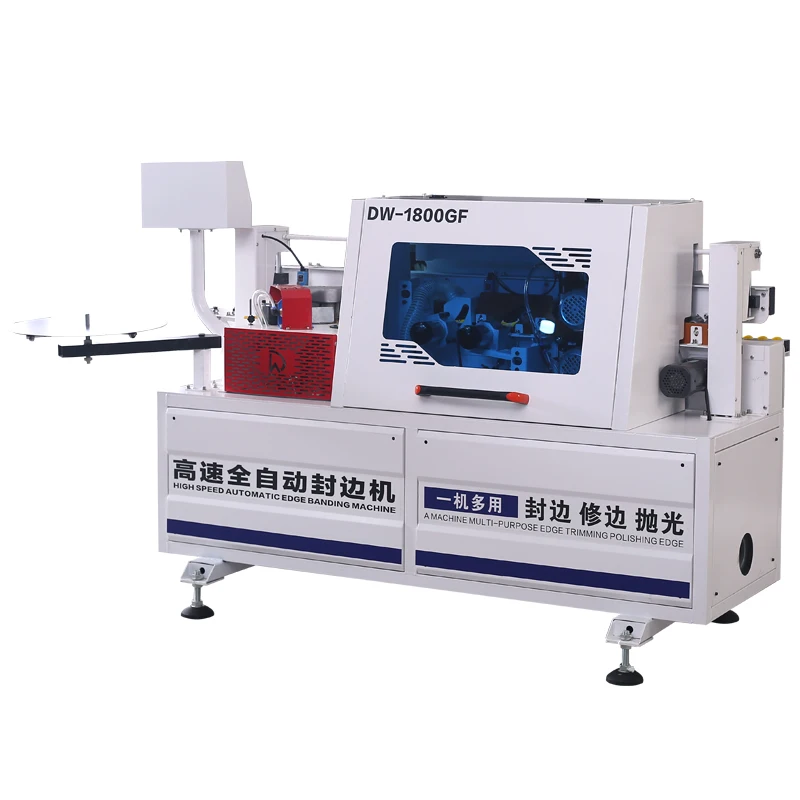
<p><strong>DW1800 Automatic Edge Banding Machine, 380V, 0–14 m/min feed speed, 0.3–3 mm banding thickness</strong> — delivers uniform double-sided gluing and four-corner profile tracking for MDF, particleboard and plywood substrates. Top and bottom trimming at 24,000 r/min ensures clean edge transitions, supporting panel widths from 100 mm and lengths from 200 mm in custom furniture and cabinet production.</p> <ul> <li>4000 ml glue pot with roll-ball differential guide for stable feed and consistent adhesive coverage</li> <li>Trimming, flexible scraping and polishing stations in one pass for ready-to-assemble edge quality</li> </ul> <p>Factory test records with your substrate and banding material available before shipment, with voltage and control language confirmed to your workshop requirements.</p>
100+
Countries
MOQ 1
Unit
15-25 Days
Lead Time
380V
DW1800
Edge Banding Machine
Furniture Factory
MDF Panel
Pre-milling
Process Guide
- Full OEM/ODM support -- custom logo, voltage (110V-440V), multilingual panels
- ISO 9001 & CE certified, 5 national patents, 60 professional engineers
- 12-month warranty, remote technical support & spare parts service
- Professional export packaging, customs clearance support, on-time delivery
Four-Stage Quality Control — Every DW1800 automatic edge banding machine undergoes incoming, in-process, finished, and pre-shipment inspection to verify glue distribution, trimming accuracy, and tracking function before dispatch.
Technical Specifications
| Parameter | Value |
|---|---|
| Model | DW1800 |
| Product Type | Automatic Edge Banding Machine with Pre-milling |
| Total Power | 4.9 kW |
| Voltage & Frequency | 380V / 220V / 415V (basis not stated in source — confirm frequency 50Hz/60Hz) |
| Feed Speed | 0–14 m/min |
| Edge Banding Thickness | 0.3–3 mm |
| Edge Banding Height (Strip Width) | 0–50 mm |
| Minimum Sheet Length | 200 mm |
| Minimum Sheet Width | 100 mm |
| Glue Pot Capacity | 4000 ml |
| Air Source Pressure | 0.4–0.6 MPa |
| Trimming Motor Power | 800W × 2 at 24,000 r/min |
| Polishing Motor Power | 380W × 2 |
| Vacuum Power | 550 W |
| Overall Dimensions (L×W×H) | 2200 × 650 × 1250 mm |
| Net Weight | 320 kg |
| Trimming Stations | Top and bottom trimming, flexible edge scraping, front and rear alignment |
| Dust Extraction Port | Yes |
| Language Options | Chinese, English (other languages available on request) |
| Assembly State | Fully assembled |
Application Suitability
| Application | Material or Output |
|---|---|
| Custom cabinet door production | MDF and particleboard with PVC edge banding |
| Wardrobe and shelving panel finishing | Plywood and ABB boards with melamine or veneer strips |
| Joinery workshop batch runs | Solid wood panels with thin ABS or wood veneer banding |
| Mixed-substrate furniture lines | Organic glass plates, PVC panels, and particleboard on shared workflow |
| Short-run sample and prototype panels | Small-format boards down to 200 mm length |
Why Glue Adhesion Fails on High-Fill Particleboard
Uniform adhesive transfer on both surfaces eliminates the weak bond that causes edge strips to peel off dusty substrates.
I spent years on the assembly floor before moving into technical support, and the most common edge banding failure I see traces back to one issue: the glue does not wet both the panel edge and the strip evenly. On high-fill particleboard, residual dust from sawing blocks adhesive contact, and single-sided gluing leaves a visible seam that peels within days. The DW1800 automatic edge banding machine woodworking process addresses this by coating both the panel edge and the strip back simultaneously from a 4000 ml glue pot, maintaining thermal stability through long production runs. When the substrate is porous or dusty, that double-sided coverage becomes the difference between a panel that ships and one that comes back from the customer [NEED_CITE: common causes of edge banding adhesion failure on particleboard].
How Double-Sided Gluing Changes Substrate Behaviour
When the glue roller applies adhesive only to the strip, the panel edge relies on residual heat to reactivate the bond. On MDF this works adequately because the surface is relatively smooth. On particleboard with coarse filler content, however, the open pores absorb the thin glue film before full contact occurs. The DW1800 applies a controlled film to both mating surfaces, filling micro-voids on the panel edge and creating a mechanical interlock that holds through temperature cycling and humidity swings. This matters for workshops processing mixed board stocks where substrate quality varies batch to batch.
Profile Tracking and the Four-Corner Problem
A flat trim leaves sharp corners where the edge strip meets the panel face. Those corners catch on hands during assembly, chip during stacking, and telegraph through foil wraps on finished cabinets. The DW1800 includes a profile tracking station that follows the panel contour around all four corners, rounding each transition automatically. For furniture factories producing cabinet doors and drawer fronts in volume, this removes a manual scraping step that otherwise slows the line and introduces inconsistency between operators [NEED_CITE: edge profiling requirements for cabinet door assembly].
Feed Speed, Trim Quality, and the 14 m/min Ceiling
The 0–14 m/min feed speed range on the DW1800 gives operators room to slow down for difficult substrates without sacrificing throughput on clean-cut MDF. The twin 800W trimming motors run at 24,000 r/min, which keeps the cutter tip speed high enough to shear PVC and ABS cleanly at faster feeds while preventing tear-out on veneer strips at lower speeds. The roll-ball differential guide maintains panel alignment through the trimming zone, so positioning accuracy stays consistent whether you are running 200 mm offcuts or full-length wardrobe panels. Panel thickness capacity up to 50 mm covers the full range from thin shelving stock to thick worktop cores.
What Happens When Voltage and Frequency Are Assumed
A machine wired for 380V 50Hz behaves differently on a 415V 60Hz supply: the trimming motors spin faster, the glue pot heater overshoots its setpoint, and the feed drive advances panels beyond the calibrated rate. I have seen entire batches scrapped because the edge strip melted at the trim station while the operator chased a temperature problem that was actually a frequency mismatch. The DW1800 is configurable across 380V, 220V, and 415V, but confirming frequency at the quoting stage prevents a machine that runs hot, fast, and wrong from the moment it powers on [NEED_CITE: effects of voltage and frequency mismatch on woodworking motors].
Why Buy From a Manufacturer That Builds the Full Workflow
The DW1800 sits within a product family that spans entry-level manual feed machines to full pre-milling lines, meaning a workshop can start here and add upstream stations later without changing the edge banding platform. Engineer-led configuration means the voltage, language, and trimming station layout are confirmed before production, not discovered at commissioning. Four-stage quality control covers incoming material checks, in-process assembly verification, finished machine testing, and pre-shipment sample runs on the buyer’s actual substrate. Factory visits are open, and the operation manual ships in the agreed language so the operator can read the control panel from day one.
Documentation & Verification
- Factory test record processed on your specified panel material and edge banding thickness before dispatch
- Electrical schematic with confirmed voltage and frequency matching your workshop supply
- Operation and maintenance manual in Chinese, English, or requested language
- CE declaration of conformity and ISO 9001 certificate available for this machine class
- Spare parts list with trimming cutter and glue roller part numbers for reorder planning
- Packing photographs documenting machine condition prior to crating
Installation, Commissioning & Support
- 2200 × 650 mm footprint fits standard workshop bays; allow clearance on the infeed side for long panels
- 4.9 kW total draw requires a dedicated circuit rated for the confirmed voltage and frequency
- Machine ships fully assembled; position, level, connect air supply at 0.4–0.6 MPa, and power on
- Glue pot heat-up and first-panel trim calibration included in commissioning guidance
- Flexible edge scraping and polishing stations tuned to your specific banding material during setup
- Vacuum port at 550W connects to your existing dust extraction system to maintain clean trimming
What to Include With Your Inquiry
Send the panel materials you run most often — particleboard, MDF, plywood — along with the edge banding type and thickness range. Confirm your workshop voltage and frequency so the machine leaves the factory wired correctly. If you process short panels near the 200 mm minimum, note that so we can verify feed stability on your actual workpiece dimensions.
Frequently Asked Questions
Q: How does double-sided gluing affect edge quality on MDF versus plywood?
A: MDF accepts a thin glue film readily because its surface is dense and smooth. Plywood, especially grades with open face veneers, absorbs adhesive unevenly, leaving starved spots that weaken the bond. Double-sided application on the DW1800 compensates by depositing adhesive on both the strip and the panel edge, bridging the absorption gap and producing consistent adhesion across both substrate types.
Q: What glue temperature and banding material combinations work best for PVC versus veneer?
A: PVC edge banding typically bonds well with EVA hot melt at standard glue pot temperatures, while natural wood veneer requires slightly higher heat to penetrate the wood fibre backing. The 4000 ml glue pot on the DW1800 maintains thermal mass through long runs, reducing temperature drop between panels. Specific temperature settings depend on the adhesive manufacturer’s data sheet for your chosen glue brand.
Q: How does the profile tracking function handle varying panel thicknesses?
A: The profile tracking station on the DW1800 follows the panel edge contour around all four corners, adjusting to strip thickness within the 0.3–3 mm range. For panels up to 50 mm thick, the tracking mechanism rounds the transition between strip and face smoothly. Consistent results require that panel thickness variation across a batch stays within the machine’s trimming adjustment range.
Q: What feed speed gives the best edge finish on particleboard?
A: On particleboard with visible glue lines as a concern, a moderate feed speed allows the double-sided glue film to transfer fully before the pressure roller makes contact. Running the DW1800 toward the upper end of its 0–14 m/min range suits clean MDF, while particleboard with coarse filler benefits from a slower pass. The roll-ball guide maintains alignment regardless of chosen speed.
Q: Can the machine handle panels at the 200 mm minimum length without feed issues?
A: The DW1800 specifies a minimum sheet length of 200 mm and a minimum width of 100 mm. Short panels can be less stable through the feed chain because fewer rollers engage simultaneously. If your production regularly includes offcuts near this minimum, mention it during the configuration stage so feed rail settings and pressure roller positions are verified against your actual workpiece dimensions before shipment.
Technical Specifications
| Parameter | Value |
|---|---|
| Product Name | Automatic Edge Banding Machine for Wood Panel – Process Guide |
| Category | Edge banding machine |
| Voltage Options | 110V / 220V / 380V / 440V (customizable) |
| Frequency | 50Hz / 60Hz (customizable) |
| Certification | ISO 9001, CE |
| MOQ | 1 Unit |
| Lead Time | 15-25 Working Days |
| Warranty | 12 Months |
| OEM / ODM | Available -- logo, color, panel language |
* Detailed technical specifications vary by model. Please contact us with your specific requirements for a complete datasheet.
Shipping & Export
-
Export Packaging
Heavy-duty wooden crate with foam padding and moisture protection
-
Shipping Methods
Sea freight (FCL/LCL), air freight, express -- we support all methods
-
Customs Support
Full documentation: CO, commercial invoice, packing list, HS code assistance
-
Port of Loading
Tianjin / Qingdao port, China -- 20 years export experience
OEM / ODM Services
-
Logo & Branding
Custom logo printing, color scheme, and nameplate engraving
-
Voltage Configuration
110V / 220V / 380V / 440V, 50Hz / 60Hz -- any region supported
-
Multilingual Panels
Control panels in English, Spanish, French, Arabic and more
-
Custom Specifications
Modified dimensions, accessories, or feature sets on request
Get a Quote
Request Product Inquiry
Fill in your details and we'll respond within 24 hours with pricing and availability.
Direct Contact
How It Works
-
1
Confirm requirements & budget
Tell us your factory scale and processing needs
-
2
Receive recommendation & quote
We match the right machine with full specs
-
3
Negotiate & place order
OEM terms, voltage, payment and delivery
-
4
Production & QC inspection
Multi-stage quality control by 60 engineers
-
5
Export packaging & shipment
Professional packing, customs clearance
-
6
After-sales support
12-month warranty, remote tech support
You May Also Like