Edge banding machine
Click to enlarge
ISO 9001
CE Certified
OEM / ODM
12-Mo Warranty
Edge banding machine
Automatic Edge Banding Machine for Woodworking Panel Furniture – Industrial Application
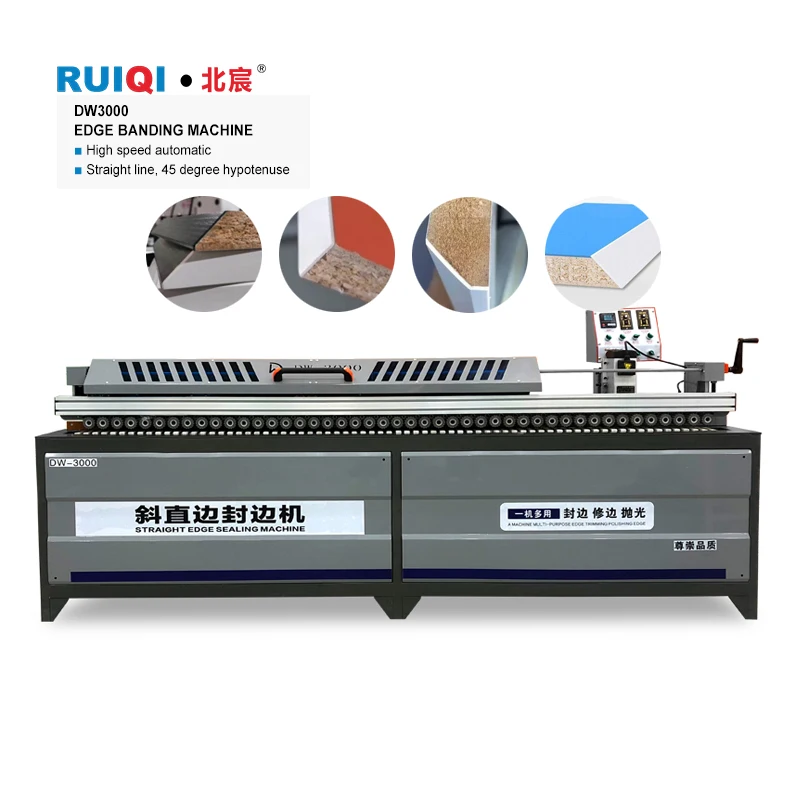
<p><strong>DW3000 Fully Automatic Edge Banding Machine, 380V, 11KW, 0–50mm Edge Height</strong> — handles both straight and 30–90° oblique edge banding in a single pass.</p> <ul> <li>Dual 2.2KW heat guns pre-heat banding material for consistent glue adhesion on MDF, plywood and particleboard substrates</li> <li>8-group adjustable oblique pressure wheels maintain uniform contact across bevel and straight profiles</li> <li>3 spindle trimming motors deliver higher rigidity and smoother cut finish versus standard trimming setups</li> <li>Flexible edge scraper removes residual glue lines for a production-ready surface before downstream assembly</li> </ul> <p>Backed by a four-stage QC process with pre-shipment verification and sample processing tests available on your specific panel material before commitment.</p>
100+
Countries
MOQ 1
Unit
15-25 Days
Lead Time
11KW Motor
45 Degree Oblique
Dual Heat Gun
DW3000
Edge Banding Machine
Furniture Factory
MDF Panel
Process Application
- Full OEM/ODM support -- custom logo, voltage (110V-440V), multilingual panels
- ISO 9001 & CE certified, 5 national patents, 60 professional engineers
- 12-month warranty, remote technical support & spare parts service
- Professional export packaging, customs clearance support, on-time delivery
In-House Manufacturing Depth — the DW3000’s patented cutting mechanisms and multi-stage inspection process ensure verified tolerances are delivered to your production floor, not just promised in a brochure.
Technical Specifications
| Parameter | Value |
|---|---|
| Model | DW3000 |
| Product Type | Fully Automatic 45 Degree Oblique Straight Edge Banding Machine |
| Total Power | 11 kW |
| Pre-milling Motor | 2.2 kW |
| Heating System | 2.2 kW × 2 (Dual Heat Gun) |
| Edge Feeding Power / Speed | 160 W / 0–12 m/min |
| Transmission Power / Speed | 180 W / 0–12 m/min |
| Trimming Power | 2.2 kW × 2 (3 Spindle Motors Total) |
| Polishing Power | 0.4 kW × 2 |
| Vacuum Power | 550 W |
| Voltage | 380 V / 415 V |
| Edge Banding Height | 0–50 mm |
| Edge Banding Thickness | 0.3–3 mm |
| Minimum Sheet Length | 30 cm |
| Minimum Sheet Width | 15 cm |
| Glue Pot Capacity | 4000 ml |
| Air Source Pressure | 0.5–0.7 MPa |
| Oblique Pressure Wheel Groups | 8 Groups (Angle Adjustable 30–90°) |
| Product Size | 299 × 65 × 130 cm |
| Product Weight | 430 kg |
| Standard Features | Plate milling, 30–90° edge banding, trimming, scraping, polishing, high-power vacuuming, edge band slotting, automatic alignment, 45° pre-milling, feeding auxiliary slide, flexible edge scraper |
| Language Options | Chinese, English (Customizable) |
| Plug Options | EU, USA, AU, UK |
| Certifications | CE, ISO 9001 |
Application Suitability
| Application | Material or Output |
|---|---|
| Custom Cabinet Production | MDF and particleboard panels with PVC or melamine edge banding |
| Furniture Manufacturing | Plywood and solid wood panels requiring straight or 45° bevel edge finishing |
| Panel Processing Plants | High-volume edge treatment for veneer and PVC materials across 0.3–3 mm thickness |
| Joinery Workshops | Automated oblique and straight edge processing for custom millwork and built-ins |
What "0–12 M/min" Actually Means for Your Substrate
Feed speed is only one variable; substrate density and glue temperature determine the real production window.
I’ve seen furniture plants lose weeks reworking panels because the edge banding machine for furniture production was set up for particleboard during the trial, but the factory ran MDF daily. The glue spread and pressure settings were completely wrong for the denser fiber structure, causing strips to peel off in batches. The DW3000’s dual heat gun design addresses this by pre-heating the edge banding material before it reaches the glue pot, ensuring consistent adhesion across different substrates. But without confirming your exact panel material and daily production mix before commissioning, even the best woodworking edge banding process will deliver inconsistent results [NEED_CITE: substrate density and glue adhesion requirements].
How Dual Heat Guns Change Glue Line Behavior
The DW3000’s dual 2.2 kW heat gun configuration pre-heats the edge banding strip before it contacts the glue roller, which matters significantly when you’re running thicker PVC or veneer materials. Cold edge banding hitting hot glue creates thermal shock, leading to incomplete wetting and visible glue lines on lighter substrates. This woodworking edge banding process design maintains thermal consistency from the moment the strip leaves the feed magazine through the pressure zone, reducing the temperature differential that causes adhesion failure on MDF and plywood.
Why Eight Pressure Wheel Groups Matter for Bevel Work
Straight edge banding is forgiving; oblique edges at 30–90 degrees are not. The DW3000’s eight adjustable pressure wheel groups apply consistent force across the entire bevel surface, preventing the strip from lifting at the acute angle where glue tends to pool. Each group can be set independently, so when you switch from a 45-degree cabinet door edge to a 60-degree decorative panel, the pressure distribution adapts without manual recalibration of the entire station. This is where most edge banding failures happen on angled work—the pressure is optimized for 90 degrees and insufficient for steeper bevels [NEED_CITE: pressure distribution on oblique edge banding applications].
Spindle Trimming vs. Standard Trimming Motors
The DW3000 uses three spindle motors total for trimming, replacing the standard single or dual motor configuration found on entry-level machines. Spindle motors deliver higher rigidity and maintain RPM under load, which translates to a smoother cut finish on the edge banding material without chatter marks. When you’re trimming 3 mm PVC on a 25 mm MDF panel, the difference shows up immediately: spindle trimming leaves a clean, flush edge ready for scraping, while standard motors can deflect and leave micro-ridges that the scraper must then work harder to remove.
The Hidden Cost of Ignoring Voltage and Frequency
Machines quoted without confirming local voltage and frequency arrive unusable, and the DW3000 defaults to 380 V / 415 V. If your facility runs on a different supply—common in parts of Southeast Asia and the Middle East where 220 V three-phase or 440 V systems exist—the motors will either underperform or burn out within days. The electrical schematic and voltage confirmation document should be reviewed before the order is placed, not after the machine is crated. I’ve watched commissioning stall for weeks while transformers were sourced locally, delaying production startup and frustrating operators who were ready to run [NEED_CITE: industrial voltage standards by region].
Why Procurement Should Verify Substrate Before Quoting
The in-house manufacturing capability here means the DW3000 can be configured with voltage options from 110 V to 440 V and multilingual control panels as standard, but only if the buyer provides accurate facility data upfront. The four-stage QC process covers incoming material inspection through pre-shipment verification, catching tolerance issues before the machine leaves the factory floor. Engineer-led configuration recommendations are provided within 24 hours of inquiry, but they’re only as good as the information about your panel materials, edge banding types, and daily throughput requirements. Factory visits are welcomed, and sample processing tests with your specific substrates validate glue line quality and trimming finish before commitment.
Documentation & Verification
- CE declaration of conformity covering the DW3000’s safety and electromagnetic compatibility
- ISO 9001 certificate for the manufacturing facility and quality management system
- Machine specification sheet with confirmed voltage, frequency, and plug type for your region
- Electrical schematic showing motor wiring and control circuit layout for local electricians
- Factory test record on your specific panel thickness range and edge banding material before dispatch
- Operation and maintenance manual in the agreed language with spare parts list and troubleshooting guide
Installation, Commissioning & Support
- Requires a dedicated 380 V / 415 V three-phase circuit with appropriate breaker sizing for the 11 kW total load
- Machine footprint of 299 × 65 cm needs clearance on all sides for material feeding and maintenance access
- Air supply at 0.5–0.7 MPa must be clean and dry to prevent moisture damage to pneumatic cylinders
- First commissioning includes parameter setup for your specific edge banding thickness and panel height range
- Operator training covers pressure wheel adjustment for oblique angles and glue pot temperature management
- Spare parts list identifies wear items like scraper blades and polishing wheels for local inventory planning
What to Include in Your Inquiry
To get an accurate configuration proposal, provide your primary panel substrates (MDF, particleboard, plywood, or solid wood), the edge banding materials you run most often (PVC, veneer, melamine), and your local voltage and frequency. If you’re processing both straight and oblique edges, specify the angle range and typical panel dimensions. Let us know if you need the control panel in a language other than Chinese or English, and whether you’d like to arrange a sample processing test with your materials before finalizing the order.
Frequently Asked Questions
Q: How does oblique edge banding differ from straight edge in terms of setup?
A: Oblique edges at 30–90 degrees require precise pressure wheel adjustment to maintain contact across the bevel surface. The DW3000’s eight independent wheel groups allow you to set pressure distribution for each angle, preventing strip lift at acute corners where glue tends to pool and cause visible defects.
Q: Which edge banding materials are compatible with the DW3000?
A: The machine handles PVC, veneer, and melamine edge banding from 0.3–3 mm thickness on MDF, particleboard, plywood, and solid wood panels. The dual heat gun system maintains thermal consistency for reliable adhesion across all these material combinations.
Q: How does the dual heat gun affect glue adhesion on thicker banding?
A: Pre-heating the edge banding strip before it contacts the glue roller eliminates thermal shock, which is critical for 2–3 mm PVC on dense substrates like MDF. This ensures complete glue wetting and reduces the risk of visible glue lines or strip delamination during trimming.
Q: What feed speed should I use for different panel and banding combinations?
A: The 0–12 m/min range covers most production scenarios, but optimal speed depends on substrate density, edge banding thickness, and glue temperature. Thicker PVC on MDF typically requires slower speeds than melamine on particleboard to allow proper glue curing under the pressure wheels.
Technical Specifications
| Parameter | Value |
|---|---|
| Product Name | Automatic Edge Banding Machine for Woodworking Panel Furniture – Industrial Application |
| Category | Edge banding machine |
| Voltage Options | 110V / 220V / 380V / 440V (customizable) |
| Frequency | 50Hz / 60Hz (customizable) |
| Certification | ISO 9001, CE |
| MOQ | 1 Unit |
| Lead Time | 15-25 Working Days |
| Warranty | 12 Months |
| OEM / ODM | Available -- logo, color, panel language |
* Detailed technical specifications vary by model. Please contact us with your specific requirements for a complete datasheet.
Shipping & Export
-
Export Packaging
Heavy-duty wooden crate with foam padding and moisture protection
-
Shipping Methods
Sea freight (FCL/LCL), air freight, express -- we support all methods
-
Customs Support
Full documentation: CO, commercial invoice, packing list, HS code assistance
-
Port of Loading
Tianjin / Qingdao port, China -- 20 years export experience
OEM / ODM Services
-
Logo & Branding
Custom logo printing, color scheme, and nameplate engraving
-
Voltage Configuration
110V / 220V / 380V / 440V, 50Hz / 60Hz -- any region supported
-
Multilingual Panels
Control panels in English, Spanish, French, Arabic and more
-
Custom Specifications
Modified dimensions, accessories, or feature sets on request
Get a Quote
Request Product Inquiry
Fill in your details and we'll respond within 24 hours with pricing and availability.
Direct Contact
How It Works
-
1
Confirm requirements & budget
Tell us your factory scale and processing needs
-
2
Receive recommendation & quote
We match the right machine with full specs
-
3
Negotiate & place order
OEM terms, voltage, payment and delivery
-
4
Production & QC inspection
Multi-stage quality control by 60 engineers
-
5
Export packaging & shipment
Professional packing, customs clearance
-
6
After-sales support
12-month warranty, remote tech support
You May Also Like