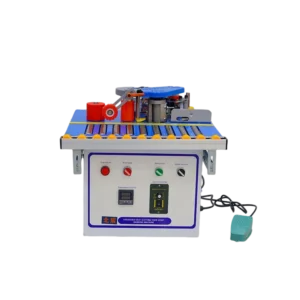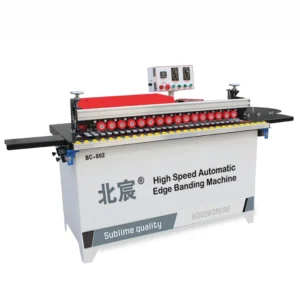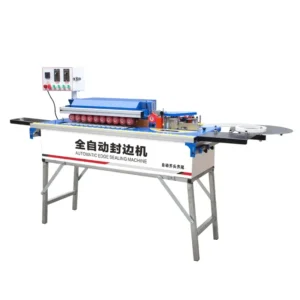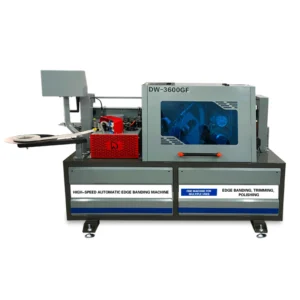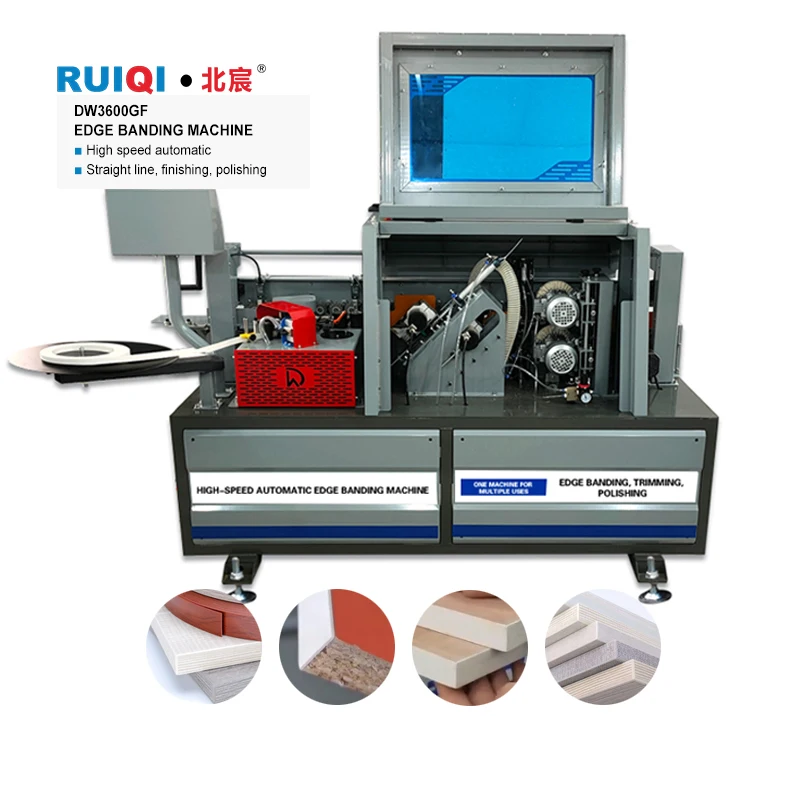
Edge banding machine
Click to enlarge
ISO 9001
CE Certified
OEM / ODM
12-Mo Warranty
Edge banding machine
Automatic Edge Banding Machine with Corner Rounding | for Furniture
<p><strong>DW-3600GF Automatic Edge Banding Machine, 380V Three-Phase, 0.3-3mm Edge Thickness</strong> — engineered for clean edge finishing on MDF, plywood and particleboard in custom furniture production.</p> <ul> <li>Dual 800W trimming motors at 24000r/min ensure precise cuts across PVC and veneer banding materials</li> <li>Adjustable feed speed 0-14m/min adapts to substrate density and downstream assembly requirements</li> <li>Six integrated functions from gluing through polishing deliver consistent edge quality within a single pass</li> </ul> <p>Pre-shipment factory test records verify actual panel processing performance before your order ships.</p>
100+
Countries
MOQ 1
Unit
15-25 Days
Lead Time
14m/min Feed Speed
380V Three-phase
Automatic Edge Banding Machine
DW-3600GF
Furniture Factory
MDF Panel
Process Application
- Full OEM/ODM support -- custom logo, voltage (110V-440V), multilingual panels
- ISO 9001 & CE certified, 5 national patents, 60 professional engineers
- 12-month warranty, remote technical support & spare parts service
- Professional export packaging, customs clearance support, on-time delivery
Precision Ground Components — Every DW-3600GF unit undergoes four-stage quality verification, ensuring edge trimming consistency holds across long production runs on MDF and plywood substrates.
Technical Specifications
| Parameter | Value |
|---|---|
| Model | DW-3600GF |
| Product Type | Automatic Edge Banding Machine |
| Voltage & Frequency | 380V Three-Phase Four-Wire |
| Total Power | 4.9kW |
| Overall Dimensions (L×W×H) | 2200×650×1250mm |
| Net Weight | 320kg |
| Edge Banding Type | Straight Edge Banding |
| Edge Band Height Range | 0-50mm |
| Edge Band Thickness Range | 0.3-3mm |
| Minimum Plate Length | 200mm |
| Feed Speed | 0-14m/min (source value — verify against manufacturer catalog) |
| Transmission Power | 180W |
| Trimming Power | 800W×2 |
| Trimming Speed | 24000r/min |
| Polishing Power | 400W×2 |
| Air Pressure Requirement | 0.4-0.6MPa |
| Standard Functions | Gluing, Trimming, Front and Rear Trimming, Scraping, Polishing, Vacuuming |
| Language Options | Chinese, English (customizable to Spanish or other languages) |
| Assembly State | Fully assembled |
| Standards | CE, ISO 9001 |
Application Suitability
| Application | Material or Output |
|---|---|
| Cabinet door edge finishing | MDF panels with 0.4-2mm PVC edge banding |
| Custom wardrobe production | Particleboard panels with melamine or veneer banding |
| Shelving and storage units | Plywood panels requiring straight edge profiling |
| Office furniture components | Laminated board with thin ABS or PVC edge strips |
| Joinery workshop output | Mixed substrate batches in small-to-medium volume runs |
Why Feed Speed Alone Won’t Tell You If This Automatic Edge Banding Machine Fits Your Line
Matching feed rate to substrate density and glue open time determines whether panels leave the machine clean or go straight to the rework pile.
I spent three weeks in a Lagos workshop watching operators fight visible glue lines on high-density MDF cabinet doors. The automatic edge banding machine specifications on paper looked adequate, but nobody had confirmed the board density against the pre-milling depth or the glue pot temperature against the local ambient heat. When substrate and machine parameters drift apart, the trimming station chatters, the scraper leaves ridges, and the polishing wheels smear rather than shine [NEED_CITE: substrate density impact on edge banding adhesion]. Production managers then discover the problem only when assembled carcasses show light gaps along the edges.
How Substrate Behavior Changes the Setup
Every board type demands a different conversation between the glue roller and the trimming knives. MDF at standard density cuts cleanly at the 24000r/min trimming speed, but denser fiberboard requires a slower feed to let the dual 800W motors hold their edge through the pass. Plywood with cross-grain face veneers needs the scraper station adjusted to follow the grain direction or risk tearing. The 0.3-3mm edge band thickness range covers most PVC and veneer strips used in furniture production, but switching between them means resetting pressure roller tension and glue application rate each time.
The Woodworking Process Behind the Numbers
Glue open time shrinks in hot, humid workshops — a factor that matters more than raw feed speed when you are running long panels. At the upper end of the 0-14m/min range, the glue must bond before the trimming station reaches the leading edge, otherwise the band shifts under the knife. I have seen operators in South Asian factories slow the feed manually to compensate, which works until someone resets the dial without understanding why [NEED_CITE: edge banding adhesive open time and ambient conditions]. The six-station sequence on this automatic edge banding machine — gluing through polishing — gives you control points at each stage, but only if the operator knows which parameter to adjust for the material in hand.
Reading the Specs Against Your Production Reality
The 2200mm footprint and 320kg weight place this machine within reach of workshops that cannot pour a dedicated foundation slab, yet the 4.9kW total power draw requires a stable 380V three-phase supply with clean voltage regulation. The 0.4-0.6MPa air pressure requirement means your compressor must maintain consistent output across all pneumatic actuators simultaneously — gluing pressure, trimming cylinder, and scraper engagement all share the same line. Edge band height coverage up to 50mm handles thick solid wood lipping for worktops, while the 200mm minimum plate length lets you process narrow drawer sides without manual feeding aids. The automatic edge banding machine specifications here define a machine built for straight-edge work across standard furniture panel dimensions.
What Happens When Configuration Is Skipped
Ordering a machine without confirming your local voltage and frequency is the fastest route to a silent workshop on delivery day. I arrived at a site where the three-phase supply ran 415V at 50Hz, but the motor windings were configured for a different standard — the trimming motors overheated within the first hour. Control panels shipped in a language the operators cannot read mean commissioning stalls until someone translates every label and alarm code [NEED_CITE: operator language requirements for industrial machinery safety]. These failures are not manufacturing defects; they are configuration gaps that a thorough pre-order specification review prevents entirely.
Why Source This Machine Through This Channel
In-house manufacturing with patented cutting mechanisms means the trimming geometry is designed and tested under one roof, not outsourced to a generic spindle supplier. The four-stage quality control process covers incoming material inspection through pre-shipment verification, catching tolerance drift before the machine leaves the factory floor. Voltage configuration from 110V to 440V and multilingual control panels are offered as standard options, not afterthought add-ons. Engineer-led configuration recommendations arrive within 24 hours of receiving your panel samples and production requirements. Factory visits are welcomed so you can watch your exact material run through the machine before committing to the order.
Documentation & Verification
- CE declaration of conformity covering the DW-3600GF electrical and mechanical safety systems
- Machine specification sheet confirming your exact voltage and frequency configuration
- Electrical schematic showing all motor connections and pneumatic valve wiring for on-site maintenance
- Factory test record on your panel material and edge band thickness before dispatch
- Operation and maintenance manual in your agreed language covering all six processing stations
Installation, Commissioning & Support
- Requires a level floor area of approximately 2200×650mm with clearance for panel infeed and outfeed
- Dedicated 380V three-phase circuit rated for the 4.9kW total power draw with proper earthing
- Arrives fully assembled; connect pneumatic supply at 0.4-0.6MPa and verify motor rotation direction
- First-run commissioning includes setting trim knife depth and glue temperature for your specific board material
- Operator training covers feed speed adjustment for the 0-14m/min range across different substrates
- Spare parts list identifies wear items: trimming knives, scraper blades, polishing wheels, and glue roller
Preparing Your Inquiry
Send your typical panel material type, board thickness range, and the edge band thickness you run most often so the configuration matches your daily output. Confirm your workshop voltage and frequency at the main distribution board, not from the utility label outside. Specify the control panel language your operators read fluently and note whether you need the machine integrated with an upstream panel saw or downstream drilling station.
Frequently Asked Questions
Q: How do I verify the trimming tolerance before placing an order?
A: Submit samples of your actual panel material and edge banding stock for a factory processing test. The test record documents edge finish quality, glue line visibility, and trimming accuracy on your specific substrate. Review the results and request shipped samples before confirming production.
Q: What voltage confirmation is needed for a 380V three-phase system?
A: Provide your workshop supply voltage and frequency measured at the distribution panel under load. The machine is configurable from 110V to 440V, and the motor winding configuration must match your exact supply to prevent overheating or failure on startup.
Q: Which edge band materials work within the 0.3-3mm thickness range?
A: Standard PVC, ABS, melamine, and thin wood veneer strips all fall within this range. Thicker solid wood lipping up to 3mm is also supported. Confirm your most-used material so the pressure roller tension and glue application rate are preset before delivery.
Q: How should I match feed speed to my panel saw output?
A: The 0-14m/min feed speed range lets you adjust throughput to balance upstream cutting and downstream assembly. Run a time study on your saw cycle per panel, then set the bander feed rate so panels queue minimally between stations without starving the trimming head.
Q: Can the control panel be supplied in a language other than Chinese or English?
A: Yes. The control interface is customizable to Spanish and other languages on request. Specify the required language during the configuration stage so the panel labels, alarm messages, and parameter screens arrive in the language your operators read.
Technical Specifications
| Parameter | Value |
|---|---|
| Product Name | Automatic Edge Banding Machine with Corner Rounding | for Furniture |
| Category | Edge banding machine |
| Voltage Options | 110V / 220V / 380V / 440V (customizable) |
| Frequency | 50Hz / 60Hz (customizable) |
| Certification | ISO 9001, CE |
| MOQ | 1 Unit |
| Lead Time | 15-25 Working Days |
| Warranty | 12 Months |
| OEM / ODM | Available -- logo, color, panel language |
* Detailed technical specifications vary by model. Please contact us with your specific requirements for a complete datasheet.
Shipping & Export
-
Export Packaging
Heavy-duty wooden crate with foam padding and moisture protection
-
Shipping Methods
Sea freight (FCL/LCL), air freight, express -- we support all methods
-
Customs Support
Full documentation: CO, commercial invoice, packing list, HS code assistance
-
Port of Loading
Tianjin / Qingdao port, China -- 20 years export experience
OEM / ODM Services
-
Logo & Branding
Custom logo printing, color scheme, and nameplate engraving
-
Voltage Configuration
110V / 220V / 380V / 440V, 50Hz / 60Hz -- any region supported
-
Multilingual Panels
Control panels in English, Spanish, French, Arabic and more
-
Custom Specifications
Modified dimensions, accessories, or feature sets on request
Get a Quote
Request Product Inquiry
Fill in your details and we'll respond within 24 hours with pricing and availability.
Direct Contact
How It Works
-
1
Confirm requirements & budget
Tell us your factory scale and processing needs
-
2
Receive recommendation & quote
We match the right machine with full specs
-
3
Negotiate & place order
OEM terms, voltage, payment and delivery
-
4
Production & QC inspection
Multi-stage quality control by 60 engineers
-
5
Export packaging & shipment
Professional packing, customs clearance
-
6
After-sales support
12-month warranty, remote tech support
You May Also Like