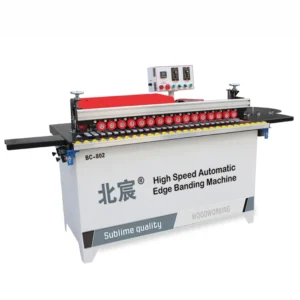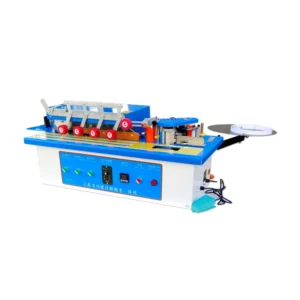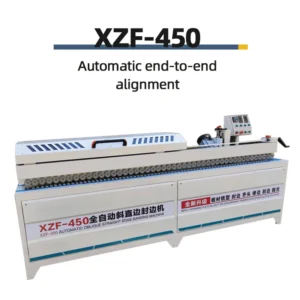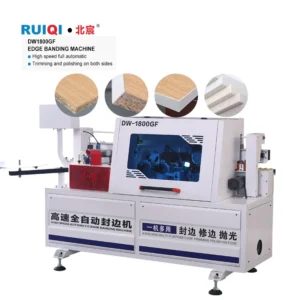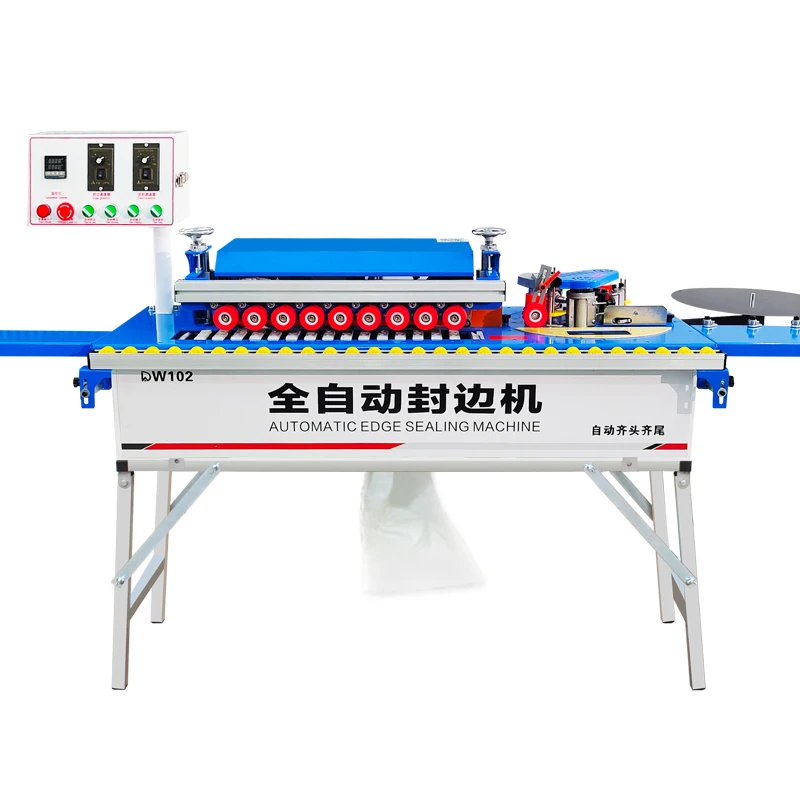
Edge banding machine
Click to enlarge
ISO 9001
CE Certified
OEM / ODM
12-Mo Warranty
Edge banding machine
Curve & Linear Edge Banding Machine for Plywood Production – Technical Guide
<p><strong>DW102 Automatic Curve and Linear Edge Banding Machine, 220V/380V, 0.3–3mm Banding Thickness, 75kg</strong> — engineered for workshops processing shaped and straight panel edges in a single setup.</p> <ul> <li>Dual trimming heads (650W × 2) and dual polishing heads (180W × 2) deliver complete in-line finishing across MDF, plywood, particleboard and polymer substrates</li> <li>Integrated 1200W vacuum holds curved workpieces firmly, maintaining consistent glue contact and minimizing visible glue lines on shaped profiles</li> <li>Edge banding height range 0–50mm with automatic head and tail cutting, reducing manual rework on custom cabinet and furniture components</li> </ul> <p>Request a factory test record using your actual substrate and banding material to verify edge adhesion and finish quality before shipment — backed by four-stage QC and pre-shipment verification.</p>
100+
Countries
MOQ 1
Unit
15-25 Days
Lead Time
== Gate == identifier: DW102 → 通过 Edge Banding Machine
220V 380V
Automatic Head And Tail Cutting
Curve And Linear Edge Banding
DW102
Plywood Edge Banding
Process And Application
Vacuum Edge Banding
- Full OEM/ODM support -- custom logo, voltage (110V-440V), multilingual panels
- ISO 9001 & CE certified, 5 national patents, 60 professional engineers
- 12-month warranty, remote technical support & spare parts service
- Professional export packaging, customs clearance support, on-time delivery
Integrated Process Validation — Every DW102 configuration is tested against your actual substrate and banding material before parameters are locked, ensuring the edge banding machine process and application aligns with real production conditions rather than catalog assumptions.
Technical Specifications
| Parameter | Value |
|---|---|
| Model | DW102 |
| Product Type | Automatic Curve and Linear Edge Banding Machine |
| Total Power | 3800W |
| Voltage & Frequency | 220V / 380V / customization (frequency to be specified at order) |
| Overall Dimensions (L×W×H) | 128 × 47 × 69 cm |
| Net Weight | 75 kg |
| Minimum Sheet Length | 25 cm |
| Minimum Sheet Width | 5 cm |
| Edge Banding Height Range | 0–50 mm |
| Edge Banding Thickness Range | 0.3–3 mm |
| Edge Feed Power | 20W |
| Transmission Power | 60W |
| Trimming Power | 650W × 2 |
| Polishing Power | 180W × 2 |
| Vacuum Power | 1200W |
| Glue Pot Capacity | 1000 ml |
| Air Source Pressure | 0.5–0.8 MPa |
| Language Options | Chinese and English (other languages customizable) |
| Plug Options | EU, USA, AU, UK |
| Key Features | Curved and straight edge banding, edge trimming, polishing, automatic head and tail cutting, integrated vacuum system |
Application Suitability
| Application | Material or Output |
|---|---|
| Custom cabinet straight-edge sealing | MDF and particleboard with PVC edge banding |
| Shaped panel contour banding | Plywood and blockboard with curved profiles |
| Polymer door panel finishing | Polymer substrates with matched thickness banding |
| Furniture workshop upgrade path | Transition from manual to semi-automated edge processing |
| Veneer edge finishing on solid panels | Thin wood veneer and solid wood banding up to 3 mm |
Why Visible Glue Lines Persist Across Different Substrates
Substrate porosity and surface energy vary between MDF, plywood, and particleboard — a single glue temperature and feed setting will not produce uniform adhesion across all three.
When operators run the same edge banding machine process and application parameters on MDF and then switch to plywood without adjusting the glue pot or trimming pressure, the result is predictable: one material shows clean adhesion while the other reveals gaps, squeeze-out, or delamination at the seam. The DW102 addresses this through a 1000 ml glue pot with adjustable temperature and a dual-trimming setup that lets you match cutting pressure to substrate density. I once spent four days reworking a plywood line where the initial PVC settings bled through thin veneer — [NEED_CITE: adhesive penetration behavior on porous vs sealed substrates] — because nobody had verified the material before the first test run.
Substrate Behaviour and Glue Line Consistency
MDF absorbs heat and adhesive differently than plywood or particleboard, which directly affects how the glue film transfers from the pot to the panel edge. The DW102’s 1000 ml glue pot holds enough adhesive for continuous runs, but the critical variable is matching pot temperature to the thermal mass of the substrate passing through. Denser materials like blockboard draw heat away from the glue line faster, requiring higher pot settings to maintain film fluidity at the point of contact. This edge banding machine process and application principle is the difference between a clean bond and a joint that fails during assembly.
Curved Profiles and Vacuum Holding Force
Straight-edge banding relies on gravity and lateral guides to keep the panel against the fence, but curved profiles introduce centrifugal drift that breaks glue contact mid-pass. The integrated 1200W vacuum system on the DW102 pulls the workpiece down against the table surface, maintaining consistent registration through the trim and polish stations. Without that holding force, curved sections — especially tight radii on plywood — tend to lift slightly at the infeed, producing a visible step at the head cut [NEED_CITE: vacuum hold-down requirements for curved edge profiling]. The automatic head and tail cutting then squares the banding ends without requiring a secondary bench operation.
Reading the Specs That Actually Affect Edge Quality
The 650W × 2 trimming power and 180W × 2 polishing heads define what the DW102 can finish in a single pass. Trimming power determines how cleanly the cutter removes excess banding without chipping the substrate edge — underpowered trimmers leave tear-out on particleboard while over-aggressive cuts score MDF surfaces. The 0.3–3 mm banding thickness range covers standard PVC through thicker veneer and solid wood strips, but each material demands different trimmer geometry and polish wheel pressure. The 0–50 mm height range accommodates most furniture panel thicknesses, though panels approaching the upper limit require verifying that the vacuum cup reach still engages the workpiece surface. Air supply at 0.5–08 MPa drives the pneumatic actuators for head cutting and polishing arm engagement; below that threshold, the tail cut becomes inconsistent and the polish wheels lose contact pressure.
The Cost of Skipping Material Verification Before Shipment
Accepting a machine based on catalog specifications alone — without running your actual panel stock and banding material through a pre-shipment test — is how workshops discover incompatibilities after installation. A glue pot calibrated for PVC may not reach the temperature needed for veneer adhesion on plywood. Trim cutters set for 1 mm PVC will shred 3 mm solid wood banding. Pneumatic pressure that handles flat panels may not hold a curved workpiece against the vacuum table [NEED_CITE: pre-shipment testing protocols for woodworking machinery]. These mismatches do not show up in a specification sheet; they appear as scrap on your shop floor.
Why This Source Supports Process-Level Configuration
The DW102 is backed by a four-stage quality control protocol covering incoming material, in-process assembly, finished product inspection, and pre-shipment verification — meaning the machine you receive has been run against documented test parameters. Voltage and frequency are confirmed at order, not assumed, so a 60 Hz market receives a motor and transformer set matched to local supply rather than a generic 380V unit that overheats on the wrong frequency. Operation and maintenance manuals are produced in the agreed language before dispatch, preventing commissioning stalls when operators cannot read the control interface. Engineer-led configuration recommendations arrive within 24 hours of inquiry, based on your stated substrate and production volume rather than a default catalog build. Factory visits are open for buyers who want to witness test runs on their own material.
Documentation & Verification
- Factory test record run on your specified panel substrate and banding thickness before dispatch
- Electrical schematic confirming voltage, frequency, and circuit protection matched to your local supply
- Operation and maintenance manual in your operator’s primary language with illustrated adjustment points
- Packing photographs showing machine securing, accessory placement, and crate condition before container loading
- CE declaration of conformity and ISO 9001 certificate at company level for customs and compliance filing
Installation, Commissioning & Support
- Requires a dedicated circuit matching the confirmed 220V or 380V supply with appropriate breaker rating for the 3800W total load
- Air compressor must deliver sustained 0.5–0.8 MPa at the machine inlet to drive pneumatic trim and polish actuators
- Compact 128 × 47 × 69 cm footprint fits standard workshop aisles; verify ceiling clearance for overhead dust extraction routing
- First-run commissioning includes glue pot temperature mapping against your actual panel material and banding stock
- Spare parts list provided at delivery covering trim cutters, polish wheels, vacuum cups, and glue pot seals
What to Include With Your Inquiry
Provide the specific panel substrates you run — MDF, plywood, particleboard, or polymer — along with the banding material type and thickness range your production requires. Confirm your local voltage and frequency so the motor and transformer are configured correctly before production begins. If your panels include curved profiles, share the minimum radius and contour complexity so vacuum table coverage and trim station reach can be verified against your geometry.
Frequently Asked Questions
Q: Which substrate and banding combinations work best on the DW102, and how does glue temperature affect adhesion?
A: The DW102 processes MDF, plywood, particleboard, and polymer panels with PVC, veneer, or solid wood banding from 0.3 to 3 mm. Glue pot temperature must match substrate thermal mass — denser plywood draws heat faster than MDF, requiring higher settings to maintain adhesive film fluidity. We verify temperature and pressure settings on your actual materials during pre-shipment testing before locking the configuration.
Q: How does curved versus straight edge banding mode change the setup procedure?
A: Switching to curved mode engages the 1200W vacuum system to hold shaped workpieces against the table, preventing drift through the trim and polish stations. Straight-edge mode relies on lateral guides and gravity. Head and tail cutting parameters adjust automatically for the selected mode. Minimum workpiece dimensions are 25 cm length and 5 cm width for stable vacuum registration.
Q: What banding thickness and height range does the DW102 support, and how do I select the right material?
A: The machine handles banding thickness from 0.3 to 3 mm and edge heights from 0 to 50 mm. Thin PVC suits high-volume cabinet work on MDF and particleboard, while thicker veneer and solid wood banding serve furniture panels requiring a premium edge. Trimming cutter geometry and polish wheel selection must match the banding material chosen for consistent finish quality.
Q: How do I verify edge trimming accuracy and polish quality before accepting delivery?
A: Request a factory test record that documents edge trim results and polish finish on your specific panel substrate and banding material. The test should include sample pieces you can inspect for glue line visibility, trim tear-out, and surface polish uniformity. This verification happens before shipment, not after installation, so any parameter adjustments are made at the factory.
Q: What air supply and vacuum requirements must my workshop meet to run the DW102?
A: Your compressor must deliver 0.5–0.8 MPa sustained pressure at the machine inlet to operate the pneumatic trim actuators, head-and-tail cutters, and polish arm engagement. The integrated 1200W vacuum system requires a clean table surface and intact vacuum cups for curved-profile holding. Verify your existing compressor capacity and air line sizing before installation to avoid intermittent actuator response during production runs.
Technical Specifications
| Parameter | Value |
|---|---|
| Product Name | Curve & Linear Edge Banding Machine for Plywood Production – Technical Guide |
| Category | Edge banding machine |
| Voltage Options | 110V / 220V / 380V / 440V (customizable) |
| Frequency | 50Hz / 60Hz (customizable) |
| Certification | ISO 9001, CE |
| MOQ | 1 Unit |
| Lead Time | 15-25 Working Days |
| Warranty | 12 Months |
| OEM / ODM | Available -- logo, color, panel language |
* Detailed technical specifications vary by model. Please contact us with your specific requirements for a complete datasheet.
Shipping & Export
-
Export Packaging
Heavy-duty wooden crate with foam padding and moisture protection
-
Shipping Methods
Sea freight (FCL/LCL), air freight, express -- we support all methods
-
Customs Support
Full documentation: CO, commercial invoice, packing list, HS code assistance
-
Port of Loading
Tianjin / Qingdao port, China -- 20 years export experience
OEM / ODM Services
-
Logo & Branding
Custom logo printing, color scheme, and nameplate engraving
-
Voltage Configuration
110V / 220V / 380V / 440V, 50Hz / 60Hz -- any region supported
-
Multilingual Panels
Control panels in English, Spanish, French, Arabic and more
-
Custom Specifications
Modified dimensions, accessories, or feature sets on request
Get a Quote
Request Product Inquiry
Fill in your details and we'll respond within 24 hours with pricing and availability.
Direct Contact
How It Works
-
1
Confirm requirements & budget
Tell us your factory scale and processing needs
-
2
Receive recommendation & quote
We match the right machine with full specs
-
3
Negotiate & place order
OEM terms, voltage, payment and delivery
-
4
Production & QC inspection
Multi-stage quality control by 60 engineers
-
5
Export packaging & shipment
Professional packing, customs clearance
-
6
After-sales support
12-month warranty, remote tech support
You May Also Like