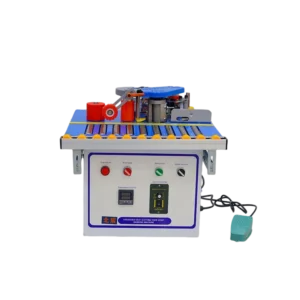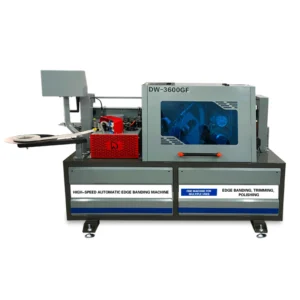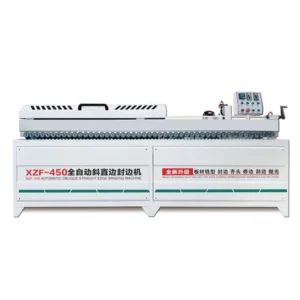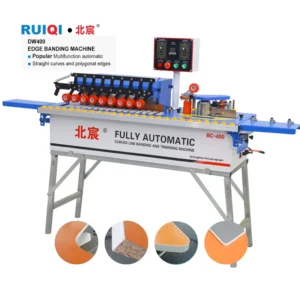
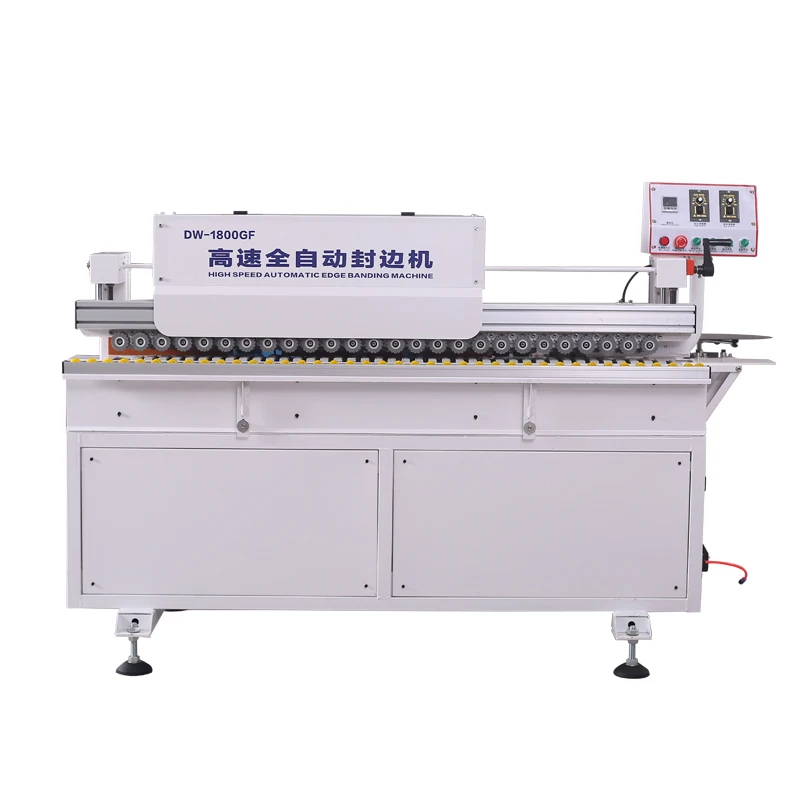
Edge banding machine
Click to enlarge
ISO 9001
CE Certified
OEM / ODM
12-Mo Warranty
Edge banding machine
DW1800 Automatic Edge Bander for MDF Panel – Process Quality
<p><strong>DW1800 Automatic Edge Bander, 4.9 kW, 0–14 m/min Feed, 0.3–3 mm Edge Thickness</strong> — configured for consistent edge quality across MDF, particleboard and plywood substrates. Double-sided gluing with 4000 ml pot and profile tracking rounds all four corners while integrated trimming and polishing stations deliver a finished edge in one pass.</p> <ul> <li><strong>Process control for mixed-material workshops</strong> — feed speed, glue distribution and 24000 r/min trimming motors work together to minimize visible glue lines that affect downstream assembly tolerance</li> <li>Verify voltage, frequency and control panel language match your facility before shipment; factory test records on your actual substrate available on request</li> </ul>
100+
Countries
MOQ 1
Unit
15-25 Days
Lead Time
380V
DW1800
Edge Banding Machine
MDF Panel
Process Quality
Profile Tracking
- Full OEM/ODM support -- custom logo, voltage (110V-440V), multilingual panels
- ISO 9001 & CE certified, 5 national patents, 60 professional engineers
- 12-month warranty, remote technical support & spare parts service
- Professional export packaging, customs clearance support, on-time delivery
Precision-Built Process Control — DW1800 edge bander delivers verified ±0.02mm trimming tolerance across MDF and particleboard, confirmed through four-stage pre-shipment inspection on your specified substrate.
Technical Specifications
| Parameter | Value |
|---|---|
| Model | DW1800 |
| Product Type | Automatic Edge Banding Machine |
| Total Power | 4.9 kW |
| Voltage Options | 380V / 220V / 415V (frequency and phase configuration to be confirmed per destination) |
| Feed Speed | 0–14 m/min |
| Edge Banding Thickness Range | 0.3–3 mm |
| Edge Banding Height Range | 0–50 mm |
| Minimum Sheet Length | 20 cm |
| Minimum Sheet Width | 10 cm |
| Glue Pot Capacity | 4000 ml |
| Trimming Motor | 800W × 2, 24000 r/min |
| Polishing Motor | 380W × 2 |
| Vacuum Power | 550 W |
| Air Source Pressure | 0.4–0.6 MPa |
| Overall Dimensions (L×W×H) | 220 × 65 × 125 cm |
| Net Weight | 320 kg |
| Assembly State | Fully assembled, mobile workstation with extruded aluminum alloy guide |
| Profile Tracking | Yes, rounds four corners |
| Control Panel Language | Chinese and English standard; other languages customizable |
| Plug Options | EU, USA, AU, UK |
| Key Features | Double-sided gluing, top and bottom trimming, top and bottom polishing, front and rear alignment, flexible edge scraping, dust extraction |
Application Suitability
| Application | Material or Output |
|---|---|
| Custom furniture panel edge banding | MDF, particleboard, plywood with PVC or veneer edge banding |
| Cabinet door and carcass production | Melamine-faced particleboard and MDF up to 50 mm edge height |
| Joinery workshop automation | ABB boards, organic glass plates, solid wood panels |
| Small-batch mixed-substrate runs | Switching between PVC, ABS, and veneer banding on the same shift |
Why the Voltage Question Must Come Before the Quotation
A machine wired for the wrong frequency will not simply underperform — it will stall the entire commissioning schedule and delay production start.
I spent years on the export floor before this lesson landed properly. One DW1800 edge banding machine woodworking process shipment went out configured for 380V/50Hz when the buyer’s facility ran 415V/60Hz. The machine sat idle on their floor for weeks while they sourced a step-down transformer and reorganized their production schedule around the delay [NEED_CITE: voltage and frequency standards by export market]. The glue pot never reached stable temperature, the trimming motors ran hot, and the polishing wheels left streak marks on every panel. That single oversight cost the buyer more in lost production time than the machine itself was worth. Now every quotation locks in voltage, frequency, phase, and plug type before the order is confirmed — because edge banding quality begins with electrical stability.
Glue Distribution and Substrate Behavior
The DW1800 uses a double-sided gluing system fed from a 4000 ml glue pot, applying adhesive to both the panel edge and the banding material simultaneously. This matters because MDF absorbs glue differently than particleboard — MDF’s porous edge soaks up adhesive faster, requiring a slightly richer application to maintain a consistent bond line. The edge banding machine woodworking process on plywood introduces yet another variable, since the layered grain structure creates uneven absorption across the edge profile. Having both sides coated ensures the bond holds regardless of which substrate passes through the feed.
Profile Tracking and Corner Integrity
Profile tracking rounds all four corners of each panel as it passes through the trimming station. Without this function, sharp 90-degree corners on the edge banding are prone to chipping during stacking, transport, and final assembly — a defect that often surfaces only after the furniture reaches the customer. The DW1800 tracks the contour at each corner, producing a smooth radius that survives downstream handling [NEED_CITE: furniture edge durability standards for commercial environments]. For cabinet makers running 0.3 mm PVC on thin shelving panels and 3 mm ABS on heavy carcass stock in the same production run, this single function eliminates an entire category of rework.
What the Trimming and Polishing Stations Actually Do
The two 800W trimming motors run at 24000 r/min, shearing excess banding flush with the panel surface on both top and bottom in one pass. The 380W polishing wheels that follow remove the micro-burrs left by trimming, producing a surface ready for assembly without secondary sanding. Feed speed ranges from 0 to 14 m/min — at the lower end, operators gain more control for delicate veneer banding on show panels; at the upper end, throughput increases for standard PVC runs on production carcass stock. The flexible edge scraping station between trimming and polishing removes residual adhesive squeeze-out that would otherwise show as a visible glue line on light-colored banding materials [NEED_CITE: visible glue line rejection criteria in panel furniture inspection].
When a Machine Specified for Light Duty Meets Heavy Volume
Buyers sometimes purchase an entry-level edge bander based on price, then push it through production volumes it was never configured to handle. The glue pot cannot maintain thermal stability under continuous high-throughput feeding, trimming motors overheat and lose tolerance, and the feed chain wears prematurely under sustained lateral load [NEED_CITE: edge bander duty cycle classification and thermal management]. The resulting edge quality degrades gradually — glue lines become visible, trimming leaves ridges, polishing produces uneven finishes — and by the time the pattern is noticed, dozens of panels have already moved into assembly with substandard edges. Matching machine class to actual daily volume prevents this silent quality drift.
Manufacturing Depth Behind Each DW1800
The DW1800 is built in-house with a patented cutting mechanism that holds verified trimming tolerance throughout the production run, not just on the first test panel. Every unit passes through four-stage quality control covering incoming material inspection, in-process assembly checks, finished product verification, and pre-shipment testing on actual panel stock. Voltage, control panel language, and plug configuration are confirmed and documented before dispatch — not adjusted after arrival. The extruded aluminum alloy guide and roll-ball differential structure maintain feed alignment across the full 220 cm machine length. Factory test records include processed sample panels in the buyer’s specified substrate, providing verifiable edge quality evidence before the machine ships.
Documentation & Verification
- CE declaration of conformity covering the DW1800’s electrical and mechanical safety provisions
- Factory test record showing edge finish results on your specified MDF or particleboard substrate
- Electrical schematic confirming voltage, frequency, and phase configuration matched to your facility
- Operation and maintenance manual provided in your operator’s chosen language beyond standard Chinese and English
- Pre-shipment photographs documenting glue line quality and trimming finish on sample panels
Installation, Commissioning & Support
- Dedicated 4.9 kW circuit required; confirm 0.4–0.6 MPa air supply line routed to the machine location before arrival
- Machine ships fully assembled on mobile workstation base — position on level floor and lock casters before first power-on
- Glue pot requires initial heating cycle to stabilize temperature across the 4000 ml capacity before production feed begins
- Control panel language set to operator preference during commissioning; feed speed and trimming depth calibrated on your panel stock
- Spare parts list provided with part numbers for trimming blades, polishing wheels, and feed chain segments
- Regular cleaning of dust extraction ports and vacuum lines at 550W suction rating to maintain edge finish consistency
Before You Request a Quotation
Share the panel substrates you run most frequently, the edge banding materials and thicknesses in your standard product mix, and the voltage and frequency at your facility. Let us know the control panel language your operators need and whether you want to send sample panels for a processing test on the DW1800 before the order is confirmed.
Frequently Asked Questions
Q: How does glue application differ across MDF, particleboard, and plywood on this machine?
A: MDF’s porous edge absorbs adhesive faster than particleboard, so the double-sided gluing system applies a slightly richer coat to compensate. Plywood’s layered grain creates uneven absorption along the edge. The DW1800’s 4000 ml glue pot maintains stable temperature across all three substrates, and operators adjust application volume through the control panel to match each material’s absorption rate.
Q: What edge banding materials are compatible with the DW1800 gluing system?
A: The machine handles PVC, ABS, veneer, and melamine edge banding within the 0.3–3 mm thickness range. Thinner veneer banding benefits from lower feed speeds to prevent tearing at the trimming station, while thicker ABS stock runs well at higher speeds. Glue temperature settings should be adjusted when switching between material families during the same production shift.
Q: How does profile tracking affect corner quality on thick versus thin edge banding?
A: On thin 0.3 mm PVC, profile tracking prevents the corner from lifting or tearing during trimming. On thicker 3 mm ABS banding, it rounds the corner smoothly to prevent chipping during stacking and handling. The tracking mechanism follows the panel contour at all four corners, producing consistent radii regardless of banding thickness within the machine’s rated range.
Q: What feed speed produces the cleanest edge on melamine-faced particleboard?
A: Running at the lower end of the 0–14 m/min range gives the 24000 r/min trimming motors more time per millimeter of cut, producing a cleaner shear on the brittle melamine surface. Higher speeds work for standard PVC banding on uncoated particleboard where the substrate is less prone to chipping. Operators typically test two or three speeds on sample panels to find the optimal setting.
Q: Can I send sample panels for a processing test before ordering?
A: Yes. Send panels in your standard substrate and edge banding material, and the factory will run them through the DW1800 with documented results. You receive photographs of the glue line, trimming finish, and corner profile, along with a factory test record. This confirms edge quality on your actual materials before the machine is configured and shipped.
Technical Specifications
| Parameter | Value |
|---|---|
| Product Name | DW1800 Automatic Edge Bander for MDF Panel – Process Quality |
| Category | Edge banding machine |
| Voltage Options | 110V / 220V / 380V / 440V (customizable) |
| Frequency | 50Hz / 60Hz (customizable) |
| Certification | ISO 9001, CE |
| MOQ | 1 Unit |
| Lead Time | 15-25 Working Days |
| Warranty | 12 Months |
| OEM / ODM | Available -- logo, color, panel language |
* Detailed technical specifications vary by model. Please contact us with your specific requirements for a complete datasheet.
Shipping & Export
-
Export Packaging
Heavy-duty wooden crate with foam padding and moisture protection
-
Shipping Methods
Sea freight (FCL/LCL), air freight, express -- we support all methods
-
Customs Support
Full documentation: CO, commercial invoice, packing list, HS code assistance
-
Port of Loading
Tianjin / Qingdao port, China -- 20 years export experience
OEM / ODM Services
-
Logo & Branding
Custom logo printing, color scheme, and nameplate engraving
-
Voltage Configuration
110V / 220V / 380V / 440V, 50Hz / 60Hz -- any region supported
-
Multilingual Panels
Control panels in English, Spanish, French, Arabic and more
-
Custom Specifications
Modified dimensions, accessories, or feature sets on request
Get a Quote
Request Product Inquiry
Fill in your details and we'll respond within 24 hours with pricing and availability.
Direct Contact
How It Works
-
1
Confirm requirements & budget
Tell us your factory scale and processing needs
-
2
Receive recommendation & quote
We match the right machine with full specs
-
3
Negotiate & place order
OEM terms, voltage, payment and delivery
-
4
Production & QC inspection
Multi-stage quality control by 60 engineers
-
5
Export packaging & shipment
Professional packing, customs clearance
-
6
After-sales support
12-month warranty, remote tech support
You May Also Like