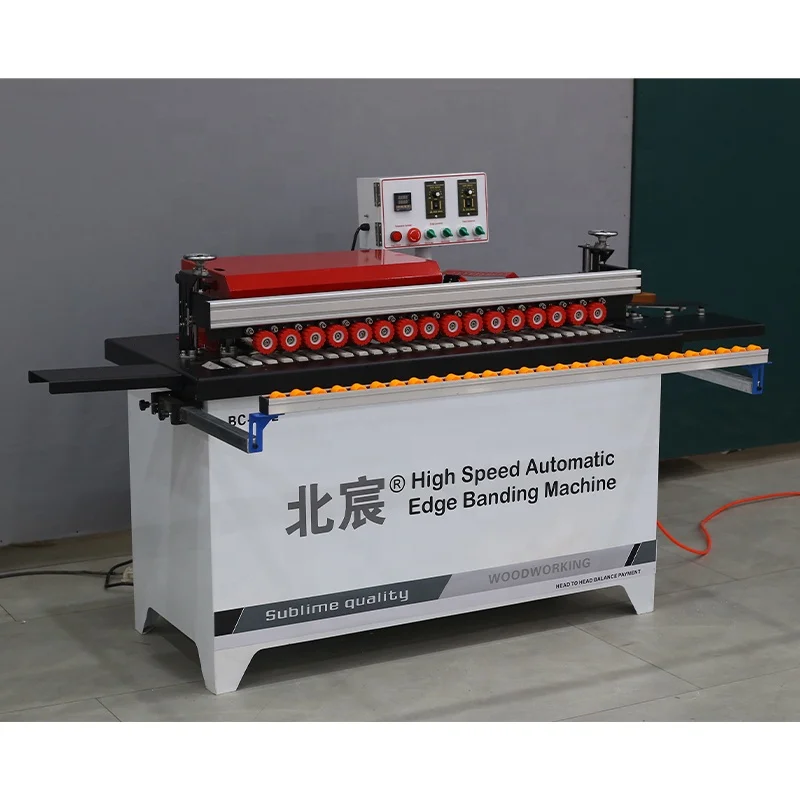
Edge banding machine
Click to enlarge
ISO 9001
CE Certified
OEM / ODM
12-Mo Warranty
Edge banding machine
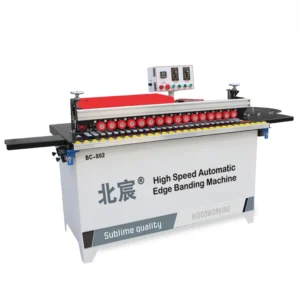
DW802 Automatic MDF Edge Banding Machine with PLC
<p><strong>DW802 Automatic Edge Banding Machine</strong>, 4200W total power, PLC control, 0.3–3mm banding thickness — delivers gluing, trimming, automatic head-and-tail cutting and polishing in a single pass for MDF, particleboard, plywood and solid wood panels.</p> <ul> <li>4000ml glue pot capacity supports continuous multi-panel runs with minimal operator intervention</li> <li>Dual 800W trimming and dual 180W polishing stations produce clean, glue-line-free edges across substrate types</li> <li>Integrated 1200W vacuum system removes dust and offcuts at the trimming stage</li> <li>Edge banding height 0–50mm, minimum sheet size 250×100mm</li> </ul> <p>Pre-shipment test records verify trimming accuracy and edge finish consistency on your specific panel material before dispatch.</p>
100+
Countries
MOQ 1
Unit
15-25 Days
Lead Time
Automatic Head And Tail Cutting
Custom Furniture
DW802
Edge Banding Machine
MDF Panel
PLC Control
Process And Application
- Full OEM/ODM support -- custom logo, voltage (110V-440V), multilingual panels
- ISO 9001 & CE certified, 5 national patents, 60 professional engineers
- 12-month warranty, remote technical support & spare parts service
- Professional export packaging, customs clearance support, on-time delivery
Voltage-confirmed integration — the DW802 ships with electrical schematics matching your facility’s exact supply, preventing the dead-on-arrival failures common when frequency is assumed rather than verified.
Technical Specifications
| Parameter | Value |
|---|---|
| Model | DW802 |
| Product Type | Automatic Edge Banding Machine |
| Total Power | 4200W |
| Voltage & Frequency | 220V / 380V / customization available |
| Edge Banding Thickness Range | 0.3–3MM |
| Edge Banding Height | 0–50MM |
| Minimum Sheet Length | 25CM |
| Minimum Sheet Width | 10CM |
| Glue Pot Capacity | 4000ml |
| Trimming Power | 800W × 2 stations |
| Polishing Power | 180W × 2 stations |
| Vacuum Power | 1200W |
| Air Source Pressure | 0.4–0.8Mpa |
| Product Size | 130 × 60 × 95CM |
| Product Weight | 135KG |
| Control System | PLC core components |
| Key Features | Gluing, trimming, polishing, automatic head-and-tail cutting, integrated vacuum |
| Language Options | Chinese and English standard; Spanish and others on request |
| Plug Options | EU, USA, AU, UK |
Application Suitability
| Application | Material or Output |
|---|---|
| Cabinet and wardrobe panel edge sealing | MDF, particleboard |
| Custom furniture component finishing | Plywood, ecological board |
| Interior fitout joinery | Solid wood board, plywood |
| Small-to-medium workshop production | PVC, melamine, and veneer edge banding (0.3–3MM) |
Why Visible Glue Lines Keep Ruining Otherwise Good Panels
Consistent edge adhesion depends on matching glue temperature and feed rate to the actual substrate — not a generic setting.
I once set up an edge bander for a custom furniture plant using standard ABS parameters, only to find the PVC banding they actually ran developed white glue lines and chipped trimming edges. The entire batch had to be reworked. That experience shifted how I approach every configuration: I now ask for sample panels and banding strips before finalizing machine parameters. The DW802 edge banding machine woodworking process application supports this kind of material-specific tuning with its 4000ml glue pot and dual-stage trimming. [NEED_CITE: substrate-specific glue temperature requirements for PVC and melamine banding]
Different substrates absorb and transfer heat differently, meaning a setting that works on MDF may starve particleboard of adhesive or overheat veneer. Without sample testing, you are guessing at the interface between glue, band, and board.
How Substrate Choice Changes the Edge Banding Sequence
MDF presents a dense, uniform surface that accepts hot-melt adhesive predictably, but its fine dust can contaminate the glue pot if upstream cutting is not well-extracted. The edge banding machine woodworking process application on MDF typically requires moderate glue temperature and steady feed pressure. Particleboard, by contrast, has a more open surface structure that absorbs adhesive differently, often demanding a thicker glue film or adjusted roller pressure to achieve full contact along the edge.
Plywood and Veneer: Where Trimming Precision Becomes Visible
Plywood edge banding introduces grain-direction variables that affect how trimming blades engage the material. A dull or misaligned trimmer on veneer banding produces tear-out visible at any viewing angle. The dual 800W trimming stations on this unit address that by providing sufficient torque to maintain blade speed through denser veneer and solid wood edges. Polishing then removes any residual adhesive film, which is especially important on lighter-toned plywood where glue residue shows as a dull streak under finish. [NEED_CITE: veneer edge banding trimming best practices for tear-out prevention]
What the Spec Sheet Numbers Actually Mean on the Floor
The 0.3–3MM edge banding thickness range covers the three materials most furniture workshops encounter daily: thin PVC and melamine for cabinet carcases, and thicker veneer or solid wood lipping for visible furniture edges. Running 0.3MM PVC at the same trimmer setting as 2MM ABS will either leave a ridge or gouge the panel, so operators must adjust per material. The 4000ml glue pot capacity means a typical production run of cabinet panels can proceed without interrupting for refill, which matters when glue temperature fluctuation during restart causes the very inconsistency you are trying to eliminate. The 1200W integrated vacuum captures trimming offcuts and dust at the point of generation, keeping the polishing wheels clean and preventing debris from being pressed into the freshly trimmed edge. Air pressure between 0.4 and 0.8Mpa drives the pneumatic actuators for head-and-tail cutting and roller pressure; dropping below this range causes incomplete cuts and uneven band seating.
What Happens When Configuration Skips the Details
A machine quoted without confirming local voltage and frequency can arrive at a workshop and simply refuse to start, or worse, run at incorrect motor speed and produce inconsistent trimming. Control panels left in a language the operator cannot read stall commissioning entirely, turning a productive first week into a troubleshooting exercise. Edge banding machines bought without verifying substrate compatibility often reveal their mismatch only after the first production batch fails quality inspection, by which point material waste has already accumulated. [NEED_CITE: common commissioning failures from unconfirmed voltage and frequency specifications]
Why Sourcing This Machine Here Makes Sense
In-house manufacturing with proprietary cutting mechanisms means tolerance claims are backed by the same facility that builds the machine, not a trading intermediary. The product family spans entry-level through full-function configurations, so a workshop can scale output without switching suppliers and re-learning controls. Voltage customization from standard 220V/380V through to site-specific requirements is handled before shipment rather than left for the buyer to resolve locally. A four-stage quality control process covers incoming material inspection, in-process checks, finished product verification, and pre-shipment testing with the buyer’s actual panel samples. Engineer-led configuration recommendations come with a formal quotation typically within 24 hours, reducing the back-and-forth that delays equipment decisions.
Documentation & Verification
- CE declaration of conformity covering machinery directive compliance for this model class
- ISO 9001 certificate documenting the manufacturing quality management system
- Electrical schematic with confirmed voltage and frequency for your facility
- Factory test record run on your specific panel thickness and banding material
- Operation and maintenance manual in your operator’s confirmed language
- Spare parts list with part numbers for trimming blades, polishing wheels, and glue pot components
Installation, Commissioning & Support
- Requires a dedicated circuit matching the confirmed voltage (220V or 380V) with appropriate breaker rating for 4200W total draw
- Arrives fully assembled at 130 × 60 × 95CM; plan floor space and access route accordingly
- Air supply line must deliver 0.4–0.8Mpa clean, dry air to the machine’s pneumatic inlet
- Initial commissioning includes glue temperature calibration against your actual banding samples
- Trimming and polishing station alignment verified on-site during first production run
- PLC control interface set to confirmed language before operator training begins
Before You Request a Quote
To match this machine to your production, share the panel substrates you run most frequently, the edge banding materials and thickness range, and your local voltage and frequency. If you are replacing an existing edge bander, note what quality issues you are currently seeing — glue line visibility, trimming inconsistency, or polishing marks — so the configuration can address them directly. Sending sample panels and banding strips for a pre-production test allows parameter verification before the machine ships.
Frequently Asked Questions
Q: How does edge quality differ between MDF, particleboard, and plywood on this machine?
A: Each substrate interacts with hot-melt adhesive differently. MDF’s uniform surface gives predictable results, particleboard’s open structure may need adjusted glue film thickness, and plywood requires careful trimming to avoid grain tear-out. The dual trimming and polishing stations handle all three when parameters are set to the specific material.
Q: Which edge banding materials work within the 0.3–3MM thickness range?
A: PVC, melamine, ABS, and real wood veneer banding all fall within this range. Thin PVC suits carcase panels, while thicker veneer or solid lipping covers visible furniture edges. Operators adjust trimming stations to match the specific material and thickness being run.
Q: How long can the 4000ml glue pot run before needing a refill?
A: Capacity supports extended production runs on typical cabinet panel batches. Exact duration depends on glue film thickness, banding width, and panel feed rate. The large pot reduces temperature fluctuation that occurs when smaller pots require frequent topping up mid-run.
Q: What happens if workshop air pressure drops below 0.4Mpa?
A: Insufficient pressure causes incomplete head-and-tail cuts, uneven roller pressure during band application, and inconsistent trimming actuation. A dedicated air line with a regulator and moisture trap at the machine inlet prevents these issues from affecting edge quality.
Q: Can I send sample panels and banding to test before ordering?
A: Yes. Providing your actual substrate and edge banding material allows pre-production parameter tuning. The factory runs your samples through the complete gluing, trimming, and polishing sequence, and shares the test record with results before shipment is confirmed.
Technical Specifications
| Parameter | Value |
|---|---|
| Product Name | DW802 Automatic MDF Edge Banding Machine with PLC |
| Category | Edge banding machine |
| Voltage Options | 110V / 220V / 380V / 440V (customizable) |
| Frequency | 50Hz / 60Hz (customizable) |
| Certification | ISO 9001, CE |
| MOQ | 1 Unit |
| Lead Time | 15-25 Working Days |
| Warranty | 12 Months |
| OEM / ODM | Available -- logo, color, panel language |
* Detailed technical specifications vary by model. Please contact us with your specific requirements for a complete datasheet.
Shipping & Export
-
Export Packaging
Heavy-duty wooden crate with foam padding and moisture protection
-
Shipping Methods
Sea freight (FCL/LCL), air freight, express -- we support all methods
-
Customs Support
Full documentation: CO, commercial invoice, packing list, HS code assistance
-
Port of Loading
Tianjin / Qingdao port, China -- 20 years export experience
OEM / ODM Services
-
Logo & Branding
Custom logo printing, color scheme, and nameplate engraving
-
Voltage Configuration
110V / 220V / 380V / 440V, 50Hz / 60Hz -- any region supported
-
Multilingual Panels
Control panels in English, Spanish, French, Arabic and more
-
Custom Specifications
Modified dimensions, accessories, or feature sets on request
Get a Quote
Request Product Inquiry
Fill in your details and we'll respond within 24 hours with pricing and availability.
Direct Contact
How It Works
-
1
Confirm requirements & budget
Tell us your factory scale and processing needs
-
2
Receive recommendation & quote
We match the right machine with full specs
-
3
Negotiate & place order
OEM terms, voltage, payment and delivery
-
4
Production & QC inspection
Multi-stage quality control by 60 engineers
-
5
Export packaging & shipment
Professional packing, customs clearance
-
6
After-sales support
12-month warranty, remote tech support
You May Also Like