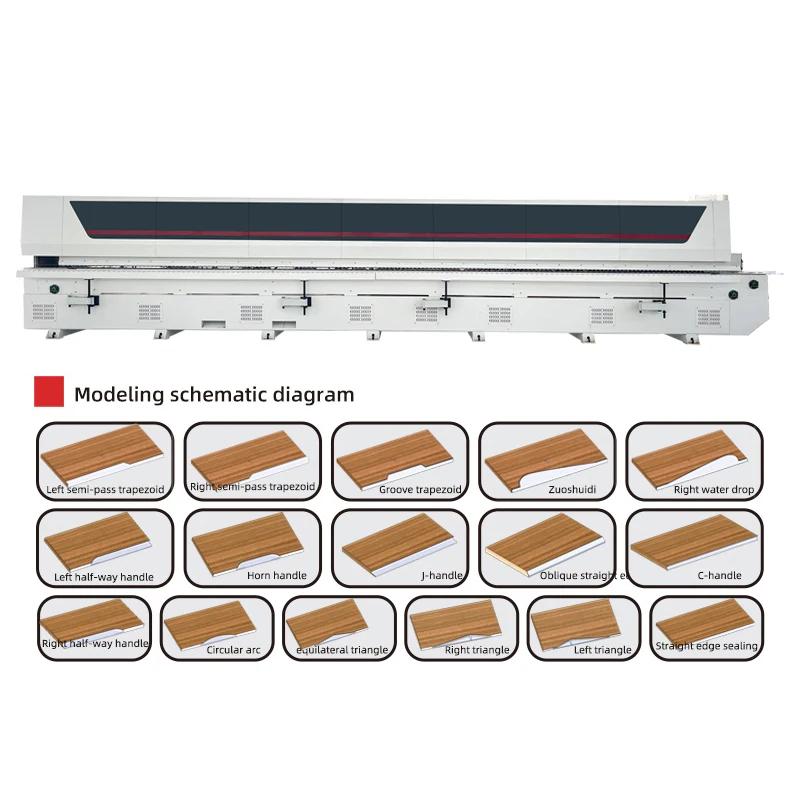
Edge banding machine
Click to enlarge
ISO 9001
CE Certified
OEM / ODM
12-Mo Warranty
Edge banding machine
Edge Banding Machine 16-Function Auto | for Furniture Cupboards
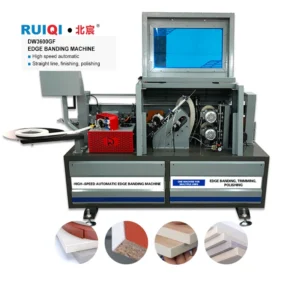
<p><strong>DW985 Soft Forming Edge Banding Machine, 16 Stations, 380V</strong> — processes veneer, PVC and melamine edge banding on MDF, particleboard, plywood and solid wood panels for cupboard and custom furniture production.</p> <ul> <li>Dedicated plate heating, rubber coating and soft forming pressing stations adapt glue activation and pressure to each substrate and banding material, minimizing visible glue lines across varying workshop temperatures.</li> <li>Wheeled profiling system with touch-screen shape switching reduces setup time when changing between edge profiles, supporting frequent product mix changes in furniture factory environments.</li> </ul> <p>Supported by engineer-led configuration proposals and pre-shipment test records verifying edge quality on your specific panel and banding combination.</p>
100+
Countries
MOQ 1
Unit
15-25 Days
Lead Time
16-Function
380V
Cupboard Furniture
DW985
Process And Application
Soft Forming Edge Banding Machine
Touch Screen Control
Veneer Edge Banding
- Full OEM/ODM support -- custom logo, voltage (110V-440V), multilingual panels
- ISO 9001 & CE certified, 5 national patents, 60 professional engineers
- 12-month warranty, remote technical support & spare parts service
- Professional export packaging, customs clearance support, on-time delivery
Soft Forming Edge Banding Process Control — the DW985 delivers a complete 16-station edge banding sequence with dedicated plate heating, rubber coating and profiling stations, allowing production managers to control glue activation, pressure and edge finish from a single touch-screen interface.
Technical Specifications
| Parameter | Value |
|---|---|
| Model | DW985 |
| Product Type | Soft Forming Edge Banding Machine |
| Processing Stations | 16 (Separate, Linear Pre-milling, Milling, Rough Mill, Inclined Straight Pre-milling, Finish Milling ×2, Handle-free Chamfer, Plate Heating, Wash, Edge Banding and Slotting, Rubber Coating, Heating System, Soft Forming and Pressing, End to End, Rough Repair, Truing, Scraping, Copying Chamfer, Wash, Polish) |
| Semi-J Rough Milling Motor | 5 kW |
| Inclined Straight Edge Pre-milling Motor | 5 kW |
| Semi-J Finish Milling Motor | 6 kW × 2 |
| Milling Servo Drive | 0.75 kW × 3 |
| Slab Chamfering and Edge Banding Breaking Motor | 0.55 kW × 2 |
| Edge Banding and Slotting Motor | 0.3 kW |
| End to End Motor | 0.37 kW × 2 |
| Coarse and Fine Finishing Department Motor | 0.75 kW × 2 |
| Plate Polishing Motor | 0.37 kW × 2 |
| Plate Conveying Motor | 5.5 kW |
| Pressure Beam Lifting Motor | 0.37 kW |
| Voltage | 380V (frequency to be confirmed — 50Hz or 60Hz) |
| Processing Speed | 8–12 m/min (basis not stated in source — confirm panel material, thickness and edge band type) |
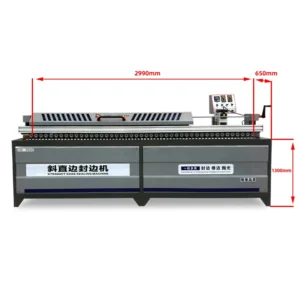
| Machine Size | 950 × 98 × 184 cm (source value — verify against manufacturer catalog) |
| Gross Mass | 4.2 t (source value — verify against manufacturer catalog) |
| Control System | Touch screen with operation key switches for shape selection |
| Profiling System | Wheeled profiling design with remote upgrade capability |
| Handle Design | Handle-free (semi-automatic) |
| Language Options | Chinese and English standard; Spanish and other languages customizable |
| Plug Options | EU, USA, AU, UK |
| Assembly State | Fully assembled, pre-shipment tested |
| Key Features | CE referenced, ISO 9001 referenced, remote profile upgrade, multi-language interface |
Application Suitability
| Application | Material or Output |
|---|---|
| Cupboard and cabinet door edge banding | Veneer and PVC on MDF, particleboard and plywood |
| Custom furniture panel production | MDF and particleboard with soft-formed shaped edges |
| Joinery workshop automation transition | Solid wood panels and plywood with PVC or melamine banding |
| Furniture factory production lines | High-volume panel edge finishing with profiling and polishing |
Why Visible Glue Lines Keep Showing Up on Finished Panels
Glue activation must match the substrate, the banding material and the workshop temperature — not just the machine setting.
I have walked into furniture workshops where the edge banding looked acceptable on the first few panels in the morning, then started showing visible glue lines by midday as the ambient temperature shifted. The problem was rarely the edge bander itself — it was the lack of dedicated pre-heating and adjustable pressure across the banding sequence. When MDF, particleboard and plywood move through the same station settings, each substrate absorbs and transfers heat differently, leaving some panels under-activated and others over-pressed [NEED_CITE: substrate thermal conductivity differences in wood panel processing]. The soft forming edge banding machine woodworking process on the DW985 addresses this by placing a dedicated plate heating station ahead of the rubber coating and pressing stages, so the glue activation curve can be adjusted independently from the milling and trimming sequence.
Substrate-Specific Glue Activation Across 16 Stations
A 16-station configuration means the panel enters at the separate station and does not leave the machine until final polishing is complete. Between those two points, the DW985 runs the board through linear pre-milling, rough milling, inclined pre-milling, double finish milling, handle-free chamfering, plate heating, washing, edge banding with slotting, rubber coating, soft forming and pressing, end cutting, rough repair, truing, scraping, copying chamfer, a second wash and polishing. Each station performs one specific task, so the soft forming edge banding machine woodworking process can be tuned at any point without disturbing the upstream or downstream operations. For a production manager switching between 18mm MDF for cabinet carcasses and 25mm particleboard for shelving, this means the plate heating temperature and the rubber coating pressure can be adjusted independently while the pre-milling and finish milling stations remain constant.
Profiling Without Hardware Changes
The wheeled profiling system on the DW985 uses a mechanical follower that traces the edge contour during the soft forming and pressing stage. When a new edge profile is required — for example, switching from a simple rounded edge to a more complex shaped contour for a cabinet door — additional profiles can be uploaded remotely to the control system rather than requiring a physical change of the profiling wheel assembly [NEED_CITE: remote CNC profile update methods in edge banding equipment]. The touch screen stores shape-specific parameters, so operators select the profile by name and the machine adjusts the pressing pressure, feed speed and heating sequence accordingly. This reduces changeover time between production runs and eliminates the trial-and-error adjustments that typically consume the first several panels of each batch.
Reading the Spec Sheet Against Actual Production Needs
The two 6 kW finish milling motors handle the bulk of material removal after pre-milling, and their combined rating matters when processing dense MDF or high-resin particleboard where the cutting resistance is higher. The three 0.75 kW milling servo drives control the feed positioning for the rough mill, inclined pre-mill and finish mill stations — servo-driven positioning gives more consistent depth control than pneumatic cylinders, particularly when panel thickness varies within a batch. The 5.5 kW plate conveying motor drives the feed chain, and its rating directly determines the maximum stable feed speed under load; a weaker conveyor motor will slow down as panel weight increases, causing inconsistent glue application [NEED_CITE: conveyor motor sizing and feed consistency in panel processing]. The 8–12 m/min processing speed range is achievable, but the actual sustainable speed depends on panel thickness, substrate density and whether veneer or PVC banding is being applied — always confirm the speed basis against your specific material combination before committing to a production schedule.
What Happens When Voltage and Frequency Are Assumed
Machines quoted without confirming local voltage and frequency arrive at the workshop and sit idle until a transformer or frequency converter is sourced. The DW985 is configured for 380V as standard, but the frequency — 50Hz or 60Hz — changes the actual RPM of every motor on the machine, which in turn changes the milling speed, the conveyor feed rate and the glue pot heating cycle. A 6 kW finish milling motor rated at 50Hz will run at a different spindle speed on a 60Hz supply, altering the cutting geometry and the edge finish quality. This is not a theoretical concern — it is one of the most common reasons for commissioning delays on imported woodworking equipment [NEED_CITE: voltage and frequency standards by export market]. Confirm the frequency before the machine is built, not after it arrives.
Why Process Documentation Matters at Delivery
The DW985 is manufactured within a facility that holds ISO 9001 and CE references, and the production process includes a four-stage quality check covering incoming material, in-process assembly, finished product inspection and pre-shipment verification. For a production manager, the value of this is not the certificate itself but the traceability it provides: the factory test record documents the actual edge banding results on a specific substrate and banding material combination, the electrical schematic confirms the voltage and wiring configuration that left the factory, and the operation manual — delivered in the agreed language — means the operator does not have to guess at parameter meanings during the first week of production [NEED_CITE: CE machinery directive requirements for industrial equipment].
Documentation & Verification
- CE declaration of conformity covering the full 16-station assembly and electrical system
- ISO 9001 certificate for the manufacturing and quality control process
- Machine specification sheet confirming all 16 station motor ratings and processing speed basis
- Factory test record showing edge banding results on your specific substrate and banding material
- Electrical schematic with voltage and frequency confirmation matching your facility supply
- Operation and maintenance manual delivered in the agreed language with spare parts list
Installation, Commissioning & Support
- Requires a level concrete floor capable of supporting 4.2 t gross mass across the 950 cm machine length
- Dedicated 380V three-phase circuit with confirmed frequency before first power-on
- Arrives fully assembled and pre-shipment tested — no on-site mechanical assembly required
- Touch screen commissioning includes shape profile loading and glue temperature calibration for your banding material
- Operator training covers all 16 stations with emphasis on plate heating and soft forming parameter adjustment
- Spare parts list provided with recommended consumable stock for the first production year
What to Share Before Requesting a Quotation
Send your primary panel substrate types and thicknesses, the edge banding materials you run most frequently, and your workshop voltage and frequency. If you are integrating the DW985 into an existing line, include the upstream and downstream equipment models so the feed height and throughput can be matched. Confirm the control panel language your operators require and whether you need plug configuration for EU, USA, AU or UK standards.
Frequently Asked Questions
Q: How does panel thickness and substrate type affect the 8–12 m/min processing speed range?
A: The speed range is achievable, but actual sustainable speed depends on panel density, thickness and banding material. Thicker particleboard requires slower feed to maintain pre-milling quality, while thinner MDF can run faster. Veneer banding typically demands lower speed than PVC due to the pressing and heating requirements. Always confirm the speed basis against your specific material combination before setting production targets.
Q: Which glue types and edge banding materials work with the soft forming and rubber coating stations?
A: The rubber coating and soft forming stations handle standard hot-melt adhesives used in furniture edge banding. Compatible banding materials include veneer, PVC and melamine. The dedicated plate heating station upstream of the coating stage ensures consistent glue activation across different materials. Confirm your specific glue type and banding supplier specifications so the factory can set the heating and pressure parameters before shipment.
Q: How does the wheeled profiling system receive remote upgrades after installation?
A: New edge profiles are uploaded to the touch screen control system remotely, and the wheeled profiling mechanism adjusts its follower path accordingly. This means additional shapes can be added without replacing mechanical components on the machine. The system supports shape-specific parameter storage, so each profile carries its own heating, pressure and speed settings for repeatable production.
Q: What assembly tolerances can be expected from the pre-milling and finish milling stations?
A: The linear and inclined pre-milling stations prepare the panel edge before banding, and the double finish milling motors refine the contour after pressing. The combination of servo-driven positioning on the milling stations and the dedicated truing and scraping stages downstream produces edge tolerances suitable for standard furniture assembly. Request the factory test record on your specific panel material to verify the actual tolerance achieved.
Q: How does the plate heating station compensate for seasonal workshop temperature changes?
A: The plate heating station pre-warms the panel edge before glue application, which is critical when workshop temperatures drop in winter or rise in summer. Operators adjust the heating temperature through the touch screen based on ambient conditions, ensuring consistent glue activation regardless of the season. This prevents the common issue of edge banding failing to bond on cold panels in unheated workshops.
Technical Specifications
| Parameter | Value |
|---|---|
| Product Name | Edge Banding Machine 16-Function Auto | for Furniture Cupboards |
| Category | Edge banding machine |
| Voltage Options | 110V / 220V / 380V / 440V (customizable) |
| Frequency | 50Hz / 60Hz (customizable) |
| Certification | ISO 9001, CE |
| MOQ | 1 Unit |
| Lead Time | 15-25 Working Days |
| Warranty | 12 Months |
| OEM / ODM | Available -- logo, color, panel language |
* Detailed technical specifications vary by model. Please contact us with your specific requirements for a complete datasheet.
Shipping & Export
-
Export Packaging
Heavy-duty wooden crate with foam padding and moisture protection
-
Shipping Methods
Sea freight (FCL/LCL), air freight, express -- we support all methods
-
Customs Support
Full documentation: CO, commercial invoice, packing list, HS code assistance
-
Port of Loading
Tianjin / Qingdao port, China -- 20 years export experience
OEM / ODM Services
-
Logo & Branding
Custom logo printing, color scheme, and nameplate engraving
-
Voltage Configuration
110V / 220V / 380V / 440V, 50Hz / 60Hz -- any region supported
-
Multilingual Panels
Control panels in English, Spanish, French, Arabic and more
-
Custom Specifications
Modified dimensions, accessories, or feature sets on request
Get a Quote
Request Product Inquiry
Fill in your details and we'll respond within 24 hours with pricing and availability.
Direct Contact
How It Works
-
1
Confirm requirements & budget
Tell us your factory scale and processing needs
-
2
Receive recommendation & quote
We match the right machine with full specs
-
3
Negotiate & place order
OEM terms, voltage, payment and delivery
-
4
Production & QC inspection
Multi-stage quality control by 60 engineers
-
5
Export packaging & shipment
Professional packing, customs clearance
-
6
After-sales support
12-month warranty, remote tech support
You May Also Like