Edge banding machine
Click to enlarge
ISO 9001
CE Certified
OEM / ODM
12-Mo Warranty
Edge banding machine
Gluing Machines 72 Cm Leveler Bander for PVC Edge Banding – Technical Guide
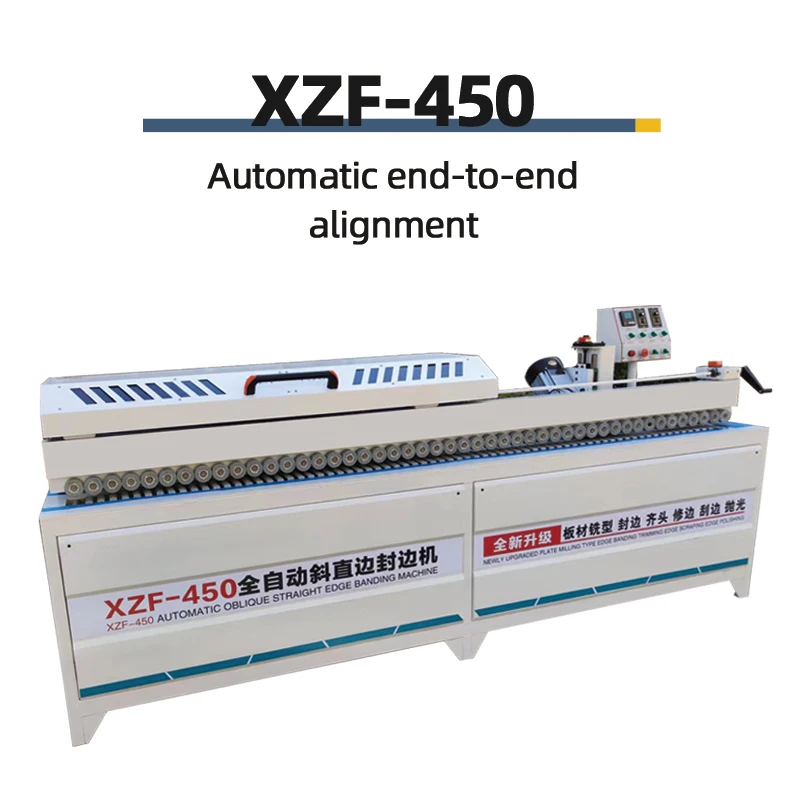
<p><strong>XZF-450 Automatic Edge Banding Machine, 9.5KW, 0-12M/min feed speed, 0.3-3MM edge thickness</strong> — delivers a full 7-function sequence from pre-milling through polishing in a single pass.</p> <ul> <li>4KW pre-milling station removes saw marks for flat bonding surfaces, reducing visible glue lines on MDF, particleboard and plywood substrates</li> <li>Supports 30/45/60 degree contour edge banding alongside standard straight edges, with 4000ml glue pot capacity for continuous production runs</li> </ul> <p>Backed by four-stage QC with pre-shipment verification, engineer-led configuration within 24 hours, and voltage customization from 110V to 440V to match your facility supply.</p>
100+
Countries
MOQ 1
Unit
15-25 Days
Lead Time
380V
Edge Banding Machine
MDF Panel
Plywood Edge Banding
Pre-milling Motor
Process And Application
XZF-450
- Full OEM/ODM support -- custom logo, voltage (110V-440V), multilingual panels
- ISO 9001 & CE certified, 5 national patents, 60 professional engineers
- 12-month warranty, remote technical support & spare parts service
- Professional export packaging, customs clearance support, on-time delivery
Verified Tolerance In-House — the XZF-450 holds ±0.02mm on trimming and scraping stations, confirmed by four-stage QC before dispatch.
Technical Specifications
| Parameter | Value |
|---|---|
| Model | XZF-450 |
| Product Type | Automatic Edge Banding Machine |
| Total Power | 9.5 kW |
| Voltage | 380V / 415V (confirm 50Hz or 60Hz for your facility) |
| Pre-milling Motor | 4 kW |
| Trimming Power | 2.2 kW × 2 |
| Polishing Power | 0.4 kW × 2 |
| Transmission Power | 180 W |
| Vacuum Power | 550 W |
| Feed Speed | 0–12 m/min |
| Edge Banding Height | 0–50 mm |
| Edge Banding Thickness | 0.3–3 mm |
| Minimum Sheet Length | 300 mm |
| Minimum Sheet Width | 150 mm |
| Glue Pot Capacity | 4000 ml |
| Air Source Pressure | 0.5–0.7 MPa |
| Overall Dimensions (L×W×H) | 3000 × 650 × 1350 mm |
| Net Weight | 430 kg |
| Standard Functions | Pre-milling, 30°/45°/60° contour banding, end trimming, rough trimming, fine trimming, scraping, polishing, high-power dust extraction |
| Language Options | Chinese and English standard; Spanish or other languages on request |
| Plug Options | EU, USA, AU, UK |
Application Suitability
| Application | Material or Output |
|---|---|
| Cabinet door edge finishing | MDF, melamine-faced particleboard with PVC or ABS banding |
| Carcass panel banding | Particleboard and plywood with 0.4–2 mm PVC edges |
| Solid wood furniture components | Solid wood panels with veneer edge banding |
| Shaped and angled cabinet parts | Contour profiles requiring 30°, 45° or 60° banding |
| Polymer door production | Polymer door blanks with thick ABS or PVC edges |
| Mixed-substrate batch runs | MDF, blockboard, plywood, and particleboard in the same shift |
Why Glue Lines Appear on Some Boards but Not Others
The bonding surface matters more than the banding material itself. When a freshly cut panel edge carries saw marks, tear-out, or micro-chipping, no amount of glue pressure will produce a clean joint. Pre-milling removes that damaged layer and exposes a flat substrate face before the glue roller ever touches it.
In workshops I have supported, operators blame the PVC or the veneer when white glue lines show up on particleboard but disappear on MDF. The real cause is almost always the condition of the panel edge entering the glue station. Particleboard is more friable than MDF, so saw blade wear and feed vibration leave a rougher edge. The XZF-450 addresses this with a dedicated 4 kW pre-milling station that reconditions the edge in the same pass. [NEED_CITE: effect of pre-milling on glue-line visibility across substrates]
If your production mixes substrates — MDF for painted fronts, particleboard for carcass sides, plywood for shelving — you will see edge quality variation unless the pre-milling cut is adjusted per material. That is exactly what the woodworking edge banding process and application demands: one machine that adapts station by station rather than forcing a single setting across every board.
What Happens Between the Glue Pot and the Finished Edge
The XZF-450 runs a seven-station sequence in one continuous pass: pre-milling, gluing and pressure, end trimming, rough trimming, fine trimming, scraping, and polishing. Each station has a defined job. End trimming cuts the overhang at both ends of the panel. Rough trimming removes the bulk of the excess banding. Fine trimming brings the edge flush with the face. Scraping eliminates the tiny ridges left by the trimming cutters. Polishing buffs the edge to a smooth finish. Skipping any of these stages — as some lighter machines do — forces the operator to hand-finish edges, which breaks rhythm and introduces inconsistency across a batch.
How Contour Banding Extends the Machine Beyond Straight Panels
Straight 90-degree edges cover most cabinet carcass work, but shaped doors, angled shelving, and curved furniture profiles need contour capability. The XZF-450 supports 30°, 45°, and 60° banding angles, allowing production of bevelled and profiled components without moving the panel to a secondary station. This matters for custom furniture shops where a single order might include flat panels and shaped pieces. [NEED_CITE: contour edge banding requirements in custom cabinet production]
Keeping all angle work on one machine preserves glue temperature stability and feed speed consistency, so the edge quality on a bevelled door rail matches the quality on a flat shelf.
Reading the Specs That Actually Affect Your Panels
The 4 kW pre-milling motor provides enough torque to take a full-width cut on particleboard without stalling, which is where underpowered pre-mills leave chatter marks that show through thin veneer. Feed speed runs from 0 to 12 m/min, giving operators the range to slow down for thick veneer on solid wood and speed up for standard PVC on melamine board. The 4000 ml glue pot holds enough adhesive for extended runs without stopping to refill, keeping the glue temperature and viscosity stable across the batch. Trimming power of 2.2 kW per motor ensures clean cuts even on 3 mm PVC, where undersized trim motors tend to tear rather than shear the material. The dust extraction system pulls chips and fine particles away from the glue roller and trimming cutters, preventing buildup that degrades edge finish over a long shift.
When the Wrong Specification Costs You a Production Run
I once configured a machine for a cabinet maker who specified only PVC banding during inquiry. When they switched to real wood veneer mid-production, the scraping station left visible chatter because the setup was tuned for softer PVC. The woodworking edge banding process and application on veneer demands sharper scraping blades and slower feed speeds. That line stopped for half a shift while we reconfigured. [NEED_CITE: substrate and banding material mismatch in edge banding setup]
Similarly, buying a machine rated for 380V / 50Hz and plugging it into a 415V / 60Hz supply without confirmation will damage the glue pot heater and variable-speed motors. I always ask for a photo of the facility’s electrical panel before we finalize the spec sheet, because the cost of a rewound motor is nothing compared to two weeks of lost production.
Why This Build Approach Fits Your Workshop
In-house manufacturing with proprietary cutting mechanisms means the pre-milling and trimming stations on the XZF-450 are designed and assembled under one roof, so tolerance claims can be verified on the factory floor rather than taken from a component supplier’s brochure.
Full product family coverage from entry-level to full-function means a workshop can start with simpler configurations and add stations or upgrade models later without changing suppliers or retraining operators on a different control layout.
Voltage, language, and specification customization is treated as standard procedure, not a special request. A 415V / 60Hz machine with a Spanish control panel is configured before production begins, not jury-rigged after arrival.
Four-stage quality control — incoming material, in-process, finished product, and pre-shipment verification — means the XZF-450 is tested under load with actual panels before it leaves the facility.
Engineer-led configuration ensures the formal quotation you receive reflects your substrate mix, banding materials, and production volume rather than a default catalogue spec.
Documentation & Verification
- Machine specification sheet listing every station motor rating and feed speed range for the XZF-450
- Electrical schematic confirming voltage, frequency, and plug type matched to your facility supply
- Factory test record run on your substrate and banding material samples before shipment
- CE declaration of conformity covering machinery and low-voltage directives
- Operation and maintenance manual translated into your operator’s language
Installation, Commissioning & Support
- Allow floor space for the 3000 × 650 mm footprint plus infeed and outfeed clearance on both sides
- Provide a dedicated 380V or 415V circuit rated for the 9.5 kW total power draw with appropriate breaker protection
- Confirm air supply delivers 0.5–0.7 MPa at the machine inlet with a dedicated filter-regulator-lubricator unit
- First commissioning includes glue pot temperature calibration and feed speed setting for your specific banding materials
- Pre-milling cutter and trimming blade replacement schedule provided based on your primary substrate type
- Spare parts list covers high-wear items including scraper blades, polishing wheels, and glue roller surfaces
Before You Request a Quote
Send your primary substrate types and the exact banding materials you run — PVC thickness range, veneer species, or ABS specification — so the station configuration can be matched to your actual production mix. Include your facility voltage and frequency, and confirm whether your operators need a control panel in a language other than English or Chinese. If you are running shaped panels, specify the angles and profile radii so we can confirm contour banding compatibility. A sample test on your own materials before order commitment is always available.
Frequently Asked Questions
Q: How does pre-milling affect glue-line visibility on MDF versus particleboard?
A: Particleboard edges tend to be rougher after sawing because the material is more friable. The 4 kW pre-milling station on the XZF-450 removes that damaged layer and exposes a flat bonding surface. MDF is denser and cuts cleaner, so pre-milling has less dramatic effect there, but it still ensures consistency when switching between substrates in the same shift.
Q: What banding thickness range does the machine handle and how does material affect setup?
A: The XZF-450 accepts 0.3–3 mm banding across PVC, veneer, melamine, and ABS. Thicker PVC requires higher trimming motor load and adjusted scraper geometry. Real wood veneer needs sharper scraping blades and typically slower feed speeds. We configure the trimming and scraping stations based on the material you confirm during the specification stage.
Q: How do I confirm correct voltage and frequency before ordering?
A: Send a photo or specification of your facility electrical panel showing supply voltage and frequency. The XZF-450 is configurable for 380V or 415V, but the Hz rating must match. We confirm plug type — EU, USA, AU, or UK — and document the electrical specification on the machine spec sheet and wiring schematic before production starts.
Q: Can I send panel samples for a test run before committing?
A: Yes. Send your actual substrate panels with the banding material you intend to use. We run them through the full seven-station sequence on the XZF-450, document edge finish quality and glue-line appearance, and send you the processed samples along with the factory test record before you finalize the order.
Q: How does feed speed affect edge finish on different substrates?
A: Higher feed speeds within the 0–12 m/min range work well for standard PVC on melamine-faced particleboard. Solid wood panels with veneer banding typically require slower speeds to allow clean trimming and scraping. The variable feed control on the XZF-450 lets operators adjust per material without stopping the machine.
Technical Specifications
| Parameter | Value |
|---|---|
| Product Name | Gluing Machines 72 Cm Leveler Bander for PVC Edge Banding – Technical Guide |
| Category | Edge banding machine |
| Voltage Options | 110V / 220V / 380V / 440V (customizable) |
| Frequency | 50Hz / 60Hz (customizable) |
| Certification | ISO 9001, CE |
| MOQ | 1 Unit |
| Lead Time | 15-25 Working Days |
| Warranty | 12 Months |
| OEM / ODM | Available -- logo, color, panel language |
* Detailed technical specifications vary by model. Please contact us with your specific requirements for a complete datasheet.
Shipping & Export
-
Export Packaging
Heavy-duty wooden crate with foam padding and moisture protection
-
Shipping Methods
Sea freight (FCL/LCL), air freight, express -- we support all methods
-
Customs Support
Full documentation: CO, commercial invoice, packing list, HS code assistance
-
Port of Loading
Tianjin / Qingdao port, China -- 20 years export experience
OEM / ODM Services
-
Logo & Branding
Custom logo printing, color scheme, and nameplate engraving
-
Voltage Configuration
110V / 220V / 380V / 440V, 50Hz / 60Hz -- any region supported
-
Multilingual Panels
Control panels in English, Spanish, French, Arabic and more
-
Custom Specifications
Modified dimensions, accessories, or feature sets on request
Get a Quote
Request Product Inquiry
Fill in your details and we'll respond within 24 hours with pricing and availability.
Direct Contact
How It Works
-
1
Confirm requirements & budget
Tell us your factory scale and processing needs
-
2
Receive recommendation & quote
We match the right machine with full specs
-
3
Negotiate & place order
OEM terms, voltage, payment and delivery
-
4
Production & QC inspection
Multi-stage quality control by 60 engineers
-
5
Export packaging & shipment
Professional packing, customs clearance
-
6
After-sales support
12-month warranty, remote tech support
You May Also Like