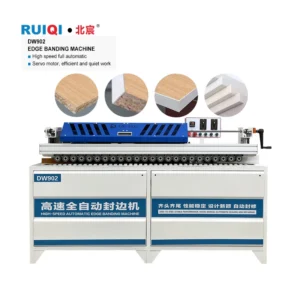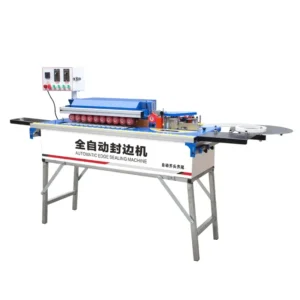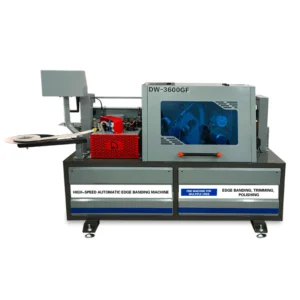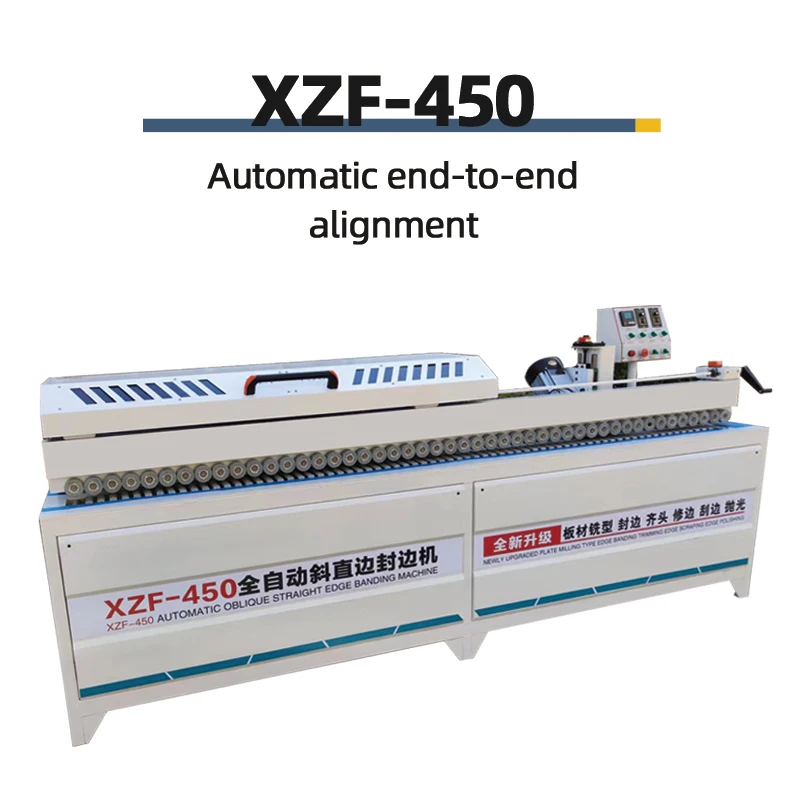
Edge banding machine
Click to enlarge
ISO 9001
CE Certified
OEM / ODM
12-Mo Warranty
Edge banding machine
Gluing Machines 72 Cm Leveler Bander S That Are 120 Volts Pvc Edge Banding Production Machine – Industrial Application
<p><strong>XZF450 45 Degree Full-Automatic Edge Banding Machine, 9.5KW, 0-12M/min Feed Speed</strong> — handles pre-milling through polishing across seven stations for MDF, particleboard and plywood substrates.</p> <ul> <li><strong>30/45/60 degree edge banding</strong> with 0.3-3mm thickness range and 4KW pre-milled motor for clean substrate preparation before gluing</li> <li>Scraping and polishing stations ensure smooth transitions between banding and panel, reducing downstream finishing effort on cabinet doors and custom furniture components</li> </ul> <p>Voltage confirmation, multilingual control panel setup and factory test records provided before dispatch to match your workshop's electrical system and operator requirements.</p>
100+
Countries
MOQ 1
Unit
15-25 Days
Lead Time
380V
45 Degree Edge Banding
Edge Banding Machine
MDF Panel
Plywood Edge Banding
Pre-milling
Process Application
XZF-450
- Full OEM/ODM support -- custom logo, voltage (110V-440V), multilingual panels
- ISO 9001 & CE certified, 5 national patents, 60 professional engineers
- 12-month warranty, remote technical support & spare parts service
- Professional export packaging, customs clearance support, on-time delivery
Precision-ground tolerance — every critical contact surface on the XZF-450 edge banding machine process application is verified before dispatch, keeping glue lines tight across MDF, plywood and particleboard runs.
Technical Specifications
| Parameter | Value |
|---|---|
| Model | XZF450 |
| Product Type | 45 Degree Full-Automatic Edge Banding Machine |
| Total Power | 9.5 kW |
| Pre-milled Motor | 4 kW |
| Trimming Power | 2.2 kW × 2 |
| Polishing Power | 0.4 kW × 2 |
| Vacuum Power | 550 W |
| Edge Power / Speed | 0.16 kW / 0–12 m/min |
| Transmission Power / Speed | 180 W / 0–12 m/min |
| Feed Speed | 0–12 m/min |
| Voltage | 380V / 415V |
| Air Source Pressure | 0.5–0.7 MPa |
| Glue Pot Capacity | 4000 ml |
| Edge Banding Thickness | 0.3–3 mm |
| Edge Banding Height | 0–50 mm |
| Minimum Sheet Length | 30 cm |
| Minimum Sheet Width | 15 cm |
| Standard Features | Plate milling, 30/45/60° edge banding, trimming, scraping, polishing, high-power vacuuming |
| Product Size | 300 × 65 × 135 cm |
| Product Weight | 430 kg |
Application Suitability
| Application | Material or Output |
|---|---|
| Cabinet door production | MDF and melamine board with PVC or ABS edge banding |
| Custom furniture panels | Plywood and blockboard with veneer or melamine strips |
| Angled joinery components | 45° and 60° bevel cuts on particleboard and polymer doors |
| Solid wood edge finishing | Solid wood board with thin veneer banding up to 3 mm |
| Mixed-material batch runs | Switching between PVC, ABS and wood veneer on the same line |
Why the Substrate Decides Your Edge Banding Machine Process Application Before Anything Else
A machine that performs well on PVC-coated particleboard can still fail on raw MDF if the pre-milling and glue temperature are not matched to the substrate.
I have watched cabinet factories blame the glue when the real problem was saw blade chatter left on the panel edge. MDF absorbs moisture differently than plywood, and particleboard has a crumbly core that demands a clean pre-milled surface before any adhesive touches it. When those variables are ignored, visible glue lines appear and entire batches of doors need rework [NEED_CITE: substrate behaviour and adhesive compatibility in panel edge banding].
Pre-Milling as the Foundation of Edge Quality
The 4 kW pre-milled motor on this edge banding machine process application removes saw marks and micro-fractures from the panel edge before the glue pot is even reached. On particleboard, this step prevents the crumbly core from pulling adhesive into the substrate instead of bonding it to the banding. On plywood, it levels the alternating grain layers that would otherwise create an uneven glue line. Skipping pre-milling on any substrate denser than standard chipboard almost guarantees rework downstream.
Multi-Angle Banding for Joinery That Actually Fits Together
Standard 90° edge banding covers most cabinet carcass work, but angled joints for corner units, scribe fillers and bevelled door fronts require the 30/45/60° capability built into this machine. The transition between angles involves resetting the pressure roller alignment and verifying that the trimming knives follow the new contour. Getting this right means the assembled joint closes without gaps — and without forcing the fitter to hand-plane every bevelled edge on the bench [NEED_CITE: angled edge banding tolerance and joint assembly accuracy].
Reading the Specs That Actually Matter in Production
The 0–12 m/min feed speed range gives operators room to slow down for thick veneer banding and speed up for thin PVC on straight runs. Glue pot capacity at 4000 ml means fewer refill stops during a full shift, which matters when running cabinet batches that require consistent adhesive temperature throughout. The trimming station uses two 2.2 kW motors — enough to shear cleanly through 3 mm ABS without leaving witness marks that the scraping station must then remove. Air pressure at 0.5–0.7 MPa drives the pneumatic actuators on the pressure rollers and trimming units; if the workshop compressor cannot sustain that range, the rollers will stutter and the glue transfer becomes uneven.
What Happens When Voltage and Air Supply Are Ignored
Machines quoted without confirming local electrical standards arrive at the dock and sit idle while the buyer sources a transformer. Beyond the voltage mismatch, undersized air compressors cause pneumatic actuators to lag, which shows up as inconsistent trimming depth and incomplete scraping on the panel edge [NEED_CITE: voltage and frequency standards by export market]. These are problems that surface during commissioning, not during the factory test, and they delay production starts by weeks.
Why This Configuration Exists
The seven-station layout — pre-milling, gluing, end trimming, rough trimming, fine trimming, scraping and polishing — covers the complete finishing sequence in one pass, eliminating the need for a separate scraping bench. The 300 × 65 × 135 cm footprint fits into a standard panel processing cell without requiring structural floor modifications. A 430 kg frame mass absorbs vibration at higher feed speeds, keeping the trimming knives stable on dense substrates like blockboard. Voltage options at 380V and 415V align with three-phase industrial supply across most export markets, and the multilingual control panel option prevents operator confusion during first-day commissioning.
Documentation & Verification
- CE declaration of conformity covering the XZF450 edge bander assembly
- ISO 9001 certificate for the manufacturing quality system
- Electrical schematic with confirmed voltage and breaker ratings for your facility
- Factory test record using your specified panel thickness and banding material
- Operation and maintenance manual produced in your agreed language
- Spare parts list with part numbers for trimmers, scrapers and pressure rollers
Installation, Commissioning & Support
- Requires a level concrete floor and 300 cm clear length for the XZF450 frame placement
- Dedicated 380V/415V three-phase circuit rated for the 9.5 kW total draw
- Arrives partially assembled; trimming and polishing units need on-site alignment calibration
- First-run commissioning includes setting glue temperature for your chosen banding material
- Operator training covers the 30/45/60° angle changeover and feed speed adjustment
- Scraping blades and polishing wheels stocked as consumables with reorder part numbers
Before You Request a Quotation
Share the panel substrates you run most often, the edge banding materials in your current inventory, and whether your line includes angled joinery that needs the 45° or 60° station. Confirm your workshop voltage and whether your compressor can hold 0.5–0.7 MPa continuously. If you are replacing a manual edge bander, note your current daily panel count so the feed speed setting can be matched to your throughput.
Frequently Asked Questions
Q: Why does MDF produce a more visible glue line than melamine-faced particleboard?
A: MDF has a porous, uniform fibre structure that absorbs hot-melt adhesive differently. The pre-milling station must leave a clean, burnished edge so the glue bonds to the surface rather than soaking in. Adjusting glue pot temperature and roller pressure for MDF typically reduces the visible line to acceptable levels.
Q: When is the pre-milling station essential versus optional?
A: Any panel cut with a sliding table saw or beam saw leaves micro-chatter on the edge. For plywood, blockboard and solid wood, pre-milling removes this and creates a flat bonding surface. On pre-cut melamine chipboard with clean edges, some operators bypass it, but glue adhesion still benefits from a fresh milled surface.
Q: How does switching between PVC and wood veneer banding affect setup?
A: Wood veneer requires lower glue temperature and slower feed speed to prevent the thin material from cracking under the pressure rollers. The 0.3–3 mm thickness range covers both, but operators must adjust the glue pot thermostat and reduce feed rate when changing from PVC to real veneer.
Q: Does 45° edge banding slow down the feed rate compared to 90° straight runs?
A: Yes, angled banding requires the pressure rollers and trimming knives to follow a bevelled contour, which works best at the lower end of the 0–12 m/min range. Production planners should account for this when scheduling mixed batches of straight and angled panels.
Technical Specifications
| Parameter | Value |
|---|---|
| Product Name | Gluing Machines 72 Cm Leveler Bander S That Are 120 Volts Pvc Edge Banding Production Machine – Industrial Application |
| Category | Edge banding machine |
| Voltage Options | 110V / 220V / 380V / 440V (customizable) |
| Frequency | 50Hz / 60Hz (customizable) |
| Certification | ISO 9001, CE |
| MOQ | 1 Unit |
| Lead Time | 15-25 Working Days |
| Warranty | 12 Months |
| OEM / ODM | Available -- logo, color, panel language |
* Detailed technical specifications vary by model. Please contact us with your specific requirements for a complete datasheet.
Shipping & Export
-
Export Packaging
Heavy-duty wooden crate with foam padding and moisture protection
-
Shipping Methods
Sea freight (FCL/LCL), air freight, express -- we support all methods
-
Customs Support
Full documentation: CO, commercial invoice, packing list, HS code assistance
-
Port of Loading
Tianjin / Qingdao port, China -- 20 years export experience
OEM / ODM Services
-
Logo & Branding
Custom logo printing, color scheme, and nameplate engraving
-
Voltage Configuration
110V / 220V / 380V / 440V, 50Hz / 60Hz -- any region supported
-
Multilingual Panels
Control panels in English, Spanish, French, Arabic and more
-
Custom Specifications
Modified dimensions, accessories, or feature sets on request
Get a Quote
Request Product Inquiry
Fill in your details and we'll respond within 24 hours with pricing and availability.
Direct Contact
How It Works
-
1
Confirm requirements & budget
Tell us your factory scale and processing needs
-
2
Receive recommendation & quote
We match the right machine with full specs
-
3
Negotiate & place order
OEM terms, voltage, payment and delivery
-
4
Production & QC inspection
Multi-stage quality control by 60 engineers
-
5
Export packaging & shipment
Professional packing, customs clearance
-
6
After-sales support
12-month warranty, remote tech support
You May Also Like