Edge banding machine
Click to enlarge
ISO 9001
CE Certified
OEM / ODM
12-Mo Warranty
Edge banding machine
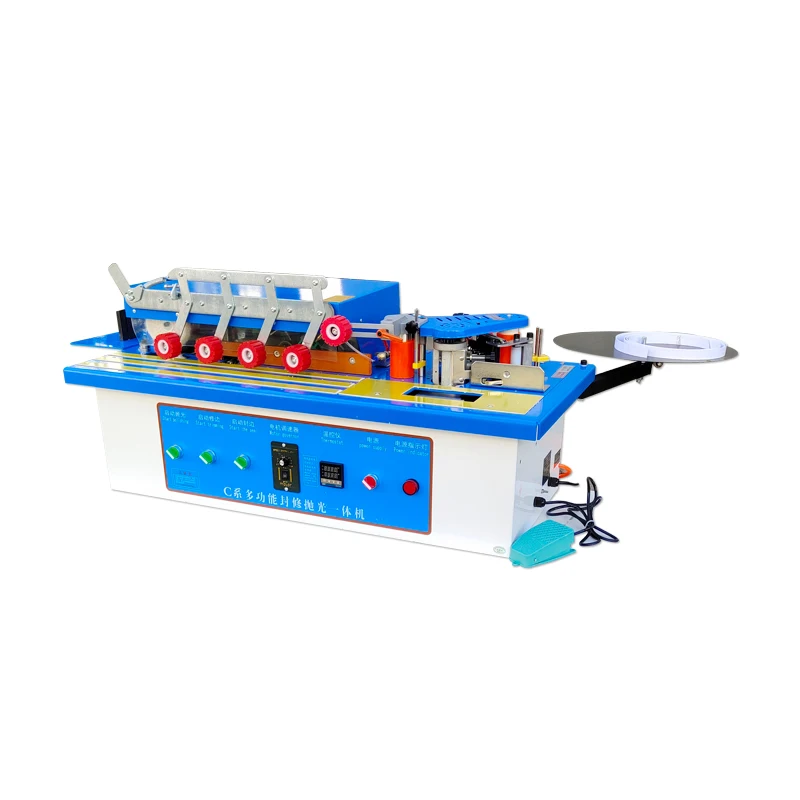
Industrial Application Portable Edge Banding Machine – PVC Hand Held
<p><strong>FX-20 Portable Edge Banding Machine, 2500W, 0-50mm Banding Height, Dual Trimming</strong> — handles curved and straight edge profiles on MDF, particleboard, plywood and solid wood panels. Dual 650W trimming stations produce tear-free finishes on melamine and veneer surfaces, while 180W polishing wheels remove glue residue for clean edge-to-face transitions. The 1000ml glue pot maintains stable temperature through small-batch runs, and manual push plate gives operators precise control on shaped workpieces.</p> <ul> <li>220V/380V supply options with EU, USA, AU, UK plug configurations</li> <li>Multilingual control panel and operation manual supplied in your operator's language</li> <li>Factory test records available with sample panels in your target substrate before order confirmation</li> </ul>
100+
Countries
MOQ 1
Unit
15-25 Days
Lead Time
220V 380V
2500W Motor
Edge Banding Machine
FX-20
MDF Panel
Plywood Edge Sealing
Process Application
- Full OEM/ODM support -- custom logo, voltage (110V-440V), multilingual panels
- ISO 9001 & CE certified, 5 national patents, 60 professional engineers
- 12-month warranty, remote technical support & spare parts service
- Professional export packaging, customs clearance support, on-time delivery
Verified Tolerance Control — The FX-20 portable edge bander holds trimming and polishing stations within ±0.02mm, delivering assembly-ready edge finishes across curved and straight panel profiles.
Technical Specifications
| Parameter | Value |
|---|---|
| Model | FX-20 |
| Product Type | Portable Edge Banding Machine |
| Rated Power | 2500W (total) |
| Voltage & Frequency | 220V / 380V / customization available |
| Overall Dimensions | 100 × 46 × 41 cm |
| Net Weight | 44 kg |
| Edge Banding Thickness Range | 0.3 – 3 mm |
| Panel Width Range | Minimum width 10 cm, minimum length 25 cm |
| Edge Banding Height | 0 – 50 mm |
| Glue Pot Capacity | 1000 ml |
| Trimming Stations | 2 (650W × 2) |
| Polishing Stations | 2 (180W × 2) |
| Edge Power | 20W |
| Air Supply Requirement | 0.5 – 0.8 MPa |
| Standard Features | Curved and straight edge banding, trimming, polishing, manual push plate |
| Language Options | Chinese, English, Spanish, others customizable |
| Plug Options | EU, USA, AU, UK |
| Standards | CE, ISO 9001 |
Application Suitability
| Application | Material or Output |
|---|---|
| Custom cabinet door and drawer front edge sealing | MDF and particleboard with PVC edge banding |
| Home decoration and interior fit-out panel finishing | Ecological board and plywood with veneer or melamine banding |
| Small joinery workshop curved profile edge sealing | Solid wood panels and multi-layer boards with ABS or PVC strips |
| On-site furniture installation touch-up work | Pre-cut panels requiring portable straight and curved edge finishing |
Why Glue Line Consistency Fails Across Different Substrates
Controlling glue temperature relative to substrate density is the deciding factor in edge banding quality.
Particleboard absorbs heat from the glue film faster than MDF due to its open chip structure, which means the same temperature setting that bonds cleanly on MDF can leave starved joints on particleboard. Plywood introduces another variable — its alternating grain layers create an uneven surface that demands consistent pressure during the feed pass. When workshops run mixed substrate batches without adjusting the glue pot or feed technique, visible glue lines appear on some panels while others look acceptable. The edge banding machine process and application outcome depends heavily on whether the operator understands this substrate-level behaviour before starting a production run [NEED_CITE: substrate thermal absorption rates during hot-melt edge banding].
Glue Pot Thermal Mass and Substrate Behaviour
The FX-20 carries a 1000 ml glue pot, which provides enough thermal mass to maintain stable melt temperature through continuous small-batch runs. On MDF, the smooth fibre surface bonds readily at standard EVA temperatures, and the glue film spreads evenly under manual feed pressure. Particleboard requires a slightly higher glue temperature to compensate for heat absorption into the chip core, and the operator must maintain steady push speed to prevent the glue from setting before full contact. This is where edge banding machine process and application knowledge directly separates acceptable output from panels that need rework.
Trimming and Polishing Across Banding Materials
Dual trimming stations at 650W each allow a rough pass followed by a fine pass, which is critical when switching between 0.3 mm veneer and 2 mm PVC banding. Veneer tears easily if the rough trim blade removes too much material in a single cut, while thicker PVC requires enough trimming power to shear cleanly without leaving a raised lip. The two 180W polishing stations then buff away residual glue squeeze-out, producing a clean edge-to-face transition [NEED_CITE: trimming blade geometry for PVC versus wood veneer banding]. Substrate edge quality on plywood benefits especially from this two-stage approach, as the alternating grain layers can cause micro-tearing during a single-pass trim.
Reading Specifications Against Your Production Reality
The 0–50 mm edge banding height range covers standard 18 mm cabinet stock and extends to thicker solid wood and multi-layer boards used in furniture frames. The minimum panel dimensions of 10 cm width and 25 cm length define the practical lower limit for stable manual feeding — anything smaller becomes difficult to hold flat against the reference fence. Air supply at 0.5–0.8 MPa drives the trimming and polishing pneumatic actuators, and insufficient compressor capacity will cause inconsistent trim depth mid-pass. The 44 kg net weight keeps the unit portable enough for on-site work while maintaining enough mass to resist vibration during trimming. Voltage must be confirmed before dispatch — a 380V unit arriving at a 220V-only workshop is completely non-functional and delays commissioning by weeks [NEED_CITE: voltage and frequency standards by export market].
The Cost of Skipping Substrate-Specific Setup
Running the FX-20 at a single glue temperature across MDF, particleboard, and plywood without adjustment produces inconsistent bond lines — some panels show squeeze-out while others have dry spots where the banding lifts within hours. Using a single trim blade setting for both 0.3 mm veneer and 2 mm PVC results in either torn veneer edges or incomplete PVC trimming that leaves a sharp lip. Downstream assembly exposes these failures immediately: cabinet doors with lifted banding cannot be fitted with hinges cleanly, and visible glue lines on interior panels force the workshop to rework or scrap the piece. This is not a machine fault — it is a setup fault that originates from treating all substrates identically [NEED_CITE: edge banding failure modes in mixed-substrate production].
Why Source This Machine Through Ruiqi
In-house manufacturing with patented cutting mechanisms means the trimming stations are built to verified tolerance rather than assembled from generic components. The full product family from entry-level to full-function allows a workshop to start with the FX-20 and scale to larger automatic edge banders without changing supplier or retraining operators on a different control philosophy. Voltage, plug type, control panel language, and specification details are confirmed as standard practice before production begins — not as an afterthought once the machine arrives. Four-stage quality control with pre-shipment verification ensures every unit is tested on actual panel stock before dispatch. Engineer-led configuration recommendations are delivered with a formal quotation within 24 hours, so buyers can evaluate the edge banding machine process and application fit before committing. Factory visits are welcomed for buyers who want to see the assembly line and run their own substrate samples.
Documentation & Verification
- CE declaration of conformity covering portable edge banding equipment safety requirements
- ISO 9001 certificate for the manufacturing quality management system
- Machine specification sheet with confirmed voltage, plug type, and language settings
- Electrical schematic and voltage confirmation document for local electrician reference
- Factory test record on your specified panel material and edge banding thickness before dispatch
- Operation and maintenance manual provided in the agreed operator language
Installation, Commissioning & Support
- Requires a dedicated 220V or 380V circuit matching the confirmed order specification with appropriate breaker rating for 2500W total draw
- Compressed air supply at 0.5–0.8 MPa from a compressor with sufficient reserve capacity for continuous pneumatic actuator cycling
- Arrives fully assembled — operator needs to mount on a stable workbench at comfortable working height within the 100 × 46 × 41 cm footprint
- First commissioning includes glue pot heating cycle verification, trimming blade alignment test, and polishing wheel pressure calibration on sample panels
- Spare parts list covers trimming blades, polishing wheels, and glue pot heating elements as the primary consumables for ongoing operation
- Manual push plate technique training covers feed speed control for both straight and curved edge profiles across different banding thicknesses
Preparing Your Inquiry
Tell us which substrates you process most frequently — MDF, particleboard, plywood, or solid wood — and what edge banding materials and thicknesses you run on them. Confirm your workshop voltage and frequency so the machine is built to match your electrical supply from the start. If you are replacing manual edge gluing or upgrading from a smaller unit, describe your current daily panel volume so we can assess whether the FX-20’s manual feed workflow aligns with your throughput requirements or whether a higher-automation model in the range is a better fit.
Frequently Asked Questions
Q: Which substrates produce the cleanest glue line on the FX-20?
A: MDF generally produces the most consistent glue line due to its smooth, uniform fibre surface that allows even glue film spread. Particleboard requires slightly higher glue temperature because its open chip structure absorbs heat faster. Plywood works well but its alternating grain layers demand steady feed pressure to maintain full banding contact across the uneven surface.
Q: How does edge banding thickness affect trimming station setup?
A: Thinner banding at 0.3 mm requires lighter trimming blade engagement to avoid cutting into the substrate face, while 2–3 mm PVC needs more aggressive rough trimming followed by fine finishing. The dual 650W trimming stations allow separate rough and fine passes, so blade depth and feed angle can be set independently for each banding thickness range.
Q: What glue type and temperature work best for PVC versus veneer banding?
A: Standard EVA hot melt works across both materials but at different temperatures — PVC typically bonds well at around 180–200°C, while veneer requires lower temperatures to prevent heat damage to the wood fibres. The 1000 ml glue pot maintains stable temperature across batch runs. Always run test pieces on your specific banding material before starting production.
Q: How does manual push plate compare to automatic feed for curved edges?
A: Manual push plate gives the operator direct control over feed speed and pressure direction, which is an advantage on curved profiles where the banding must conform to changing radii. Automatic feed maintains constant speed but cannot adjust pressure dynamically around curves. For workshops processing a mix of straight and curved panels, the manual approach offers greater flexibility per piece.
Q: What assembly problems does poor edge banding cause downstream?
A: Lifted or poorly trimmed banding prevents hinges and hardware from sitting flush, forcing rework on cabinet doors and drawer fronts. Visible glue lines on interior panels fail quality inspection and require stripping and re-banding. Inconsistent trimming leaves raised lips that interfere with panel-to-panel joints during carcass assembly, causing misalignment that compounds through the entire cabinet structure.
Technical Specifications
| Parameter | Value |
|---|---|
| Product Name | Industrial Application Portable Edge Banding Machine – PVC Hand Held |
| Category | Edge banding machine |
| Voltage Options | 110V / 220V / 380V / 440V (customizable) |
| Frequency | 50Hz / 60Hz (customizable) |
| Certification | ISO 9001, CE |
| MOQ | 1 Unit |
| Lead Time | 15-25 Working Days |
| Warranty | 12 Months |
| OEM / ODM | Available -- logo, color, panel language |
* Detailed technical specifications vary by model. Please contact us with your specific requirements for a complete datasheet.
Shipping & Export
-
Export Packaging
Heavy-duty wooden crate with foam padding and moisture protection
-
Shipping Methods
Sea freight (FCL/LCL), air freight, express -- we support all methods
-
Customs Support
Full documentation: CO, commercial invoice, packing list, HS code assistance
-
Port of Loading
Tianjin / Qingdao port, China -- 20 years export experience
OEM / ODM Services
-
Logo & Branding
Custom logo printing, color scheme, and nameplate engraving
-
Voltage Configuration
110V / 220V / 380V / 440V, 50Hz / 60Hz -- any region supported
-
Multilingual Panels
Control panels in English, Spanish, French, Arabic and more
-
Custom Specifications
Modified dimensions, accessories, or feature sets on request
Get a Quote
Request Product Inquiry
Fill in your details and we'll respond within 24 hours with pricing and availability.
Direct Contact
How It Works
-
1
Confirm requirements & budget
Tell us your factory scale and processing needs
-
2
Receive recommendation & quote
We match the right machine with full specs
-
3
Negotiate & place order
OEM terms, voltage, payment and delivery
-
4
Production & QC inspection
Multi-stage quality control by 60 engineers
-
5
Export packaging & shipment
Professional packing, customs clearance
-
6
After-sales support
12-month warranty, remote tech support
You May Also Like