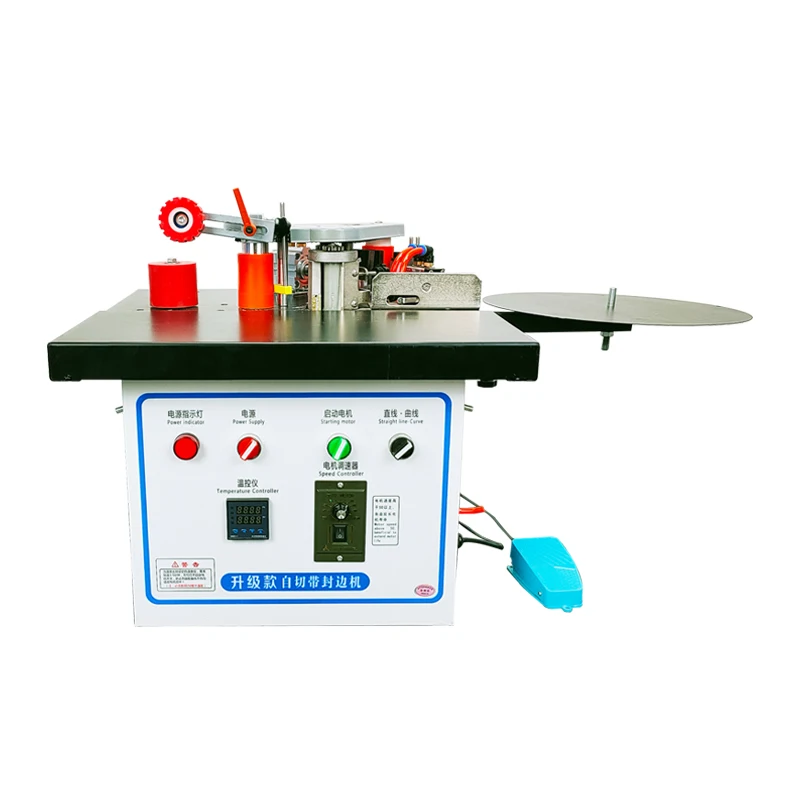
Edge banding machine
Click to enlarge
ISO 9001
CE Certified
OEM / ODM
12-Mo Warranty
Edge banding machine
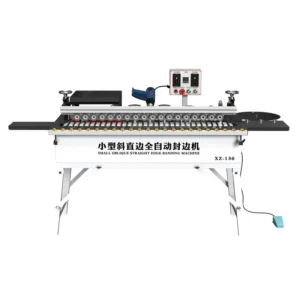
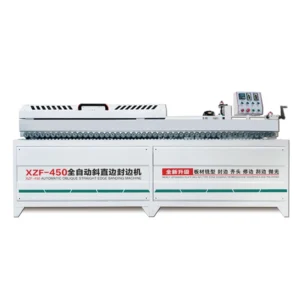
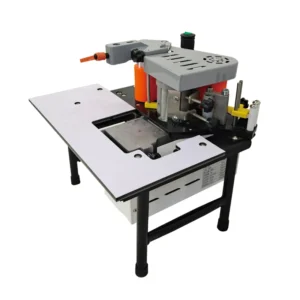
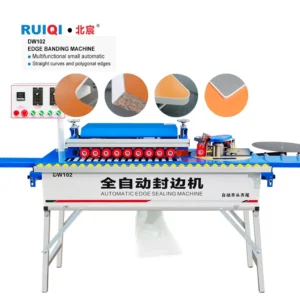
Portable Electric Automatic Edge Banding Machine for Woodworking – Industrial Application
<p><strong>Portable Edge Banding Machine, 1000W, 220V/380V, Curved & Straight Edge Sealing</strong> — delivers consistent glue application across MDF, particleboard, plywood, and solid wood panels with 0.3–3mm banding thickness and 0–50mm edge height capacity.</p> <p>Designed for on-site and workshop environments, this unit handles both curved and straight profiles with controlled glue pot temperature and pneumatic feeding at 0.5–0.8MPa, ensuring uniform edge quality across varying substrates.</p> <ul> <li>Minimum sheet dimensions: 25cm × 3cm for small offcut processing</li> <li>1000ml glue pot capacity supports extended operation cycles</li> <li>Customizable language panels and plug options (EU, USA, AU, UK)</li> </ul> <p>Backed by four-stage QC with pre-shipment verification, engineer-led configuration within 24 hours, and full voltage and language customization as standard.</p>
100+
Countries
MOQ 1
Unit
15-25 Days
Lead Time
0.3-3MM Thickness
Curved Straight Profile
Furniture Repair
MDF Particleboard Panel
Pneumatic Feeding
Portable Edge Banding Machine
Process Application
- Full OEM/ODM support -- custom logo, voltage (110V-440V), multilingual panels
- ISO 9001 & CE certified, 5 national patents, 60 professional engineers
- 12-month warranty, remote technical support & spare parts service
- Professional export packaging, customs clearance support, on-time delivery
Voltage flexibility as standard — configurable between 220V and 380V with plug options spanning EU, USA, AU, and UK markets to prevent on-site commissioning stalls.
Technical Specifications
| Parameter | Value |
|---|---|
| Product Type | Portable Edge Banding Machine |
| Total Power | 1000W |
| Voltage Options | 220V / 380V / customization |
| Standard Features | Curved and straight edge banding |
| Minimum Sheet Length | 25CM |
| Minimum Sheet Width | 3CM |
| Edge Banding Height | 0-50MM |
| Edge Banding Thickness | 0.3-3MM |
| Edge Power | 20W |
| Air Source Pressure | 0.5-0.8Mpa |
| Machine Dimensions | 50×50×47CM |
| Machine Weight | 22KG |
| Glue Pot Capacity | 1000ml |
| Language Options | Chinese, English (customizable) |
| Plug Options | EU, USA, AU, UK |
Application Suitability
| Application | Material or Output |
|---|---|
| Custom furniture workshop edge sealing | MDF and particleboard panels for cabinet doors and carcasses |
| On-site home decoration installations | Plywood and ecological board for fitted wardrobes and shelving |
| Furniture repair and refurbishment | Solid wood board and existing panel stock requiring re-banding |
| Small-scale curved profile finishing | PVC and veneer edge banding on radiused MDF components |
Why Substrate Roughness Matters More Than Machine Price
The edge banding machine process and application outcome depends on matching glue temperature and feed pressure to the actual board surface, not on catalog claims alone.
I once set up a portable edge bander in a workshop in Lagos where the operator was using locally sourced particleboard with a surface roughness far beyond what standard PVC banding could bridge. The glue line showed through on every panel, and the entire batch of wardrobe doors had to be reworked. Portable units like this 1000W system address that gap through a controllable glue pot and adjustable pneumatic feed, but only if the substrate is tested first. [NEED_CITE: particleboard surface roughness standards for edge banding adhesion]
Glue Pot Control and Banding Material Compatibility
The 1000ml glue pot on this portable edge banding machine holds enough adhesive for extended work sessions without constant refilling, which matters when you are moving between job sites or running a small batch of custom panels. Temperature stability inside the pot determines whether the glue wets the substrate properly or skins over before contact.
Curved and Straight Profiles in One Setup
Handling both curved and straight edge banding within a single portable unit removes the need for a dedicated contour station in small workshops. The edge banding machine process and application for curved profiles requires slower feed and firmer pressure roller contact to prevent the banding from lifting at the radius.
Substrate Behavior and Edge Quality Outcomes
MDF, particleboard, plywood, and ecological board each present a different surface to the glue film. Particleboard with an open-pore structure absorbs more adhesive, leaving less available for bonding the banding itself. [NEED_CITE: adhesive absorption rates across wood-based panel types] Adjusting the glue pot temperature and air source pressure between 0.5 and 0.8 Mpa lets the operator compensate for these differences rather than accepting a one-setting compromise.
Reading the Specification Sheet Against Your Actual Panels
The 0.3-3MM edge banding thickness range covers most PVC and veneer tapes used in furniture production. However, the 0-50MM banding height limit means panels thicker than 50MM require a different class of machine entirely. Feed speed is not listed as a fixed value in the source specification, so confirming the effective throughput on your panel size before ordering prevents surprises when production volume is expected to scale.
The Cost of Skipping Voltage and Frequency Verification
Ordering a portable edge bander without confirming whether the local grid runs at 50Hz or 60Hz leads to motors running hotter than rated, glue pots failing to reach set temperature, and pneumatic solenoids cycling incorrectly. I have seen this exact failure pattern at two separate installations in South Asia where the machines arrived configured for the wrong frequency. [NEED_CITE: voltage and frequency standards by export market] The 220V/380V customization option on this unit exists precisely to prevent that outcome.
Why Sourcing This Equipment From a Verified Manufacturer Matters
In-house manufacturing with patented cutting mechanisms means the tolerance claims are verifiable through factory test records, not marketing sheets. The four-stage QC process covering incoming material through pre-shipment verification catches glue pot calibration drift before the machine leaves the factory floor. Voltage, language, and specification customization are treated as standard configuration steps rather than special requests, which shortens the gap between inquiry and dispatch. An engineer reviews the factory scale and processing requirement before recommending whether this portable unit or a full-function pre-milling model better suits the workload.
Documentation & Verification
- Machine specification sheet confirming 0.3-3MM banding thickness and 0-50MM height range
- Electrical schematic with voltage and frequency matched to your local supply
- Factory test record on your specified panel material before dispatch
- Operation and maintenance manual in the agreed language for operator training
- CE declaration of conformity for customs clearance in regulated markets
Installation, Commissioning & Support
- Requires a dedicated circuit matching the configured voltage (220V or 380V) and 1000W total draw
- Air compressor must deliver stable 0.5-0.8 Mpa to feed the pneumatic system consistently
- Arrives as a single 22KG unit with dimensions of 50×50×47CM for benchtop placement
- First-run glue pot temperature calibration performed on your actual panel samples
- Spare glue pot and edge trimming blade included for initial maintenance cycle
Requesting a Configuration That Matches Your Workshop
To confirm whether this portable edge banding machine fits your production, share the panel materials you work with most frequently, the edge banding type and thickness you source locally, and the voltage and frequency at your facility. If you are running curved components, note the smallest radius so we can verify the banding will hold without delamination. Sample panel testing is available before order confirmation.
Frequently Asked Questions
Q: How does substrate moisture content affect glue adhesion and edge quality?
A: Panels above standard moisture content cause the hot-melt adhesive to cool prematurely on contact, resulting in weak bonds that fail during trimming or transport. We test incoming panels at the factory before finalizing the glue pot temperature setting, ensuring the adhesive achieves proper wetting regardless of whether you are running MDF, particleboard, or plywood in humid workshop conditions.
Q: What edge banding materials are compatible with this machine’s glue system?
A: The system handles PVC, veneer, and ABS edge banding within the 0.3-3MM thickness range. Each material requires a different glue pot temperature and feed pressure setting. We provide the recommended parameter sheet for your specific banding type so operators can switch between materials without trial-and-error waste during production runs.
Q: How does curved edge banding differ from straight edge sealing in setup and tooling?
A: Curved profiles require reduced feed speed and increased pressure roller contact to keep the banding seated against the radius without lifting. The portable unit handles both profiles, but operators must adjust the pneumatic pressure and manually guide the panel through curves, which takes practice to achieve consistent results across a batch of radiused components.
Q: What downstream trimming or scraping processes are required after edge banding?
A: After the banding is applied, excess material must be trimmed flush with the panel surface. On this portable unit, the 20W edge trimming motor handles the cut. Operators typically follow with manual scraping to remove any adhesive residue and a buffing step to polish the edge, especially on visible surfaces like cabinet doors and drawer fronts.
Q: How to adjust feed speed and temperature for different panel thicknesses?
A: Thicker panels absorb heat from the glue film faster, requiring a higher glue pot temperature to maintain bond strength. The air source pressure setting controls feed force rather than speed on this portable model. We provide a parameter chart correlating your panel thickness range with the recommended temperature and pressure values for repeatable output quality.
Technical Specifications
| Parameter | Value |
|---|---|
| Product Name | Portable Electric Automatic Edge Banding Machine for Woodworking – Industrial Application |
| Category | Edge banding machine |
| Voltage Options | 110V / 220V / 380V / 440V (customizable) |
| Frequency | 50Hz / 60Hz (customizable) |
| Certification | ISO 9001, CE |
| MOQ | 1 Unit |
| Lead Time | 15-25 Working Days |
| Warranty | 12 Months |
| OEM / ODM | Available -- logo, color, panel language |
* Detailed technical specifications vary by model. Please contact us with your specific requirements for a complete datasheet.
Shipping & Export
-
Export Packaging
Heavy-duty wooden crate with foam padding and moisture protection
-
Shipping Methods
Sea freight (FCL/LCL), air freight, express -- we support all methods
-
Customs Support
Full documentation: CO, commercial invoice, packing list, HS code assistance
-
Port of Loading
Tianjin / Qingdao port, China -- 20 years export experience
OEM / ODM Services
-
Logo & Branding
Custom logo printing, color scheme, and nameplate engraving
-
Voltage Configuration
110V / 220V / 380V / 440V, 50Hz / 60Hz -- any region supported
-
Multilingual Panels
Control panels in English, Spanish, French, Arabic and more
-
Custom Specifications
Modified dimensions, accessories, or feature sets on request
Get a Quote
Request Product Inquiry
Fill in your details and we'll respond within 24 hours with pricing and availability.
Direct Contact
How It Works
-
1
Confirm requirements & budget
Tell us your factory scale and processing needs
-
2
Receive recommendation & quote
We match the right machine with full specs
-
3
Negotiate & place order
OEM terms, voltage, payment and delivery
-
4
Production & QC inspection
Multi-stage quality control by 60 engineers
-
5
Export packaging & shipment
Professional packing, customs clearance
-
6
After-sales support
12-month warranty, remote tech support
You May Also Like