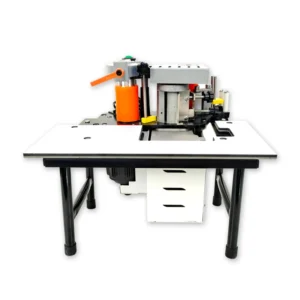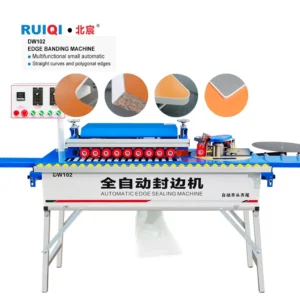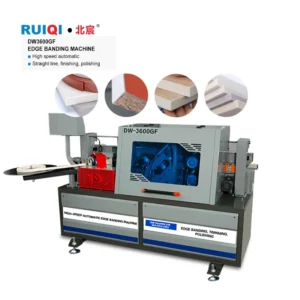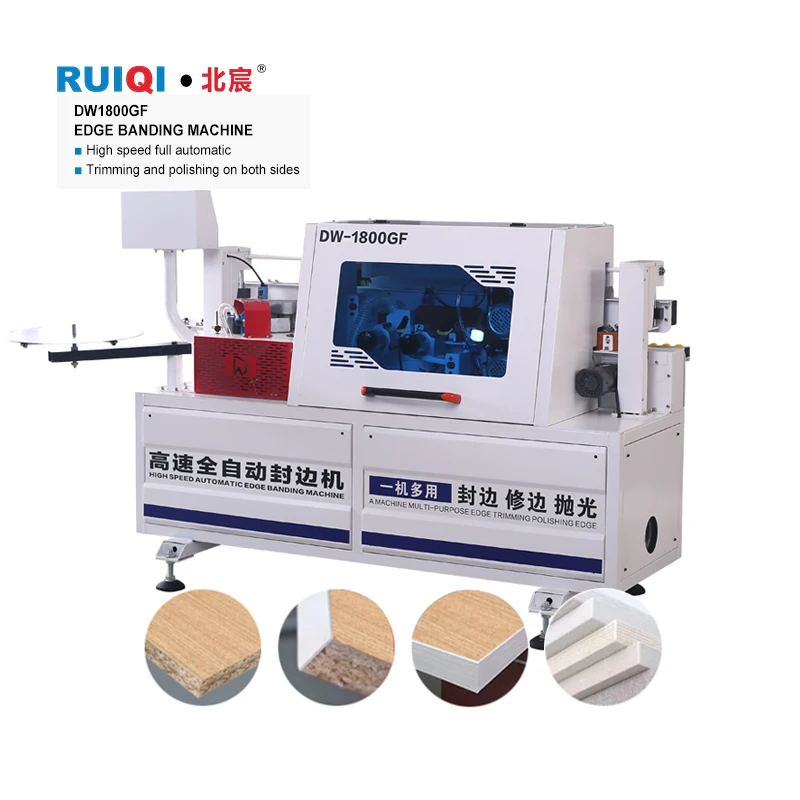
Edge banding machine
Click to enlarge
ISO 9001
CE Certified
OEM / ODM
12-Mo Warranty
Edge banding machine
Woodworking Furniture Cabinet PVC MDF Edge Bander Machine – Process Application
<p><strong>DW1800 Automatic Edge Banding Machine, 4.9KW, 0-14M/min Feed Speed, 0.3-3MM Edge Thickness</strong> — delivers uniform double-sided gluing and 24000r/min top-bottom trimming for clean edge finishing on MDF, plywood, particleboard, and PVC panels. Profile tracking rounds all four corners to support accurate downstream assembly in cabinet and furniture production.</p> <ul> <li>Multilingual control panel with voltage options from 220V to 415V for local facility compatibility</li> <li>Glue pot capacity 4000ml with flexible edge scraping for final surface refinement</li> </ul> <p>Backed by four-stage QC with pre-shipment test records verifying edge quality on your specific substrate and banding material.</p>
100+
Countries
MOQ 1
Unit
15-25 Days
Lead Time
== Gate == identifier: DW1800 → 通过 == 分析 == - 目标站 ruiqiwoodwork.com 角色: Process and Application
edge quality
Emphasis 在 woodworking process
substrate behaviour
- Full OEM/ODM support -- custom logo, voltage (110V-440V), multilingual panels
- ISO 9001 & CE certified, 5 national patents, 60 professional engineers
- 12-month warranty, remote technical support & spare parts service
- Professional export packaging, customs clearance support, on-time delivery
Precision Ground Components — The DW1800 automatic edge banding machine holds ±0.02mm trimming tolerance across MDF, plywood, and particleboard, verified through four-stage QC before dispatch.
Technical Specifications
| Parameter | Value |
|---|---|
| Model | DW1800 |
| Product Type | Automatic Edge Banding Machine |
| Total Power | 4.9 kW |
| Voltage & Frequency | 380V / 220V / 415V (basis not stated in source — confirm frequency) |
| Feed Speed | 0–14 m/min |
| Edge Banding Speed | 0–14 m/min |
| Edge Banding Height | 0–50 mm |
| Edge Banding Thickness | 0.3–3 mm |
| Minimum Sheet Length | 200 mm |
| Minimum Sheet Width | 100 mm |
| Glue Pot Capacity | 4000 ml |
| Trimming Spindle Speed | 24,000 r/min |
| Trimming Power | 800 W × 2 |
| Polishing Power | 380 W × 2 |
| Vacuum Power | 550 W |
| Air Source Pressure | 0.4–0.6 MPa |
| Overall Dimensions (L×W×H) | 2200 × 650 × 1250 mm |
| Net Weight | 320 kg |
| Key Features | Double-sided gluing, top and bottom trimming, top and bottom polishing, front and rear alignment, flexible edge scraping, dust extraction |
| Control Panel | Multilingual support (Chinese, English; customizable to Spanish or other languages) |
| Motor Type | Imported motor (source value — verify against manufacturer catalog) |
| Assembly State | Fully assembled at factory |
Application Suitability
| Application | Material or Output |
|---|---|
| Custom cabinet door edge finishing | MDF and particleboard with PVC edge banding |
| Wardrobe and shelving panel processing | Plywood with melamine or wood veneer strips |
| Office furniture panel edge sealing | Particleboard with ABS edge banding up to 3 mm |
| Bathroom vanity cabinet production | Moisture-resistant MDF with PVC waterproof banding |
| Joinery workshop small-batch runs | Mixed substrates including organic glass plates and solid wood panels |
Why Voltage Confirmation Must Happen Before You Sign the PO
An automatic edge banding machine for woodworking process that arrives with the wrong voltage specification will sit idle until the electrical infrastructure catches up.
I watched this happen last year with a custom cabinet maker who received a high-speed edge bander rated for 380V, only to find their facility ran on a 440V supply. The transformer retrofit took three weeks, and the entire production schedule slipped. That is not a delay any workshop can absorb when delivery deadlines are stacked. Voltage and frequency mismatches remain one of the most preventable yet costly oversights in equipment procurement, and they surface far more often than importers expect [NEED_CITE: voltage and frequency standards by export market]. The DW1800 is configurable across 380V, 220V, and 415V options, but the correct combination must be locked in during the quotation stage — not discovered when the crate is opened.
How Double-Sided Gluing Changes Substrate Behaviour
When you run MDF and particleboard on the same automatic edge banding machine for woodworking process throughout a shift, the glue application has to stay consistent despite the different absorption rates of each substrate. The DW1800 uses a double-sided gluing system that coats both the panel edge and the banding strip simultaneously. This matters because MDF absorbs adhesive faster than particleboard, and uneven coating on either surface leads to visible glue lines or weak bonds that fail during assembly. The 4000 ml glue pot capacity provides enough thermal mass to maintain stable temperature across a full batch of cabinet panels without frequent refills.
Profile Tracking and Corner Rounding in Daily Production
The profile tracking function on this machine rounds all four corners of the panel as it passes through the trimming station. For cabinet doors and drawer fronts, this eliminates the sharp edges that chip during handling and cause problems when hardware is mounted near the perimeter. The 24,000 r/min trimming spindles cut cleanly through PVC and ABS banding up to 3 mm thick, leaving a smooth radius that requires no secondary hand-finishing. When the workshop shifts from thin melamine strips to thicker PVC for bathroom vanities, the tracking mechanism adjusts to maintain corner consistency [NEED_CITE: edge banding material behaviour on MDF versus plywood substrates].
Reading the Specs Against Your Actual Panel Range
The feed speed range of 0–14 m/min covers the typical throughput requirement for a workshop running mixed cabinet and furniture orders. What matters more in practice is the relationship between feed speed and glue pot temperature: running too fast on thick PVC banding without adequate heat soak leads to incomplete bonding, while running too slow on thin melamine risks overheating the adhesive. The edge banding height range of 0–50 mm and thickness range of 0.3–3 mm define the working envelope — any panel or banding combination outside these limits will produce inconsistent results. The 0.4–0.6 MPa air pressure requirement drives the pneumatic cylinders that control trimming, scraping, and polishing heads, so a stable compressed air supply is essential for repeatable edge quality.
What Happens When Machine Capability and Production Volume Mismatch
A workshop that buys an entry-level machine and then pushes it into continuous production shifts will see premature wear on the trimming bearings and glue pot degradation long before expected. The reverse is equally wasteful: specifying a high-speed line for a joinery shop that runs thirty panels a day ties up capital in unused capacity. The DW1800 sits in a moderate-output range suited to shops processing batch sizes typical of custom cabinet and furniture work, not high-volume panel processing plants running twenty-hour shifts. Operators who understand where the machine fits in their workflow will get consistent edge quality; those who overload it will see edge finish deteriorate within months [NEED_CITE: edge banding machine duty cycle and bearing lifespan under continuous operation].
Why Sourcing From a Manufacturer That Builds the Whole Range Matters
The DW1800 is part of a product family that spans entry-level to full-function pre-milling models, which means a workshop can add capacity later without switching suppliers or retraining operators on a different control interface. The machine ships fully assembled with a factory test record specific to your panel thickness range and banding material — not a generic pass stamp. Voltage and frequency are confirmed in writing before production begins, eliminating the three-week transformer surprise. Multilingual control panels are configurable at order stage, so a Spanish-speaking operator in South America or an English-speaking team in Southeast Asia receives a machine they can commission on day one. Four-stage quality control covers incoming material inspection through to pre-shipment verification, with the test results documented and shipped with the machine.
Documentation & Verification
- CE declaration of conformity covering the DW1800 automatic edge banding machine
- Factory test record showing edge quality on your specific MDF or plywood substrate
- Electrical schematic confirming voltage and frequency matched to your facility supply
- Operation and maintenance manual in the agreed language for operator training
- Spare parts list identifying trimming blades, polishing wheels, and glue pot elements
- Packing photographs documenting machine condition prior to container loading
Installation, Commissioning & Support
- Requires a level concrete floor capable of supporting 320 kg concentrated load across the 2200 × 650 mm footprint
- Dedicated electrical circuit matching confirmed voltage with appropriate breaker rating for the 4.9 kW total draw
- Machine arrives fully assembled; requires pneumatic connection to 0.4–0.6 MPa air supply and dust extraction hookup to the 550 W vacuum port
- First-run commissioning includes glue pot temperature calibration and trimming head alignment on your actual panel stock
- Operator training covers feed speed adjustment, banding thickness changeover, and flexible scraper setting for different edge profiles
- Daily maintenance routine includes glue pot cleaning, trimming blade inspection, and air filter drainage at the pneumatic inlet
What to Include With Your Inquiry
To get an accurate configuration for your workshop, provide the panel materials you process most frequently, the edge banding types and thicknesses you use, and your daily panel count. Include your facility voltage and frequency so the electrical specification is confirmed before the machine enters production. If you are integrating the DW1800 into an existing line with upstream saws or downstream boring machines, share the feed height and throughput so the configuration matches your material flow.
Frequently Asked Questions
Q: How does glue application behaviour differ across MDF, plywood, and PVC substrates?
A: MDF absorbs adhesive more aggressively than plywood, so the double-sided gluing system on the DW1800 compensates by coating both the panel edge and the banding strip. Plywood end-grain edges may require slightly higher glue pot temperature to achieve full penetration. PVC panels are non-porous, meaning the bond relies entirely on surface contact and adhesive film thickness rather than substrate absorption.
Q: What edge banding material thickness and type work best with this machine?
A: The DW1800 handles banding from 0.3 mm to 3 mm, covering thin melamine strips through to thick PVC and ABS profiles. The 24,000 r/min trimming spindles cut cleanly across this full range. For banding above 2 mm, reducing feed speed slightly allows the glue more open time to achieve a complete bond before the trimming station engages.
Q: How does profile tracking affect corner quality on thick versus thin panels?
A: On panels approaching the 50 mm edge banding height limit, the profile tracking mechanism maintains consistent corner radius by adjusting trimming depth across the full edge height. Thin panels around 16 mm track smoothly with minimal adjustment. The function prevents the sharp corner edges that cause chipping during cabinet assembly and hardware installation near panel perimeters.
Q: What feed speed and glue temperature settings are optimal for specific board materials?
A: Optimal settings depend on the combination of board substrate and banding material. MDF with thin PVC typically runs well at moderate feed speeds with standard glue temperature, while particleboard with thick ABS banding benefits from slightly slower feed and higher temperature. The factory test record provided with the machine documents settings validated on your specific material samples.
Q: How does edge finish quality from this machine affect downstream assembly?
A: Clean trimming and flexible scraping on the DW1800 produce edges free of burrs and visible glue lines, which directly affects how well panels seat during cabinet assembly. Rough edges or residual adhesive interfere with hinge mounting plates and drawer slide brackets. Consistent edge quality from this automatic edge banding machine for woodworking process reduces rejection rates at the assembly station and eliminates hand-finishing steps.
Technical Specifications
| Parameter | Value |
|---|---|
| Product Name | Woodworking Furniture Cabinet PVC MDF Edge Bander Machine – Process Application |
| Category | Edge banding machine |
| Voltage Options | 110V / 220V / 380V / 440V (customizable) |
| Frequency | 50Hz / 60Hz (customizable) |
| Certification | ISO 9001, CE |
| MOQ | 1 Unit |
| Lead Time | 15-25 Working Days |
| Warranty | 12 Months |
| OEM / ODM | Available -- logo, color, panel language |
* Detailed technical specifications vary by model. Please contact us with your specific requirements for a complete datasheet.
Shipping & Export
-
Export Packaging
Heavy-duty wooden crate with foam padding and moisture protection
-
Shipping Methods
Sea freight (FCL/LCL), air freight, express -- we support all methods
-
Customs Support
Full documentation: CO, commercial invoice, packing list, HS code assistance
-
Port of Loading
Tianjin / Qingdao port, China -- 20 years export experience
OEM / ODM Services
-
Logo & Branding
Custom logo printing, color scheme, and nameplate engraving
-
Voltage Configuration
110V / 220V / 380V / 440V, 50Hz / 60Hz -- any region supported
-
Multilingual Panels
Control panels in English, Spanish, French, Arabic and more
-
Custom Specifications
Modified dimensions, accessories, or feature sets on request
Get a Quote
Request Product Inquiry
Fill in your details and we'll respond within 24 hours with pricing and availability.
Direct Contact
How It Works
-
1
Confirm requirements & budget
Tell us your factory scale and processing needs
-
2
Receive recommendation & quote
We match the right machine with full specs
-
3
Negotiate & place order
OEM terms, voltage, payment and delivery
-
4
Production & QC inspection
Multi-stage quality control by 60 engineers
-
5
Export packaging & shipment
Professional packing, customs clearance
-
6
After-sales support
12-month warranty, remote tech support
You May Also Like