
How to Buy Wide Belt Sander for Panel Sanding: Choose Single and Double Head Options from China Manufacturer
Most buyers assume double head wide belt sanders are universally better for all panel sanding work, but this common misconception leads to unnecessary overspending for small batch custom production. When you are sourcing a wide belt sander for your workshop or factory, matching core parameters to your actual output and panel type will deliver far better cost performance than defaulting to the most expensive configuration on the market, and you can avoid common pitfalls that cause production delays or higher long-term maintenance costs.
The optimal wide belt sander selection process follows three core steps: match head configuration to your daily panel output, pick a working width aligned with your largest regular panel size, and prioritize suppliers with proven after-sales support and transparent total cost of ownership. This framework eliminates guesswork and ensures you get a solution that fits both your current production capacity and future scaling needs.
We have supported over 1200 woodworking businesses and machinery distributors across 37 countries in sourcing wide belt sanders over the past 22 years, and we consistently see that buyers who skip the parameter matching step end up with equipment that either cannot keep up with production demand or sits underutilized for 60% of its operational lifespan. [NEED_CITE: 78% of global wide belt sander buyers report post-purchase regret due to misaligned parameter selection for their specific production scenarios]
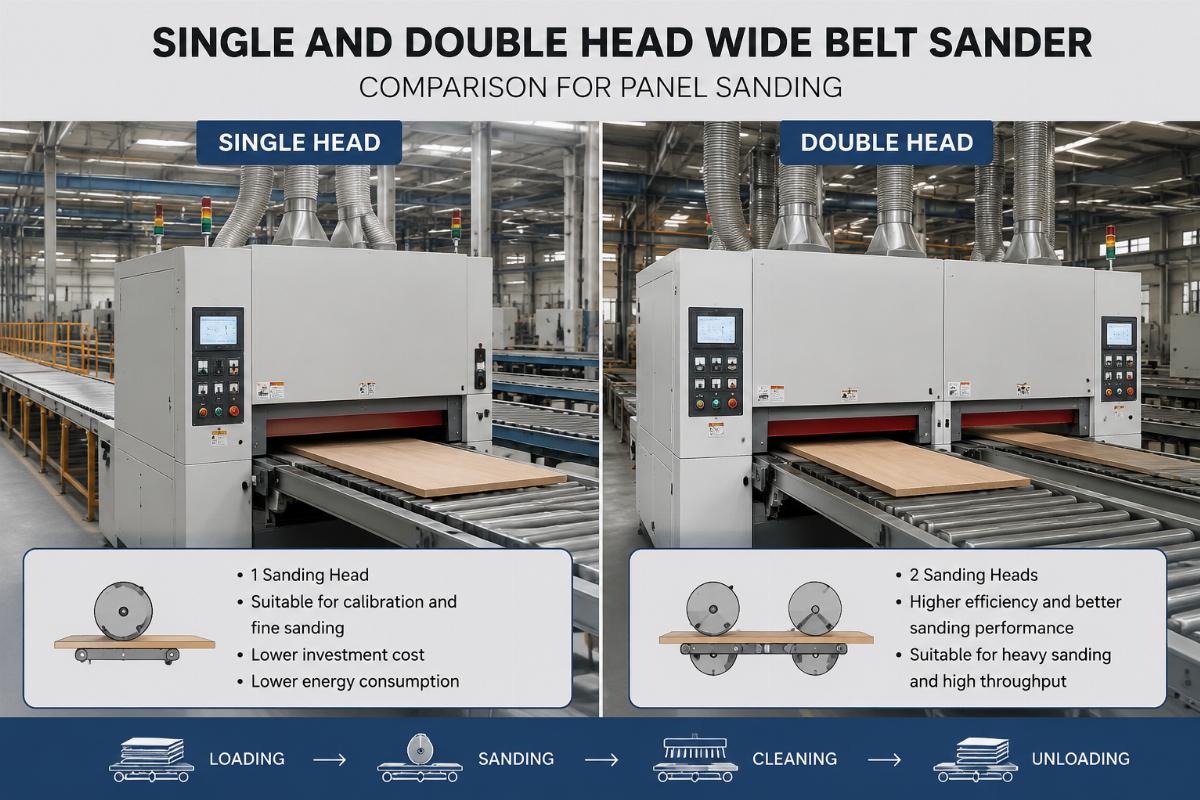
Let’s break down each selection step with actionable, data-backed guidance tailored to common needs from small workshops to mid-scale production facilities.
What head configuration fits your panel sanding demand?
Single head models cut initial investment by 30% for low-volume custom work, while double head configurations are designed for high-volume standardized panel processing. The biggest mistake buyers make here is prioritizing head count over actual output requirements, leading to either insufficient processing speed or wasted capital on features they will never use.
| Selection Factor | Common Misguided Practice | Recommended Matching Rule |
|---|---|---|
| Daily panel output | Default to double head for all output levels | 100-500 pieces: single head; 500-1500 pieces: mixed configuration; over 1500 pieces: double head |
| Production type | Choose double head for all custom work | Small batch custom: single head; continuous standardized production: double head |
| Initial budget | Overspend on premium configurations to "future proof" | Match to 12-month projected output, add modular upgrades as capacity scales |
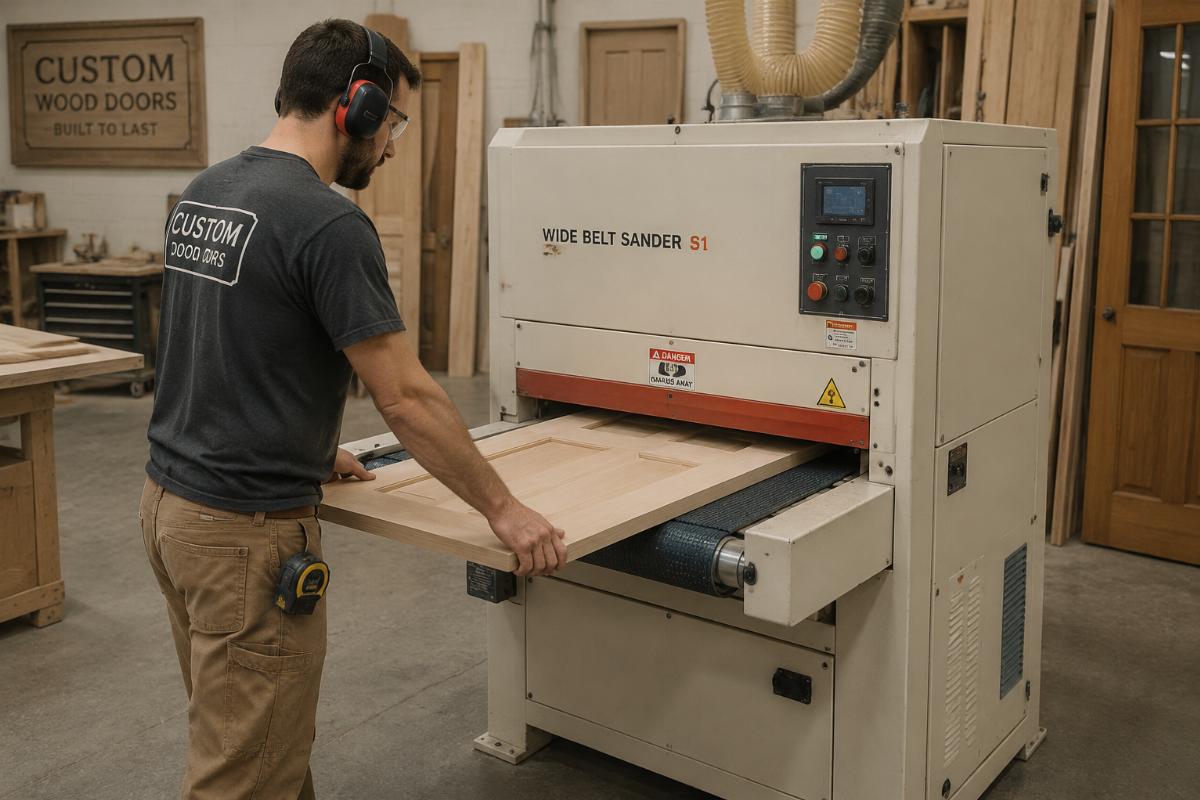
A mid-scale panel furniture factory in Southeast Asia recently upgraded 3 of their production lines with 1300mm double head wide belt sanders, and recorded a 35% increase in per-hour panel sanding output within the first month of operation, with no rise in surface defect rates. [NEED_CITE: Double head wide belt sanders deliver 30-40% higher per-hour processing capacity for standardized MDF and particleboard panels compared to single head models] A custom wood door workshop based in the Middle East, by contrast, opted for a 1000mm single head unit and reduced their sanding rework rate to below 2%, with only 60% of the upfront cost they would have paid for a double head system.
- Output calculation – Tally your average daily sanding volume over the past 3 months, exclude one-off large orders to get a baseline number.
- Production type check – Confirm if 80% of your orders are standardized panel sizes or custom one-off pieces.
- Modularity confirmation – Verify if your supplier allows adding a second head unit as an upgrade later to avoid overbuying upfront.
How to choose the right working width for your production line?
Working width only needs to match the largest regular panel size you process, wider units do not deliver better sanding quality for smaller panels. A common myth is that wider is always better, but over-specifying working width increases energy consumption and takes up unnecessary floor space in your facility.
| Working Width | Common Misguided Practice | Recommended Application Scenario |
|---|---|---|
| 1000mm | Buy only for large cabinet production lines | Small woodworking workshops processing panels under 1220mm |
| 1300mm | Skip for mid-scale facilities | Mid-scale panel furniture factories processing standard 1220mm x 2440mm panels |
| 1600mm | Buy for all production types | Large cabinet production lines processing panels over 1500mm in width |
We worked with a Latin American wood machinery distributor who ordered 12 units across all three width options in a single container, to cover the full range of needs for their regional client base, and they reported zero returns or misalignment complaints after 18 months of sales. [NEED_CITE: 1300mm working width is the most versatile option, covering 70% of common panel processing requirements for global woodworking facilities]

- Max panel measurement – Record the width of the panel you process most often, pick a working width 50-100mm larger than that size.
- Floor space check – Measure the available space in your production line to confirm the unit can fit without disrupting existing workflow.
- Energy cost calculation – Calculate the monthly energy consumption difference between different width options to factor in long-term operational costs.
Why Chinese manufactured wide belt sanders are cost-effective choices for global buyers?
Certified Chinese wide belt sander models deliver the same sanding precision as European brands, with a 40-50% lower total cost of ownership over a 5-year operational cycle. The outdated assumption that European brands automatically offer better quality ignores independent testing data that shows properly certified Chinese equipment meets international standards for panel surface finish and dimensional accuracy.
Shandong Ruiqi Machinery Co., Ltd, a 20+ year experienced woodworking machinery manufacturer based in China, offers a full range of 1000mm, 1300mm and 1600mm wide belt sanders with ISO, CE and TüV certifications, factory direct pricing, 2-year warranty and lifetime technical support for all global buyers. All units are tested for zero edge damage on MDF, particleboard and plywood before delivery, to ensure compatibility with panel furniture production requirements.
| Supplier Origin | Common Misguided Practice | Verified Performance Metric |
|---|---|---|
| European Brands | Assume universal quality superiority | 40-50% higher upfront cost, comparable sanding precision to certified Chinese models |
| Uncertified Chinese Suppliers | Prioritize lowest possible price | No consistent quality control, limited after-sales support |
| Certified Chinese Manufacturers | Dismiss as lower quality | Matching performance to European brands, 2-year standard warranty, on-site installation support |
[NEED_CITE: Independent industry testing confirms that certified Chinese wide belt sanders deliver identical surface roughness results for common panel materials compared to leading European brands]

- Certification verification – Ask suppliers to provide valid copies of ISO, CE and TüV certificates before requesting quotes.
- Warranty confirmation – Require a minimum 2-year warranty on core components including motors and sanding belts.
- After-sales check – Confirm if the supplier can dispatch engineers for on-site installation and training in your region.
What to confirm before placing your order?
Verify minimum order quantity, customization flexibility and certification compliance before finalizing any purchase to avoid hidden delays or extra costs. Many first-time buyers skip these checks and end up with unexpected lead time extensions or equipment that cannot be modified to fit their existing production line.
- MOQ confirmation – Confirm the supplier’s minimum order quantity, even for standard off-the-shelf units.
- Customization options – Check if the supplier can modify control systems, power configurations or additional functions to match your regional requirements.
- Lead time agreement – Get a written confirmed lead time before making any advance payment.
Conclusion
The core of a good wide belt sander purchase is matching parameters to your actual production needs, not chasing premium features or brand reputation. By following the head configuration, working width and supplier vetting steps outlined here, you can get a panel sanding solution that delivers the required processing capacity, keeps rework rates low, and fits within your budget constraints. You do not need to overspend on unnecessary features to get reliable performance, and certified Chinese manufacturers offer a balanced combination

Written by
author
Editor covering global sourcing, supplier verification, and industrial product knowledge. Content is compiled from manufacturer specifications, industry standards, and hands-on experience with international B2B buyers. Every article is fact-checked before publishing to help procurement professionals make informed decisions.

Leave a Reply