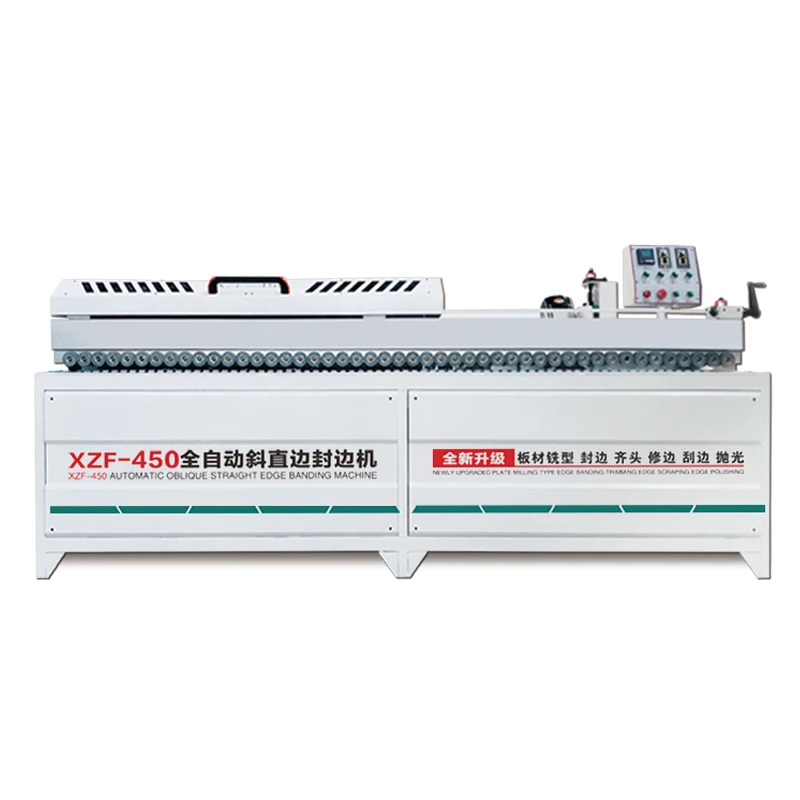
Edge banding machine
Click to enlarge
ISO 9001
CE Certified
OEM / ODM
12-Mo Warranty
Edge banding machine
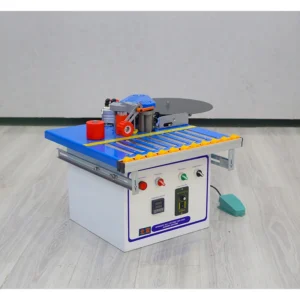
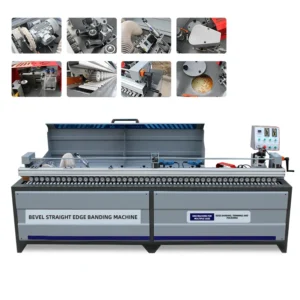
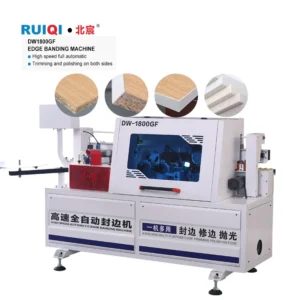
Automatic 45 Degree Bevel Edge Banding Machine XZF450 for MDF Plywood
<p><strong>XZF-450 Automatic Bevel Edge Banding Machine, 9.5KW Total Power, 30/45/60° Angle Range</strong> — handles MDF, plywood and solid wood substrates with a 4KW pre-milling station that removes surface irregularities before glue application. Dual 2.2KW trimming motors and scraping stations eliminate visible glue lines on porous materials, supporting 0.3–3MM PVC, veneer and melamine banding at 0–12M/min feed speed.</p> <ul> <li>Verified ±0.02mm tolerance on finished bevel edges through multi-stage inspection</li> <li>Four-stage QC with pre-shipment test records on buyer-supplied sample substrates</li> <li>Engineer-led configuration and formal quotation delivered within 24 hours</li> </ul>
100+
Countries
MOQ 1
Unit
15-25 Days
Lead Time
380V
CE Certified
Edge Banding Machine
MDF Panel
Plywood
Pre-milling
Process And Application
XZF450
- Full OEM/ODM support -- custom logo, voltage (110V-440V), multilingual panels
- ISO 9001 & CE certified, 5 national patents, 60 professional engineers
- 12-month warranty, remote technical support & spare parts service
- Professional export packaging, customs clearance support, on-time delivery
In-house manufacturing with verified tolerance — every XZF450 undergoes four-stage quality control including pre-shipment verification on buyer-supplied substrates before dispatch.
Technical Specifications
| Parameter | Value |
|---|---|
| Model | XZF450 |
| Product Type | Automatic Bevel Edge Banding Machine |
| Total Power | 9.5 kW |
| Voltage | 380V / 415V |
| Pre-milled Motor | 4 kW |
| Trimming Power | 2.2 kW × 2 |
| Polishing Power | 0.4 kW × 2 |
| Edge Power / Speed | 0.16 kW / 0–12 m/min |
| Transmission Power / Speed | 180 W / 0–12 m/min |
| Vacuum Power | 550 W |
| Edge Banding Height | 0–50 mm |
| Edge Banding Thickness | 0.3–3 mm |
| Minimum Sheet Length | 30 cm |
| Minimum Sheet Width | 15 cm |
| Glue Pot Capacity | 4000 ml |
| Air Source Pressure | 0.5–0.7 MPa |
| Bevel Angles | 30° / 45° / 60° |
| Product Size | 300 × 65 × 135 cm |
| Product Weight | 430 kg |
| Control System | Chinese / English panel, other languages configurable |
| Standards | CE |
Application Suitability
| Application | Material or Output |
|---|---|
| Bevel cabinet door edge finishing | MDF, melamine board |
| Plywood panel edge banding for furniture | Plywood, blockboard |
| Polymer door profile banding | Polymer composites |
| Particleboard carcass edge treatment | Particleboard |
| Solid wood furniture edge finishing | Solid wood board |
Why Substrate Preparation Decides Edge Quality on Bevel Profiles
Visible glue lines on bevel edges are rarely a glue problem — they are a milling problem.
When MDF or plywood goes straight to the glue station without pre-milling, surface irregularities from the panel saw carry through to the edge band. On a 45-degree bevel, this becomes obvious fast: the band follows every dip and ridge in the substrate, and the glue fills the gaps unevenly. Production managers in furniture factories see this as inconsistent edge quality across different board batches, when the root cause sits upstream [NEED_CITE: substrate surface roughness and adhesive bond strength correlation]. The XZF450 addresses this with a dedicated 4 kW pre-milling station that removes the sawn surface before any adhesive is applied, giving the Woodworking Process Edge Banding Machine a flat reference face to work against at any bevel angle.
Pre-milling and the Substrate Variable
MDF, plywood and solid wood behave differently under the pre-milling cutter. MDF presents a uniform density but tends to fuzz at the cut edge if the milling head is dull or the feed rate too aggressive. Plywood introduces cross-grain layers that can tear out if the cutter engagement is not matched to the veneer thickness. The 4 kW pre-milled motor on this Woodworking Process Edge Banding Machine provides sufficient torque to maintain cutter speed through density variations in both materials, while the variable feed speed from 0 to 12 m/min lets the operator dial in the rate that produces a clean milled surface rather than a torn one.
Glue Pot Management Across Banding Materials
Running PVC edge banding at 0.3 mm thickness demands a different glue pot temperature than 3 mm veneer. Too hot and the PVC distorts before the pressure roller makes contact; too cool and the adhesive does not wet the substrate properly on a 45-degree bevel where gravity pulls the band away from the panel edge. The 4000 ml glue pot capacity on this machine supports sustained production runs without frequent refills, and the operator must match temperature to both banding material and ambient workshop conditions — a variable that changes between a dry warehouse in Nairobi and a humid workshop in Lagos [NEED_CITE: hot melt adhesive temperature parameters for PVC and wood veneer edge banding].
Trimming, Scraping and the Finished Edge
The dual trimming motors at 2.2 kW each handle coarse and fine trimming in sequence. On a 30-degree bevel, the coarse trim removes the bulk overhang while the fine trim follows the bevel profile to leave a flush edge. Scraping then removes the trimming marks, and the two 0.4 kW polishing motors produce the final surface finish. This multi-stage sequence matters because skipping any station leaves visible witness lines that show up under furniture-grade lighting. The Woodworking Process Edge Banding Machine delivers all stations in a single pass, which means the operator sets the sequence once and the panel moves through without manual intervention between trimming and polishing.
Reading the Specification Sheet Against Your Production Reality
Feed speed, motor power and edge banding thickness range interact in ways that spec sheets do not always make obvious. A 0–12 m/min feed range gives flexibility, but running at maximum speed on 3 mm veneer at a 60-degree bevel may exceed what the glue can bond before the pressure roller passes. The 0.5–0.7 MPa air source pressure requirement drives the pneumatic pressure rollers that hold the band against the bevel face — if workshop air supply fluctuates below 0.5 MPa, the roller pressure drops and adhesion weakens. The 430 kg machine weight and 300 cm footprint also define installation requirements: this is not a benchtop unit, and the floor must be level to maintain the ±0.02 mm tolerance the cutting mechanism is designed to hold across the full 50 mm banding height.
The Cost of Ignoring Voltage and Air Supply
I spent time on assembly floors in West Africa where edge banders arrived, were wired up, and ran for a day before the main contactor failed. The workshop voltage sagged under load during peak hours, and the machine drew excess current to compensate. No one had confirmed the local supply characteristics against the 380V / 415V requirement before shipment [NEED_CITE: industrial voltage tolerance standards for woodworking machinery imports]. The same applies to air supply: if the workshop compressor cannot sustain 0.5 MPa at the required flow rate, the pneumatic stations on this Woodworking Process Edge Banding Machine will cycle inconsistently, producing intermittent adhesion failures that look like random defects but follow the compressor duty cycle.
Why Source This Configuration Here
In-house manufacturing means the pre-milling cutter mechanism and trimming stations are built and tested under one roof, not assembled from third-party sub-modules with unknown tolerances. The four-stage quality control process covers incoming material inspection, in-process verification, finished product testing and pre-shipment runs on actual panel stock. Voltage and control panel language are confirmed before production begins, not after the machine is crated. Engineers provide configuration recommendations matched to your substrate mix and bevel angle requirements, with formal quotations typically returned within 24 hours. Factory visits are welcomed so buyers can witness test runs on their own material before committing to shipment.
Documentation & Verification
- CE declaration of conformity covering the full machine assembly
- Factory test record on buyer-supplied MDF and plywood at specified bevel angles
- Electrical schematic confirming 380V/415V wiring and control circuit layout
- Machine specification sheet detailing all station motor ratings and feed parameters
- Operation manual in agreed language covering glue pot management and banding changeover
Installation, Commissioning & Support
- Floor must be level across the 300 cm footprint to maintain bevel trimming accuracy
- Dedicated 380V/415V circuit with overload protection rated for the 9.5 kW total draw
- Air line connection rated for sustained 0.5–0.7 MPa supply to all pneumatic stations
- First-run commissioning includes glue temperature calibration for your specific banding material
- Spare parts list covers pre-milling cutters, trimming blades and polishing wheels
- Operator training on bevel angle changeover between 30, 45 and 60 degree profiles
What to Include in Your Inquiry
Provide the substrate types you process most frequently and the bevel angles required for your current furniture designs. Confirm your workshop voltage and frequency so the electrical system is built to match before production starts. Specify the edge banding materials and thickness range you run so the glue pot and pressure roller setup is configured accordingly.
Frequently Asked Questions
Q: How does substrate type affect pre-milling depth and glue adhesion on bevel edges?
A: MDF mills cleanly at standard cutter engagement but requires sharp tooling to avoid fuzzing. Plywood cross-grain layers need lighter passes to prevent tear-out. Solid wood varies by species density. The 4 kW pre-milling station handles all three, but the operator must adjust feed speed to match the substrate for optimal adhesive contact on bevel profiles.
Q: What edge banding material thickness range is supported and how does behaviour differ at 45 degrees?
A: The machine handles 0.3 to 3 mm banding in PVC, veneer and melamine. Thinner PVC conforms easily to bevel angles but risks heat distortion. Thicker veneer holds the bevel profile well but demands higher glue pot temperature and longer pressure roller contact time to achieve full adhesive wetting on the angled surface.
Q: How does feed speed interact with glue pot temperature and pressure to maintain edge quality?
A: Higher feed speeds reduce the time the band spends under pressure roller contact, which means the glue must wet faster. At 12 m/min with 3 mm veneer on a 60-degree bevel, the operator may need to increase glue temperature or reduce speed to maintain adhesion. The 0–12 m/min variable feed lets you find the balance for each material combination.
Q: What trimming and scraping sequence eliminates visible glue lines on porous substrates like MDF?
A: Coarse trimming removes bulk overhang, fine trimming follows the bevel profile flush, and scraping removes cutter witness marks. On porous MDF, residual glue can seep into surface fibres during trimming. The scraping station must be sharp and correctly angled, followed by polishing to produce a uniform surface that hides any remaining adhesive traces.
Q: How to verify tolerance claims on finished bevel edges before accepting the machine?
A: Request a pre-shipment test record where your supplied panels are run at each required bevel angle. Measure the trimmed edge with a feeler gauge against the panel face. The machine is designed to hold tight tolerances through its precision-ground components and multi-stage inspection, but verification on your actual material is the only meaningful confirmation.
Technical Specifications
| Parameter | Value |
|---|---|
| Product Name | Automatic 45 Degree Bevel Edge Banding Machine XZF450 for MDF Plywood |
| Category | Edge banding machine |
| Voltage Options | 110V / 220V / 380V / 440V (customizable) |
| Frequency | 50Hz / 60Hz (customizable) |
| Certification | ISO 9001, CE |
| MOQ | 1 Unit |
| Lead Time | 15-25 Working Days |
| Warranty | 12 Months |
| OEM / ODM | Available -- logo, color, panel language |
* Detailed technical specifications vary by model. Please contact us with your specific requirements for a complete datasheet.
Shipping & Export
-
Export Packaging
Heavy-duty wooden crate with foam padding and moisture protection
-
Shipping Methods
Sea freight (FCL/LCL), air freight, express -- we support all methods
-
Customs Support
Full documentation: CO, commercial invoice, packing list, HS code assistance
-
Port of Loading
Tianjin / Qingdao port, China -- 20 years export experience
OEM / ODM Services
-
Logo & Branding
Custom logo printing, color scheme, and nameplate engraving
-
Voltage Configuration
110V / 220V / 380V / 440V, 50Hz / 60Hz -- any region supported
-
Multilingual Panels
Control panels in English, Spanish, French, Arabic and more
-
Custom Specifications
Modified dimensions, accessories, or feature sets on request
Get a Quote
Request Product Inquiry
Fill in your details and we'll respond within 24 hours with pricing and availability.
Direct Contact
How It Works
-
1
Confirm requirements & budget
Tell us your factory scale and processing needs
-
2
Receive recommendation & quote
We match the right machine with full specs
-
3
Negotiate & place order
OEM terms, voltage, payment and delivery
-
4
Production & QC inspection
Multi-stage quality control by 60 engineers
-
5
Export packaging & shipment
Professional packing, customs clearance
-
6
After-sales support
12-month warranty, remote tech support
You May Also Like