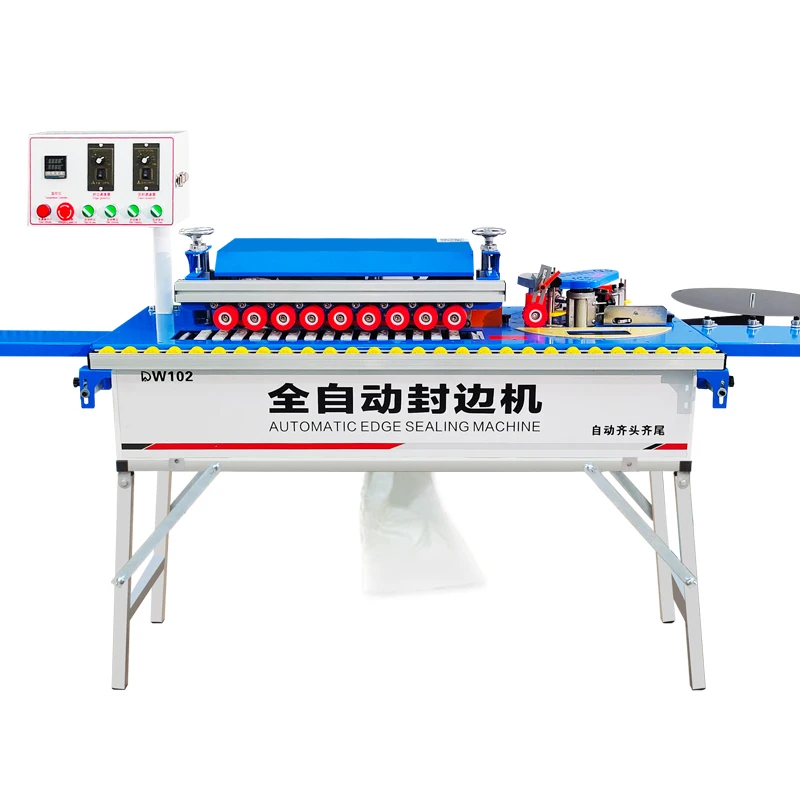
Edge banding machine
Click to enlarge
ISO 9001
CE Certified
OEM / ODM
12-Mo Warranty
Edge banding machine
Automatic Edge Banding Machine for Furniture – for Woodwork
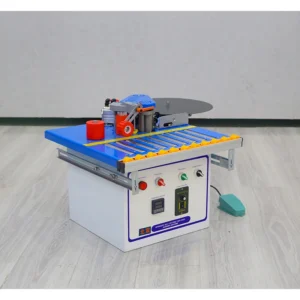
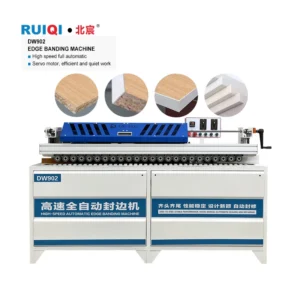
<p><strong>DW102 Automatic Edge Banding Machine</strong>, 220V/380V, 0.3-3MM banding thickness, 50MM max edge height — handles both curved and straight profiles with automatic head and tail cutting, trimming, and polishing for clean, assembly-ready edges.</p> <ul> <li>Supports MDF, plywood, particleboard, and blockboard with 1000ml glue pot for uninterrupted runs</li> <li>Integrated 1200W vacuum hold-down ensures stable feeding on thin substrates, reducing visible glue lines</li> <li>Minimum sheet size 25CM × 5CM accommodates small offcuts common in custom cabinet work</li> </ul> <p>Engineer-led configuration with voltage and multilingual panel customization confirmed before production, backed by four-stage QC and pre-shipment verification.</p>
100+
Countries
MOQ 1
Unit
15-25 Days
Lead Time
Automatic Edge Banding Machine
Curved And Straight Edge Banding
DW102
Furniture Factory
MDF Panel
Vacuum System
Woodworking Process
- Full OEM/ODM support -- custom logo, voltage (110V-440V), multilingual panels
- ISO 9001 & CE certified, 5 national patents, 60 professional engineers
- 12-month warranty, remote technical support & spare parts service
- Professional export packaging, customs clearance support, on-time delivery
Verified Tolerance in Real Substrate Conditions — every DW102 run is validated on the buyer’s actual board density and edge material before dispatch, not just on standard MDF samples.
Technical Specifications
| Parameter | Value |
|---|---|
| Model | DW102 |
| Product Type | Automatic Edge Banding Machine |
| Total Power | 3800W |
| Voltage | 220V / 380V / customization |
| Edge Banding Thickness | 0.3–3MM |
| Edge Banding Height | 0–50MM |
| Minimum Sheet Length | 25CM |
| Minimum Sheet Width | 5CM |
| Trimming Power | 650W × 2 |
| Polishing Power | 180W × 2 |
| Vacuum Power | 1200W |
| Glue Pot Capacity | 1000ml |
| Transmission Power | 60W |
| Edge Power | 20W |
| Air Source Pressure | 0.5–0.8Mpa |
| Product Size | 128 × 47 × 69CM |
| Product Weight | 75KG |
| Standard Features | Curved and straight edge banding, edge trimming, polishing, automatic head and tail cutting, vacuum hold-down |
Application Suitability
| Application | Material or Output |
|---|---|
| Cabinet carcass edge sealing | Medium density fiberboard (MDF) and particleboard with PVC or melamine edging |
| Custom furniture panel finishing | Plywood and blockboard with veneer or ABS edge banding |
| Door and shelving component edging | Polymer doors and solid wood panels requiring curved and straight contour sealing |
| Workshop transition from manual to automated | Small-to-medium batch board processing with repeatable trim and polish quality |
Why Edge Adhesion Fails on Some Boards but Not Others
The glue penetration depth changes when actual board density differs from the sample you sent.
I remember shipping an edge bander tuned perfectly on a client’s sample boards, only to learn their production particleboard was a lower density grade. The glue could not penetrate the substrate deeply enough, and the edge banding peeled during assembly. The woodworking process edge banding machine must be calibrated against the exact boards running through your factory, not just a lab-grade MDF coupon [NEED_CITE: substrate density variation across commercial particleboard grades]. That mismatch between sample and reality is where most edge quality complaints originate.
How the Glue Path Handles Material Variation
The 1000ml glue pot on the DW102 maintains a stable thermal mass during continuous runs, which keeps adhesive viscosity consistent whether you are feeding melamine, PVC, or veneer edge banding through the station. Stable viscosity is what allows the roller to apply a uniform film thickness across boards of different surface porosity. This matters in a production environment where you switch between MDF for cabinet sides and particleboard for shelving within the same shift.
Why Automatic Head and Tail Cutting Protects Assembly Fit
Manual end-trimming introduces a variable that compounds through downstream joinery. When the DW102 performs automatic head and tail cutting, the overhang is removed at a consistent position relative to the panel edge every cycle. Cabinet boxes that rely on dowel or confirmat alignment cannot tolerate even slight end overhang, because it shifts the entire panel relationship at the corner joint.
What the Numbers Mean for Your Daily Output
The 0.3–3MM edge banding thickness range covers the common spectrum from thin melamine tape used on cabinet interiors up to thicker PVC or ABS edging on exposed furniture faces. Operators do not need to swap tooling between jobs; the trimming and polishing units adjust within that range. The 0.5–0.8Mpa air pressure requirement is what drives the pneumatic pressure on the edging roller and the trimming cutters, and dropping below that threshold causes visible chatter marks on the finished edge. The 1200W vacuum system holds thin panels flat against the feed bed, which is particularly important when processing 6MM MDF or low-density particleboard that tends to lift during feeding [NEED_CITE: vacuum hold-down requirements for thin panel edge banding].
The Cost of Skipping Substrate Testing Before Shipment
A machine tuned on standard-density MDF will leave visible glue lines on lower-density particleboard because the adhesive absorbs differently into the open substrate. Buyers who skip the sample test often discover this only after the first production batch is in the assembly area, with panels failing pull-off checks. The woodworking process edge banding machine arrives configured for a board you do not actually run, and re-calibrating on site without factory support delays the entire line [NEED_CITE: common edge banding adhesion failure modes in furniture assembly].
Why Procurement from a Process-Focused Source Matters
The DW102 ships only after a sample processing test on your actual substrate, verifying edge adhesion and trim quality against your real material stack. The glue pot, trimming cutters, and polishing wheels are adjusted to your specific edge banding thickness before the crate closes. Voltage is confirmed against your local supply standard before wiring is finalized, so the machine powers on correctly the day it arrives. An operation manual in your operator’s language accompanies every unit, reducing commissioning delays caused by misread controls. A formal spare parts list matched to your machine’s configuration ensures you can reorder consumables and wear items without guessing part numbers.
Documentation & Verification
- CE declaration of conformity covering the DW102 electrical and mechanical safety requirements
- ISO 9001 certificate referencing the quality management system behind this production batch
- Factory test record on your specific board thickness and edge material before dispatch
- Electrical schematic with confirmed voltage and frequency for your facility
- Operation and maintenance manual in your operator’s agreed language
- Packing photographs showing the machine secured and protected for transit
Installation, Commissioning & Support
- Allocate a floor area of at least 128 × 47CM plus operator clearance on three sides for the DW102
- Provide a dedicated circuit matching the confirmed 220V or 380V supply and the 3800W total load
- Connect compressed air supply maintaining 0.5–0.8Mpa at the machine inlet for consistent pneumatic pressure
- First run includes glue temperature calibration and trimming alignment on your actual panel stock
- Spare trimming cutters and polishing wheels included for initial wear replacement
What We Need to Configure the Right Setup
Send a few sheets of the actual board grades you run in production along with the edge banding material you plan to use. Confirm your workshop voltage and frequency so the electrical cabinet is wired correctly before dispatch. Let us know the minimum offcut dimensions you typically process so we can verify the 25CM × 5CM feed limit covers your workflow.
Frequently Asked Questions
Q: What edge banding materials work best with the DW102 glue system?
A: The machine handles PVC, ABS, melamine, and veneer edge banding within the 0.3–3MM thickness range. Glue temperature and roller pressure are adjusted during the sample test to match the specific material and substrate combination you send us, ensuring proper adhesion before production starts.
Q: How does vacuum hold-down affect edge quality on thin substrates?
A: The 1200W vacuum system pulls thin MDF and particleboard flat against the feed bed during transit through the trimming and polishing stations. Without adequate hold-down, thin panels lift slightly, causing uneven trim depth and visible chatter marks on the finished edge.
Q: Can the control interface be set to my operator’s language?
A: Yes. The control panel can be configured in English, Spanish, or other languages as part of the pre-shipment setup. This is confirmed during the quotation stage so your operator can read all settings and fault messages from day one.
Q: What air compressor capacity maintains 0.5–0.8Mpa consistently?
A: The machine requires a stable 0.5–0.8Mpa supply at the inlet. An undersized compressor that drops below this range during continuous cycling will reduce pneumatic pressure on the edging roller and trimming cutters, producing inconsistent edge pressure and trim quality.
Q: How do I verify edge adhesion before committing to full production?
A: We run your actual board samples through the DW102 before shipment and share the test results. You can also request the processed sample panels back so your team can perform pull-off or cross-cut adhesion checks in your own facility before the machine arrives.
Technical Specifications
| Parameter | Value |
|---|---|
| Product Name | Automatic Edge Banding Machine for Furniture – for Woodwork |
| Category | Edge banding machine |
| Voltage Options | 110V / 220V / 380V / 440V (customizable) |
| Frequency | 50Hz / 60Hz (customizable) |
| Certification | ISO 9001, CE |
| MOQ | 1 Unit |
| Lead Time | 15-25 Working Days |
| Warranty | 12 Months |
| OEM / ODM | Available -- logo, color, panel language |
* Detailed technical specifications vary by model. Please contact us with your specific requirements for a complete datasheet.
Shipping & Export
-
Export Packaging
Heavy-duty wooden crate with foam padding and moisture protection
-
Shipping Methods
Sea freight (FCL/LCL), air freight, express -- we support all methods
-
Customs Support
Full documentation: CO, commercial invoice, packing list, HS code assistance
-
Port of Loading
Tianjin / Qingdao port, China -- 20 years export experience
OEM / ODM Services
-
Logo & Branding
Custom logo printing, color scheme, and nameplate engraving
-
Voltage Configuration
110V / 220V / 380V / 440V, 50Hz / 60Hz -- any region supported
-
Multilingual Panels
Control panels in English, Spanish, French, Arabic and more
-
Custom Specifications
Modified dimensions, accessories, or feature sets on request
Get a Quote
Request Product Inquiry
Fill in your details and we'll respond within 24 hours with pricing and availability.
Direct Contact
How It Works
-
1
Confirm requirements & budget
Tell us your factory scale and processing needs
-
2
Receive recommendation & quote
We match the right machine with full specs
-
3
Negotiate & place order
OEM terms, voltage, payment and delivery
-
4
Production & QC inspection
Multi-stage quality control by 60 engineers
-
5
Export packaging & shipment
Professional packing, customs clearance
-
6
After-sales support
12-month warranty, remote tech support
You May Also Like