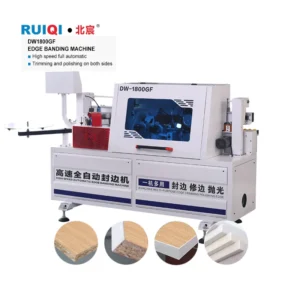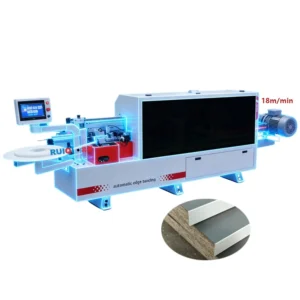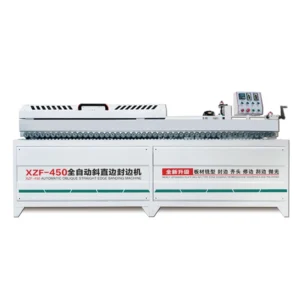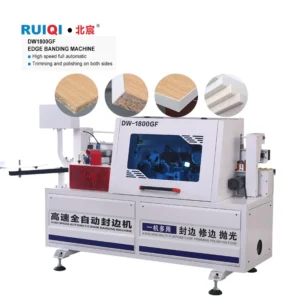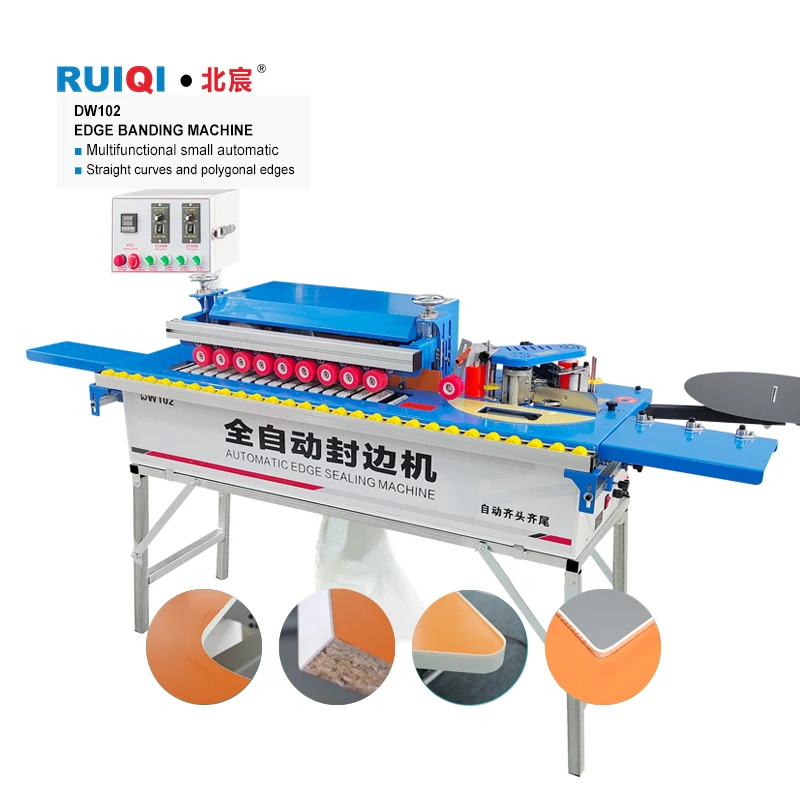
Edge banding machine
Click to enlarge
ISO 9001
CE Certified
OEM / ODM
12-Mo Warranty
Edge banding machine
DW102 Automatic Edge Banding Machine for Kitchen Cabinet – Process Application
<p><strong>DW102 Automatic Edge Banding Machine, 3800W, 0.3–3mm Edge Thickness, Dual Trimming & Polishing</strong> — engineered for consistent edge finishing across MDF, particleboard and plywood substrates in cabinet production.</p> <ul> <li>Handles straight and curved profiles with automatic head and tail cutting under vacuum hold</li> <li>Dual 650W trimming and dual 180W polishing stations deliver clean glue lines and smooth edge surfaces in one pass</li> <li>1000ml glue pot supports continuous runs with stable temperature for PVC, ABS and veneer banding</li> <li>0.5–0.8 MPa air supply and customizable 220V/380V configuration match your facility requirements</li> </ul>
100+
Countries
MOQ 1
Unit
15-25 Days
Lead Time
Automatic Head And Tail Cutting
DW102
Edge Banding Machine
MDF Panel
Plywood Edge Banding
Process Application
Vacuum Hold
- Full OEM/ODM support -- custom logo, voltage (110V-440V), multilingual panels
- ISO 9001 & CE certified, 5 national patents, 60 professional engineers
- 12-month warranty, remote technical support & spare parts service
- Professional export packaging, customs clearance support, on-time delivery
Precision-Verified Edge Quality — Every DW102 undergoes four-stage QC with pre-shipment verification to ensure consistent edge banding machine woodworking process performance across MDF, plywood and particleboard substrates.
Technical Specifications
| Parameter | Value |
|---|---|
| Model | DW102 |
| Product Type | Automatic Edge Banding Machine |
| Total Power | 3800W |
| Voltage & Frequency | 220V/380V/customization |
| Standard Features | Curved and straight edge banding, edge trimming, polishing, automatic head and tail cutting, with vacuum |
| Minimum Length of Sheet | 25 cm |
| Minimum Width of Sheet | 5 cm |
| Edge Banding Height | 0-50 mm |
| Edge Banding Thickness | 0.3-3 mm |
| Edge Power | 20W |
| Air Source Pressure | 0.5-0.8 MPa |
| Transmission Power | 60W |
| Glue Pot Capacity | 1000 ml |
| Trimming Power | 650W × 2 |
| Vacuum Power | 1200W |
| Polishing Power | 180W × 2 |
| Product Dimensions (L×W×H) | 128 × 47 × 69 cm |
| Product Weight | 75 kg |
Application Suitability
| Application | Material or Output |
|---|---|
| Kitchen cabinet and wardrobe production | Medium density fiberboard (MDF) and particleboard with PVC or ABS edge banding |
| Custom furniture manufacturing | Plywood and blockboard panels with veneer or polymer edge strips |
| Polymer door finishing | Straight and curved edge banding on engineered wood and polymer composites |
| Medium-volume panel processing | Panels ranging from 25 cm minimum length and 5 cm minimum width |
Why Glue Line Consistency Varies Across Panel Substrates
The edge banding machine woodworking process must be tuned to each substrate’s density and porosity, or visible glue lines will compromise cabinet assembly quality.
I have spent years on the shop floor watching operators struggle with the same machine producing clean edges on MDF one day and messy, uneven glue lines on particleboard the next. The issue rarely lies in the machine itself — it comes down to whether the operator understands how glue temperature, feed rate and pressure interact with the board material. Cabinet production managers who overlook this end up with downstream assembly rework that consumes more time than the edge banding process itself [NEED_CITE: woodworking substrate density and adhesive absorption behavior].
Substrate Density and Adhesive Behavior
MDF absorbs hot melt adhesive predictably due to its uniform fiber structure, which is why the DW102 typically produces clean edges on this material with minimal adjustment. Particleboard presents a different challenge: its coarser, less uniform surface means adhesive penetration varies across the panel face, requiring higher glue pot temperatures and slower feed rates to achieve consistent bonding. Plywood falls somewhere in between, though its cross-grain veneer layers can create micro-gaps that allow adhesive bleed-through if the edge banding machine woodworking process pressure settings are not properly calibrated. Understanding these differences before running production is the single most effective way to prevent edge quality failures.
Edge Trimming Sequence and Surface Finish
The DW102 runs dual trimming stations rated at 650W each, followed by dual polishing stations at 180W each, which allows the edge banding machine woodworking process to complete rough trim, fine trim and surface polish in a single pass. For curved edges on cabinet doors or shaped panels, the automatic head and tail cutting with vacuum hold reduces the manual intervention that often causes chipping at the panel ends. The vacuum system keeps the panel stable during trimming, which is especially important when working with thinner plywood or particleboard that tends to vibrate under cutting forces [NEED_CITE: edge trimming vibration effects on particleboard edge integrity]. This sequence directly affects whether the finished edge is ready for assembly or requires additional hand sanding.
Glue Pot Capacity and Thermal Stability
A 1000 ml glue pot capacity on the DW102 supports continuous production runs without frequent refilling, which matters more than it might appear at first glance. Every time the glue pot is opened and refilled, the thermal equilibrium of the adhesive is disrupted — the temperature drops, the viscosity changes, and the next several panels receive an inconsistent glue film. For custom furniture workshops running batches of cabinet sides and shelves, maintaining stable glue temperature throughout the run is what separates a clean, invisible glue line from one that shows under finish lighting. The DW102’s edge banding thickness range of 0.3–3 mm covers the PVC, ABS and veneer strips commonly specified in this type of production.
Specifying Air Supply and Electrical Requirements Correctly
The DW102 requires an air source pressure between 0.5 and 0.8 MPa, and voltage options include 220V, 380V or full customization to match local supply conditions. I have seen workshops install an edge bander only to discover their compressor cannot sustain the required air pressure under load, causing the pneumatic trimming and polishing heads to stutter mid-pass. The result is a partially trimmed edge that requires manual correction — exactly the kind of downstream rework this machine is designed to eliminate. Confirming electrical supply and compressor capacity before commissioning prevents these avoidable delays [NEED_CITE: industrial compressed air supply requirements for pneumatic woodworking equipment].
Why This Machine for Your Production Environment
The DW102 is designed for workshops and factories that need a single machine to handle both straight and curved edge banding across multiple panel materials, without requiring a dedicated operator for each function. Its 75 kg weight and compact 128 × 47 × 69 cm footprint make it practical for smaller production floors where space is constrained. The minimum sheet dimensions of 25 cm length and 5 cm width allow it to process narrow cabinet components and drawer sides that larger machines cannot feed reliably. Voltage customization as standard means the machine can be configured for your local grid before it ships, rather than requiring a transformer on site.
The Cost of Overlooking Substrate-Specific Setup
When a production manager treats all panel materials as interchangeable, the edge banding machine woodworking process produces results that look acceptable at the machine but fail under assembly scrutiny. Particleboard with visible glue lines gets rejected at the assembly station, requiring re-trimming or scrapping. Plywood edges that chip during trimming create gaps in cabinet joints that compromise structural integrity. These failures are not random — they follow predictable patterns tied to specific substrate and adhesive combinations. Identifying and correcting these patterns during sample testing, rather than on the production floor, is the difference between a stable operation and one constantly fighting edge quality fires [NEED_CITE: cabinet assembly rejection rates from edge banding defects].
What This Manufacturer Brings to the Process
In-house manufacturing with patented cutting mechanisms means the trimming stations on the DW102 are engineered and maintained under one roof, not assembled from third-party components with unknown tolerances. Four-stage quality control with pre-shipment verification ensures the machine you receive has been tested against the specifications stated at order. Voltage, language and specification customization is treated as standard practice, not a special request. Engineer-led configuration recommendation means the quotation you receive within 24 hours reflects an assessment of your actual production requirements, not a generic catalog price. Factory visits are welcomed for buyers who want to verify these capabilities directly.
Documentation & Verification
- CE declaration of conformity confirming machine safety compliance for your market
- Factory test record run on your specified panel thickness range and edge banding material
- Electrical schematic with voltage and frequency confirmation matching your facility supply
- Operation and maintenance manual in your operator’s required language
- Spare parts list with part numbers for trimming cutters, polishing pads and glue pot seals
- Pre-shipment test photographs documenting edge finish quality before dispatch
Installation, Commissioning & Support
- 128 × 47 × 69 cm footprint requires a level floor with clearance for panel infeed and outfeed
- 3800W total draw requires a dedicated electrical circuit matching your confirmed voltage specification
- Air supply compressor must sustain 0.5–0.8 MPa under continuous pneumatic demand
- Glue pot temperature calibration during first startup to match your edge banding adhesive type
- Operator training on substrate-specific adjustments for MDF, particleboard and plywood runs
- Spare trimming cutters and polishing pads included for initial production period
What to Include in Your Inquiry
Send details on the panel materials you run most frequently, the edge banding thickness range you specify, and your daily production volume so the configuration can be matched to your actual process requirements. Include your local voltage and frequency, the language your operators need for the control panel, and whether you want to submit sample panels for a processing test before confirming the order.
Frequently Asked Questions
Q: How does edge banding quality differ across MDF, particleboard and plywood on this machine?
A: MDF produces the most consistent results due to its uniform density. Particleboard requires higher glue temperature and slower feed speed to compensate for its porous surface, while plywood needs careful pressure adjustment to prevent adhesive bleed-through between veneer layers. The DW102 allows independent adjustment of each parameter to match substrate behavior.
Q: Which edge banding materials work within the 0.3–3 mm thickness range?
A: The range covers standard PVC and ABS strips used in cabinet production, as well as thinner veneer banding for furniture applications. Thicker ABS strips at the upper end of the range require adequate glue pot temperature and longer contact pressure time to achieve full adhesion on particleboard substrates.
Q: How does automatic head and tail cutting improve curved edge finishing?
A: The vacuum hold system stabilizes the panel during end cuts, reducing the vibration that causes chipping on curved plywood and particleboard edges. Manual trimming on curved profiles often produces uneven results because the operator cannot maintain consistent tool pressure around the radius.
Q: What electrical and air supply requirements must be in place before installation?
A: The DW102 draws 3800W total and requires a dedicated circuit at your confirmed voltage and frequency. Your compressor must sustain 0.5–0.8 MPa air pressure continuously — undersized compressors cause pneumatic trimming heads to lose pressure mid-pass, producing incomplete edge trims.
Q: Where should this machine sit in a production line layout?
A: Position the DW102 downstream of the panel sizing saw and upstream of boring or drilling stations. Its feed rate must be synchronized with the output of the cutting station to prevent panel queue buildup, and sufficient outfeed space must be available for trimmed panels to cool before handling.
Technical Specifications
| Parameter | Value |
|---|---|
| Product Name | DW102 Automatic Edge Banding Machine for Kitchen Cabinet – Process Application |
| Category | Edge banding machine |
| Voltage Options | 110V / 220V / 380V / 440V (customizable) |
| Frequency | 50Hz / 60Hz (customizable) |
| Certification | ISO 9001, CE |
| MOQ | 1 Unit |
| Lead Time | 15-25 Working Days |
| Warranty | 12 Months |
| OEM / ODM | Available -- logo, color, panel language |
* Detailed technical specifications vary by model. Please contact us with your specific requirements for a complete datasheet.
Shipping & Export
-
Export Packaging
Heavy-duty wooden crate with foam padding and moisture protection
-
Shipping Methods
Sea freight (FCL/LCL), air freight, express -- we support all methods
-
Customs Support
Full documentation: CO, commercial invoice, packing list, HS code assistance
-
Port of Loading
Tianjin / Qingdao port, China -- 20 years export experience
OEM / ODM Services
-
Logo & Branding
Custom logo printing, color scheme, and nameplate engraving
-
Voltage Configuration
110V / 220V / 380V / 440V, 50Hz / 60Hz -- any region supported
-
Multilingual Panels
Control panels in English, Spanish, French, Arabic and more
-
Custom Specifications
Modified dimensions, accessories, or feature sets on request
Get a Quote
Request Product Inquiry
Fill in your details and we'll respond within 24 hours with pricing and availability.
Direct Contact
How It Works
-
1
Confirm requirements & budget
Tell us your factory scale and processing needs
-
2
Receive recommendation & quote
We match the right machine with full specs
-
3
Negotiate & place order
OEM terms, voltage, payment and delivery
-
4
Production & QC inspection
Multi-stage quality control by 60 engineers
-
5
Export packaging & shipment
Professional packing, customs clearance
-
6
After-sales support
12-month warranty, remote tech support
You May Also Like