Edge banding machine
Click to enlarge
ISO 9001
CE Certified
OEM / ODM
12-Mo Warranty
Edge banding machine
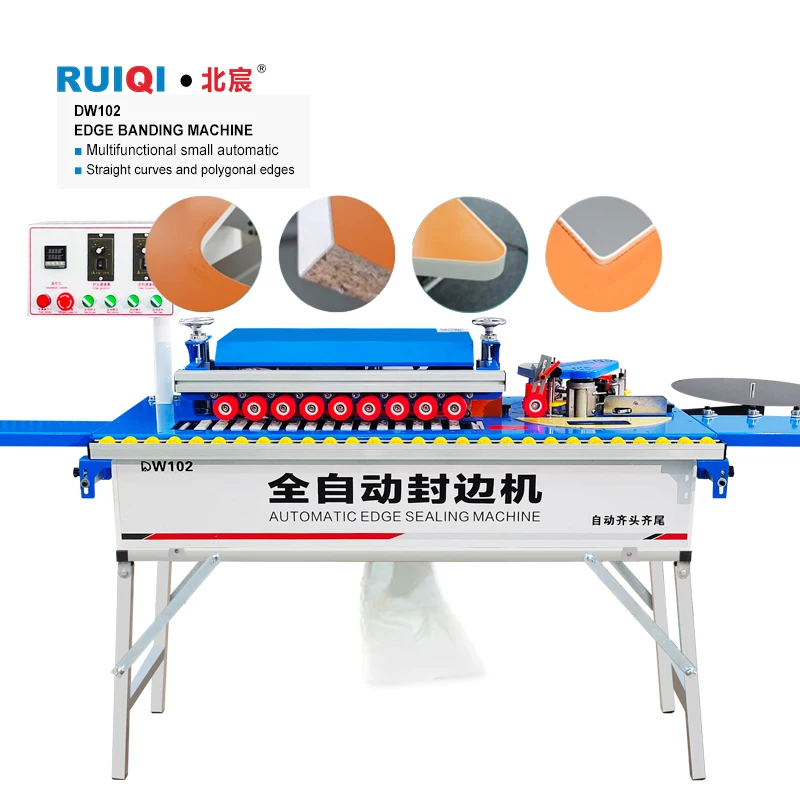
DW102 Curved and Straight Edge Banding Machine for MDF Plywood – Compact
<p><strong>DW102 Automatic Curved and Straight Edge Banding Machine, 3800W, 0.3–3mm Banding Thickness</strong> — handles MDF, plywood and particleboard with integrated auto gluing, trimming, polishing and end cutting in a single pass.</p> <ul> <li>Processes both <strong>curved and straight edges</strong> without machine changeover, maintaining consistent glue-line quality across substrates</li> <li>1000ml glue pot supports continuous batch runs; vacuum hold-down ensures stable panel feed for reliable edge adhesion</li> </ul> <p>Factory test records with your actual substrate available before shipment — engineer-led configuration confirmed within 24 hours.</p>
100+
Countries
MOQ 1
Unit
15-25 Days
Lead Time
Automatic Head And Tail Cutting
Curved And Straight Edge Banding
DW102
Edge Banding Machine
MDF Plywood
Process And Application
Vacuum Hold Down
- Full OEM/ODM support -- custom logo, voltage (110V-440V), multilingual panels
- ISO 9001 & CE certified, 5 national patents, 60 professional engineers
- 12-month warranty, remote technical support & spare parts service
- Professional export packaging, customs clearance support, on-time delivery
Precision-verified edge finishing — DW102 curved and straight edge banding confirmed on your MDF, plywood or particleboard samples with pre-shipment factory test records.
Technical Specifications
| Parameter | Value |
|---|---|
| Model | DW102 |
| Product Type | Automatic Curved and Straight Edge Banding Machine |
| Total Power | 3800W |
| Voltage | 220V/380V/customization |
| Trimming Power | 650W×2 |
| Polishing Power | 180W×2 |
| Vacuum Power | 1200W |
| Edge Banding Thickness | 0.3–3 mm |
| Edge Banding Height | 0–50 mm |
| Minimum Sheet Length | 25 cm |
| Minimum Sheet Width | 5 cm |
| Glue Pot Capacity | 1000 ml |
| Air Source Pressure | 0.5–0.8 MPa |
| Product Size | 128×47×69 cm |
| Product Weight | 75 kg |
| Language Options | Chinese, English standard; Spanish and others customizable |
| Plug Options | EU, USA, AU, UK |
Application Suitability
| Application | Material or Output |
|---|---|
| Cabinet door and drawer front production | MDF and particleboard with straight and shaped edge profiles |
| Custom furniture mixed-substrate processing | Plywood, MDF, blockboard requiring consistent edge sealing across materials |
| Small-batch polymer door manufacturing | Shaped panels requiring curved edge banding alongside straight runs |
| Edge trimming and chamfering operations | PVC, melamine and veneer strips 0.3–3 mm thick |
Why Edge Banding Consistency Matters More Than Feed Speed
Visible glue lines on finished panels almost always trace back to substrate-specific setup rather than machine capability.
Production managers who process MDF, plywood and particleboard on the same line frequently encounter inconsistent edge adhesion. The substrate porosity differs, the glue absorption rate shifts, and the trimming response changes from material to material. When a single edge banding machine woodworking process must handle all three, the operator needs a workstation that allows quick parameter adjustment without full reconfiguration between batches [NEED_CITE: substrate porosity and hot-melt glue adhesion variables].
How Substrate Choice Dictates Glue Temperature and Banding Pressure
The DW102 handles MDF, particleboard, plywood and blockboard, but each material demands different thermal and mechanical treatment. MDF absorbs hot-melt adhesive readily due to its porous fiber structure, often requiring a lower glue temperature to prevent over-penetration and starved joints. Plywood, with its denser laminated veneers, typically needs higher pot temperature and firmer roller pressure to achieve adequate bond strength across the edge banding machine woodworking process.
Curved and Straight Profiles Without Machine Changeover
Cabinet components rarely consist of straight edges only. Routed profiles, radius corners and shaped drawer fronts require curved edge banding that a straight-only machine cannot address. The DW102 processes both geometries in a single workstation, eliminating the downtime of moving panels between two machines. The 0.3–3 mm thickness range covers PVC, melamine and veneer strips, giving production managers material flexibility without changing tooling between jobs [NEED_CITE: curved edge banding mechanics on shaped panel components].
Reading the Spec Sheet Against Your Actual Production Requirement
The 1000 ml glue pot capacity determines how long continuous batch runs proceed before refill interruption. For a workshop running full cabinet door sets, this volume supports sustained operation through multiple panels. The 0.5–0.8 MPa air source pressure requirement is non-negotiable — insufficient pneumatic supply degrades vacuum hold-down performance and produces inconsistent edge pressing on thinner panels. The 25 cm minimum sheet length and 5 cm minimum width define the smallest workpiece the machine processes, which matters for drawer component and small shelf production. Trimming power at 650W per station provides adequate torque for clean PVC and veneer cuts without tear-out at the trim point.
The Cost of Skipping Voltage Verification Before Shipment
Specifying an edge banding machine without confirming workshop voltage and phase configuration leads to machines sitting idle on the dock. A 220V single-phase unit shipped into a facility wired only for three-phase 380V cannot run without transformer retrofit, and that delay extends into weeks rather than hours. The DW102 supports voltage customization, but the confirmation must happen during the quotation stage, not at the time of packing [NEED_CITE: industrial voltage and frequency mismatch consequences].
Why This Configuration Fits Mixed-Substrate Workshops
The machine addresses a specific production environment: small to medium furniture workshops processing multiple panel types where edge consistency across substrates directly affects downstream assembly tolerance. In-house manufacturing with verified edge trimming precision ensures panels leave the banding station within assembly-ready tolerance. Voltage, plug type and control panel language are configured before build rather than adapted after arrival. The four-stage quality verification covers incoming material inspection through pre-shipment factory testing on the buyer’s specified substrate. Engineer-led configuration recommendation ensures the DW102 matches the actual production mix rather than being selected on catalogue specification alone [NEED_CITE: pre-shipment factory test protocol on buyer-supplied samples].
Documentation & Verification
- CE declaration of conformity covering the DW102 electrical and mechanical safety requirements
- Factory test record on your specific MDF, plywood or particleboard samples before dispatch
- Machine specification sheet confirming voltage, plug type and control language as ordered
- Electrical schematic matching the customized 220V/380V configuration for your workshop electrician
- Operation manual in your operator’s language covering glue temperature and feed parameter settings
- Spare parts list identifying trimming blades and polishing wheels for ongoing edge quality maintenance
Installation, Commissioning & Support
- Benchtop format at 128×47×69 cm requires a stable workbench with adequate load rating for the 75 kg unit
- Dedicated electrical circuit matching confirmed 220V or 380V supply with correct plug type pre-installed
- Fully assembled arrival eliminates on-site mechanical build; operator connects air supply and power only
- Pneumatic line must deliver 0.5–0.8 MPa consistently to maintain vacuum hold-down during curved edge processing
- Initial commissioning verifies glue pot temperature calibration against your PVC, melamine or veneer banding material
- Trimming blade and polishing wheel replacement schedule provided based on your daily panel volume
Before You Request a Quotation
Provide the substrate types you process most frequently — MDF, plywood, particleboard or a mix — along with your typical panel thickness range and the edge banding material you use. Confirm your workshop voltage and phase supply so the electrical configuration is correct from the start. Specify the control panel language your operators read and the plug standard your facility uses.
Frequently Asked Questions
Q: How does substrate type affect glue temperature settings on the DW102?
A: MDF absorbs hot-melt adhesive faster due to its fiber porosity, so lower glue temperature prevents over-penetration and starved glue joints. Plywood requires higher temperature and firmer pressing pressure because its laminated veneer surface is denser. Particleboard falls between the two. The operator adjusts the glue pot temperature based on substrate and banding material combination before each production run.
Q: What banding materials work within the 0.3–3 mm thickness range?
A: PVC, melamine and wood veneer strips all fall within this range. Thinner PVC at 0.3 mm requires lighter trim station pressure to avoid cutting through the material, while 3 mm veneer needs sharper trimming blades and slower feed for clean edge removal. The operator adjusts trim station depth and polishing wheel pressure according to banding material type and thickness.
Q: How do you verify curved edge banding quality before full production?
A: Request a pre-shipment factory test using your actual substrate and banding material, cut to the curved profile you produce. Inspect the sample for glue line visibility, edge trim cleanliness and polishing finish at the radius points. This confirms the machine handles your specific geometry before committing to a production run.
Q: What is the relationship between vacuum hold-down and edge sealing on thin panels?
A: Panels under 10 mm thickness tend to flex under roller pressure if not adequately secured. The 1200W vacuum system holds the workpiece flat against the feed bed, ensuring consistent roller contact along the entire edge. Insufficient pneumatic supply below 0.5 MPa reduces vacuum effectiveness and produces uneven edge adhesion, particularly on curved sections.
Technical Specifications
| Parameter | Value |
|---|---|
| Product Name | DW102 Curved and Straight Edge Banding Machine for MDF Plywood – Compact |
| Category | Edge banding machine |
| Voltage Options | 110V / 220V / 380V / 440V (customizable) |
| Frequency | 50Hz / 60Hz (customizable) |
| Certification | ISO 9001, CE |
| MOQ | 1 Unit |
| Lead Time | 15-25 Working Days |
| Warranty | 12 Months |
| OEM / ODM | Available -- logo, color, panel language |
* Detailed technical specifications vary by model. Please contact us with your specific requirements for a complete datasheet.
Shipping & Export
-
Export Packaging
Heavy-duty wooden crate with foam padding and moisture protection
-
Shipping Methods
Sea freight (FCL/LCL), air freight, express -- we support all methods
-
Customs Support
Full documentation: CO, commercial invoice, packing list, HS code assistance
-
Port of Loading
Tianjin / Qingdao port, China -- 20 years export experience
OEM / ODM Services
-
Logo & Branding
Custom logo printing, color scheme, and nameplate engraving
-
Voltage Configuration
110V / 220V / 380V / 440V, 50Hz / 60Hz -- any region supported
-
Multilingual Panels
Control panels in English, Spanish, French, Arabic and more
-
Custom Specifications
Modified dimensions, accessories, or feature sets on request
Get a Quote
Request Product Inquiry
Fill in your details and we'll respond within 24 hours with pricing and availability.
Direct Contact
How It Works
-
1
Confirm requirements & budget
Tell us your factory scale and processing needs
-
2
Receive recommendation & quote
We match the right machine with full specs
-
3
Negotiate & place order
OEM terms, voltage, payment and delivery
-
4
Production & QC inspection
Multi-stage quality control by 60 engineers
-
5
Export packaging & shipment
Professional packing, customs clearance
-
6
After-sales support
12-month warranty, remote tech support
You May Also Like