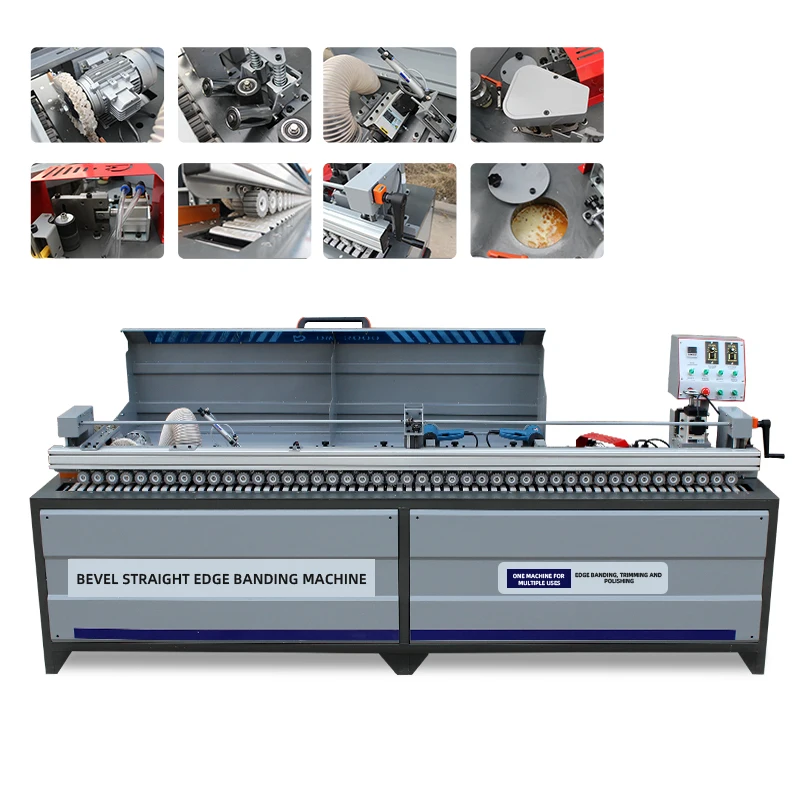
Edge banding machine
Click to enlarge
ISO 9001
CE Certified
OEM / ODM
12-Mo Warranty
Edge banding machine
DW3000 Automatic Edge Banding Machine for Wood Panel PVC ABS – Process Application
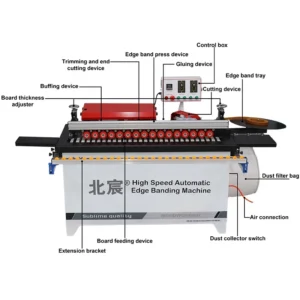
<p><strong>DW3000 Automatic Straight and Bevel Edge Banding Machine</strong>, 11 kW total power, 0–12 m/min feed speed, 380V/415V — handles both straight and 30°–90° bevel edge banding on MDF, particleboard and plywood with 0.3–3 mm PVC or ABS banding. Double hot air pre-heating (2.2 kW × 2) improves adhesion on low-density substrates, while spindle trimming and flexible scraping deliver clean glue lines for downstream assembly. Supported by four-stage QC with pre-shipment verification, engineer-led configuration within 24 hours, and voltage/language customization as standard.</p>
100+
Countries
MOQ 1
Unit
15-25 Days
Lead Time
11KW Motor
380V
Bevel Edge Banding
DW3000
Edge Banding Machine
MDF Panel
Process Application
PVC Edge Banding
- Full OEM/ODM support -- custom logo, voltage (110V-440V), multilingual panels
- ISO 9001 & CE certified, 5 national patents, 60 professional engineers
- 12-month warranty, remote technical support & spare parts service
- Professional export packaging, customs clearance support, on-time delivery
Voltage and Specification Customization as Standard — the DW3000 is configured to your facility’s exact electrical supply and operator language before it leaves the factory floor, eliminating the costly stall that happens when a machine arrives and cannot be powered on or read.
Technical Specifications
| Parameter | Value |
|---|---|
| Model | DW3000 |
| Product Type | Automatic Straight and Bevel Edge Banding Machine |
| Total Installed Power | 11 kW |
| Feed Speed | 0–12 m/min |
| Bevel Angle Range | 30°–90° (8 adjustable pressure wheel groups) |
| Edge Banding Thickness Capacity | 0.3–3 mm |
| Edge Banding Height Capacity | 0–50 mm |
| Minimum Sheet Dimensions | 30 cm (L) × 15 cm (W) |
| Glue Pot Capacity | 4000 ml |
| Pre-milling Motor | 2.2 kW |
| Trimming Configuration | 2.2 kW × 2 spindle motors |
| Heating System | 2.2 kW × 2 double hot air guns |
| Polishing Motors | 0.4 kW × 2 |
| Voltage Options | 380V / 415V (customizable 110V–440V) |
| Air Source Requirement | 0.5–0.7 MPa |
| Net Weight | 430 kg |
| Machine Dimensions (L×W×H) | 299 × 65 × 130 cm |
Application Suitability
| Application Scenario | Material or Output Focus |
|---|---|
| Custom cabinet carcass production | Particleboard and MDF with PVC straight-edge banding |
| Angled cabinet door and drawer fronts | MDF and plywood with 30°–90° bevel edge profiles |
| Mixed-substrate workshop runs | Switching between MDF, particleboard, and plywood in a single shift |
| PVC and ABS edge finishing | 0.3–3 mm thickness banding materials on panel furniture |
| Concealed joinery preparation | Edge band slotting for specialty hardware integration |
Why Glue Lines Show on Some Boards and Not Others
Visible glue seams on edge banded panels usually trace back to a mismatch between substrate density, glue temperature at the point of contact, and pressure wheel alignment — not the adhesive itself.
Production managers running particleboard alongside MDF often see clean edges on the MDF panels and thick, visible glue lines on the particleboard ones, even though both ran through the same machine on the same day. The particleboard surface is more porous and absorbs heat faster from the glue bead, dropping the adhesive temperature below its effective bonding window before the pressure wheels make full contact. When that happens, the banding material does not seat uniformly, and the excess adhesive gets squeezed out as a visible ridge rather than forming a thin, hidden bond line [NEED_CITE: thermal conductivity differences between MDF and particleboard substrates]. The DW3000 addresses this through double hot air pre-heating and adjustable pressure wheel groups that compensate for these substrate differences. Understanding this interaction is central to the edge banding machine process and application on mixed-material production floors.
How Pre-Heating Changes the Bonding Window on Low-Density Substrates
The double hot air system on this unit directs heated air onto both the panel edge and the banding material immediately before the glue application point. On particleboard, which draws heat away from the adhesive rapidly due to its open cell structure, this pre-heating step raises the substrate surface temperature so the glue maintains its flow characteristics long enough for the pressure wheels to achieve full contact. Without this step, the edge banding machine process and application on porous boards tends to produce inconsistent adhesion, particularly at higher feed speeds where contact time is already reduced.
Matching Pressure Wheel Configuration to Bevel Geometry
The eight groups of oblique pressure wheels adjust independently across the 30° to 90° range, allowing each wheel group to match the specific angle of the panel edge being processed. On a 45° bevel cut for a cabinet door profile, the wheels must apply force perpendicular to the angled surface rather than the standard vertical axis used for straight edges. If the wheels are set for a straight 90° run and a bevel panel is fed through, the banding material gets pushed down rather than into the angled surface, creating a gap along the upper edge that becomes visible after trimming [NEED_CITE: pressure wheel alignment tolerances for bevel edge banding operations]. This adjustability is what makes the machine viable for workshops running both carcass panels and angled door fronts on the same production day.
Reading the Specification Sheet Against Your Actual Production Requirements
The 0–12 m/min feed speed range and 11 kW total power rating define the throughput envelope of this machine, but the practical output depends on the substrate and edge profile being run. Pre-milling at 2.2 kW handles the initial edge truing on boards that arrive from the panel saw with minor edge chipping, which directly affects the final glue line quality. The 4000 ml glue pot capacity supports continuous runs without thermal interruption on standard PVC and ABS materials in the 0.3–3 mm thickness range. The double cylinder feeding belt system maintains panel registration through the entire workstation sequence, which matters most on the minimum 15 cm wide panels where a single belt system can allow lateral drift. Each of these parameters connects directly to the edge quality your downstream assembly will receive.
The Cost of Buying a Machine That Does Not Match Your Material Flow
Workshops that purchase edge banders based solely on maximum feed speed without accounting for their actual substrate mix frequently encounter adhesion failures that only appear after the panels reach the assembly bench. The visible glue lines or lifting banding on particleboard panels force rework that consumes more labor than running the machine at a slower, thermally matched speed would have cost in the first place. When machines arrive without voltage confirmation matching the facility supply, the unit sits idle while transformers or electrical upgrades are sourced, delaying the entire commissioning timeline [NEED_CITE: common causes of commissioning delays in imported woodworking machinery]. Panels that fail assembly because edge tolerance was never verified against the actual material in use represent wasted board stock, wasted banding material, and wasted machine hours.
Why Procurement Verification Matters at This Level
Each machine ships with a factory test record produced using the specific substrate and banding material you will run, so edge quality is verified against your actual assembly tolerance before the unit leaves the facility. Voltage and frequency are confirmed against your local supply standards during the specification stage, not assumed from a default configuration. The four-stage quality control process covers incoming component inspection through pre-shipment verification, with the test record documenting the results. An engineer reviews your factory layout and production requirements to recommend the pressure wheel and workstation configuration rather than shipping a standard setup. The operation and maintenance manual is produced in the language your operators will read at commissioning.
Documentation & Verification
- CE declaration of conformity matching the machine’s electrical and mechanical safety configuration
- Factory test record on your specified panel substrate and edge banding material before dispatch
- Electrical schematic confirming voltage, frequency, and circuit protection values for your facility
- Machine specification sheet with tolerance values verified against your assembly requirements
- Operation and maintenance manual in the operator language agreed at order confirmation
- Spare parts list with part numbers matching the components installed on your specific machine
Installation, Commissioning & Support
- Dedicated 380V/415V circuit with appropriate breaker sizing for the 11 kW total power draw
- Compressed air supply at 0.5–0.7 MPa plumbed to the machine inlet before first power-on
- Machine arrives fully assembled; leveling and alignment verification required at placement
- First-run parameter setting for glue temperature, feed speed, and pressure wheel angle matched to your material
- Spindle trimming motor and scraper adjustment calibrated to your specific edge banding thickness range
- Routine cleaning of glue pot and feed belt system per maintenance schedule in your operator manual
What to Include With Your Inquiry
Provide the substrate types and thicknesses you run most frequently, along with the edge banding materials and thickness range your production requires. Share your local voltage and frequency specifications so the electrical configuration is confirmed before production begins. Indicate whether you need straight edge only or a combination of straight and bevel profiles, and note the angle range your product designs call for. If you have specific edge profiles or slotting requirements for concealed hardware, include those drawings with your inquiry.
Frequently Asked Questions
Q: How does substrate density affect glue adhesion and what settings compensate?
A: Lower-density substrates like particleboard absorb heat from the glue bead faster than MDF, reducing the adhesive’s effective bonding window before pressure wheels make contact. Compensating requires pre-heating the panel edge to raise surface temperature and adjusting feed speed to allow adequate contact time. The double hot air system on this machine addresses this thermal difference directly at the application point.
Q: What edge banding materials produce the cleanest trim finish on bevel cuts?
A: PVC and ABS materials in the 0.3–2 mm thickness range generally produce the cleanest trim results on bevel cuts because they flex into the angled pressure wheel configuration without resisting the spindle trimming motors. Thicker banding materials above 2 mm require reduced feed speeds on bevel profiles to allow the trimming cutters to engage fully without leaving witness marks on the angled surface.
Q: How does double hot air pre-heating change bonding behaviour on cold panels?
A: Panels stored in unheated warehouse areas can drop well below the glue’s optimal application temperature, causing the adhesive to cool and thicken before pressure is applied. The double hot air guns raise both the panel edge and the banding material surface temperature immediately before the glue pot application point, maintaining consistent adhesive viscosity regardless of the substrate’s starting temperature.
Q: What is the relationship between feed speed and edge quality when switching between straight and bevel?
A: Bevel edge banding requires slower feed speeds than straight edge because the angled pressure wheels have a smaller effective contact area against the banding material. Running bevel profiles at straight-edge feed speeds reduces pressure wheel contact time, leading to incomplete adhesion along the upper edge of the angle. Operators should reduce feed speed when transitioning from straight to bevel production runs.
Q: How does edge band slotting interact with downstream assembly?
A: The adjustable slotting device cuts a groove into the edge banded panel, enabling concealed joinery hardware such as spline joints, connector fittings, or specialty hinge mounting plates. The slot height adjustment allows the groove position to match the specific hardware profile your assembly process requires, eliminating a secondary machining operation after edge banding is complete.
Technical Specifications
| Parameter | Value |
|---|---|
| Product Name | DW3000 Automatic Edge Banding Machine for Wood Panel PVC ABS – Process Application |
| Category | Edge banding machine |
| Voltage Options | 110V / 220V / 380V / 440V (customizable) |
| Frequency | 50Hz / 60Hz (customizable) |
| Certification | ISO 9001, CE |
| MOQ | 1 Unit |
| Lead Time | 15-25 Working Days |
| Warranty | 12 Months |
| OEM / ODM | Available -- logo, color, panel language |
* Detailed technical specifications vary by model. Please contact us with your specific requirements for a complete datasheet.
Shipping & Export
-
Export Packaging
Heavy-duty wooden crate with foam padding and moisture protection
-
Shipping Methods
Sea freight (FCL/LCL), air freight, express -- we support all methods
-
Customs Support
Full documentation: CO, commercial invoice, packing list, HS code assistance
-
Port of Loading
Tianjin / Qingdao port, China -- 20 years export experience
OEM / ODM Services
-
Logo & Branding
Custom logo printing, color scheme, and nameplate engraving
-
Voltage Configuration
110V / 220V / 380V / 440V, 50Hz / 60Hz -- any region supported
-
Multilingual Panels
Control panels in English, Spanish, French, Arabic and more
-
Custom Specifications
Modified dimensions, accessories, or feature sets on request
Get a Quote
Request Product Inquiry
Fill in your details and we'll respond within 24 hours with pricing and availability.
Direct Contact
How It Works
-
1
Confirm requirements & budget
Tell us your factory scale and processing needs
-
2
Receive recommendation & quote
We match the right machine with full specs
-
3
Negotiate & place order
OEM terms, voltage, payment and delivery
-
4
Production & QC inspection
Multi-stage quality control by 60 engineers
-
5
Export packaging & shipment
Professional packing, customs clearance
-
6
After-sales support
12-month warranty, remote tech support
You May Also Like