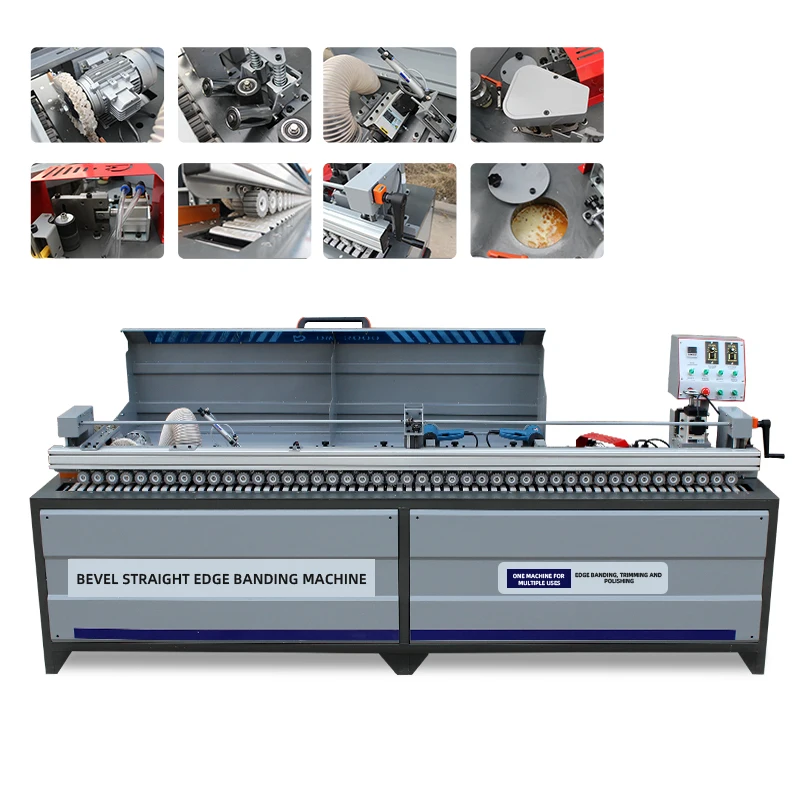
Edge banding machine
Click to enlarge
ISO 9001
CE Certified
OEM / ODM
12-Mo Warranty
Edge banding machine
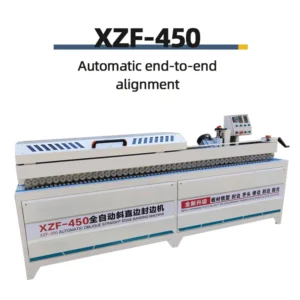
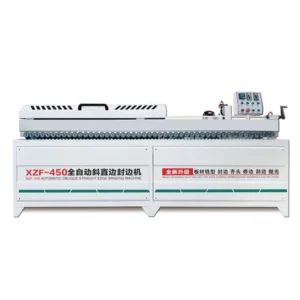
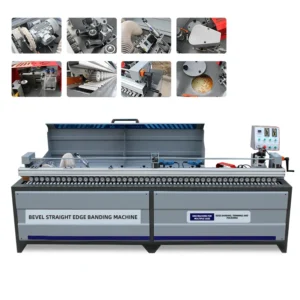
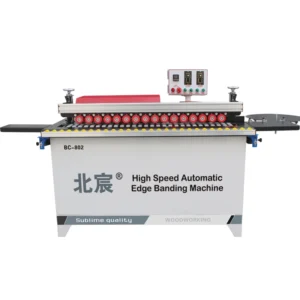
DW3000 Automatic Straight Bevel Edge Banding Machine for Wood Panel
<p><strong>DW3000 Automatic Straight Bevel Edge Banding Machine, 11KW, 0.3–3mm Edge Thickness</strong> — handles 30–90° bevel and straight edge sealing on MDF, particleboard and plywood. Double heat gun design and 45-degree pre-milling prepare uneven substrate edges for consistent glue bonding, while three spindle trimming motors and a flexible scraper deliver clean joint lines on angled profiles.</p> <ul> <li>Backed by four-stage QC with pre-shipment test records for your substrate and edge material.</li> <li>Voltage, control language and specifications customized to your facility requirements.</li> <li>Engineer-led configuration with formal quotation and factory test samples available before order.</li> </ul>
100+
Countries
MOQ 1
Unit
15-25 Days
Lead Time
11KW Motor
380V
Bevel Edge Banding
DW3000
Edge Banding Machine
MDF Panel
Plywood Panel
Process And Application
- Full OEM/ODM support -- custom logo, voltage (110V-440V), multilingual panels
- ISO 9001 & CE certified, 5 national patents, 60 professional engineers
- 12-month warranty, remote technical support & spare parts service
- Professional export packaging, customs clearance support, on-time delivery
Pre-Milling Verification — Edge banding samples run on MDF, particleboard and plywood before configuration is locked, ensuring the DW3000 glue line and trimming output match your actual substrate behaviour.
Technical Specifications
| Parameter | Value |
|---|---|
| Model | DW3000 |
| Product Type | Automatic Straight Bevel Edge Banding Machine |
| Total Power | 11 kW |
| Voltage | 380V/415V (frequency 50Hz/60Hz to be confirmed) |
| Pre-milling Motor | 2.2 kW |
| Heating Power | 2.2 kW × 2 |
| Edge Feed Power / Speed | 160 W / 0–12 m/min |
| Transmission Power / Speed | 180 W / 0–12 m/min |
| Trimming Power | 2.2 kW × 2 |
| Polishing Power | 0.4 kW × 2 |
| Vacuum Power | 550 W |
| Glue Pot Capacity | 4000 ml |
| Air Source Pressure | 0.5–0.7 MPa |
| Minimum Sheet Size | 300 mm (L) × 150 mm (W) |
| Edge Banding Height | 0–50 mm |
| Edge Banding Thickness | 0.3–3 mm |
| Bevel Angle Range | 30° to 90° (8 groups of adjustable oblique pressure wheels) |
| Trimming Configuration | 3 spindle trimming motors |
| Machine Dimensions (L×W×H) | 2990 × 650 × 1300 mm |
| Machine Weight | 430 kg |
| Key Features | 45° pre-milling, double heat gun, edge band slotting device, flexible edge scraper, double cylinder feeding belt, automatic alignment |
Application Suitability
| Application | Material or Output |
|---|---|
| Cabinet door panels with bevel-edge profiles | MDF and plywood with PVC or ABS edge banding |
| Custom furniture drawer fronts | Particleboard and MDF with 0.3–3 mm edge banding |
| Mixed straight and angled edge production runs | Plywood, MDF and particleboard substrates |
| Joinery workshop panel finishing | Solid wood panels and veneer edge banding |
Why Substrate Density Dictates Your Edge Banding Process Setup
The same edge banding machine produces different glue line results on MDF, particleboard and plywood — not because of operator error, but because substrate density and surface porosity change how hot-melt adhesive bonds.
I spent weeks in a Dubai cabinet factory troubleshooting this exact problem. The DW3000 ran perfectly on standard PVC over particleboard during the factory test, but once we switched to their actual MDF stock, the glue penetration was insufficient and trim tear-out appeared on the bevel cuts. Particleboard absorbs adhesive differently than MDF, and plywood grain direction introduces another variable entirely. This is why the woodworking process edge banding bevel straight sealing sequence must be validated against your specific board stock before any production commitment. [NEED_CITE: substrate porosity effects on hot-melt adhesive bonding in panel processing]
How the Pre-Milling Station Changes Substrate Behaviour
The 45° pre-milling station removes the factory-cut panel edge before adhesive application. On particleboard, this exposes a fresh, uniform surface free from chipping left by the panel saw. The 2.2 kW pre-milling motor provides sufficient torque to clean MDF edges without generating excessive dust that contaminates the glue pot downstream. This step matters most when running plywood, where the cross-grain structure at the panel edge often leaves voids that a standard straight edge cannot seal reliably.
Double Heat Gun Control Over Edge Banding Conformity
The dual 2.2 kW heating elements serve distinct functions across the woodworking process edge banding bevel straight sealing workflow. The first heat gun brings the hot-melt adhesive to working temperature inside the 4000 ml glue pot, while the second softens the PVC or ABS edge banding material just before it meets the panel edge. On bevel angles between 30° and 90°, the banding material must conform to a profiled surface rather than a flat edge. The eight groups of adjustable oblique pressure wheels press the softened banding into the bevel, and the second heat gun ensures the material remains pliable enough to follow the contour without springing back. [NEED_CITE: thermal softening requirements for ABS vs PVC edge banding on angled profiles]
Reading the Spec Sheet Against Your Production Reality
The 0–12 m/min feed speed range covers most custom furniture panel throughput requirements, but feed speed and glue pot temperature must be matched to your edge banding thickness. Running 3 mm ABS at maximum speed risks insufficient adhesive transfer, while 0.3 mm PVC at slow speed can overheat and distort. The three spindle trimming motors handle the increased cutting load that bevel edges impose compared to straight edges, where a single trimming pass often suffices. The flexible edge scraper following the trimming station removes the thin adhesive residue that remains visible on bevel surfaces — a detail that becomes critical when the finished panel is inspected under workshop lighting. Air pressure at 0.5–0.7 MPa drives the pneumatic cylinders controlling the pressure wheels and scraper engagement, so confirming your workshop compressor capacity is part of the installation check.
The Cost of Skipping Voltage Confirmation Before Shipment
Machines arrive at site and the main breaker trips immediately, or worse, the motors run but at reduced torque that shows up only as inconsistent trimming quality three weeks into production. I have seen woodworking process edge banding bevel straight sealing operations stall for weeks because the machine was configured for 380V/50Hz while the local grid delivers 415V/60Hz. The 11 kW total power draw of the DW3000 means voltage mismatch affects every station simultaneously — pre-milling, heating, trimming and polishing all degrade together. The cost is not just the electrician’s visit; it is the batch of panels produced before anyone noticed the trimming motors were underperforming. [NEED_CITE: voltage and frequency standards by export market]
What You Are Actually Buying When You Source This Machine
The DW3000 is built around a double cylinder feeding belt and an automatic alignment system, which means the panel enters the pre-milling station square every time — a mechanical feature that reduces operator dependency on manual feeding skill. The edge band slotting device with adjustable slotting height allows the same machine to process different panel thicknesses without a tooling changeover that takes the line offline. Factory testing covers your specific substrate and edge banding combination before dispatch, not a generic sample. The machine ships with an electrical schematic and voltage confirmation document, so your local electrician can verify the installation matches the configuration. CE certification is documented for markets that require it, and the operation manual is supplied in your operator’s language.
Documentation & Verification
- CE declaration of conformity covering the DW3000 automatic edge banding machine
- Electrical schematic matching your confirmed voltage and frequency configuration
- Factory test record using your panel substrate and edge banding material
- Operation and maintenance manual in your specified workshop language
- Spare parts list identifying consumable trimming blades and scraper elements
Installation, Commissioning & Support
- 2990 × 650 mm footprint requires a clear feed and exit zone for full-length panels
- 11 kW total power needs a dedicated circuit with the confirmed voltage and frequency
- Machine arrives assembled; connect air supply at 0.5–0.7 MPa and power to commission
- First-run calibration sets pre-milling depth and glue temperature for your substrate
- Trimming blade and scraper replacement intervals documented in the maintenance manual
Before You Send an Inquiry
Tell me what panel substrates you run most often — MDF, particleboard, plywood or a mix — and which edge banding materials you use across your product range. I also need your local voltage and frequency so the DW3000 configuration is confirmed before production. If you are running bevel profiles beyond standard 45°, specify the angle so the pressure wheel setup and feed speed recommendation match your actual output requirement.
Frequently Asked Questions
Q: How does bevel angle affect feed speed and glue application on this machine?
A: Steeper bevel angles like 30° reduce the contact surface between the edge banding and the panel edge, requiring slower feed speeds and precise heat gun temperature to ensure the PVC or ABS conforms fully. The eight adjustable oblique pressure wheels compensate by increasing contact pressure on the angled profile, but feed speed still needs to be matched to the angle during initial setup.
Q: Which substrate produces the cleanest bevel edge with this process?
A: MDF generally produces the most consistent bevel edge because its uniform density allows the pre-milling station to create a smooth bonding surface. Plywood requires more careful pre-milling depth control due to its cross-grain structure, and particleboard can show edge porosity that affects glue penetration. Testing with your actual board stock is the only reliable verification.
Q: How does the double heat gun setup affect PVC versus ABS edge banding?
A: ABS requires higher softening temperatures than PVC to conform properly to bevel profiles. The second heat gun on the DW3000 allows independent temperature control for the edge banding material, so ABS at 2–3 mm thickness can be softened adequately without overheating the adhesive in the glue pot. This separation is essential when switching between materials on the same production run.
Q: What panel thickness range works with the slotting station?
A: The edge band slotting device accommodates adjustable slotting heights across the 0–50 mm edge banding height range. The slotting depth is set to match your panel thickness so the edge banding sits flush with or slightly proud of the panel surface before trimming. This adjustment is mechanical and set during commissioning based on your standard panel stock.
Q: How do I verify trimming and scraping quality on bevel edges before batch production?
A: Run a minimum of five sample panels through the full woodworking process edge banding bevel straight sealing sequence at your intended production feed speed. Inspect the trimmed bevel under workshop lighting for tear-out, check the scraped surface for visible glue residue, and assemble the panel into its final joinery to confirm the edge profile does not interfere with fitting.
Technical Specifications
| Parameter | Value |
|---|---|
| Product Name | DW3000 Automatic Straight Bevel Edge Banding Machine for Wood Panel |
| Category | Edge banding machine |
| Voltage Options | 110V / 220V / 380V / 440V (customizable) |
| Frequency | 50Hz / 60Hz (customizable) |
| Certification | ISO 9001, CE |
| MOQ | 1 Unit |
| Lead Time | 15-25 Working Days |
| Warranty | 12 Months |
| OEM / ODM | Available -- logo, color, panel language |
* Detailed technical specifications vary by model. Please contact us with your specific requirements for a complete datasheet.
Shipping & Export
-
Export Packaging
Heavy-duty wooden crate with foam padding and moisture protection
-
Shipping Methods
Sea freight (FCL/LCL), air freight, express -- we support all methods
-
Customs Support
Full documentation: CO, commercial invoice, packing list, HS code assistance
-
Port of Loading
Tianjin / Qingdao port, China -- 20 years export experience
OEM / ODM Services
-
Logo & Branding
Custom logo printing, color scheme, and nameplate engraving
-
Voltage Configuration
110V / 220V / 380V / 440V, 50Hz / 60Hz -- any region supported
-
Multilingual Panels
Control panels in English, Spanish, French, Arabic and more
-
Custom Specifications
Modified dimensions, accessories, or feature sets on request
Get a Quote
Request Product Inquiry
Fill in your details and we'll respond within 24 hours with pricing and availability.
Direct Contact
How It Works
-
1
Confirm requirements & budget
Tell us your factory scale and processing needs
-
2
Receive recommendation & quote
We match the right machine with full specs
-
3
Negotiate & place order
OEM terms, voltage, payment and delivery
-
4
Production & QC inspection
Multi-stage quality control by 60 engineers
-
5
Export packaging & shipment
Professional packing, customs clearance
-
6
After-sales support
12-month warranty, remote tech support
You May Also Like