Edge banding machine
Click to enlarge
ISO 9001
CE Certified
OEM / ODM
12-Mo Warranty
Edge banding machine
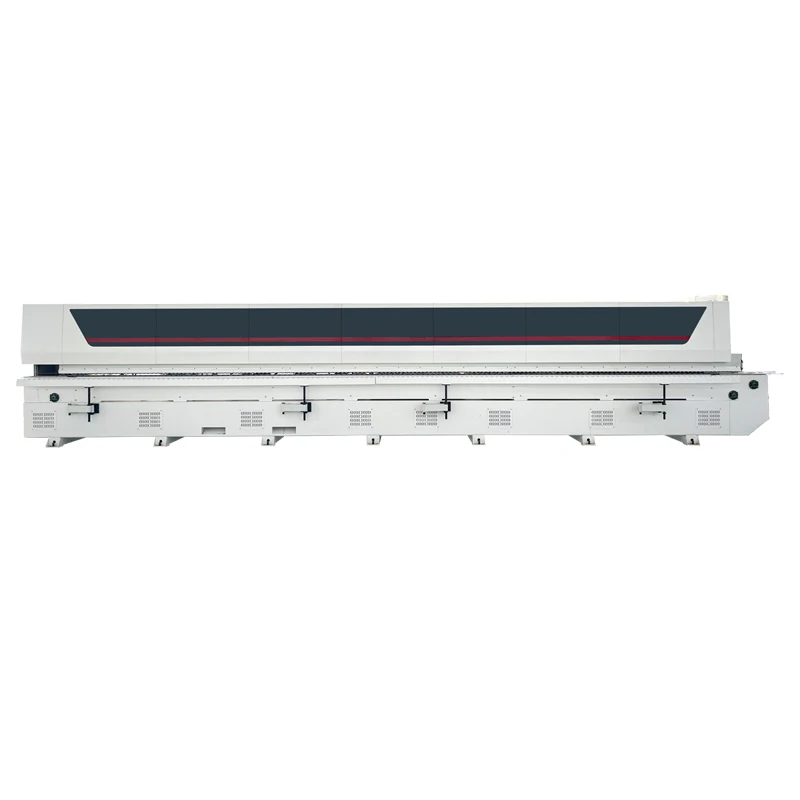
DW985 Automatic Edge Banding Machine for Furniture Cabinet Door Production–16 Functions with Soft Forming and Pre-Milling
<p><strong>DW985 Automatic Soft Forming Edge Banding Machine, 380V, 16 Functions, 8-12m/min Feed Speed</strong> — engineered for handle-free cabinet door production requiring invisible edge transitions across MDF, particleboard, and plywood substrates.</p> <ul> <li>Multi-stage pre-milling and soft forming pressing system eliminates visible glue lines on contoured profiles, with wheeled profiling supporting quick shape changeovers</li> <li>Touch screen control with multilingual interface allows operators to select shape-specific parameters for consistent edge quality</li> </ul> <p>Supported by four-stage QC with pre-shipment verification and engineer-led configuration within 24 hours.</p>
100+
Countries
MOQ 1
Unit
15-25 Days
Lead Time
16 Functions
Automated Process
DW985
Edge Banding Machine
Furniture Cabinet Door
Soft Forming
- Full OEM/ODM support -- custom logo, voltage (110V-440V), multilingual panels
- ISO 9001 & CE certified, 5 national patents, 60 professional engineers
- 12-month warranty, remote technical support & spare parts service
- Professional export packaging, customs clearance support, on-time delivery
Precision-ground edge preparation — Four-stage milling sequence verified against MDF, particleboard, and plywood substrates before soft forming, eliminating visible glue lines on handle-free cabinet profiles.
Technical Specifications
| Parameter | Value |
|---|---|
| Model | DW985 |
| Product Type | Automatic Soft Forming Edge Banding Machine |
| Function Stations | 16 integrated stations (pre-milling, rough/finish milling, soft forming, scraping, polishing) |
| Semi-J Rough Milling Motor | 5 kW |
| Inclined Straight Edge Pre-milling Motor | 5 kW |
| Semi-J Finish Milling Motor | 6 kW × 2 |
| Milling Servo Drive | 0.75 kW × 3 |
| End to End Motor | 0.37 kW × 2 |
| Coarse and Fine Finishing Motor | 0.75 kW × 2 |
| Plate Conveying Motor | 5.5 kW |
| Plate Polishing Motor | 0.37 kW × 2 |
| Maximum Processing Speed | 8–12 m/min (basis to be confirmed for panel material and edge banding type) |
| Voltage | 380V (configurable from 110V to 440V) |
| Machine Size | 950 × 98 × 184 cm |
| Gross Mass | 4.2 t |
| Control System | Touch screen with remote upgrading capability |
| Profiling Design | Wheeled profiling system supporting multiple shapes |
| Assembly State | Fully automatic / semi-automatic without handle |
| Language Options | Chinese and English standard; customizable to Spanish or other languages |
| Plug Options | EU, USA, AU, UK |
| Certification | CE, ISO 9001 |
Application Suitability
| Application | Material or Output |
|---|---|
| Handle-free cabinet door edge banding | MDF and plywood with PVC soft forming |
| Custom furniture panel processing | Particleboard with ABS or veneer edge banding |
| High-mix workshop production | Solid wood panels requiring contoured edge profiles |
| Soft forming on curved door edges | PVC and wood veneer on shaped substrates |
Why Your Substrate Dictates the Milling Sequence Before Anything Else
Edge quality is decided in the first three seconds of panel contact, not at the polishing wheel.
I once watched a production manager in a panel processing plant blame the glue for visible seam lines on particleboard cabinet doors. The glue was fine. The real issue was that the pre-milling station had been bypassed to save time, leaving a torn edge surface from the panel saw that no amount of soft forming pressure could smooth over. When working with a woodworking process edge banding machine at this function count, the substrate density and saw cut quality determine which milling stations need to be active and at what feed rate. Skipping this diagnostic step is the most common reason edge banding fails assembly inspection downstream [NEED_CITE: substrate edge preparation standards for panel furniture manufacturing].
How Multi-Stage Milling Prepares the Edge for Glue Adhesion
The DW985 sequences linear pre-milling, rough milling, inclined straight pre-milling, and dual finish milling before the panel ever reaches the glue pot. Each stage removes a specific layer of saw damage: the linear pre-mill takes the coarse tear-out from the panel saw, the rough mill squares the edge, and the finish milling pair brings the surface to the tolerance needed for consistent glue film thickness. On MDF, which tends to fuzz along the cut line, this sequence prevents the fibers from absorbing glue unevenly. On particleboard, the inclined pre-milling station addresses the crumbly core layer that standard straight milling leaves exposed.
Soft Forming Pressure and Temperature Interaction with Edge Banding Material
The soft forming and pressing station works in concert with the plate heating system to bring PVC or veneer edge banding to a pliable state before it meets the contoured panel edge. This matters because handle-free cabinet doors require the edge banding to wrap around shaped profiles without stress whitening or lifting at the radius. The heating system warms the banding material before the forming rollers engage, so the material stretches rather than snaps. Different PVC thicknesses and wood veneers respond differently to this thermal-mechanical combination, which is why the touch screen control stores shape-specific temperature and pressure parameters [NEED_CITE: PVC soft forming temperature ranges for edge banding applications].
Reading the Specification Sheet Against Your Actual Production Conditions
The 5.5 kW plate conveying motor drives the feed chain at 8–12 m/min, but that speed range only applies when the panel weight, edge banding thickness, and ambient temperature fall within the tested envelope. The 6 kW dual finish milling motors provide the torque needed to maintain cut quality at higher feed rates on dense MDF, while particleboard can often run at lower motor load. The three 0.75 kW milling servo drives control the position of the profiling wheels, which track the panel edge contour during soft forming. For a workshop running mixed substrates through the same woodworking process edge banding machine in a single shift, these servo drives enable quick profile changeover without manual wheel adjustment.
What Happens When Voltage and Frequency Are Assumed Rather Than Confirmed
I learned this the hard way early in my career. A DW985-class machine wired for 380V/50Hz was shipped to a Middle East facility running 415V/60Hz. The motors burned within the first week. The 5.5 kW conveying motor and the 6 kW finish milling motors are particularly vulnerable because they run continuously during production. This is why the electrical schematic and voltage confirmation must happen before the machine enters production, not after it arrives on the container [NEED_CITE: voltage and frequency standards by export market]. A woodworking process edge banding machine with configurable voltage from 110V to 440V eliminates this failure mode entirely, provided the buyer sends a photo of the facility’s distribution panel before the order is finalized.
Why Procurement Through This Channel Reduces Commissioning Risk
In-house manufacturing means the patented cutting mechanisms and precision-ground components are built and tested under one roof, not assembled from third-party sub-contracts. The four-stage QC process — incoming material, in-process, finished product, and pre-shipment verification — catches tolerance drift before the machine is crated. Engineer-led configuration means the 16 function stations are set up for the buyer’s specific substrate and edge banding combination, not shipped in a default arrangement. Factory test records are generated on the buyer’s actual panel material, providing verifiable evidence that the ±0.02mm tolerance claim holds under production-representative conditions. The wheeled profiling system arrives with shape parameters already loaded for the agreed cabinet door profiles.
Documentation & Verification
- Factory test record demonstrating edge quality on your specified MDF or particleboard substrate
- Electrical schematic confirming voltage and frequency match your facility distribution panel
- Operation manual in the agreed language with shape-specific parameter tables for each profile
- Pre-shipment verification photograph showing all 16 stations tested under load
- CE declaration of conformity and ISO 9001 certificate for customs and compliance
Installation, Commissioning & Support
- Foundation must support 4.2 t gross mass across the 950 × 98 cm footprint with leveled anchor points
- Dedicated 380V three-phase circuit with breaker sized for the combined 5.5 kW conveying and 6 kW milling motor load
- Machine ships fully assembled; pressure beam lifting motor requires calibration on-site for your panel thickness range
- Touch screen control loaded with your profile library during commissioning, with remote upgrade capability for future shapes
- Spare parts list includes wear items for all 16 function stations, prioritized by replacement frequency
- Daily maintenance covers glue pot cleaning and profiling wheel inspection; weekly covers servo drive lubrication
What to Provide With Your Inquiry
Send the panel material type and thickness range you run most frequently, along with the edge banding material — PVC thickness or veneer species. Include your facility’s voltage and frequency from the distribution panel, and the language your operators read. If you are running handle-free profiles, share the door shape drawings so the wheeled profiling system can be configured and tested before dispatch.
Frequently Asked Questions
Q: How does the soft forming process adapt to PVC versus wood veneer edge banding?
A: The plate heating system and forming pressure are adjusted through the touch screen for each material. PVC requires lower heat and moderate pressure to avoid gloss loss, while wood veneer needs higher temperature to become pliable enough for contoured profiles. Shape-specific parameters are stored so changeover between materials takes only a screen selection.
Q: What edge profile shapes can the wheeled profiling system handle?
A: The system supports multiple contoured shapes required for handle-free cabinet doors and furniture panels. New profiles can be added through the remote upgrading capability built into the control system, so your shape library grows as your product line expands without requiring mechanical modifications to the profiling wheels.
Q: How can I verify the ±0.02mm tolerance on my specific panel material?
A: Request a factory test using samples of your actual MDF, particleboard, or plywood along with your chosen edge banding material. The pre-shipment verification process includes running these samples through all 16 stations and documenting the edge quality and dimensional results before the machine is approved for dispatch.
Q: What glue temperature works best for particleboard with high moisture content?
A: Particleboard with elevated moisture absorbs heat from the glue pot faster, which can cause the adhesive to set before the soft forming station completes the wrap. The heating system compensates by warming the panel edge before glue application, but the exact temperature depends on your substrate’s measured moisture level at the time of production.
Technical Specifications
| Parameter | Value |
|---|---|
| Product Name | DW985 Automatic Edge Banding Machine for Furniture Cabinet Door Production–16 Functions with Soft Forming and Pre-Milling |
| Category | Edge banding machine |
| Voltage Options | 110V / 220V / 380V / 440V (customizable) |
| Frequency | 50Hz / 60Hz (customizable) |
| Certification | ISO 9001, CE |
| MOQ | 1 Unit |
| Lead Time | 15-25 Working Days |
| Warranty | 12 Months |
| OEM / ODM | Available -- logo, color, panel language |
* Detailed technical specifications vary by model. Please contact us with your specific requirements for a complete datasheet.
Shipping & Export
-
Export Packaging
Heavy-duty wooden crate with foam padding and moisture protection
-
Shipping Methods
Sea freight (FCL/LCL), air freight, express -- we support all methods
-
Customs Support
Full documentation: CO, commercial invoice, packing list, HS code assistance
-
Port of Loading
Tianjin / Qingdao port, China -- 20 years export experience
OEM / ODM Services
-
Logo & Branding
Custom logo printing, color scheme, and nameplate engraving
-
Voltage Configuration
110V / 220V / 380V / 440V, 50Hz / 60Hz -- any region supported
-
Multilingual Panels
Control panels in English, Spanish, French, Arabic and more
-
Custom Specifications
Modified dimensions, accessories, or feature sets on request
Get a Quote
Request Product Inquiry
Fill in your details and we'll respond within 24 hours with pricing and availability.
Direct Contact
How It Works
-
1
Confirm requirements & budget
Tell us your factory scale and processing needs
-
2
Receive recommendation & quote
We match the right machine with full specs
-
3
Negotiate & place order
OEM terms, voltage, payment and delivery
-
4
Production & QC inspection
Multi-stage quality control by 60 engineers
-
5
Export packaging & shipment
Professional packing, customs clearance
-
6
After-sales support
12-month warranty, remote tech support
You May Also Like