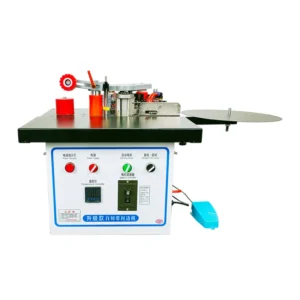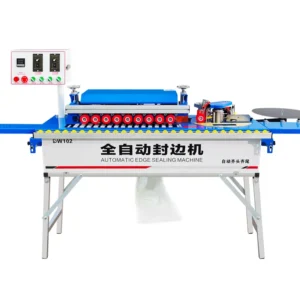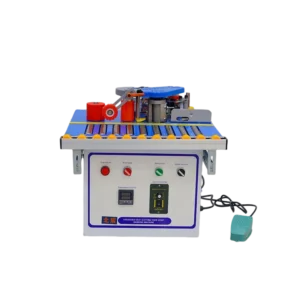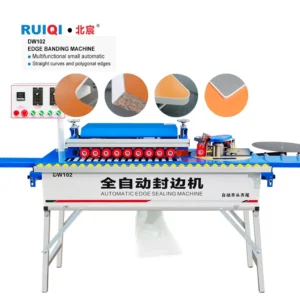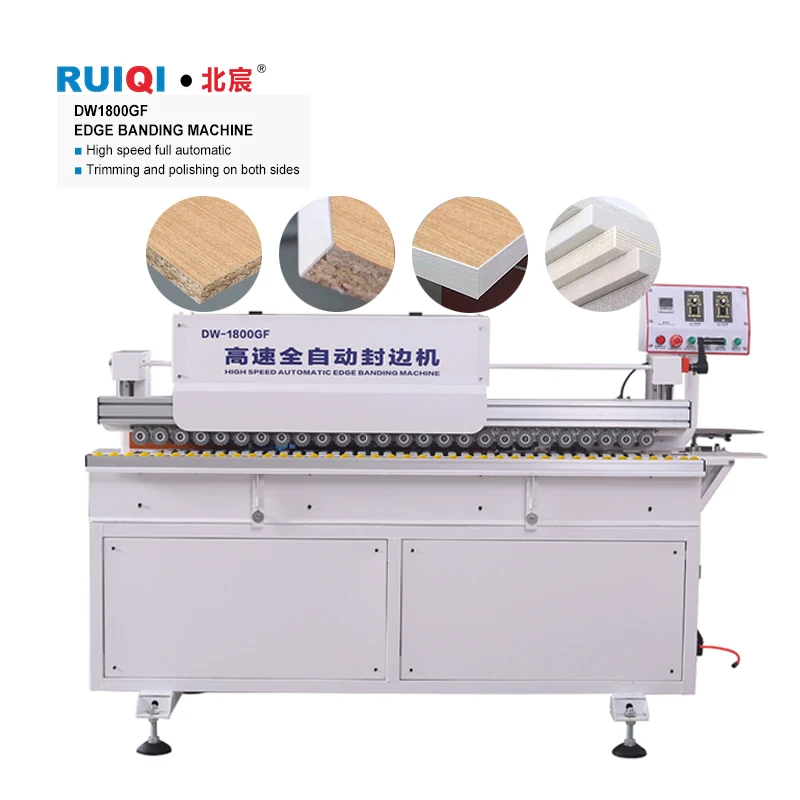
Edge banding machine
Click to enlarge
ISO 9001
CE Certified
OEM / ODM
12-Mo Warranty
Edge banding machine
Industrial Application Edge Banding Machine for MDF Plywood
<p><strong>DW1800 Automatic Edge Banding Machine</strong>, 4.9KW, 0-14M/min feed speed, 0.3-3MM edge thickness — engineered for consistent edge finishing across MDF, particleboard and plywood substrates in custom furniture production.</p> <ul> <li><strong>Double-sided gluing system</strong> with 4000ml pot capacity and 24000r/min trimming ensures uniform adhesive distribution and clean top-bottom cuts</li> <li>Profile tracking rounds all four corners, reducing visible glue lines that compromise downstream assembly fit</li> </ul> <p>Verified through four-stage QC with pre-shipment panel testing in your substrate material.</p>
100+
Countries
MOQ 1
Unit
15-25 Days
Lead Time
Double-Sided Gluing
DW1800
Edge Banding Machine
Factory Test Verified
MDF Panel
Plywood Edge Banding
Profile Tracking
- Full OEM/ODM support -- custom logo, voltage (110V-440V), multilingual panels
- ISO 9001 & CE certified, 5 national patents, 60 professional engineers
- 12-month warranty, remote technical support & spare parts service
- Professional export packaging, customs clearance support, on-time delivery
Precision-Engineered Gluing — The DW1800 edge bander maintains uniform adhesive distribution across MDF, particleboard and plywood through its 4000ml glue pot and double-sided application system, verified by four-stage pre-shipment testing.
Technical Specifications
| Parameter | Value |
|---|---|
| Product Type | Automatic Edge Banding Machine |
| Model | DW1800 |
| Total Power | 4.9 KW |
| Voltage Options | 380V / 220V / 415V (frequency to be confirmed per region) |
| Feed Speed | 0–14 m/min |
| Edge Banding Thickness Range | 0.3–3 mm |
| Edge Banding Height Range | 0–50 mm |
| Minimum Sheet Dimensions | 200 mm (L) × 100 mm (W) |
| Glue Pot Capacity | 4000 ml |
| Trimming Motor Power | 800 W × 2 |
| Trimming Speed | 24,000 r/min |
| Polishing Motor Power | 380 W × 2 |
| Vacuum Motor Power | 550 W |
| Transmission Power | 180 W |
| Edge Feed Power | 160 W |
| Air Source Pressure | 0.4–0.6 MPa |
| Overall Dimensions | 2200 × 650 × 1250 mm |
| Net Weight | 320 kg |
| Control Panel Language | Chinese/English standard; Spanish and other languages configurable |
| Plug Standards | EU, US, AU, UK options |
| Certification | CE |
Application Suitability
| Application | Material or Output |
|---|---|
| Custom cabinet panel edge finishing | MDF and moisture-resistant particleboard with PVC edge banding |
| Wardrobe and shelving board processing | Plywood and melamine-faced chipboard with 0.4–2 mm ABS or PVC strips |
| Joinery workshop production runs | Solid wood panels and veneer banding up to 3 mm thickness |
| PVC and acrylic panel trimming | Non-wood substrates of similar hardness requiring clean edge profiling |
| Small-batch bespoke furniture | ABB boards and organic glass plates with flexible scraping finish |
Why Substrate Choice Changes Everything About Glue Behavior
The edge banding quality you see on a sample panel rarely tells the whole story until you run your actual production material through the machine.
I spent four days in a cabinet factory once, re-tuning a woodworking process edge banding machine that had performed perfectly on standard MDF during the factory test. The customer’s real stock was high-moisture particleboard, and the glue temperature and viscosity settings were completely wrong for that substrate. Edges that looked flawless on day one started lifting within a week. That gap between demo conditions and production reality is where most edge banding failures actually live [NEED_CITE: substrate moisture content and hot-melt adhesive bonding behavior].
How Double-Sided Gluing Addresses Visible Glue Lines
When edge banding strips are applied to porous substrates like particleboard, single-sided gluing often leaves uneven adhesive coverage at the strip-to-panel interface. The DW1800 applies adhesive to both the panel edge and the banding strip simultaneously, using the 4000ml glue pot to maintain a stable thermal mass. This double-sided approach means the glue stays within its working temperature window longer, which matters when you are feeding panels continuously and cannot afford temperature drop-off mid-run. The result is a more consistent bond line across different densities of MDF and plywood.
Profile Tracking and Corner Quality on Cabinet Components
Cabinet doors and drawer fronts take the most abuse at their corners, and that is exactly where edge banding failures become visible to the end user. The profile tracking function on this woodworking process edge banding machine rounds all four corners of each panel as it passes through the scraping station. Rather than leaving a sharp transition where the top and side edges meet, the scraper follows the panel contour to produce a smooth radius. For cabinet makers moving from manual edge banding to automated processing, this eliminates the hand-finishing step that typically creates inconsistency between operators [NEED_CITE: corner edge profiling standards in cabinet manufacturing].
Reading the Specs Against Your Actual Production Requirements
The 0–14 m/min feed speed range is not simply a throughput figure — it is a process tuning parameter. Lower-density particleboard requires a slower feed rate to allow the glue adequate open time before the pressure roller compresses the strip, while denser MDF can run faster without sacrificing bond integrity. The trimming station runs at 24,000 r/min with dual 800 W motors, which provides sufficient spindle speed to produce a clean cut on PVC and ABS banding up to 3 mm thick without chatter marks. The 0.4–0.6 MPa air pressure requirement drives the pneumatic pressure rollers and scraper actuators; operating below this range causes inconsistent roller contact, which shows up as intermittent bonding failures along the panel edge.
The Hidden Cost of Ignoring Voltage and Air Supply
Machines quoted and shipped without confirming local voltage and frequency are a recurring problem in cross-border equipment purchases. A woodworking process edge banding machine rated for 380V/50Hz will run its motors hotter and slower on a 415V/60Hz supply, and the glue pot thermostat will cycle incorrectly. Beyond electrical mismatch, inadequate compressed air supply causes the pressure rollers to lose contact force intermittently. The resulting edge failures are often blamed on the adhesive or the banding material, when the root cause is an air compressor that cannot maintain 0.4 MPa under continuous draw [NEED_CITE: compressed air pressure stability requirements for pneumatic woodworking equipment].
Why Procurement Through This Channel Makes Sense
The DW1800 is built in a facility with patented cutting mechanisms and a four-stage QC protocol covering incoming material, in-process inspection, finished product checks and pre-shipment verification. Voltage, plug type and control panel language are confirmed during the quotation stage rather than discovered after arrival. The product family spans from entry-level to full-function configurations, so a workshop can scale production volume without switching suppliers or relearning a different control interface. Each machine ships with factory test records run on the buyer’s specified substrate, an operation manual in the agreed language, and a complete spare parts list. Configuration recommendations are engineer-led, with formal quotations typically issued within 24 hours of receiving production requirements.
Documentation & Verification
- CE declaration of conformity covering the DW1800’s electrical and mechanical safety systems
- Factory test record showing edge finish quality on your specified panel material and thickness
- Electrical schematic confirming voltage, frequency and plug type match your workshop supply
- Operation and maintenance manual in your operator’s preferred language with illustrated adjustment guides
- Spare parts list with part numbers for trimming blades, scraper inserts and glue pot seals
Installation, Commissioning & Support
- Allow a floor footprint of approximately 2200 × 650 mm plus operator clearance on the feed and exit sides
- Confirm a dedicated 380V or 220V circuit with adequate amperage for the 4.9 KW total power draw before delivery
- The 320 kg net weight requires a level concrete floor; no special foundation or anchoring bolts are specified
- First-run commissioning includes glue pot temperature calibration and trimming depth adjustment for your specific banding thickness
- Feed speed, pressure roller force and scraper profile settings are tuned to your primary substrate during the initial production run
- Maintain a stock of trimming blades and polishing wheels from the supplied spare parts list to avoid unplanned downtime
What to Include in Your Inquiry
Send details on the panel substrates you process most frequently — MDF grade, particleboard density, plywood thickness — along with the edge banding materials and thicknesses you intend to run. Specify your workshop’s voltage and frequency so the electrical configuration is locked before production begins. If you need sample panels processed on the DW1800 to verify edge quality before committing, include your standard panel dimensions and the edge finish standard your downstream assembly requires.
Frequently Asked Questions
Q: How does glue application differ between MDF, particleboard and plywood on this machine?
A: MDF absorbs heat differently than particleboard, so the glue pot temperature and feed speed must be adjusted for each substrate. The DW1800’s double-sided gluing system compensates for varying porosity, but the operator must match feed rate to material density. Plywood, with its grain structure, typically requires slightly higher glue temperature for consistent bonding along the edge.
Q: What edge banding materials work best within the 0.3–3 mm thickness range?
A: PVC and ABS strips in the 0.4–2 mm range produce the cleanest trimmed edges at the standard 24,000 r/min spindle speed. Thicker 3 mm solid wood veneer banding can be processed but may require feed speed reduction and trimming depth adjustment. The flexible scraping station handles the full range without changing tooling between material types.
Q: How does profile tracking affect corner quality and downstream assembly fit?
A: Profile tracking rounds each corner to a consistent radius, eliminating sharp transitions that catch during handling and assembly. This produces cabinet doors and drawer fronts where the edge banding sits flush at every corner junction. Consistent corner geometry also means hinge mounting and drawer slide installation are not affected by edge banding buildup.
Q: What air supply requirements must be in place for stable operation?
A: The machine requires 0.4–0.6 MPa of clean, dry compressed air delivered at a volume sufficient to sustain continuous pneumatic actuator cycling. An undersized compressor will cause pressure drops that reduce roller contact force, leading to intermittent bonding failures. A dedicated air line with a regulator and moisture trap at the machine inlet is recommended.
Q: How to match feed speed to substrate type for optimal edge finish?
A: Start at a lower feed speed with unfamiliar substrates and increase incrementally while inspecting bond strength and trim quality. Denser materials like MDF tolerate the upper range of the 0–14 m/min scale, while low-density particleboard requires slower feeding to allow adequate glue open time. Document the optimal setting for each material in your production records.
Technical Specifications
| Parameter | Value |
|---|---|
| Product Name | Industrial Application Edge Banding Machine for MDF Plywood |
| Category | Edge banding machine |
| Voltage Options | 110V / 220V / 380V / 440V (customizable) |
| Frequency | 50Hz / 60Hz (customizable) |
| Certification | ISO 9001, CE |
| MOQ | 1 Unit |
| Lead Time | 15-25 Working Days |
| Warranty | 12 Months |
| OEM / ODM | Available -- logo, color, panel language |
* Detailed technical specifications vary by model. Please contact us with your specific requirements for a complete datasheet.
Shipping & Export
-
Export Packaging
Heavy-duty wooden crate with foam padding and moisture protection
-
Shipping Methods
Sea freight (FCL/LCL), air freight, express -- we support all methods
-
Customs Support
Full documentation: CO, commercial invoice, packing list, HS code assistance
-
Port of Loading
Tianjin / Qingdao port, China -- 20 years export experience
OEM / ODM Services
-
Logo & Branding
Custom logo printing, color scheme, and nameplate engraving
-
Voltage Configuration
110V / 220V / 380V / 440V, 50Hz / 60Hz -- any region supported
-
Multilingual Panels
Control panels in English, Spanish, French, Arabic and more
-
Custom Specifications
Modified dimensions, accessories, or feature sets on request
Get a Quote
Request Product Inquiry
Fill in your details and we'll respond within 24 hours with pricing and availability.
Direct Contact
How It Works
-
1
Confirm requirements & budget
Tell us your factory scale and processing needs
-
2
Receive recommendation & quote
We match the right machine with full specs
-
3
Negotiate & place order
OEM terms, voltage, payment and delivery
-
4
Production & QC inspection
Multi-stage quality control by 60 engineers
-
5
Export packaging & shipment
Professional packing, customs clearance
-
6
After-sales support
12-month warranty, remote tech support
You May Also Like