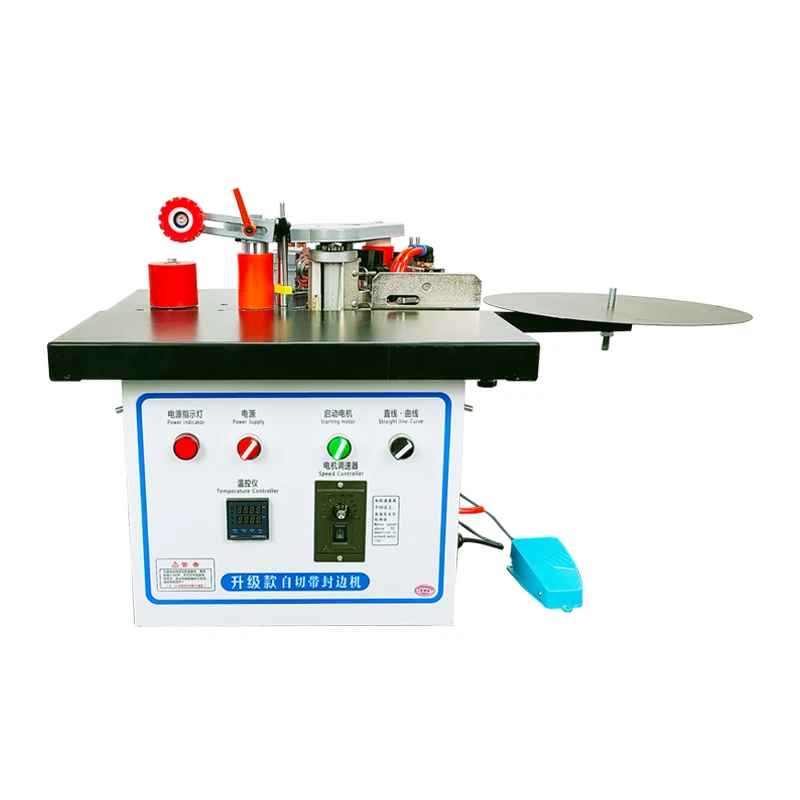
Edge banding machine
Click to enlarge
ISO 9001
CE Certified
OEM / ODM
12-Mo Warranty
Edge banding machine
Portable and Mini Automatic Edge Banding Machine ST-50 for Woodworking – Small Workshop
<p><strong>ST-50 Portable Edge Banding Machine, 1000W, 0.3-3mm Banding Thickness</strong> — handles curved and straight profiles on MDF, plywood, particleboard and solid wood panels down to 25cm length. This compact unit suits small-batch joinery shops where substrate and edge profile change between jobs, with 1000ml glue pot maintaining thermal stability during intermittent runs. - Request a sample processing test with your actual panel and banding material to verify glue-line quality before committing to production volumes.</p>
100+
Countries
MOQ 1
Unit
15-25 Days
Lead Time
220V 380V
Curved And Straight Edge Banding
Edge Banding Machine
MDF Plywood Particleboard
Portable Edge Banding
ST-50
Woodworking Workshop
- Full OEM/ODM support -- custom logo, voltage (110V-440V), multilingual panels
- ISO 9001 & CE certified, 5 national patents, 60 professional engineers
- 12-month warranty, remote technical support & spare parts service
- Professional export packaging, customs clearance support, on-time delivery
Precision-ground edge banding — every ST-50 portable edge banding machine undergoes a four-stage QC cycle with pre-shipment verification on your specified panel material and banding thickness before it leaves the factory.
Technical Specifications
| Parameter | Value |
|---|---|
| Product Type | Portable Edge Banding Machine |
| Total Power | 1000W |
| Voltage & Frequency | 220V/380V/customization |
| Edge Banding Height Range | 0-50mm |
| Edge Banding Thickness Range | 0.3-3mm |
| Minimum Sheet Length | 25cm |
| Minimum Sheet Width | 3cm |
| Edge Feed Motor Power | 20W |
| Glue Pot Capacity | 1000ml |
| Air Source Pressure | 0.5-0.8MPa |
| Overall Dimensions (L×W×H) | 50×50×47cm |
| Net Weight | 22kg |
| Standard Features | Curved and straight edge banding |
| Language Options | Chinese, English; custom language available (source value — verify against manufacturer catalog) |
| Plug Options | EU, USA, AU, UK (source value — verify against manufacturer catalog) |
Application Suitability
| Application | Material or Output |
|---|---|
| Custom cabinet edge sealing | MDF and particleboard with PVC or melamine tape |
| On-site furniture repair and modification | Pre-cut plywood and ecological board panels |
| Small-batch joinery production | Solid wood boards with veneer edge banding |
| Home decoration workshop tasks | Curved and straight profiles on various sheet materials |
Why the Glue Line Keeps Showing Up on MDF But Not Plywood
Substrate porosity dictates how the adhesive behaves, and ignoring that variable is the most common cause of visible glue lines on portable edge banding equipment.
I have seen operators spend hours adjusting feed speed and roller pressure on a portable edge banding machine, only to find that the MDF they switched to that morning absorbs the hot melt adhesive at a completely different rate than the plywood they ran yesterday. The result is a starved glue joint on MDF and a squeeze-out mess on denser substrates. This is not a machine defect; it is a process mismatch. [NEED_CITE: adhesive penetration behavior on porous vs semi-porous wood panels] When you run small batches and change panel stock between jobs, the edge banding process and application portable edge banding machine demands constant attention to this variable.
How Curved Profiles Change the Adhesive Game
When you feed a curved panel through the ST-50, the contact time between the pressure roller and the edge band shifts continuously. On a straight edge, the roller maintains a constant footprint, pressing the banding into the adhesive film with uniform force. On a convex curve, the roller rides on a smaller contact area, concentrating pressure; on a concave curve, the roller bridges across, and the center of the banding may not fully seat. This means that curved and straight edge banding capability is not just about whether the machine physically accepts the panel shape — it is about understanding that the glue distribution and bond quality will vary unless the operator compensates with feed speed adjustments.
Thermal Stability During Intermittent Production
The 1000ml glue pot on the ST-50 is sized for small-batch and intermittent work, not continuous production runs. In a workshop where the machine starts and stops throughout the day, the adhesive sits at temperature during idle periods. Hot melt adhesives degrade when held at operating temperature for extended durations — the open time shortens, the viscosity shifts, and the bond quality deteriorates. This is a critical consideration for edge banding process and application portable edge banding machine setups where the operator might seal a few panels in the morning, shut down for other tasks, and restart after lunch. The glue should be purged and refreshed rather than simply reheated. [NEED_CITE: hot melt adhesive degradation at sustained operating temperatures]
Reading the Specs Against Your Actual Production Needs
The 0.3–3mm edge banding thickness range covers PVC, melamine paper, and thin wood veneer — but each material demands different glue temperature settings and trimming approaches. PVC at 2mm is forgiving; melamine at 0.4mm is brittle and chips easily during trimming if the cutting angle is not precisely set. The 0.5–0.8MPa air source pressure requirement is non-negotiable: below 0.5MPa, the pneumatic pressure rollers cannot maintain consistent contact force, and you get intermittent bonding. Above 0.8MPa, you risk crushing softer banding materials against the panel edge. The 220V/380V voltage configurability matters when the portable edge banding machine ships to a region with single-phase domestic supply versus a workshop with three-phase industrial power — getting this wrong means the machine arrives and simply does not run.
What Happens When Air Pressure Drops Below Spec
I once visited a small cabinet workshop where the operator blamed the machine for inconsistent bond lines. The real issue was a shared air compressor that also fed a nail gun and a spray booth — every time someone else drew air, the pressure at the ST-50 dropped below the 0.5MPa minimum. The pressure roller force became erratic, and the banding lifted on random panels that only failed when the customer installed the cabinet doors weeks later. [NEED_CITE: pneumatic supply stability requirements for woodworking machinery] The downstream assembly problems from this kind of intermittent bond failure are costly because the defect is invisible until the panel is under mechanical stress in the final installation. A dedicated air line or a local regulator with a pressure gauge at the machine inlet eliminates this entirely.
Why Buyers Choose This Source for Portable Edge Sealing
The ST-50 is built on a production floor that holds ISO 9001 certification and runs a four-stage QC protocol — incoming material inspection, in-process checks, finished product verification, and a pre-shipment test on your actual specified panel and banding combination. The proprietary cutting mechanism patents are applied across the product family, meaning the trimming quality on this portable unit is grounded in the same engineering principles used on the larger stationary machines. Voltage and plug configuration are confirmed before production, not discovered at the dock. Custom language panels are available so your operator reads the controls in their working language from the first day. Engineer-led configuration support means you get a formal quotation addressing your specific substrate and banding material within 24 hours.
Documentation & Verification
- Factory test record run on your specified MDF or plywood thickness before dispatch
- Electrical schematic confirming voltage, frequency, and plug type for your workshop supply
- Operation manual in your operator’s language covering glue temperature and feed settings
- CE declaration of conformity applicable to your import market requirements
- Spare parts list identifying wear items specific to the ST-50 configuration you ordered
Installation, Commissioning & Support
- Requires a stable workbench surface given the 50×50×47cm footprint and 22kg weight
- Dedicated 220V or 380V circuit matching the confirmed voltage and frequency specification
- Air compressor with regulator set to 0.5–0.8MPa connected to the machine inlet before first run
- Initial glue pot fill and temperature calibration using your selected banding material thickness
- Operator training covers curved versus straight edge feed technique and roller pressure adjustment
- Replacement pressure rollers and trimming blades identified on the supplied spare parts list
Before You Request a Quote
Tell us the panel materials you actually run — MDF, particleboard, plywood, or solid wood — and the edge banding material type and thickness you intend to use. Specify your workshop voltage and frequency, and confirm whether you need curved edge capability or only straight runs. If your production involves frequent material changeovers, mention that so the configuration recommendation accounts for glue pot management and thermal recovery time.
Frequently Asked Questions
Q: How does substrate porosity affect glue penetration and visible glue-line quality?
A: MDF absorbs hot melt adhesive rapidly due to its open fiber structure, often leaving a starved joint if the glue application rate is not increased. Plywood and melamine-faced particleboard are less absorbent, meaning excess adhesive squeezes out and creates a visible line. Matching glue temperature and application volume to the substrate is essential for a clean result.
Q: Which edge banding materials work within the 0.3–3mm thickness range?
A: The ST-50 handles PVC from 0.4mm to 3mm, melamine paper tapes around 0.3–0.5mm, and thin wood veneer typically between 0.5–1.5mm. PVC is the most forgiving during trimming; melamine is brittle and requires precise cutter angles; veneer needs careful feed speed control to avoid splitting along the grain during the trimming pass.
Q: What glue temperature produces the best bond on curved versus straight edges?
A: Straight edges tolerate a slightly lower glue temperature because the roller maintains constant contact time. Curved edges benefit from a marginally higher temperature to extend the open time, allowing the adhesive to remain tacky as the banding conforms to the profile. The exact setting depends on the specific adhesive formulation and ambient workshop temperature.
Q: How does inconsistent air pressure affect roller pressure and bond-line uniformity?
A: When pressure drops below 0.5MPa, the pneumatic rollers lose contact force, creating intermittent bonding that may pass visual inspection but fails under mechanical stress. Above 0.8MPa, softer banding materials deform under excessive roller force. A dedicated air supply with a local pressure gauge and regulator at the machine inlet maintains consistent results across the production run.
Q: What downstream assembly problems result from poor edge banding tolerance?
A: Excess adhesive squeeze-out prevents flush fitting of adjacent panels during cabinet assembly. Incomplete bonding on curved edges causes banding to lift when hinges or hardware are mounted near the edge. Both defects are typically discovered only after the furniture reaches the installation site, making on-site rework costly and damaging to customer confidence.
Technical Specifications
| Parameter | Value |
|---|---|
| Product Name | Portable and Mini Automatic Edge Banding Machine ST-50 for Woodworking – Small Workshop |
| Category | Edge banding machine |
| Voltage Options | 110V / 220V / 380V / 440V (customizable) |
| Frequency | 50Hz / 60Hz (customizable) |
| Certification | ISO 9001, CE |
| MOQ | 1 Unit |
| Lead Time | 15-25 Working Days |
| Warranty | 12 Months |
| OEM / ODM | Available -- logo, color, panel language |
* Detailed technical specifications vary by model. Please contact us with your specific requirements for a complete datasheet.
Shipping & Export
-
Export Packaging
Heavy-duty wooden crate with foam padding and moisture protection
-
Shipping Methods
Sea freight (FCL/LCL), air freight, express -- we support all methods
-
Customs Support
Full documentation: CO, commercial invoice, packing list, HS code assistance
-
Port of Loading
Tianjin / Qingdao port, China -- 20 years export experience
OEM / ODM Services
-
Logo & Branding
Custom logo printing, color scheme, and nameplate engraving
-
Voltage Configuration
110V / 220V / 380V / 440V, 50Hz / 60Hz -- any region supported
-
Multilingual Panels
Control panels in English, Spanish, French, Arabic and more
-
Custom Specifications
Modified dimensions, accessories, or feature sets on request
Get a Quote
Request Product Inquiry
Fill in your details and we'll respond within 24 hours with pricing and availability.
Direct Contact
How It Works
-
1
Confirm requirements & budget
Tell us your factory scale and processing needs
-
2
Receive recommendation & quote
We match the right machine with full specs
-
3
Negotiate & place order
OEM terms, voltage, payment and delivery
-
4
Production & QC inspection
Multi-stage quality control by 60 engineers
-
5
Export packaging & shipment
Professional packing, customs clearance
-
6
After-sales support
12-month warranty, remote tech support
You May Also Like