Edge banding machine
Click to enlarge
ISO 9001
CE Certified
OEM / ODM
12-Mo Warranty
Edge banding machine
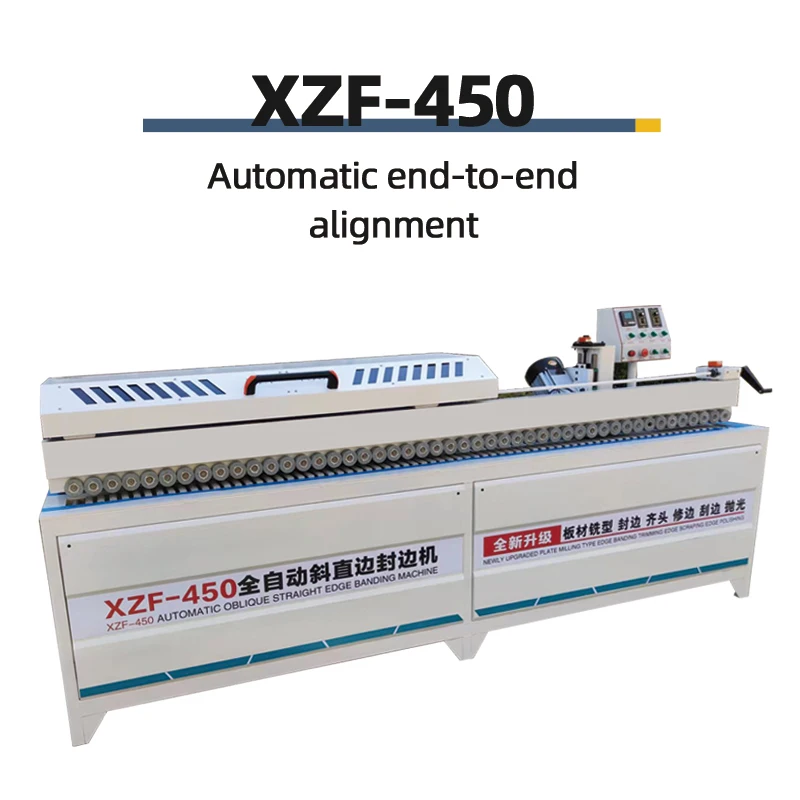
45-Degree Automatic Edge Banding Machine for MDF Plywood – Process Application
<p><strong>XZF450 45-Degree Automatic Edge Banding Machine, 9.5KW Total Power, 380V/415V</strong> — delivers integrated pre-milling, trimming and polishing for MDF, plywood and particleboard substrates.</p> <ul> <li>4KW pre-milling station ensures clean substrate edges before gluing, reducing visible glue lines across mixed material batches</li> <li>30/45/60-degree banding capability handles beveled and angled panel components with 0.3-3MM edge thickness range</li> <li>Dual 2.2KW trimming plus dual 0.4KW polishing stations complete edge finishing in a single pass at 0-12M/min feed speed</li> </ul> <p>Each processing stage is tuned for consistent edge quality on angled and standard panels, supporting cabinet and furniture production workflows. Factory test records available with sample processing on your specific substrate and edge material before shipment.</p>
100+
Countries
MOQ 1
Unit
15-25 Days
Lead Time
380V
45 Degree Edge Banding
4KW Pre-Milling
Edge Banding Machine
MDF Panel
Plywood Edge Banding
Process Application
XZF-450
- Full OEM/ODM support -- custom logo, voltage (110V-440V), multilingual panels
- ISO 9001 & CE certified, 5 national patents, 60 professional engineers
- 12-month warranty, remote technical support & spare parts service
- Professional export packaging, customs clearance support, on-time delivery
Integrated Process Control — the XZF450 manages substrate prep through final polish in a single automated sequence, maintaining edge consistency across MDF, plywood and particleboard batches.
Technical Specifications
| Parameter | Value |
|---|---|
| Model | XZF-450 |
| Product Type | 45-Degree Automatic Edge Banding Machine |
| Total Installed Power | 9.5 kW |
| Pre-milling Motor | 4 kW |
| Trimming Motors | 2.2 kW × 2 |
| Polishing Motors | 0.4 kW × 2 |
| Vacuum Extraction Power | 550 W |
| Transmission Drive | 180 W |
| Supply Voltage | 380V / 415V (configurable) |
| Feed Speed Range | 0–12 m/min |
| Glue Pot Capacity | 4000 ml |
| Edge Banding Thickness | 0.3–3 mm |
| Edge Banding Height | 0–50 mm |
| Minimum Sheet Length | 300 mm |
| Minimum Sheet Width | 150 mm |
| Air Source Pressure | 0.5–0.7 MPa |
| Overall Dimensions | 3000 × 650 × 1350 mm |
| Net Weight | 430 kg |
| Control Language Options | Chinese, English (Spanish and others on request) |
| Plug Configurations | EU, USA, AU, UK |
| Key Features | Plate milling, 30°/45°/60° multi-angle banding, dual trimming, scraping, dual polishing, high-power dust extraction |
Application Suitability
| Application | Material or Output |
|---|---|
| Custom furniture panel edge banding | MDF, melamine-faced board, particleboard |
| Cabinet component finishing | Plywood, blockboard with PVC or veneer strips |
| Angled edge profiles for design furniture | 30°, 45°, 60° bevel cuts on solid wood and composite panels |
| Polymer door edge treatment | Polymer composite profiles with 0.3–3 mm banding |
| Medium-to-high volume batch processing | Mixed substrate runs requiring consistent edge quality |
Why Edge Banding Quality Varies Between Substrates
Visible glue lines often trace back to inadequate substrate preparation, not the adhesive itself.
When panels move from MDF to plywood on the same line, the pre-milling stage becomes the variable that determines whether the glue bonds cleanly or leaves gaps. Plywood surfaces carry irregularities from veneer layup that standard feed systems simply press into the glue joint. MDF, by contrast, presents a uniform face but tends to absorb moisture from water-based adhesives unevenly [NEED_CITE: substrate moisture absorption rates in edge banding applications]. The edge banding machine process and application sequence on the XZF-450 addresses this by running a dedicated 4 kW pre-milling station ahead of the glue pot, removing a thin layer from the panel edge so each substrate enters the bonding zone at a consistent surface condition.
Substrate Preparation and Its Effect on Glue Line Integrity
The 4 kW pre-milling motor removes material from the panel edge before adhesive application. On particleboard, this clears loose surface particles that would otherwise embed in the glue film and create weak points. On plywood, it levels veneer overlaps that cause localized bond failure. Running the edge banding machine process and application sequence with pre-milling active produces a mechanically true edge, which lets the glue pot lay down a uniform film across substrates that would otherwise demand separate setup routines.
Multi-Angle Banding Beyond Straight Edges
Most workshop edge banders handle only 90-degree straight edges. The XZF-450 adds 30, 45 and 60-degree banding angles within the same feed path. This matters when cabinet makers produce beveled door fronts or angled shelving components where the edge profile must match the panel cut [NEED_CITE: tolerance requirements for angled panel assembly in cabinet manufacturing]. Switching between angles does not require tooling changes — the banding unit adjusts to the profile angle while downstream trimming and scraping stations follow the contour.
Reading the Specs Against Your Production Reality
The 0–12 m/min feed speed range is adjustable, but actual edge finish quality depends on where you set it relative to your substrate and banding material. Running 3 mm PVC on MDF at the upper end of the feed range may leave insufficient dwell time for the adhesive to reach full tack before the trimming station engages. Conversely, thin 0.3 mm veneer strips on particleboard at low feed speeds risk heat buildup in the scraping zone. The 4000 ml glue pot capacity supports sustained runs without frequent refill stops, though glue type must match both the banding material and the substrate porosity. Dual 2.2 kW trimming motors handle the initial rough trim and the finish trim in sequence, which reduces the load on each cutter and extends tool life between changes. The 550 W vacuum extraction pulls debris from the trimming and sc*urfaces.
The Cost of Skipping Configuration Checks
When a machine arrives with a control panel the operator cannot read, commissioning stalls until someone translates the interface — or worse, settings get guessed wrong. When voltage and frequency are not confirmed against the facility supply before the machine ships, the motor windings can overheat within the first production run [NEED_CITE: voltage mismatch damage to industrial motors in export equipment]. These are not rare edge cases. They show up regularly in workshops that ordered on price alone and never specified the language, plug type, or electrical standard their electrician would need to connect the machine.
What Manufacturing Depth Means for Your Order
In-house production with patented cutting mechanisms means the pre-milling and trimming assemblies are built and inspected under one roof, not sourced as third-party subassemblies and bolted together. Four-stage quality control covers incoming material checks, in-process assembly verification, finished product testing and pre-shipment inspection — so the machine you receive has been run under load before packing. Voltage, language and plug configuration are confirmed at the quotation stage, not treated as afterthoughts. The XZF-450 sits within a full product family, so if your workshop scales from single-machine operation to a multi-station line, the control logic and mechanical interfaces stay within one supplier ecosystem [NEED_CITE: benefits of single-supplier equipment scaling in woodworking]. Engineer-led configuration means the proposal you receive accounts for your actual substrate mix and daily panel volume, not just the model number you initially asked about.
Documentation & Verification
- CE declaration of conformity covering the XZF-450 mechanical and electrical safety systems
- Factory test record showing edge banding results on your specified substrate and banding thickness
- Electrical schematic with confirmed voltage and frequency matching your facility supply
- Operation and maintenance manual in the agreed language for your floor operators
- Spare parts list identifying consumable cutters, scraper blades and polishing wheels by part number
- Packing photographs documenting machine condition and crate integrity before dispatch
Installation, Commissioning & Support
- 380V/415V three-phase dedicated circuit required, sized for the 9.5 kW total draw plus startup surge
- Air supply at 0.5–0.7 MPa must be clean and dry; inline filtration protects pneumatic cylinders
- 3000 mm footprint plus operator clearance on feed and discharge sides determines bay layout
- First-run calibration covers glue temperature, feed speed, trimming depth and polishing pressure for your panel type
- Trimming and polishing cutter replacements follow a documented schedule based on substrate abrasiveness
- Multilingual control panel configured before shipment so operators read instructions in their working language
Preparing Your Inquiry
Send the substrate types you run most often, the edge banding materials and thicknesses you stock, and the daily panel count your line must sustain. Include your facility voltage and frequency so the electrical package is specified correctly from the start. If you run angled components, note the bevel angles and which substrates they involve so the multi-angle stations are configured for your actual work.
Frequently Asked Questions
Q: How does pre-milling affect edge quality on MDF versus plywood versus particleboard?
A: Pre-milling removes surface irregularities before gluing. On MDF, it exposes a fresh, uniform edge for clean adhesive bonding. On plywood, it levels veneer overlaps that would cause localized glue gaps. On particleboard, it clears loose surface particles that weaken the bond. The 4 kW pre-milling station on the XZF-450 handles all three without separate tooling setups.
Q: What glue and edge banding combinations work with the 4000 ml glue pot?
A: The pot runs standard hot-melt EVA adhesives compatible with PVC, ABS, melamine and wood veneer strips from 0.3 to 3 mm thick. Glue selection depends on your substrate porosity and the operating temperature your banding material tolerates. Confirm adhesive type with your supplier based on the specific panel and strip combination you run most frequently.
Q: How do 30/45/60-degree banding angles affect downstream assembly tolerances?
A: Angled edge banding must match the panel cut angle precisely or gaps appear at joints during cabinet assembly. The XZF-450 adjusts banding angle within the feed path, and downstream trimming follows the contour. Consistent angle accuracy across a batch means panels fit together without hand-fitting at the assembly bench.
Q: What is the relationship between feed speed and edge finish quality?
A: Higher feed speeds reduce dwell time between glue application and trimming, which can affect bond strength on porous substrates. Thicker PVC banding at 12 m/min may need higher glue temperature to compensate. Thinner veneer at low speed risks heat buildup during scraping. The adjustable 0–12 m/min range lets you find the setting that balances throughput with finish quality for each material combination.
Q: How does the scraping and polishing sequence affect final edge appearance?
A: Scraping removes the trimming marks and excess adhesive bead left after rough and finish trimming. The dual polishing stations then bring the edge to a smooth, consistent surface. Running both stages in one pass eliminates the need for manual touch-up, which is where most visible edge defects actually originate in workshop production.
Technical Specifications
| Parameter | Value |
|---|---|
| Product Name | 45-Degree Automatic Edge Banding Machine for MDF Plywood – Process Application |
| Category | Edge banding machine |
| Voltage Options | 110V / 220V / 380V / 440V (customizable) |
| Frequency | 50Hz / 60Hz (customizable) |
| Certification | ISO 9001, CE |
| MOQ | 1 Unit |
| Lead Time | 15-25 Working Days |
| Warranty | 12 Months |
| OEM / ODM | Available -- logo, color, panel language |
* Detailed technical specifications vary by model. Please contact us with your specific requirements for a complete datasheet.
Shipping & Export
-
Export Packaging
Heavy-duty wooden crate with foam padding and moisture protection
-
Shipping Methods
Sea freight (FCL/LCL), air freight, express -- we support all methods
-
Customs Support
Full documentation: CO, commercial invoice, packing list, HS code assistance
-
Port of Loading
Tianjin / Qingdao port, China -- 20 years export experience
OEM / ODM Services
-
Logo & Branding
Custom logo printing, color scheme, and nameplate engraving
-
Voltage Configuration
110V / 220V / 380V / 440V, 50Hz / 60Hz -- any region supported
-
Multilingual Panels
Control panels in English, Spanish, French, Arabic and more
-
Custom Specifications
Modified dimensions, accessories, or feature sets on request
Get a Quote
Request Product Inquiry
Fill in your details and we'll respond within 24 hours with pricing and availability.
Direct Contact
How It Works
-
1
Confirm requirements & budget
Tell us your factory scale and processing needs
-
2
Receive recommendation & quote
We match the right machine with full specs
-
3
Negotiate & place order
OEM terms, voltage, payment and delivery
-
4
Production & QC inspection
Multi-stage quality control by 60 engineers
-
5
Export packaging & shipment
Professional packing, customs clearance
-
6
After-sales support
12-month warranty, remote tech support
You May Also Like