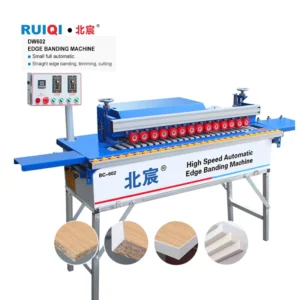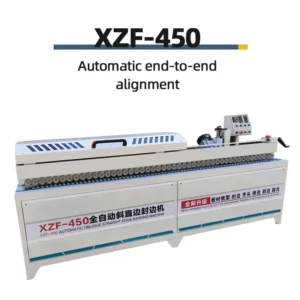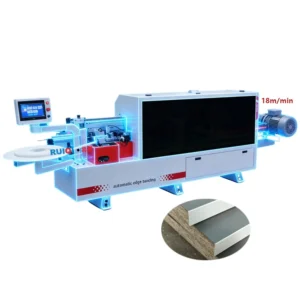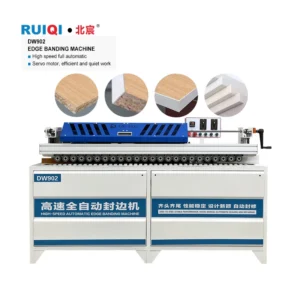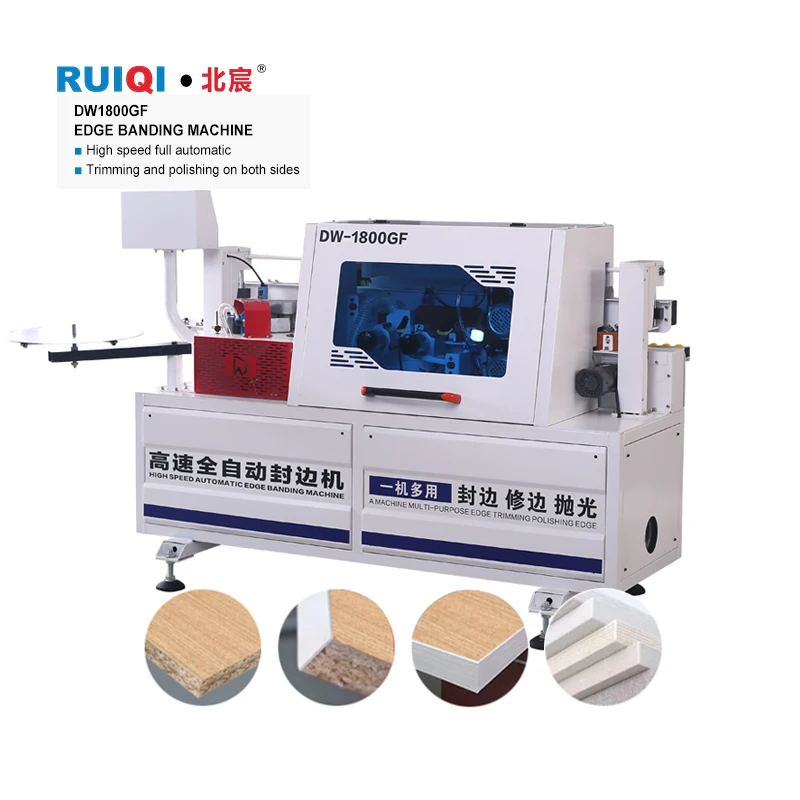
Edge banding machine
Click to enlarge
ISO 9001
CE Certified
OEM / ODM
12-Mo Warranty
Edge banding machine
Industrial Application Edge Banding Machine for Furniture Cabinet MDF
<p><strong>DW1800 Automatic Edge Banding Machine, 4.9 kW, 0-14 m/min feed speed, 0.3-3 mm edge thickness</strong> — delivers double-sided gluing with profile tracking that rounds all four corners, followed by trimming, flexible scraping and polishing in one pass for MDF, particleboard and plywood panels.</p> <ul> <li>Roll-ball differential guide with extruded aluminum alloy ensures stable conveyance and consistent edge contact across varying substrate densities</li> <li>Glue pot capacity of 4000 ml supports continuous runs without frequent refill interruptions</li> <li>Compatible with PVC, veneer and melamine edge banding materials for mixed-material workshop environments</li> </ul> <p>Engineer-led configuration recommendation with formal quotation within 24 hours ensures voltage, language and specification alignment before production begins.</p>
100+
Countries
MOQ 1
Unit
15-25 Days
Lead Time
380V
Cabinet Maker
DW1800
Edge Banding Machine
MDF Panel
Process And Application
Profile Tracking
- Full OEM/ODM support -- custom logo, voltage (110V-440V), multilingual panels
- ISO 9001 & CE certified, 5 national patents, 60 professional engineers
- 12-month warranty, remote technical support & spare parts service
- Professional export packaging, customs clearance support, on-time delivery
Verified Edge Consistency — a complete gluing-to-polishing sequence with profile tracking and double-sided adhesive application ensures panel edges arrive at assembly clean and dimensionally stable.
Technical Specifications
| Parameter | Value |
|---|---|
| Model | DW1800 |
| Product Type | Automatic Edge Banding Machine |
| Total Power | 4.9 kW |
| Voltage Options | 380V / 220V / 415V |
| Feed Speed | 0–14 m/min |
| Edge Banding Speed | 0–14 m/min |
| Glue Pot Capacity | 4000 ml |
| Edge Banding Thickness Range | 0.3–3 mm |
| Edge Banding Height Range | 0–50 mm |
| Minimum Panel Length | 200 mm |
| Minimum Panel Width | 100 mm |
| Trimming Motor Power | 800W × 2 at 24000 r/min |
| Polishing Motor Power | 380W × 2 |
| Vacuum Motor Power | 550W |
| Air Source Pressure | 0.4–0.6 MPa |
| Transmission Motor Power | 180W |
| Edge Motor Power | 160W |
| Overall Dimensions (L×W×H) | 2200 × 650 × 1250 mm |
| Net Weight | 320 kg |
| Standard Functions | Double-sided gluing, front and rear alignment, top and bottom trimming, flexible edge scraping, top and bottom polishing, dust extraction |
| Profile Tracking | Yes (rounds four corners) |
| Guide Structure | Roll-ball differential mobile table guide with high-strength extruded aluminum alloy |
| Table Surface Treatment | Oxidation treatment |
| Control Panel Languages | Chinese and English (Spanish and other languages customizable) |
| Plug Options | EU, USA, AU, UK |
| Blade Inclination Display | Precision instrument visual display |
| Certification | CE, ISO 9001 |
Application Suitability
| Application | Material or Output |
|---|---|
| Kitchen cabinet door edging | MDF and particleboard with PVC or melamine banding |
| Wardrobe side panel finishing | Plywood and ABB boards with veneer or PVC strips |
| Custom furniture component edging | Solid wood panels and organic glass plates up to 50 mm height |
| Small-batch panel processing | Mixed substrate runs requiring frequent banding thickness changeover |
| Workshop-scale production lines | Boards from 200 mm minimum length through full panel sheets |
Why Glue Lines Show Up on Some Substrates and Not Others
Uniform adhesive distribution across varying board densities is what separates a clean edge from a visible seam.
When a PVC MDF Edge Bander hits particleboard, the porous surface absorbs glue differently than it does on sealed MDF or laminated plywood. I have watched entire batches come off the line with hairline gaps on the particleboard panels while the MDF pieces from the same run looked flawless — same machine, same operator, different substrate behaviour. The edge banding machine woodworking process substrate quality relationship depends as much on glue delivery consistency as it does on the trimming stations that follow [NEED_CITE: substrate porosity and hot-melt adhesive penetration rates].
Double-Sided Gluing and What It Changes on the Shop Floor
The DW1800 applies adhesive to both the panel edge and the banding strip simultaneously through its 4000 ml glue pot. This matters when you are running 0.3 mm PVC on thin MDF drawer fronts — one-sided application often starves the bond line on low-density cores. Double-sided coverage keeps the adhesive film continuous across the full 0–50 mm height range, reducing the cold spots that lead to peeling weeks after delivery.
Profile Tracking as a Downstream Assembly Safeguard
Every cabinet door and shelf front that leaves a workshop gets handled, installed, and leaned against. The profile tracking on this edge banding machine woodworking process substrate quality chain rounds all four corners in the same pass, eliminating the sharp burrs that catch on packaging and the gaps that show up when two panels meet at an inside corner. For furniture factories shipping flat-pack or pre-assembled units, corner rounding is what keeps returns down and installers satisfied [NEED_CITE: furniture panel corner finish standards for export markets].
Reading the Specs Through a Production Lens
The 800W × 2 trimming motors running at 24000 r/min define how cleanly the machine cuts excess banding from the panel face. At lower speeds, trimming blades drag on dense PVC and leave micro-chips along the cut line — visible under LED lighting in a finished kitchen. The roll-ball differential mobile table guide with extruded aluminum alloy construction keeps the panel flat and square through every station, which directly affects whether the trimming cut hits the same spot on every board. Combined with the 0–14 m/min variable feed speed, an operator can slow the line for thick 3 mm solid-wood banding on plywood or speed it up for thin melamine strips on particleboard, matching the feed rate to the trimming load. The oxidation-treated table surface prevents corrosion from glue residue and humidity, maintaining flatness over years of use in tropical workshops where ambient moisture is a constant factor.
What Happens When Voltage and Language Are Afterthoughts
I once had a machine land in Vietnam with a 380V motor wired for a site running 220V — the main motor would not start, and the factory floor backed up with unedged panels for two weeks before an electrician could reconfigure the supply. Machines quoted without confirming local voltage and frequency arrive unusable, and control panels in a language the operator cannot read stall commissioning entirely [NEED_CITE: voltage and frequency standards by export market]. The DW1800 ships with selectable voltage from 380V down to 220V and control panels configurable in English, Spanish, or other agreed languages, but those options only help if the conversation happens before the order is placed.
Why This Machine Belongs in a Process-Focused Workshop
In-house manufacturing with patented cutting mechanisms means the trimming accuracy you see on a sample board is repeatable across production runs, not a one-off setup. The four-stage quality check covers incoming material through pre-shipment verification, so the glue pot, trimming blades, and polishing wheels are all validated before the crate closes. Engineer-led configuration means the voltage, plug type, and control language are locked to your facility before production begins rather than discovered as surprises at unboxing. Factory test records on your specified substrate and banding material travel with the machine, giving your team a baseline to match at commissioning [NEED_CITE: CE machinery directive requirements for industrial equipment].
Documentation & Verification
- Factory test record processed on your specified MDF or particleboard thickness before dispatch
- Machine specification sheet confirming selected voltage, frequency, and plug type for your facility
- Operation and maintenance manual delivered in the agreed control panel language
- Electrical schematic with voltage confirmation for local electrician reference at installation
- Spare parts list itemizing trimming blades, polishing wheels, and scraping components
Installation, Commissioning & Support
- Requires a dedicated circuit matching the selected 380V, 220V, or 415V configuration at the confirmed frequency
- Overall footprint of 2200 × 650 mm demands clear access on the infeed and outfeed sides for panel handling
- Air supply must deliver 0.4–0.6 MPa continuously to feed the gluing, trimming, and scraping pneumatic actuators
- Dust extraction port connects to your existing collection system via the 550W vacuum motor interface
- First-run calibration covers feed speed, glue temperature, and trimming blade angle for your chosen banding thickness
- Spare trimming blades and polishing wheels ship with the unit to cover initial consumable needs
Preparing Your Inquiry
Tell us the substrate types you run most often — MDF, particleboard, plywood, or solid wood — along with the edge banding material and thickness range you need to cover. Share your facility voltage and frequency so the motor and control wiring are configured before build. If you are matching this machine to an existing panel saw or boring station, include the upstream feed height and throughput so the 0–14 m/min speed range aligns with your line flow.
Frequently Asked Questions
Q: How does glue application uniformity vary across MDF, particleboard, and plywood?
A: Each substrate absorbs hot-melt adhesive at a different rate due to surface density and porosity. The DW1800 addresses this through its double-sided gluing system and 4000 ml glue pot, which maintains consistent adhesive film thickness across the full 0–50 mm edge height. Operators adjust feed speed and glue temperature to match the specific board core, ensuring bond-line continuity whether the panel is dense MDF or open-structured particleboard.
Q: What edge banding materials and thicknesses work with this machine’s stations?
A: The DW1800 handles PVC, melamine, veneer, and ABS banding from 0.3 mm to 3 mm thick. The trimming motors at 24000 r/min cut cleanly across this range, while the flexible edge scraping and polishing stations adapt to the surface hardness of each material. Thicker solid-wood banding may require reduced feed speed for optimal trimming finish.
Q: How does profile tracking affect corner quality on different panel sizes?
A: Profile tracking rounds all four corners of each panel in the same pass, removing sharp edges that cause handling injuries and visible gaps at panel joints. The system tracks panels from the 200 mm minimum length up through full sheets. Smaller panels and cabinet door components show the most noticeable improvement in corner consistency when profile tracking is engaged.
Q: What dust extraction setup is recommended for maintaining edge quality?
A: The built-in 550W vacuum motor provides suction at the trimming and scraping stations, but a centralized extraction system rated for continuous wood dust and PVC particle collection is recommended for sustained operation. Adequate extraction prevents dust buildup on the polishing wheels, which otherwise leaves micro-scratches on finished edges and reduces polishing wheel lifespan.
Q: How does feed speed selection affect finish quality on different substrates?
A: At the lower end of the 0–14 m/min range, trimming blades spend more contact time per millimeter, producing a smoother cut on dense substrates like solid wood and thick PVC. Higher feed speeds suit thin melamine on particleboard where the trimming load is lighter. Operators typically dial in the optimal speed during the first batch and record it for repeat runs on the same material combination.
Technical Specifications
| Parameter | Value |
|---|---|
| Product Name | Industrial Application Edge Banding Machine for Furniture Cabinet MDF |
| Category | Edge banding machine |
| Voltage Options | 110V / 220V / 380V / 440V (customizable) |
| Frequency | 50Hz / 60Hz (customizable) |
| Certification | ISO 9001, CE |
| MOQ | 1 Unit |
| Lead Time | 15-25 Working Days |
| Warranty | 12 Months |
| OEM / ODM | Available -- logo, color, panel language |
* Detailed technical specifications vary by model. Please contact us with your specific requirements for a complete datasheet.
Shipping & Export
-
Export Packaging
Heavy-duty wooden crate with foam padding and moisture protection
-
Shipping Methods
Sea freight (FCL/LCL), air freight, express -- we support all methods
-
Customs Support
Full documentation: CO, commercial invoice, packing list, HS code assistance
-
Port of Loading
Tianjin / Qingdao port, China -- 20 years export experience
OEM / ODM Services
-
Logo & Branding
Custom logo printing, color scheme, and nameplate engraving
-
Voltage Configuration
110V / 220V / 380V / 440V, 50Hz / 60Hz -- any region supported
-
Multilingual Panels
Control panels in English, Spanish, French, Arabic and more
-
Custom Specifications
Modified dimensions, accessories, or feature sets on request
Get a Quote
Request Product Inquiry
Fill in your details and we'll respond within 24 hours with pricing and availability.
Direct Contact
How It Works
-
1
Confirm requirements & budget
Tell us your factory scale and processing needs
-
2
Receive recommendation & quote
We match the right machine with full specs
-
3
Negotiate & place order
OEM terms, voltage, payment and delivery
-
4
Production & QC inspection
Multi-stage quality control by 60 engineers
-
5
Export packaging & shipment
Professional packing, customs clearance
-
6
After-sales support
12-month warranty, remote tech support
You May Also Like