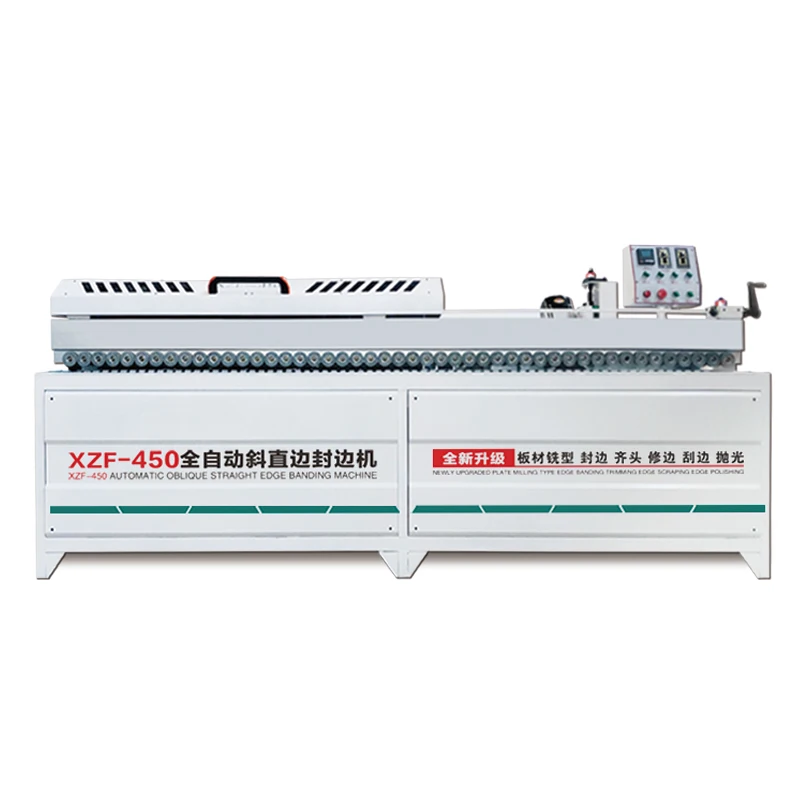
Edge banding machine
Click to enlarge
ISO 9001
CE Certified
OEM / ODM
12-Mo Warranty
Edge banding machine
XZF-450 Edge Banding Machine for Wood Panel Processing
<p><strong>XZF-450 Edge Banding Machine, 9.5KW Total Power, 0-12M/min Feed Speed</strong> — integrates pre-milling, trimming, scraping and polishing across seven stations in one pass. Pre-milling at 4KW removes particleboard tear-out before gluing, directly addressing visible glue lines on MDF and porous substrates. Handles 0.3–3MM PVC, ABS, melamine and veneer banding with 30°/45°/60° bevel capability for shaped panels.</p> <ul> <li>Sample processing test available with your substrate and banding material before order commitment</li> <li>Voltage confirmed to 380V/415V with plug standard matched to your local market</li> <li>Four-stage QC with pre-shipment verification and 99.8% quality pass rate documented per unit</li> </ul>
100+
Countries
MOQ 1
Unit
15-25 Days
Lead Time
380V
Automatic Feeding
Edge Banding Machine
MDF Panel
Particleboard
Plywood Processing
Pre-milling
XZF-450
- Full OEM/ODM support -- custom logo, voltage (110V-440V), multilingual panels
- ISO 9001 & CE certified, 5 national patents, 60 professional engineers
- 12-month warranty, remote technical support & spare parts service
- Professional export packaging, customs clearance support, on-time delivery
In-house patented mechanisms — The XZF-450 integrates a proprietary 4KW pre-milling station calibrated to remove substrate tear-out before glue application, addressing the most common edge quality failure on porous panels.
Technical Specifications
| Parameter | Value |
|---|---|
| Model | XZF-450 |
| Product Type | Automatic Edge Banding Machine |
| Total Power | 9.5KW |
| Pre-milling Motor | 4KW |
| Trimming Power | 2.2KW × 2 |
| Polishing Power | 0.4KW × 2 |
| Edge Power | 0.16KW |
| Transmission Power | 180W |
| Vacuum Power | 550W |
| Voltage | 380V / 415V |
| Feed Speed | 0–12 m/min |
| Edge Banding Height | 0–50 mm |
| Edge Banding Thickness | 0.3–3 mm |
| Minimum Sheet Length | 30 cm |
| Minimum Sheet Width | 15 cm |
| Glue Pot Capacity | 4000 ml |
| Air Source Pressure | 0.5–0.7 MPa |
| Product Size | 300 × 65 × 135 cm |
| Product Weight | 430 kg |
| Language Options | Chinese, English (customizable to Spanish or other languages) |
| Plug Options | EU, USA, AU, UK |
| Key Features | Pre-milling, 30°/45°/60° edge banding, trimming, scraping, polishing, high-power vacuum extraction |
Application Suitability
| Application | Material or Output |
|---|---|
| Cabinet door and carcass panel production | MDF and melamine-faced particleboard with PVC or ABS banding |
| Plywood furniture component finishing | Plywood panels with natural wood veneer edge banding |
| Solid wood panel edge treatment | Solid wood boards requiring scraping and polishing for seamless transitions |
| Polymer door and shaped panel manufacturing | Profiled components needing 45° or 60° bevel edge banding |
| Custom joinery workshop output | Particleboard and blockboard with melamine or thin PVC edge strips |
Why Visible Glue Lines Persist Even on New Edge Banding Machines
Substrate surface preparation before gluing determines edge adhesion more than any downstream station.
Production managers scaling from manual to automated edge finishing often discover that the edge banding machine woodworking process produces inconsistent results across different panel types. Particleboard tears out during cutting, leaving micro-voids along the edge that trap excess glue and create visible bond lines. MDF behaves differently again — its dense fiber structure demands higher pre-milling torque to achieve a flat bonding surface. Without a dedicated pre-milling stage, these substrate defects transfer directly into the finished edge [NEED_CITE: substrate preparation standards in panel edge finishing]. I have seen workshops blame the glue or the banding material when the real problem was an unprepared edge profile entering the glue station.
How Pre-Milling Resolves Substrate-Dependent Edge Defects
The 4KW pre-milling motor on the XZF-450 removes up to a defined layer from the panel edge before it reaches the glue pot, producing a flat, tear-free bonding surface regardless of whether the upstream saw left chip-out or compression fractures. This stage is what makes the edge banding machine woodworking process repeatable across MDF, plywood, and particleboard without manual parameter changes between batches. Operators running mixed-material production runs benefit most, as the pre-milled surface provides consistent glue absorption across substrate types.
Bevel Edge Banding Beyond Standard 90-Degree Panels
The 30°/45°/60° angle capability extends this machine beyond flat cabinet panels into shaped furniture components and polymer door profiles. Most workshops that handle only straight edges eventually encounter a customer order requiring bevel banding on a contoured panel, and outsourcing that single operation disrupts the production flow. With integrated angle stations, the edge banding machine woodworking process covers shaped components in the same pass sequence as standard panels [NEED_CITE: bevel edge banding applications in custom furniture manufacturing]. This matters for factories producing both flat carcass panels and profiled door fronts on a single line.
Reading the Specification Sheet Against Your Actual Production Requirements
The 0–12 m/min feed speed range allows operators to slow the line for thick veneer banding that demands longer glue open time, then increase speed for thin PVC on high-volume cabinet runs. The 0.3–3 mm banding thickness range covers melamine strips at the lower end and solid wood veneer or heavy ABS at the upper end. The 4000 ml glue pot capacity supports sustained production without frequent refill interruptions, though glue type and temperature must match the banding material selected — EVA hot melt behaves differently from PUR adhesive when processing natural veneer versus PVC. The 0.5–0.7 MPa air pressure requirement drives the pneumatic trimming and scraping stations, and insufficient air supply causes inconsistent edge removal across the panel length.
The Cost of Skipping Substrate-Specific Configuration
Ordering an edge bander without confirming which banding materials you will actually run leads to predictable failures. I once configured a unit for a Southeast Asian customer based on PVC banding samples, and the machine performed well during testing. When the customer switched to natural wood veneer on their own, the glue line became visible and the trimming station left whitened edges. A week of remote parameter adjustment was needed to stabilize output across both materials. Now I ask every buyer to list all banding materials before the machine ships, because retrofitting stations or replacing rollers after installation costs far more than configuring correctly at the factory [NEED_CITE: edge banding material compatibility in automated finishing lines].
Why Sourcing This Machine from a Manufacturing-Integrated Supplier Matters
The XZF-450 is built in a facility that controls its own precision grinding and multi-stage inspection, meaning the pre-milling and trimming tolerances are verified before the machine ships rather than assumed from component specifications. The patented cutting mechanisms are developed and tested in-house, so replacement parts and technical guidance come from the same engineering team that designed the stations. Voltage and plug configuration are confirmed before production — 380V/415V units ship with EU, USA, AU, or UK plugs as specified, eliminating the commissioning failures that occur when a machine arrives with an incompatible power connection. The control panel language is set to the buyer’s requirement before dispatch, so operators can read the interface from the first production run. Factory test records are generated using the buyer’s specified panel thickness range and banding material, providing documented evidence of edge quality before the machine leaves Shandong.
Documentation & Verification
- CE declaration of conformity covering the XZF-450 pre-milling and trimming station safety requirements
- Factory test record using your specified panel material and edge banding thickness before dispatch
- Electrical schematic confirming voltage, frequency, and plug type for your local installation
- Operation and maintenance manual in the agreed language matching the control panel display
- Spare parts list identifying wear items for pre-milling cutters, trimming blades, and scraping tools
Installation, Commissioning & Support
- The 300 × 65 × 135 cm footprint requires clear floor space plus operator access on the feed and discharge sides
- A dedicated 380V/415V three-phase circuit must be installed before the 9.5KW total load is connected
- The 430 kg machine weight requires standard forklift handling and level concrete flooring for stable operation
- First commissioning includes glue pot temperature calibration and pneumatic pressure setting within the 0.5–0.7 MPa range
- Operator training covers feed speed adjustment across the 0–12 m/min range for different banding thicknesses
- Pre-milling cutter and trimming blade replacement schedules are defined in the maintenance manual
What We Need to Configure the Right Machine for Your Line
Before quoting, I need to know the specific panel substrates you process, the full list of edge banding materials you run or plan to run, and whether any of your products require bevel edge profiles. Confirming your local voltage and frequency standard ensures the electrical system matches your facility on arrival. If you have an existing production line, let me know the upstream cutting equipment and downstream assembly requirements so the feed speed and panel dimensions align with your workflow. Sample processing with your actual materials is available before you commit to an order.
Frequently Asked Questions
Q: How does pre-milling affect edge quality on different substrates such as MDF versus particleboard?
A: Particleboard edges typically show tear-out from the cutting saw, creating voids that trap excess glue and produce visible bond lines. The 4KW pre-milling station removes this damaged layer to expose a flat surface. MDF, being denser, requires more torque to mill cleanly but produces a smoother bonding surface afterward. Plywood edges vary by veneer quality and may need slower feed speeds during pre-milling to prevent splintering.
Q: Which edge banding materials are compatible, and how does glue temperature interact with each?
A: The 0.3–3 mm thickness range covers thin melamine strips, standard PVC and ABS, and thicker natural wood veneer. Each material demands a specific glue temperature and open time — PVC works with standard EVA hot melt at moderate temperatures, while veneer often requires lower temperatures to prevent show-through. The 4000 ml glue pot maintains stable temperature across production runs, but the operator must match the adhesive type to the material before starting.
Q: How do you choose between straight edge and bevel edge banding for different panel profiles?
A: Standard 90-degree edges suit flat cabinet carcass and door panels. Bevel angles at 30°, 45°, or 60° are needed for shaped furniture components, contoured door fronts, and decorative panels where the edge meets the face at an angle. The XZF-450 handles both configurations in the same pass sequence, so workshops producing mixed product lines do not need a separate machine for bevel work.
Q: What feed speed and banding thickness settings produce consistent edge quality at production volume?
A: Thinner banding materials like 0.3 mm melamine tolerate higher feed speeds within the 0–12 m/min range, while thicker veneer or ABS requires slower speeds for adequate glue contact and trimming accuracy. The pre-milling depth and trimming pressure must be adjusted together when switching materials. Running sample pieces at your target speed before committing to a full batch reveals whether the current settings hold edge quality across the panel length.
Q: How does the integrated vacuum extraction affect workshop air quality and downstream finishing?
A: The 550W vacuum system captures dust and trimming debris at the source, preventing particle accumulation on freshly glued edges that would compromise surface finish. This matters for workshops where edge-banded panels move directly to assembly or surface coating — residual dust from trimming causes visible defects in lacquer or foil wrapping. Proper dust extraction ducting must be connected before operation to maintain the designed airflow at each station.
Technical Specifications
| Parameter | Value |
|---|---|
| Product Name | XZF-450 Edge Banding Machine for Wood Panel Processing |
| Category | Edge banding machine |
| Voltage Options | 110V / 220V / 380V / 440V (customizable) |
| Frequency | 50Hz / 60Hz (customizable) |
| Certification | ISO 9001, CE |
| MOQ | 1 Unit |
| Lead Time | 15-25 Working Days |
| Warranty | 12 Months |
| OEM / ODM | Available -- logo, color, panel language |
* Detailed technical specifications vary by model. Please contact us with your specific requirements for a complete datasheet.
Shipping & Export
-
Export Packaging
Heavy-duty wooden crate with foam padding and moisture protection
-
Shipping Methods
Sea freight (FCL/LCL), air freight, express -- we support all methods
-
Customs Support
Full documentation: CO, commercial invoice, packing list, HS code assistance
-
Port of Loading
Tianjin / Qingdao port, China -- 20 years export experience
OEM / ODM Services
-
Logo & Branding
Custom logo printing, color scheme, and nameplate engraving
-
Voltage Configuration
110V / 220V / 380V / 440V, 50Hz / 60Hz -- any region supported
-
Multilingual Panels
Control panels in English, Spanish, French, Arabic and more
-
Custom Specifications
Modified dimensions, accessories, or feature sets on request
Get a Quote
Request Product Inquiry
Fill in your details and we'll respond within 24 hours with pricing and availability.
Direct Contact
How It Works
-
1
Confirm requirements & budget
Tell us your factory scale and processing needs
-
2
Receive recommendation & quote
We match the right machine with full specs
-
3
Negotiate & place order
OEM terms, voltage, payment and delivery
-
4
Production & QC inspection
Multi-stage quality control by 60 engineers
-
5
Export packaging & shipment
Professional packing, customs clearance
-
6
After-sales support
12-month warranty, remote tech support
You May Also Like