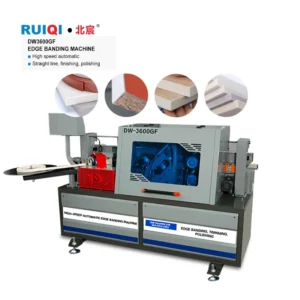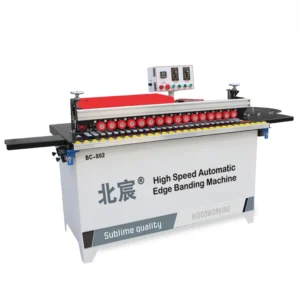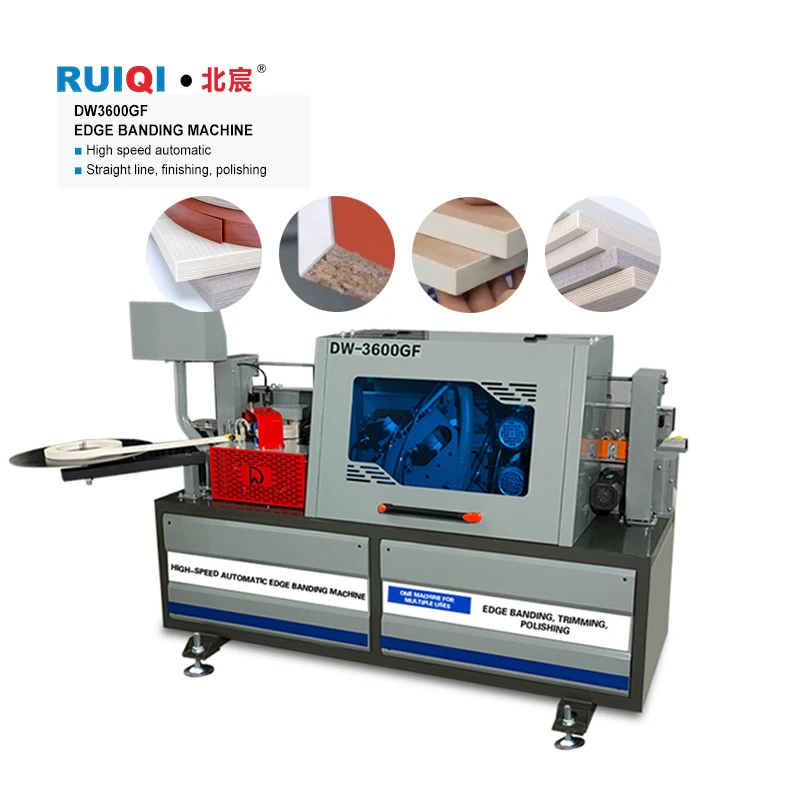
Edge banding machine
Click to enlarge
ISO 9001
CE Certified
OEM / ODM
12-Mo Warranty
Edge banding machine
DW3600 Automatic Edge Banding Machine for MDF – Process Application Guide
<p>Supported by four-stage QC with pre-shipment verification and a factory test record matching your specific board material.</p>
100+
Countries
MOQ 1
Unit
15-25 Days
Lead Time
380V Three-phase
DW-3600GF
DW3600
Edge Banding Machine
Furniture Factory
MDF Panel
Process Application
PVC Edge Banding
- Full OEM/ODM support -- custom logo, voltage (110V-440V), multilingual panels
- ISO 9001 & CE certified, 5 national patents, 60 professional engineers
- 12-month warranty, remote technical support & spare parts service
- Professional export packaging, customs clearance support, on-time delivery
Process integrity — Every gluing, trimming, scraping and polishing station on the DW-3600GF is verified at our Ningjin facility before dispatch, so the edge finish you see on the test sample is what you get on your shop floor.
Technical Specifications
| Parameter | Value |
|---|---|
| Model | DW-3600GF |
| Product Type | Automatic Edge Banding Machine |
| Voltage & Frequency | 380V Three-Phase Four-Wire (50Hz/60Hz to be confirmed) |
| Total Power | 4.9 kW |
| Overall Dimensions (L×W×H) | 2200 × 650 × 1250 mm |
| Net Weight | 320 kg |
| Edge Banding Type | Straight Edge |
| Edge Band Height Range | 0–50 mm |
| Edge Band Thickness Range | 0.3–3 mm |
| Minimum Panel Length | 200 mm |
| Feed Speed | 0–14 m/min |
| Transmission Power | 180 W |
| Trimming Power | 800 W × 2 |
| Trimming Speed | 24,000 r/min |
| Polishing Power | 400 W × 2 |
| Air Supply Requirement | 0.4–0.6 MPa |
| Standard Functions | Gluing, Trimming, Front & Rear End Trimming, Scraping, Polishing, Vacuuming |
| Control Panel Language | Chinese and English standard; Spanish and others on request |
| Plug Options | EU, USA, AU, UK |
| Assembly State | Fully assembled |
Application Suitability
| Application | Material or Output |
|---|---|
| Custom cabinet door and carcass production | MDF panels with PVC edge banding |
| Wardrobe and storage unit panel finishing | Particleboard with melamine or veneer strips |
| Small-to-medium furniture workshop output | Plywood components requiring straight-edge finishing |
| Transition from manual to automated edge finishing | Board stock in 0.3–3 mm band thickness range |
Why Feed Speed Matters More Than You Think in Edge Banding
Matching feed rate to substrate density is the single biggest factor separating a clean edge from a rework pile.
When a production manager asks me why the Edge Banding Machine woodworking process application leaves visible glue lines on some boards but not others, the conversation almost always lands on feed speed. A dense MDF sheet absorbs heat from the glue roller differently than a lighter particleboard, and running both at the same belt speed forces a compromise on bond quality. Operators who dial the variable feed down for high-density substrates and up for lighter stock consistently see cleaner trim lines. [NEED_CITE: MDF density variation and thermal transfer in edge banding adhesion]
Glue Application and Substrate Behaviour
The gluing station applies hot-melt adhesive across the panel edge just before the pressure roller bonds the strip. On MDF, which tends to absorb adhesive quickly, maintaining a consistent glue film thickness requires the operator to balance pot temperature with feed rate. The Edge Banding Machine woodworking process application becomes predictable only when these two variables are matched to the specific board density on the line.
Trimming Station Dynamics and Edge Cleanliness
Once the band is bonded, the front and rear end-trimming cutters remove excess strip length, followed by top-and-bottom trimming cutters running at 24,000 r/min. This spindle speed is important for PVC and thin veneer materials because a slower cutter tends to tear rather than shear the strip. Dual 800 W trimming motors hold torque under load so the cutters do not stall when transitioning from a thin 0.3 mm strip to a heavier 3 mm band. [NEED_CITE: high-frequency trimming spindle requirements for PVC edge band materials]
Reading the Spec Sheet Against Your Actual Panels
Panel thickness range, glue pot operating temperature, and tolerance figures are not always listed on entry-level spec sheets, yet they define whether the machine fits your product mix. A 4.9 kW total power envelope means the DW-3600GF is sized for workshops that run a moderate variety of board thicknesses rather than high-volume single-format lines. The 0.4–0.6 MPa air supply drives the pneumatic actuators at each station, and any pressure drop below this range causes inconsistent scraping and polishing contact, leaving residue on light-coloured substrates. Operators should verify that their compressor and dryer can sustain the required flow rate before commissioning.
When a Misconfigured Machine Costs You Weeks
One cabinet maker I worked with received a machine wired for a voltage standard that did not match their facility. The transformer swap delayed production by several weeks and nearly triggered a full return. That kind of avoidable mismatch happens more often than buyers expect. [NEED_CITE: electrical supply mismatch incidents in exported woodworking machinery]
Why Production Teams Source This Configuration Here
The DW-3600GF is built in a facility where cutting-mechanism patents target the ±0.02 mm tolerance range buyers verify on their own test panels. Four-stage quality control covers incoming material, in-process assembly, finished-product inspection, and pre-shipment verification. Voltage, plug type, and control panel language are confirmed before production starts, so the unit that arrives on your floor matches your electrical supply and operator literacy. Engineers provide a formal configuration recommendation within 24 hours of receiving your panel samples and production brief. Factory visits are welcomed, and any buyer can witness their own boards running through the line before crating.
Documentation & Verification
- Machine specification sheet confirming your panel thickness range and tolerance targets
- Factory test record showing edge finish on your specific MDF or particleboard samples
- Electrical schematic with voltage and frequency confirmation matched to your facility
- Operation and maintenance manual in your agreed language for shop-floor use
- Spare parts list covering trimming cutters, scraping blades, and polishing wheels
Installation, Commissioning & Support
- Allocate a level floor area exceeding 2200 × 650 mm with clearance on both sides for panel feed and off-feed
- Provide a dedicated 380V three-phase circuit matching the confirmed 4.9 kW load and local frequency
- Machine ships fully assembled; position and level before connecting air supply at 0.4–0.6 MPa
- First-run parameter setup covers glue pot temperature, feed speed, and trimming depth for your board stock
- Operator training includes language-specific manual review and safety interlock familiarisation
- Initial spare parts kit covers trimming blades and scraping inserts for the first production cycle
Starting a Productive Inquiry
Share the panel materials, thicknesses, and edge band types you intend to run so the configuration can be matched to your output. Confirm your local voltage, frequency, and preferred plug type early to avoid on-site delays. If you need sample panels processed before commitment, send representative board stock to the factory for a documented test run.
Frequently Asked Questions
Q: How do glue temperature and feed speed interact on different MDF densities?
A: Denser MDF absorbs heat faster, so operators typically raise the pot temperature or reduce feed speed to maintain a consistent glue film. Lighter particleboard needs the opposite balance. Finding the right pairing for your board stock is usually done during the factory test run before the machine ships.
Q: Which PVC edge banding thicknesses does the trimming station handle cleanly?
A: The dual 800 W trimming heads running at 24,000 r/min cut PVC and veneer strips across the 0.3–3 mm range. Thicker bands near 3 mm require a slightly slower feed speed to prevent chipping. Clean results depend on sharp tooling and correct feed rate matching.
Q: How do scraping and polishing remove visible glue lines on light substrates?
A: The scraping blade removes the thin adhesive bead left after trimming, and the polishing wheels buff the edge to a uniform finish. On white or pale melamine boards, this two-stage pass eliminates the shadow line that would otherwise show in finished cabinetry under direct lighting.
Q: What air supply quality is needed for consistent pneumatic performance?
A: The machine requires 0.4–0.6 MPa of clean, dry air. Moisture or particulates in the line cause pneumatic actuators to stick or respond slowly, which affects scraping pressure and polishing contact. A dedicated filter-regulator-lubricator unit upstream of the machine is strongly recommended.
Technical Specifications
| Parameter | Value |
|---|---|
| Product Name | DW3600 Automatic Edge Banding Machine for MDF – Process Application Guide |
| Category | Edge banding machine |
| Voltage Options | 110V / 220V / 380V / 440V (customizable) |
| Frequency | 50Hz / 60Hz (customizable) |
| Certification | ISO 9001, CE |
| MOQ | 1 Unit |
| Lead Time | 15-25 Working Days |
| Warranty | 12 Months |
| OEM / ODM | Available -- logo, color, panel language |
* Detailed technical specifications vary by model. Please contact us with your specific requirements for a complete datasheet.
Shipping & Export
-
Export Packaging
Heavy-duty wooden crate with foam padding and moisture protection
-
Shipping Methods
Sea freight (FCL/LCL), air freight, express -- we support all methods
-
Customs Support
Full documentation: CO, commercial invoice, packing list, HS code assistance
-
Port of Loading
Tianjin / Qingdao port, China -- 20 years export experience
OEM / ODM Services
-
Logo & Branding
Custom logo printing, color scheme, and nameplate engraving
-
Voltage Configuration
110V / 220V / 380V / 440V, 50Hz / 60Hz -- any region supported
-
Multilingual Panels
Control panels in English, Spanish, French, Arabic and more
-
Custom Specifications
Modified dimensions, accessories, or feature sets on request
Get a Quote
Request Product Inquiry
Fill in your details and we'll respond within 24 hours with pricing and availability.
Direct Contact
How It Works
-
1
Confirm requirements & budget
Tell us your factory scale and processing needs
-
2
Receive recommendation & quote
We match the right machine with full specs
-
3
Negotiate & place order
OEM terms, voltage, payment and delivery
-
4
Production & QC inspection
Multi-stage quality control by 60 engineers
-
5
Export packaging & shipment
Professional packing, customs clearance
-
6
After-sales support
12-month warranty, remote tech support
You May Also Like