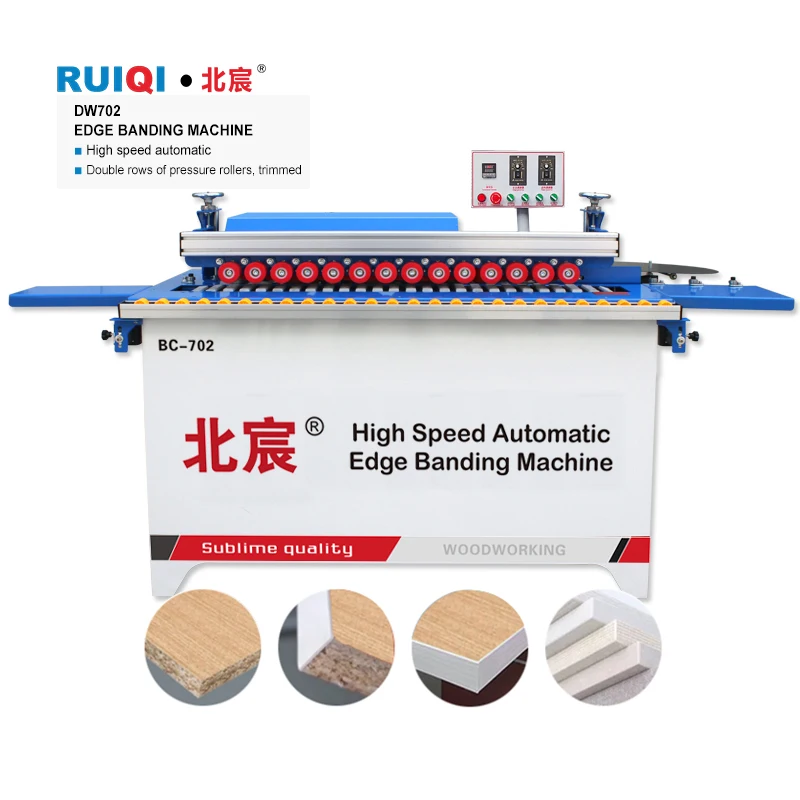
Edge banding machine
Click to enlarge
ISO 9001
CE Certified
OEM / ODM
12-Mo Warranty
Edge banding machine
DW702 Automatic Edge Banding Machine for Wood Panel – Process Guide
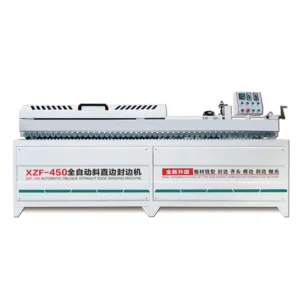
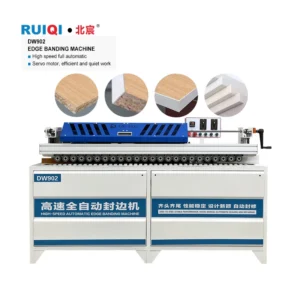
<p><strong>DW702 Automatic Edge Banding Machine, 0.3–3mm Banding Thickness, 0–50mm Edge Height</strong> — performs integrated gluing, trimming and polishing in a single pass for MDF, particleboard and plywood. The dual 800W trimming heads and 1000ml glue pot address substrate porosity differences to maintain consistent edge sealing quality across custom cabinet and furniture panels.</p> <ul> <li>Supports PVC, melamine and veneer banding materials within 0.3–3mm range</li> <li>220V/380V voltage options with multilingual control panel configuration</li> <li>Sample processing test available on your specific substrate before order confirmation <strong>Four-stage QC with pre-shipment verification and factory test records provided for every unit.</strong></li> </ul>
100+
Countries
MOQ 1
Unit
15-25 Days
Lead Time
Automatic Trimming
DW702
Edge Banding Machine
MDF Panel
Process Application
Vacuum Feed
Wood Panel
- Full OEM/ODM support -- custom logo, voltage (110V-440V), multilingual panels
- ISO 9001 & CE certified, 5 national patents, 60 professional engineers
- 12-month warranty, remote technical support & spare parts service
- Professional export packaging, customs clearance support, on-time delivery
Patented cutting mechanisms verified on the shop floor — The DW702 automatic edge banding machine applies consistent trimming pressure across MDF, particleboard and plywood, addressing the substrate variability that stalls cabinet workshops moving from manual to machine-based production.
Technical Specifications
| Parameter | Value |
|---|---|
| Model | DW702 |
| Product Type | Automatic Edge Banding Machine |
| Total Power | 3800W |
| Voltage | 220V / 380V / customization available |
| Edge Banding Height | 0–50 mm |
| Edge Banding Thickness | 0.3–3 mm |
| Minimum Sheet Length | 25 cm (source value — verify against manufacturer catalog) |
| Minimum Sheet Width | 10 cm (source value — verify against manufacturer catalog) |
| Glue Pot Capacity | 1000 ml |
| Air Source Pressure | 0.4–0.8 MPa |
| Transmission Power | 140W |
| Trimming Power | 800W × 2 |
| Polishing Power | 180W × 2 |
| Vacuum Power | 1200W |
| Product Size | 120 × 55 × 110 cm |
| Product Weight | 105 kg |
| Key Features | Integrated edge banding, trimming, polishing, automatic head-and-tail cutting, vacuum-assisted feed |
| Language Options | Chinese, English (configurable to Spanish or other languages) |
Application Suitability
| Application | Material or Output |
|---|---|
| Custom cabinet carcass production | MDF and particleboard panels with PVC edge banding |
| Plywood furniture edge finishing | Plywood sheets with wood veneer banding, clean trim without tear-out |
| Polymer door panel sealing | Polymer composite boards with melamine or PVC edge strips |
| Small-to-medium joinery workshops | Transitioning from hand-applied banding to semi-automated edge processing |
Why Visible Glue Lines Keep Showing Up on Certain Substrates
The glue line you see is usually a substrate porosity problem, not a machine problem.
When I first started commissioning edge banders in furniture workshops across Africa and South Asia, the most common complaint was inconsistent edge banding machine process and application results — clean seals on MDF, then visible glue seepage on particleboard from the same batch of banding material. The DW702’s 1000 ml glue pot and paired trimming stations handle these differences, but only when the operator understands why each substrate behaves differently under heat and pressure [NEED_CITE: substrate porosity and hot-melt adhesion behaviour in panel board processing]. Particleboard absorbs glue unevenly due to its coarse chip structure, while plywood’s cross-grain layers create micro-channels that wick adhesive away from the bond line. Setting a single glue temperature across all three materials guarantees failures on at least one.
Substrate Porosity and Glue Behaviour Across Panel Types
MDF presents the most forgiving surface for edge banding because its fine, uniform fibre structure allows hot-melt adhesive to form a continuous bond line. The edge banding machine process and application on MDF typically requires moderate glue pot temperatures, and the DW702’s dual 800W trimming heads produce a flush finish that rarely needs secondary sanding. Particleboard demands higher glue application volume to compensate for its open chip structure, and operators who skip this adjustment discover weak bonds only during assembly. Plywood introduces a third variable — the grain direction of the outer veneer layer affects how the banding material adheres, and feeding against the grain can cause veneer banding to lift at the trailing edge.
Trimming Accuracy and Its Downstream Effect on Cabinet Assembly
The twin trimming stations on the DW702 each draw 800W, providing enough torque to cut through PVC and melamine banding up to 3 mm thick without chattering. When trimming is incomplete or leaves a raised lip, the panel will not seat flush against its mating part during carcass assembly — a fault that compounds across an entire kitchen run. In joinery workshops I have visited, panels that failed assembly tolerance checks traced back to uneven trimming on the edge bander rather than the panel saw [NEED_CITE: tolerance stack-up in panel furniture assembly from edge finishing defects]. The automatic head-and-tail cutting function removes the overhang at both ends of the panel in the same pass, which reduces the manual cleanup that slows down small-batch custom production.
Reading the Specs That Actually Matter on the Shop Floor
The 0.3–3 mm edge banding thickness range covers the materials most workshops stock: thin PVC for budget cabinet runs, 2 mm melamine for moisture-resistant applications, and real wood veneer for visible furniture faces. Running veneer at the upper end of this range requires careful feed speed control, as the brittle nature of thick veneer makes it prone to cracking at the trimming station. The 0–50 mm edge banding height accommodates standard 18 mm board as well as thicker blockboard and polymer door panels. Air source pressure between 0.4 and 0.8 MPa must be stable — fluctuating pressure causes the vacuum-assisted feed to grip unevenly, producing a wavy edge that the polishing wheels cannot correct. The 1200W vacuum system is what keeps lighter panels like 6 mm MDF backing boards flat against the feed table, preventing the lift that causes banding misalignment on narrow stock.
The Hidden Cost of Skipping the Voltage Confirmation Step
Machines quoted without confirming local voltage and frequency arrive unusable — I have seen workshops wait weeks for a transformer because the edge bander was wired for 380V when the site only had 220V single-phase supply. The DW702 supports 220V/380V and custom configurations, but this must be locked in before production begins, not discovered at uncrating. Control panels delivered in a language the operator cannot read stall commissioning entirely, which is why confirming the language option — Chinese, English, Spanish or another agreed language — belongs in the order specification alongside the electrical schematic [NEED_CITE: electrical supply standards and phase requirements for light industrial machinery in export markets]. Single machines purchased without considering the wider line often turn out incompatible in feed height or throughput with the panel saw upstream, creating bottlenecks that negate any benefit of automation.
What You Are Actually Buying Beyond the Machine Itself
In-house manufacturing with proprietary cutting mechanisms means trimming tolerances are verifiable on the test record, not just claimed in a brochure. The full edge banding product family — from entry-level to full-function pre-milling models — lets a workshop scale production volume without changing supplier or retraining operators on an unfamiliar interface. Voltage, language and specification customization are treated as standard configuration steps rather than special requests that add lead time. Four-stage quality control with pre-shipment verification ensures the unit you receive matches the factory test record. Engineer-led configuration recommendations, with a formal quotation within 24 hours, mean you get a machine matched to your actual panel stock and production rhythm rather than a catalogue default.
Documentation & Verification
- CE declaration of conformity matching the DW702 configuration shipped
- ISO 9001 certificate covering the manufacturing facility
- Machine specification sheet confirming voltage, language and banding thickness range
- Electrical schematic with voltage and phase confirmation for your workshop supply
- Factory test record showing trimming results on your specific panel material
- Operation and maintenance manual in the agreed operator language
Installation, Commissioning & Support
- Allocate floor space for the 120 × 55 × 110 cm footprint with clearance on the feed and discharge sides
- Confirm dedicated circuit capacity for the 3800W total power draw at the agreed voltage
- Machine ships as a single 105 kg unit, positionable by pallet jack without overhead crane
- First-run commissioning includes glue pot temperature calibration for your specific banding material
- Operator training covers air pressure adjustment within the 0.4–0.8 MPa range for different panel weights
- Spare parts list includes trimming blades, polishing wheels and glue pot seals
What to Share Before Requesting a Quote
Send the panel substrates you process most often — MDF, particleboard, plywood or a mix — along with the edge banding material type and thickness you intend to run. Specify your workshop’s available voltage and phase, the control panel language your operators need, and whether you want to submit sample stock for a processing test before committing to the order. If you are planning a wider production line, note your existing panel saw and boring equipment so the feed height and throughput can be matched from the start.
Frequently Asked Questions
Q: How does glue adhesion differ between MDF, particleboard and plywood on the DW702?
A: MDF’s fine fibre structure forms the most uniform bond line. Particleboard’s coarse chips absorb glue unevenly, requiring adjusted application volume. Plywood’s cross-grain veneer layer can wick adhesive away from the bond line, particularly on the outer face. The 1000 ml glue pot allows operators to tune application rates for each substrate.
Q: What edge banding materials work best within the 0.3–3 mm thickness range?
A: Thin PVC suits high-volume budget cabinet runs, while 2 mm melamine offers better moisture resistance for kitchen and bathroom carcasses. Wood veneer up to 3 mm is viable for visible furniture faces but requires slower feed speeds to prevent cracking at the trimming station during processing.
Q: How does trimming accuracy affect panel assembly tolerances downstream?
A: Incomplete trimming leaves a raised lip that prevents panels from seating flush during carcass assembly. This fault compounds across a full kitchen run, forcing rework at the bench. The DW702’s dual 800W trimming heads and automatic head-and-tail cutting reduce this risk when maintained to specification.
Q: What air supply must my workshop meet for stable vacuum-assisted feed?
A: The machine requires compressed air between 0.4 and 0.8 MPa, delivered consistently. Fluctuating pressure causes the 1200W vacuum system to grip unevenly on lighter panels, producing a wavy edge that polishing cannot correct. A dedicated regulator upstream of the machine is recommended.
Q: How do I arrange a sample processing test with my own panel stock?
A: Submit representative samples of your panel substrate and preferred edge banding material. The factory runs a test on the DW702, records trimming results and glue line quality, and shares the factory test record before you confirm the order.
Technical Specifications
| Parameter | Value |
|---|---|
| Product Name | DW702 Automatic Edge Banding Machine for Wood Panel – Process Guide |
| Category | Edge banding machine |
| Voltage Options | 110V / 220V / 380V / 440V (customizable) |
| Frequency | 50Hz / 60Hz (customizable) |
| Certification | ISO 9001, CE |
| MOQ | 1 Unit |
| Lead Time | 15-25 Working Days |
| Warranty | 12 Months |
| OEM / ODM | Available -- logo, color, panel language |
* Detailed technical specifications vary by model. Please contact us with your specific requirements for a complete datasheet.
Shipping & Export
-
Export Packaging
Heavy-duty wooden crate with foam padding and moisture protection
-
Shipping Methods
Sea freight (FCL/LCL), air freight, express -- we support all methods
-
Customs Support
Full documentation: CO, commercial invoice, packing list, HS code assistance
-
Port of Loading
Tianjin / Qingdao port, China -- 20 years export experience
OEM / ODM Services
-
Logo & Branding
Custom logo printing, color scheme, and nameplate engraving
-
Voltage Configuration
110V / 220V / 380V / 440V, 50Hz / 60Hz -- any region supported
-
Multilingual Panels
Control panels in English, Spanish, French, Arabic and more
-
Custom Specifications
Modified dimensions, accessories, or feature sets on request
Get a Quote
Request Product Inquiry
Fill in your details and we'll respond within 24 hours with pricing and availability.
Direct Contact
How It Works
-
1
Confirm requirements & budget
Tell us your factory scale and processing needs
-
2
Receive recommendation & quote
We match the right machine with full specs
-
3
Negotiate & place order
OEM terms, voltage, payment and delivery
-
4
Production & QC inspection
Multi-stage quality control by 60 engineers
-
5
Export packaging & shipment
Professional packing, customs clearance
-
6
After-sales support
12-month warranty, remote tech support
You May Also Like