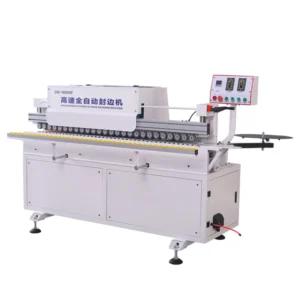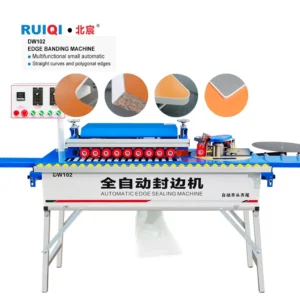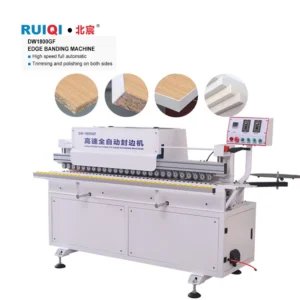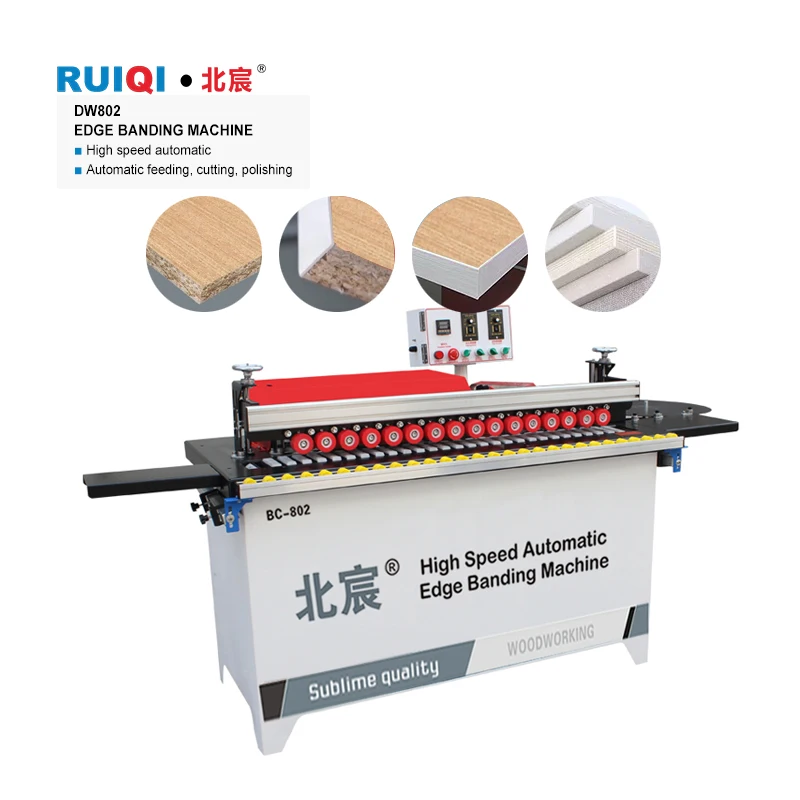
Edge banding machine
Click to enlarge
ISO 9001
CE Certified
OEM / ODM
12-Mo Warranty
Edge banding machine
DW802 Automatic Edge Banding Machine for MDF & Particleboard – Process Guide
<p><strong>DW802 Automatic Edge Banding Machine, 4200W, 220V/380V, 0.3–3mm Banding Thickness</strong> — engineered for MDF, particleboard, plywood, and ecological board edge sealing in custom furniture and home decoration workshops.</p> <ul> <li><strong>0.3–3mm edge banding thickness</strong> handles PVC, melamine, and veneer materials in one setup without recalibration across common panel substrates</li> <li><strong>Dual 800W trimming stations</strong> deliver flush top and bottom trimming in a single pass, reducing chip-out on particleboard leading and trailing edges</li> </ul> <p>Request a sample processing test with your own panel material to verify glue-line visibility and trimming flush on your specific substrate combination.</p>
100+
Countries
MOQ 1
Unit
15-25 Days
Lead Time
380V
Automatic Trimming
DW802
Edge Banding Machine
MDF Panel
Particleboard Edge Sealing
Process And Application
- Full OEM/ODM support -- custom logo, voltage (110V-440V), multilingual panels
- ISO 9001 & CE certified, 5 national patents, 60 professional engineers
- 12-month warranty, remote technical support & spare parts service
- Professional export packaging, customs clearance support, on-time delivery
Integrated Pressure & Thermal Control — the DW802 maintains consistent glue adhesion across MDF, particleboard, and plywood substrates by managing temperature and feed dynamics within a single automated pass.
Technical Specifications
| Parameter | Value |
|---|---|
| Model | DW802 |
| Product Type | Automatic Edge Banding Machine |
| Total Power | 4200W |
| Voltage & Frequency | 220V / 380V / Customization |
| Edge Banding Height | 0–50 mm |
| Edge Banding Thickness | 0.3–3 mm |
| Minimum Sheet Length | 25 cm |
| Minimum Sheet Width | 10 cm |
| Glue Pot Capacity | 4000 ml |
| Air Source Pressure | 0.4–0.8 MPa |
| Trimming Power | 800W × 2 |
| Polishing Power | 180W × 2 |
| Vacuum Power | 1200W |
| Product Size | 130 × 60 × 95 cm |
| Product Weight | 135 kg |
| Language Options | Chinese, English (customizable to Spanish or other languages) |
| Plug Options | EU, USA, AU, UK |
Application Suitability
| Application | Material or Output |
|---|---|
| Cabinet door and shelving edge sealing | MDF and particleboard panels |
| Custom furniture component finishing | Ecological board and plywood |
| Home decoration millwork production | Solid wood board with PVC or veneer banding |
| Small-batch mixed substrate processing | Switching between 0.3 mm melamine and 3 mm PVC banding |
What Substrate Variation Really Means for Edge Banding Machine Woodworking Process Output
Visible glue lines and banding lift-off are almost always a function of substrate density interacting with glue temperature and feed pressure, not a machine defect.
When a production manager receives panels back from assembly with edge banding peeling at the corners, the first assumption is often adhesive failure. In reality, MDF absorbs heat differently than particleboard, and plywood surface irregularities demand different pressure profiles. The DW802 addresses this variation through its integrated vacuum hold-down and adjustable glue application, but the operator still needs to understand how material changes affect the edge banding machine woodworking process outcome. [NEED_CITE: substrate density and thermal conductivity differences in panel processing]
Glue Application Consistency Across Panel Types
The 4000 ml glue pot on the DW802 allows continuous operation across multiple panels before refill is required, reducing operator interruption during batch runs. For production managers running mixed MDF and particleboard orders, this capacity means the thermal equilibrium of the adhesive stays stable throughout a shift. The edge banding machine woodworking process depends heavily on maintaining that thermal consistency, especially when switching between substrates with different surface porosity and absorption characteristics.
Trimming Precision and Downstream Assembly Fit
Dual 800W trimming stations handle flush trimming on both top and bottom edges simultaneously, eliminating the need for secondary manual cleanup. When particleboard panels are trimmed with insufficient power or misaligned cutters, the result is chip-out along the edge that becomes visible after lamination or painting. The DW802’s dedicated trimming motors provide independent cutting force, which matters when running thicker 3 mm PVC banding that demands more torque than standard 0.5 mm melamine strips. [NEED_CITE: trimming station power requirements for varying edge banding thickness]
Reading the Specification Sheet Against Your Actual Production Needs
The edge banding thickness range of 0.3–3 mm covers most common furniture production scenarios, from thin melamine tape on cabinet interiors to thicker PVC or wood veneer on visible door faces. The minimum sheet dimensions — 25 cm length and 10 cm width — define the smallest component the DW802 can process, which affects whether small drawer sides or narrow shelf brackets can run through the machine without manual edge sealing. Air source pressure between 0.4 and 0.8 MPa drives the pneumatic cylinders controlling pressure beam height and trimming station engagement, meaning workshop air supply must be sized to sustain that demand continuously during production cycles. The 1200W vacuum system holds panels against the conveyor fence, and insufficient vacuum on warped plywood sheets can result in skewed feeding and uneven glue distribution along the edge.
When Machine Configuration Does Not Match the Substrate
Production managers who purchase edge banders based on price alone often discover that machines configured for standard PVC banding struggle when the workshop switches to real wood veneer or thin melamine. The glue temperature that works for 2 mm PVC will scorch 0.3 mm melamine, and feed speed optimized for MDF will cause veneer to crack on particleboard edges. These mismatches do not show up during the factory acceptance test when the supplier runs sample panels using their own material. [NEED_CITE: edge banding material compatibility and glue temperature settings]
Why Sourcing Directly from the Manufacturing Floor Matters Here
In-house production with patented cutting mechanisms means the DW802’s trimming stations are designed and tested at the same facility where assembly occurs, not outsourced as separate modules bolted together. Voltage customization from 220V to 380V and plug options for EU, USA, AU, and UK markets are configured before dispatch, so the machine arrives ready to connect without local electrical modification. A four-stage quality check covering incoming material through pre-shipment verification catches tolerance drift before the machine leaves the factory. Control panel language is set to the operator’s requirement — English, Spanish, or other languages — so commissioning does not stall because the crew cannot read the interface. Engineer-led configuration review within 24 hours ensures the quotation reflects actual workshop requirements rather than a generic catalog entry.
Documentation & Verification
- CE declaration of conformity matched to DW802 model specifications
- Factory test record using your panel thickness range and banding material before dispatch
- Electrical schematic confirming voltage and frequency as ordered for local grid compatibility
- Operation and maintenance manual delivered in the agreed operator language
- Spare parts list identifying consumable trimmer blades and glue pot components
Installation, Commissioning & Support
- Requires dedicated circuit matching configured voltage; verify amperage against 4200W total draw
- Machine footprint 130 × 60 cm needs clearance on both sides for panel infeed and outfeed
- Arrives fully assembled; connect air supply at 0.4–0.8 MPa and power before first run
- Initial glue pot temperature calibration performed against your specific banding material stock
- Trimming and polishing station alignment verified on your panel samples during commissioning
- Spare trimming blades and polishing wheels included for early production maintenance
What to Include in Your Inquiry
Provide the specific panel materials you run most frequently — MDF, particleboard, plywood, or ecological board — along with typical thickness and the edge banding material type and width. State your local voltage and frequency so the electrical system is configured correctly before shipment. If you want to verify output quality before committing, request a sample processing test using your own panel and banding stock shipped to the factory.
Frequently Asked Questions
Q: What panel thickness and edge banding thickness range does the DW802 handle, and how does substrate density affect glue adhesion?
A: The DW802 processes edge banding from 0.3 mm to 3 mm thick on panels up to 50 mm in height. Denser substrates like MDF require different glue temperature settings than particleboard because heat transfers through the material at different rates. Confirm your primary substrate with the supplier so the machine ships with appropriate default temperature parameters.
Q: How do glue pot temperature and feed speed interact across different substrates?
A: Higher feed speeds reduce contact time between glue and substrate, requiring higher temperatures for proper adhesion. MDF tolerates higher temperatures than plywood, which can delaminate under excessive heat. The DW802’s 4000 ml glue pot maintains thermal stability, but operators should document optimal settings for each substrate combination during initial production runs.
Q: Can I run a sample test with my own panel material and banding stock before ordering?
A: Sample processing tests are available and recommended. Ship your panel material and preferred edge banding to the factory, and the test results — including glue-line visibility, trimming flush quality, and adhesion strength — will be documented and shared before you confirm the order.
Q: What trimming result should I expect on particleboard leading and trailing edges?
A: The dual 800W trimming stations cut both top and bottom edges flush, while automatic head and tail cutting removes banding overhang at panel ends. On particleboard, this eliminates the chip-out that manual end-trimming typically causes, producing clean edges suitable for visible cabinet and furniture surfaces.
Q: How do I match the DW802 output speed with upstream and downstream equipment?
A: Confirm the DW802 feed speed against your panel saw cutting rate and boring machine cycle time so panels do not accumulate between stations. Request the machine specification sheet showing feed speed range and compare it against your line throughput requirements to identify potential bottlenecks before installation.
Technical Specifications
| Parameter | Value |
|---|---|
| Product Name | DW802 Automatic Edge Banding Machine for MDF & Particleboard – Process Guide |
| Category | Edge banding machine |
| Voltage Options | 110V / 220V / 380V / 440V (customizable) |
| Frequency | 50Hz / 60Hz (customizable) |
| Certification | ISO 9001, CE |
| MOQ | 1 Unit |
| Lead Time | 15-25 Working Days |
| Warranty | 12 Months |
| OEM / ODM | Available -- logo, color, panel language |
* Detailed technical specifications vary by model. Please contact us with your specific requirements for a complete datasheet.
Shipping & Export
-
Export Packaging
Heavy-duty wooden crate with foam padding and moisture protection
-
Shipping Methods
Sea freight (FCL/LCL), air freight, express -- we support all methods
-
Customs Support
Full documentation: CO, commercial invoice, packing list, HS code assistance
-
Port of Loading
Tianjin / Qingdao port, China -- 20 years export experience
OEM / ODM Services
-
Logo & Branding
Custom logo printing, color scheme, and nameplate engraving
-
Voltage Configuration
110V / 220V / 380V / 440V, 50Hz / 60Hz -- any region supported
-
Multilingual Panels
Control panels in English, Spanish, French, Arabic and more
-
Custom Specifications
Modified dimensions, accessories, or feature sets on request
Get a Quote
Request Product Inquiry
Fill in your details and we'll respond within 24 hours with pricing and availability.
Direct Contact
How It Works
-
1
Confirm requirements & budget
Tell us your factory scale and processing needs
-
2
Receive recommendation & quote
We match the right machine with full specs
-
3
Negotiate & place order
OEM terms, voltage, payment and delivery
-
4
Production & QC inspection
Multi-stage quality control by 60 engineers
-
5
Export packaging & shipment
Professional packing, customs clearance
-
6
After-sales support
12-month warranty, remote tech support
You May Also Like