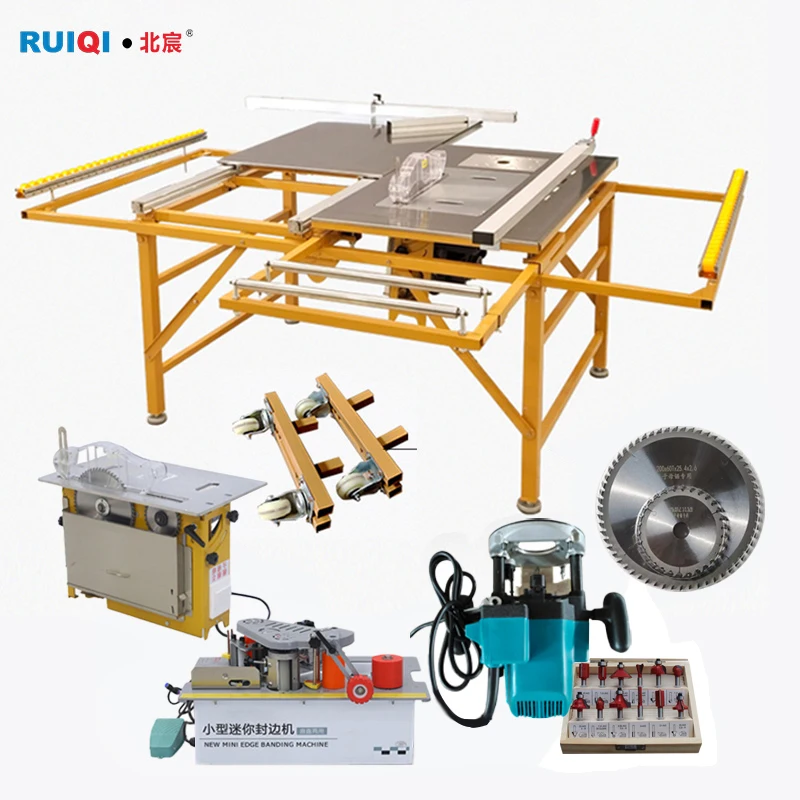
Edge banding machine
Click to enlarge
ISO 9001
CE Certified
OEM / ODM
12-Mo Warranty
Edge banding machine
JT160 PRO Portable Folding Woodworking Table Saw with Edge Banding Machine for Small Workshop
<p><strong>JT160 PRO Portable Folding Woodworking Table Saw with Edge Banding Machine, 6200W, 220V/380V</strong> — combines a dual-blade folding saw table and compact edge banding unit for small workshops.</p> <ul> <li>Sub-saw runs at <strong>13,000 r/min</strong> to reduce chipping on MDF and particleboard before banding</li> <li>Handles PVC and veneer banding 0.3–3 mm thick on panels up to 50 mm high, both straight and curved edges</li> <li>Foldable 250 × 205 cm work surface supports full 2.44 m sheet cutting in space-constrained environments</li> </ul> <p>Backed by four-stage QC with pre-shipment verification, engineer-led configuration within 24 hours, and voltage/language customization as standard.</p>
100+
Countries
MOQ 1
Unit
15-25 Days
Lead Time
220V 380V
Curved Edge Banding
Edge Banding Machine
JT160 PRO
MDF Panel
Portable Folding Table Saw
Process And Application
Small Workshop
- Full OEM/ODM support -- custom logo, voltage (110V-440V), multilingual panels
- ISO 9001 & CE certified, 5 national patents, 60 professional engineers
- 12-month warranty, remote technical support & spare parts service
- Professional export packaging, customs clearance support, on-time delivery
In-house patented cutting mechanisms — Verified tolerance and proprietary saw design built into a portable system that keeps small workshops cutting and banding without compromise.
Technical Specifications
| Parameter | Value |
|---|---|
| Product Type | Portable Folding Woodworking Table Saw with Edge Banding Machine |
| Model | JT160 PRO |
| Total Power | 6200W (Male and Female Saw) + 1000W (Edge Banding Machine) |
| Main Saw Power and Speed | 3000W, 3800 r/min |
| Sub Saw Power and Speed | 2000W, 13000 r/min |
| Main Saw Diameter | 20 cm |
| Vacuum Cleaner Power | 1200W |
| Maximum Plank Cutting Length | 2.44 m |
| Maximum Plank Cutting Thickness | 4 cm |
| Track Width / Length | 8 cm / 100 cm, double track |
| Voltage Options | 220V / 380V / customization |
| Edge Banding Features | Curved and straight edge banding, manual push plate |
| Minimum Sheet Length (edge banding) | 25 cm |
| Minimum Sheet Width (edge banding) | 5 cm |
| Edge Banding Height | 0–50 mm |
| Edge Banding Thickness | 0.3–3 mm |
| Air Source Pressure | 0.5–0.8 MPa |
| Glue Pot Capacity | 1000 ml |
| Language Options | Chinese and English standard; Spanish or other languages customizable |
| Plug Options | EU / USA / AU / UK |
| Folded Saw Table Size | 100 × 72 × 30 cm |
| Unfolded Saw Table Size | 250 × 205 × 75 cm |
| Male and Female Saw Size | 50 × 30 × 38 cm |
| Edge Banding Machine Size | 54 × 35 × 33 cm |
Application Suitability
| Application | Material or Output |
|---|---|
| Small workshop panel cutting | MDF, particleboard, plywood up to 2.44 m length and 4 cm thickness |
| Compact straight and curved edge banding | PVC and veneer banding, 0.3–3 mm thickness, up to 50 mm panel height |
| Joinery workshops transitioning from manual tools | Semi-automated cutting and banding on small-to-medium panels |
| Mobile or space-constrained production | Foldable saw table with integrated auxiliary banding in on-site or compact environments |
Why the Voltage Question Must Come Before the Woodworking Process Edge Banding and Cutting Machine Order
A machine that cannot be powered on the day it arrives is a machine that costs money every day it sits idle.
I worked with a cabinet maker who received a saw and banding unit only to discover his facility ran on 440V/60Hz while the machine was built for a different supply. The workshop stood still for three weeks waiting for a transformer, and every scheduled delivery slipped [NEED_CITE: voltage and frequency standards by export market]. That is why I now ask for a photo of the factory electrical cabinet before I confirm any quotation. When you are evaluating a woodworking process edge banding and cutting machine, the voltage confirmation is not a footnote — it is the first specification to lock down.
How the Dual-Saw Configuration Shapes Cut Quality
The male and female saw arrangement on the JT160 PRO pairs a 3000W main saw at 3800 r/min with a 2000W sub saw spinning at 13000 r/min. The sub saw scores the panel underside before the main blade completes the cut, which reduces chipping on laminated boards. In a woodworking process edge banding and cutting machine workflow, a clean score line means the edge that meets the banding tape is already smooth, requiring less trimming downstream.
Substrate Behaviour Across MDF, Particleboard and Plywood
Different boards react differently to the same blade and feed approach. MDF cuts cleanly but generates fine dust that can interfere with glue adhesion if not extracted — the 1200W vacuum unit addresses this directly. Particleboard is prone to tear-out along the cut line, which is where the 13000 r/min sub saw earns its place. Plywood, with its alternating grain layers, demands a sharp main saw blade at the correct height to avoid splintering across plies [NEED_CITE: woodworking substrate cutting behaviour and blade selection]. Understanding these differences is essential when the same woodworking process edge banding and cutting machine handles multiple material types in a single production day.
Reading the Specs That Matter on the Shop Floor
The maximum plank cutting length of 2.44 m covers standard full-size sheets, which is the baseline requirement for most panel work. The edge banding thickness range of 0.3–3 mm accommodates both thin PVC for cabinet edges and thicker veneer strips for visible furniture faces. Air source pressure between 0.5–0.8 MPa must be maintained for consistent glue application — a drop below this range leads to uneven adhesion and visible glue lines. The unfolded saw table surface of 250 × 205 cm provides enough support area to keep large panels stable during scoring and cutting, reducing the chance of the board shifting mid-pass.
The Hidden Cost of Skipping Configuration Checks
Ordering a machine without confirming the local electrical supply, the compressed air capacity, or the operator’s language needs leads to problems that only surface after delivery. A workshop with insufficient air pressure will see banding tape lift within days. An operator who cannot read the control panel will stall at commissioning and may misconfigure glue temperature [NEED_CITE: common commissioning delays in exported woodworking machinery]. These are not manufacturing defects — they are specification mismatches that could have been resolved with a checklist before production started.
Why Sourcing This Machine Through Ruiqi Woodwork Works
Every JT160 PRO is built around an in-house cutting mechanism covered by proprietary patents, so the tolerance claims you see are backed by the same team that machined the components. The four-stage QC process — incoming material, in-process, finished product, and pre-shipment verification — means the unit you receive has been tested on actual panel stock, not just bench-checked. Voltage options span 220V to 380V with further customization available, confirmed against your electrical cabinet photo before production begins. Language options for the operation and maintenance manual are set at the order stage, so the operator reading it on day one understands every step. The engineer-led configuration process delivers a formal quotation within 24 hours, including a recommended setup based on your actual panel materials and daily volume.
Documentation & Verification
- CE declaration of conformity matching the JT160 PRO portable saw and banding configuration
- Electrical schematic with your confirmed voltage and plug type noted
- Factory test record run on panel thickness within your specified range
- Operation and maintenance manual in your agreed language
- Spare parts list with consumable item codes for glue pot and saw blades
Installation, Commissioning & Support
- Unfolded table footprint of 250 × 205 cm requires clear floor space and level concrete
- Dedicated circuit matching confirmed voltage (220V or 380V) with appropriate breaker rating
- Arrives folded at 100 × 72 × 30 cm for transport, assembled on site
- First-run calibration of sub saw scoring depth and main saw blade height
- Compressed air line rated to 0.5–0.8 MPa connected before edge banding test
- Glue pot refill cycle and 1000 ml capacity reviewed during operator training
Before You Request a Quotation
Send a photo of your electrical cabinet so we can confirm voltage and frequency match. Tell us which panel materials you cut most often — MDF, particleboard, plywood, or solid wood — and the typical board thickness. Let us know if your operators need a control panel or manual in a language beyond Chinese or English.
Frequently Asked Questions
Q: How does the dual-saw setup affect edge quality on particleboard compared to MDF?
A: The 2000W sub saw at 13000 r/min scores the underside of the panel before the main blade finishes the cut. On particleboard this reduces tear-out significantly, producing a cleaner edge that bonds better with PVC or veneer banding. MDF already cuts cleanly, so the benefit there is mainly dust reduction at the cut line.
Q: What happens if the air pressure drops below 0.5 MPa during edge banding?
A: Insufficient air pressure leads to inconsistent glue application across the banding tape. You will see uneven adhesion, particularly on longer edges or curved sections. The system requires a stable supply between 0.5 and 0.8 MPa to maintain uniform pressure on the banding roller during the entire pass.
Q: Can this combination handle the transition from small batches to higher daily volumes?
A: The JT160 PRO is designed for small workshops and joinery operations moving from manual tools. It handles single-sheet and short-run production well. If your daily volume grows beyond what a manual push-plate workflow supports, a fully automatic edge banding line would be the next step.
Q: Does the glue pot capacity of 1000 ml require frequent refills during a production day?
A: The 1000 ml capacity is sized for the compact edge banding unit on this system. For short runs and small-batch work, it lasts through a typical session. For continuous full-day banding on larger panels, plan for periodic refills to maintain consistent glue temperature and flow.
Technical Specifications
| Parameter | Value |
|---|---|
| Product Name | JT160 PRO Portable Folding Woodworking Table Saw with Edge Banding Machine for Small Workshop |
| Category | Edge banding machine |
| Voltage Options | 110V / 220V / 380V / 440V (customizable) |
| Frequency | 50Hz / 60Hz (customizable) |
| Certification | ISO 9001, CE |
| MOQ | 1 Unit |
| Lead Time | 15-25 Working Days |
| Warranty | 12 Months |
| OEM / ODM | Available -- logo, color, panel language |
* Detailed technical specifications vary by model. Please contact us with your specific requirements for a complete datasheet.
Shipping & Export
-
Export Packaging
Heavy-duty wooden crate with foam padding and moisture protection
-
Shipping Methods
Sea freight (FCL/LCL), air freight, express -- we support all methods
-
Customs Support
Full documentation: CO, commercial invoice, packing list, HS code assistance
-
Port of Loading
Tianjin / Qingdao port, China -- 20 years export experience
OEM / ODM Services
-
Logo & Branding
Custom logo printing, color scheme, and nameplate engraving
-
Voltage Configuration
110V / 220V / 380V / 440V, 50Hz / 60Hz -- any region supported
-
Multilingual Panels
Control panels in English, Spanish, French, Arabic and more
-
Custom Specifications
Modified dimensions, accessories, or feature sets on request
Get a Quote
Request Product Inquiry
Fill in your details and we'll respond within 24 hours with pricing and availability.
Direct Contact
How It Works
-
1
Confirm requirements & budget
Tell us your factory scale and processing needs
-
2
Receive recommendation & quote
We match the right machine with full specs
-
3
Negotiate & place order
OEM terms, voltage, payment and delivery
-
4
Production & QC inspection
Multi-stage quality control by 60 engineers
-
5
Export packaging & shipment
Professional packing, customs clearance
-
6
After-sales support
12-month warranty, remote tech support
You May Also Like