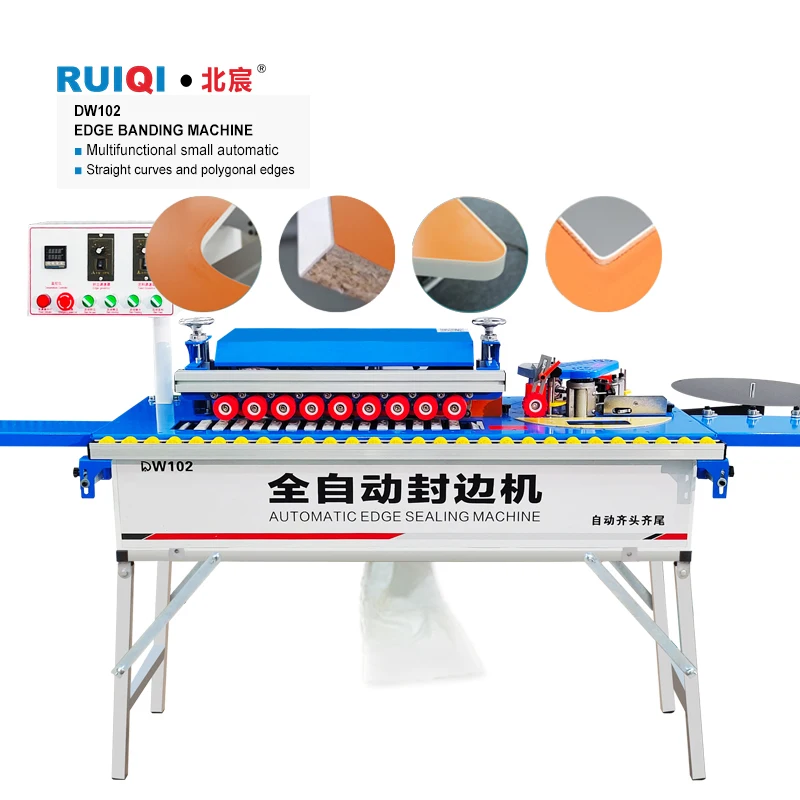
Edge banding machine
Click to enlarge
ISO 9001
CE Certified
OEM / ODM
12-Mo Warranty
Edge banding machine
Small Workshop Curve and Straight Edge Banding Machine for MDF Plywood
<p><strong>DW102 Manual Edge Banding Machine, 220V/380V, 0.3–3mm Edge Thickness, Curve & Straight</strong> — designed for small workshops processing both shaped and flat components on MDF, plywood and particleboard.</p> <ul> <li>Integrated 650W×2 trimming and 180W×2 polishing stations deliver clean edges across curved and straight profiles in one pass</li> <li>1000 ml glue pot supports sustained batch runs without frequent refill interruptions</li> <li>Handles edge banding heights up to 50 mm with vacuum-assisted workholding for stable feed</li> </ul> <p>Engineer-led configuration ensures voltage, frequency and control language match your workshop requirements before shipment, backed by four-stage quality verification.</p>
100+
Countries
MOQ 1
Unit
15-25 Days
Lead Time
CE Certified
Curve and Straight
DW102
Edge Banding Machine
MDF Plywood
Production Tested
Vacuum
- Full OEM/ODM support -- custom logo, voltage (110V-440V), multilingual panels
- ISO 9001 & CE certified, 5 national patents, 60 professional engineers
- 12-month warranty, remote technical support & spare parts service
- Professional export packaging, customs clearance support, on-time delivery
Engineer-led configuration — Every DW102 is matched to your substrate mix and local voltage before production begins, preventing the grid-compatibility failures that stall small workshops.
Technical Specifications
| Parameter | Value |
|---|---|
| Model | DW102 |
| Product Type | Manual Edge Banding Machine (Curve and Straight) |
| Total Power | 3800W |
| Voltage & Frequency | 220V / 380V / customization (frequency to be confirmed: 50Hz or 60Hz) |
| Control System | Manual operation with automatic head and tail trimming |
| Overall Dimensions (L×W×H) | 128 × 47 × 69 cm |
| Net Weight | 75 kg |
| Minimum Sheet Length | 25 cm |
| Minimum Sheet Width | 5 cm |
| Edge Banding Height | 0–50 mm |
| Edge Banding Thickness | 0.3–3 mm |
| Edge Feed Power | 20W |
| Transmission Power | 60W |
| Trimming Power | 650W × 2 |
| Polishing Power | 180W × 2 |
| Vacuum Power | 1200W |
| Glue Pot Capacity | 1000 ml |
| Air Source Pressure | 0.5–0.8 MPa |
| Standard Features | Curved and straight edge banding, edge trimming, polishing, automatic head and tail trimming, vacuum-assisted workholding |
| Language Options | Chinese and English; Spanish and other languages available on customization |
| Plug Options | EU, USA, AU, UK |
| Standards | CE, ISO 9001 |
Application Suitability
| Application | Material or Output |
|---|---|
| Small-scale custom furniture panel edge banding | MDF, blockboard, and particleboard |
| Curved wardrobe and headboard component finishing | Plywood and polymer door panels |
| Cabinet door edge banding in whole-house customization shops | PVC and wood veneer edge tape |
| Joinery workshops transitioning from manual to machine-assisted operation | Mixed straight and curved panel runs |
| Compact production of custom shelving and drawer fronts | Boards from 0.3 mm to 3 mm edge thickness |
Why Voltage Confirmation Matters Before You Compare the Edge Banding Machine Process and Application
A machine that cannot run on your local grid produces nothing — regardless of its edge finish quality.
I shipped a Manual Edge Banding Machine to a furniture shop in Brazil early in my career. We failed to confirm the local 220V/60Hz specification, and the motor burned out within seconds of being plugged in. The shop owner waited three weeks for a replacement while his production sat idle. That single oversight cost him far more than any price negotiation could have saved. [NEED_CITE: voltage and frequency standards by export market]
The DW102 supports 220V and 380V configurations, but frequency — whether your region runs on 50Hz or 60Hz — must be explicitly stated on the electrical schematic before the unit leaves the factory. A 60Hz motor running on a 50Hz supply will overheat under sustained load, particularly during trimming cycles where the 650W × 2 motors draw heavily. Conversely, undersupplying voltage to a 380V-configured unit from a 220V source will cause the vacuum system and glue pot heater to underperform, resulting in weak workholding and inconsistent glue temperature across the production run.
How Substrate Density Affects Glue Adhesion and Trim Finish
MDF, plywood, and particleboard each demand different glue behaviour during the edge banding machine process and application. MDF’s uniform density allows the EVA hot melt adhesive to penetrate consistently along the glue line, producing a bond that holds through trimming without delamination. Plywood, with its alternating grain layers, absorbs glue unevenly — the 1000 ml glue pot on this unit supports sustained application so the operator can maintain feed contact without stopping to refill mid-panel.
Particleboard presents the greatest challenge: its porous surface can absorb excess adhesive, leaving a starved glue line if the application rate is not adjusted. The manual feed on the DW102 gives the operator direct tactile feedback — you can feel when the edge tape is seating properly versus when it is riding on a dry spot. This level of control is what separates workshop-grade results from the visible seam lines that send cabinet doors back to rework. [NEED_CITE: EVA hot melt adhesion behaviour on porous wood-based substrates]
Curved Versus Straight Edge Behaviour During Feed and Trimming
When you switch from straight cabinet panels to curved wardrobe components on the same machine, the edge tape must conform to a changing radius while the trimming knives follow the contour. The DW102 handles both geometries in a single setup, which matters for shops that produce mixed batches of flat shelving and shaped headboards without the volume to justify separate dedicated machines.
The 0.3–3 mm thickness range covers the PVC tapes used on curved profiles — thinner stock flexes around tighter radii without cracking or lifting at the ends. The automatic head and tail trimming stations engage at panel entry and exit, removing overhang cleanly so the operator does not need to return with a hand router for secondary finishing. This integrated workflow is where the edge banding machine process and application directly influences downstream assembly: panels that arrive at the doweling or hinge boring station with flush, clean edges require no additional prep before hardware installation.
What the Power Breakdown Tells You About Production Capacity
The 3800W total power rating distributes across five functional zones: edge feed (20W), transmission (60W), dual trimming motors (650W × 2), dual polishing wheels (180W × 2), and the vacuum pump (1200W). The vacuum system draws the largest single share, which reflects its role in holding the panel flat against the worktable during curved-edge banding where gravity alone cannot keep the workpiece stable.
The dual 650W trimming motors indicate sufficient torque for cutting through 3 mm PVC and wood veneer without bogging down at the panel head and tail — the points where most manual edge banders leave ragged overhang. The 180W × 2 polishing wheels address the micro-scratches left by trimming knives, producing a surface that reads as finished without hand sanding. The air source pressure requirement of 0.5–0.8 MPa is standard for pneumatic actuators controlling the trimming and polishing station engagement. [NEED_CITE: pneumatic pressure requirements for woodworking trimming actuators]
The Hidden Cost of Skipping Substrate-Specific Sample Testing
Ordering an edge bander based on brochure specifications alone means you discover the glue line quality on your specific MDF or plywood only after the machine arrives. If the bond fails on your substrate, you face weeks of troubleshooting — adjusting glue temperature, testing different adhesive formulations, modifying feed pressure — while production remains stalled. This is not a theoretical scenario; it happens regularly when shops buy machines configured for a generic material range rather than their actual board stock.
Requesting a factory test on your own panel samples and edge tape before shipment shifts this discovery process to the pre-order stage. The test record documents the edge banding machine process and application performance on your materials, giving you a baseline to match during commissioning. Without that document, you have no reference point to determine whether a poor glue line stems from the machine setup or the substrate itself. [NEED_CITE: pre-shipment testing protocols for woodworking machinery]
Why Configuration Depth Separates Reliable Deliveries
Every DW102 ships with a confirmed electrical schematic matching your facility’s voltage and frequency, documented before production begins rather than assumed at packing. The glue pot, trimming motors, and vacuum pump all behave differently at 50Hz versus 60Hz, and the factory builds to the verified specification rather than a default setting.
The four-stage quality control process covers incoming component inspection, in-process assembly checks, finished product testing, and pre-shipment verification — with each stage documented in the factory test record that accompanies your machine. Engineer-led configuration recommendations mean the model selection accounts for your substrate mix, production volume, and workshop layout rather than defaulting to the highest-spec option. Language customization for the operation manual and control panel is confirmed at the order stage, so your operators receive documentation in the language they read. Factory visits are available for buyers who want to witness the edge banding machine process and application on their own materials before committing to an order.
Documentation & Verification
- CE declaration of conformity covering machinery safety directives for this edge bander class
- ISO 9001 certificate documenting the quality management system governing production
- Electrical schematic confirming your specified voltage, frequency, and plug type before dispatch
- Factory test record demonstrating edge banding performance on your submitted panel samples and tape
- Operation and maintenance manual produced in your agreed language, including Spanish on request
- Spare parts list with part numbers for trimming knives, polishing wheels, and glue pot components
Installation, Commissioning & Support
- Requires a level concrete floor section accommodating the 128 × 47 × 69 cm footprint with operator clearance on three sides
- Dedicated electrical circuit matching the confirmed 220V or 380V specification with appropriate breaker rating for the 3800W total draw
- Ships with assembly state to be confirmed — verify whether fully assembled or requiring on-site mounting of trimming and polishing stations
- Initial commissioning includes glue pot temperature calibration, trimming knife alignment, and vacuum pressure verification at your specified 0.5–0.8 MPa
- Operator training covers curved versus straight feed technique, automatic head and tail trimming engagement, and glue refill procedures for the 1000 ml pot
- Wear parts include trimming knife sets and polishing wheels — confirm spare quantities included at shipment
Preparing Your Enquiry for Accurate Configuration
To configure the DW102 for your workshop, provide the substrates you process most frequently — MDF, plywood, particleboard, or a mix — along with the edge tape materials and thicknesses you run. State your local voltage and frequency so the electrical system is built to match from the start. Specify the language required for the operation manual and control panel interface, particularly if your operators need Spanish or another language beyond the standard Chinese and English options. If you want sample edge banding performed on your actual materials before committing, send panel and tape samples to the factory with your enquiry.
Frequently Asked Questions
Q: How does edge banding quality differ between MDF, plywood, and particleboard on the DW102?
A: MDF’s uniform density allows consistent glue penetration and clean trimming. Plywood absorbs adhesive unevenly due to alternating grain layers, requiring steady feed contact that the 1000 ml glue pot supports. Particleboard’s porous surface can starve the glue line if application rate is not adjusted — the manual feed gives operators tactile feedback to compensate during the edge banding machine process and application.
Q: What glue type and temperature work best for PVC versus wood veneer edge tape?
A: EVA hot melt adhesive is standard for both materials, but wood veneer typically requires a slightly higher pot temperature to achieve full penetration into the natural fibre backing. PVC bonds effectively at standard EVA operating temperatures. The 1000 ml glue pot maintains thermal stability across batch runs, though exact temperature settings depend on the specific adhesive manufacturer’s recommendations for your tape stock.
Q: How does curved-edge banding affect feed behaviour compared to straight panels?
A: Curved edges require the tape to flex around a changing radius while the trimming knives follow the contour. The DW102 handles both in a single setup, with vacuum-assisted workholding at 0.5–0.8 MPa keeping the panel stable during curved feed. Thinner edge tape in the 0.3–1 mm range conforms more easily to tight radii without lifting at the head or tail.
Q: What air supply does the vacuum system need for stable workholding?
A: The vacuum pump draws 1200W and requires an air source pressure between 0.5 and 0.8 MPa for consistent panel hold. The pneumatic actuators controlling the trimming and polishing stations share this supply. Ensure your workshop compressor can maintain this pressure range under continuous duty, as pressure drops during curved-edge banding will cause the workpiece to shift against the feed direction.
Q: Can the trimming and polishing stations produce assembly-ready edges without hand finishing?
A: The dual 650W trimming motors remove head and tail overhang in one pass, while the 180W × 2 polishing wheels address micro-scratches left by the knives. On standard PVC and veneer tapes within the 0.3–3 mm range, the output is ready for doweling and hinge boring without secondary hand work. Edge quality should be verified on your specific materials during the pre-shipment factory test.
Technical Specifications
| Parameter | Value |
|---|---|
| Product Name | Small Workshop Curve and Straight Edge Banding Machine for MDF Plywood |
| Category | Edge banding machine |
| Voltage Options | 110V / 220V / 380V / 440V (customizable) |
| Frequency | 50Hz / 60Hz (customizable) |
| Certification | ISO 9001, CE |
| MOQ | 1 Unit |
| Lead Time | 15-25 Working Days |
| Warranty | 12 Months |
| OEM / ODM | Available -- logo, color, panel language |
* Detailed technical specifications vary by model. Please contact us with your specific requirements for a complete datasheet.
Shipping & Export
-
Export Packaging
Heavy-duty wooden crate with foam padding and moisture protection
-
Shipping Methods
Sea freight (FCL/LCL), air freight, express -- we support all methods
-
Customs Support
Full documentation: CO, commercial invoice, packing list, HS code assistance
-
Port of Loading
Tianjin / Qingdao port, China -- 20 years export experience
OEM / ODM Services
-
Logo & Branding
Custom logo printing, color scheme, and nameplate engraving
-
Voltage Configuration
110V / 220V / 380V / 440V, 50Hz / 60Hz -- any region supported
-
Multilingual Panels
Control panels in English, Spanish, French, Arabic and more
-
Custom Specifications
Modified dimensions, accessories, or feature sets on request
Get a Quote
Request Product Inquiry
Fill in your details and we'll respond within 24 hours with pricing and availability.
Direct Contact
How It Works
-
1
Confirm requirements & budget
Tell us your factory scale and processing needs
-
2
Receive recommendation & quote
We match the right machine with full specs
-
3
Negotiate & place order
OEM terms, voltage, payment and delivery
-
4
Production & QC inspection
Multi-stage quality control by 60 engineers
-
5
Export packaging & shipment
Professional packing, customs clearance
-
6
After-sales support
12-month warranty, remote tech support
You May Also Like