Edge banding machine
Click to enlarge
ISO 9001
CE Certified
OEM / ODM
12-Mo Warranty
Edge banding machine
Industrial Application Edge Banding Machine – DW102 Pre Milling
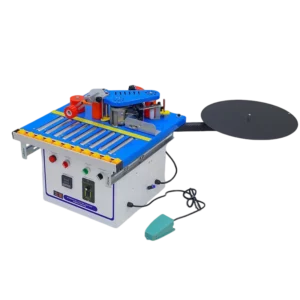
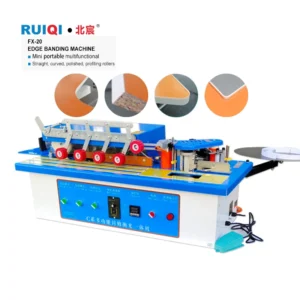
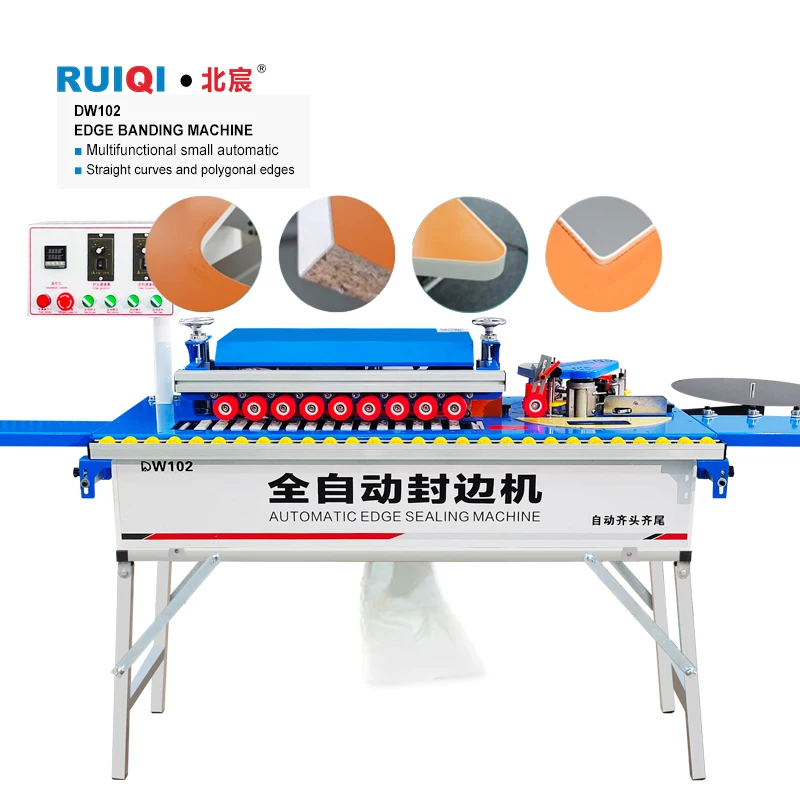
<p><strong>DW102 Multifunctional Automatic Edge Banding Machine, 220V/380V, 0.3–3mm Banding Thickness</strong> — engineered for consistent edge sealing across MDF, plywood, and particleboard substrates in cabinet and furniture production.</p> <ul> <li>Handles curved and straight profiles with dual 650W trimming stations and automatic head/tail cutting</li> <li>1000ml glue pot supports continuous operation; integrated vacuum ensures clean edge termination</li> <li>Processes panels from 25cm length and 5cm width with 0–50mm thickness range</li> </ul> <p>Supported by four-stage QC with pre-shipment verification and engineer-led configuration within 24 hours.</p>
100+
Countries
MOQ 1
Unit
15-25 Days
Lead Time
Curved Edge Banding
DW102
Edge Banding Machine
MDF Panel
Plywood Processing
Pre-milling
Process Application
Vacuum System
- Full OEM/ODM support -- custom logo, voltage (110V-440V), multilingual panels
- ISO 9001 & CE certified, 5 national patents, 60 professional engineers
- 12-month warranty, remote technical support & spare parts service
- Professional export packaging, customs clearance support, on-time delivery
Precision Ground Components — The DW102 Automatic Edge Banding Machine integrates a four-stage QC process with pre-shipment verification to ensure every sealed edge meets tolerance requirements before leaving the factory.
Technical Specifications
| Parameter | Value |
|---|---|
| Model | DW102 |
| Product Type | Multifunctional Automatic Edge Banding Machine |
| Total Power | 3800W |
| Voltage | 220V / 380V / customization |
| Edge Banding Height | 0–50mm |
| Edge Banding Thickness | 0.3–3mm |
| Minimum Sheet Length | 250mm |
| Minimum Sheet Width | 50mm |
| Glue Pot Capacity | 1000ml |
| Trimming Power | 650W × 2 |
| Polishing Power | 180W × 2 |
| Edge Power | 20W |
| Transmission Power | 60W |
| Vacuum Power | 1200W |
| Air Source Pressure | 0.5–0.8 MPa |
| Key Features | Curved and straight edge banding, edge trimming, polishing, automatic head and tail cutting, vacuum system |
| Product Size | 128 × 47 × 69 cm |
| Product Weight | 75 kg |
| Language Options | Chinese, English, Spanish, French, or custom |
| Standards | CE (inferred), ISO 9001 |
Application Suitability
| Application | Material or Output |
|---|---|
| Cabinet carcase edge sealing | Medium density fiberboard (MDF) |
| Furniture panel finishing | Plywood and particleboard |
| Custom joinery components | Wood panels and blockboard |
| Polymer door edge profiling | Polymer composite substrates |
| Radius component banding | Curved MDF and plywood panels |
Why Substrate Density Determines Your Edge Banding Machine Process and Application Outcome
The edge banding machine process and application result is only as reliable as the glue temperature match to your specific panel density.
I spent years at European trade shows watching manufacturers demonstrate flawless PVC banding on MDF, only to discover the same settings fail on denser substrates like birch plywood. Particleboard absorbs heat differently from MDF, and solid wood veneer reacts entirely unlike PVC or ABS strip. When the glue pot temperature does not match the substrate and banding material combination, the adhesive either fails to penetrate or degrades before bonding completes [NEED_CITE: substrate-specific glue temperature requirements for edge banding]. The visible glue line or the lifted edge rarely appears during the demo run — it shows up after the panels acclimate in the customer’s workshop, sometimes weeks into production.
How Glue and Banding Material Selection Affects Edge Quality
The edge banding machine process and application on the DW102 accommodates banding thicknesses from 0.3mm to 3mm, which covers most PVC, ABS, and melamine strips used in cabinet and furniture production. A 1000ml glue pot provides continuous operation without frequent refill interruptions, maintaining thermal stability across a batch. When switching from thin PVC to thicker solid wood veneer, the operator must allow the glue pot to reach the correct working temperature before resuming — rushing this transition is a common cause of delamination on the first few panels after a material change.
Curved and Straight Profiles in a Single Workflow
Workshops producing custom furniture frequently encounter radius components alongside standard rectangular panels. The DW102 handles both curved and straight edge trimming within the same pass, eliminating the need for a secondary manual station for shaped parts. The automatic head and tail cutting mechanism, combined with the integrated vacuum system, keeps the work area clear of trimmed banding debris that can otherwise interfere with downstream polishing [NEED_CITE: vacuum extraction effectiveness on compact edge banding workstations]. This capability matters particularly for joinery workshops transitioning from manual banding to machine-assisted consistency.
Reading the Specs That Actually Impact Output
The dual 650W trimming stations provide sufficient cutting power to profile edges cleanly on banding up to 3mm thick without chatter marks, which directly affects whether panels pass visual inspection before assembly. The polishing stage at 180W per motor smooths the trimmed edge to a finish that does not require secondary handwork. Air source pressure between 0.5 and 0.8 MPa drives the pneumatic actuators controlling feed pressure and trimmer engagement — operating below this range causes inconsistent trimming depth, while exceeding it risks damaging thinner 0.3mm banding. The vacuum system at 1200W captures trim waste at the cutting point, which matters when processing MDF or particleboard where fine dust contaminates the glue line if not extracted immediately. The machine’s minimum sheet dimensions of 250mm length and 50mm width define the lower boundary for automated feeding; smaller offcuts require manual edge treatment outside this workflow.
What Happens When Voltage and Configuration Are Overlooked
Ordering an edge bander without confirming local voltage and frequency is a recurring source of workshop downtime [NEED_CITE: voltage mismatch incidents in imported woodworking machinery]. The DW102 supports 220V, 380V, or custom configurations, but this must be specified before production. A machine wired for 380V three-phase arriving at a 220V single-phase workshop will not run until a transformer is sourced and installed. Beyond electrical supply, operators facing control panels in an unfamiliar language stall at commissioning, sometimes for days, while waiting for translated instructions. The language options on this unit address that gap, but the correct language must be selected at the order stage.
Why Procurement Through This Channel Reduces Process Risk
The configuration recommendation for the DW102 comes from an engineer-led review of your actual substrate mix and banding materials rather than a catalog-only selection. The four-stage quality control process — incoming material inspection, in-process checks, finished product verification, and pre-shipment testing — applies to every unit regardless of order size. In-house manufacturing with proprietary cutting mechanisms means tolerance claims can be verified on your panel samples before shipment [NEED_CITE: verification of edge banding tolerance on customer-supplied substrates]. Voltage, control language, and specification adjustments are treated as standard configuration items, not special requests that add lead time or cost ambiguity.
Documentation & Verification
- Machine specification sheet listing confirmed glue pot temperature range for your banding materials
- Electrical schematic with voltage and frequency marked to match your facility supply
- Factory test record showing edge sealing quality on your actual MDF, plywood, or particleboard samples
- Operation and maintenance manual in the agreed language covering startup and material changeover procedures
- CE declaration of conformity and ISO 9001 certificate for customs and compliance filing
Installation, Commissioning & Support
- Requires a stable level surface supporting the 75kg unit with clearance for 128cm length and panel infeed
- Dedicated electrical circuit matching confirmed 220V or 380V supply with appropriate breaker rating for 3800W total draw
- Compressed air connection at 0.5–0.8 MPa with clean dry air filtration to protect pneumatic trimmer actuators
- Initial glue pot temperature calibration against your specific banding material before production run begins
- Operator training on material changeover between PVC, ABS, and veneer including glue temperature adjustment
Preparing Your Inquiry With the Right Process Details
When requesting a configuration proposal for the DW102, specify the panel substrates you process most frequently and the edge banding materials and thicknesses in your current or planned product mix. Include your local voltage and frequency so the electrical system is built correctly from the start. If you produce curved components, note the typical radius range so the feed system suitability can be confirmed before order.
Frequently Asked Questions
Q: How does edge banding quality vary between MDF, plywood, and particleboard on this machine?
A: Each substrate absorbs and transfers heat differently, affecting how the adhesive bonds to the edge. MDF’s uniform density gives the most consistent results, while plywood’s grain structure and particleboard’s porosity require glue temperature and feed speed adjustments. The DW102 allows these parameters to be tuned per material to maintain edge sealing quality across mixed batches.
Q: What banding materials are compatible with the 1000ml glue pot?
A: The glue pot supports standard EVA-based hot melt adhesives used for PVC, ABS, and melamine edge banding within the 0.3–3mm thickness range. Solid wood veneer requires specific temperature ranges that should be confirmed against the adhesive manufacturer’s data sheet. A factory test on your actual material combination verifies compatibility before production commitment.
Q: How does the vacuum system affect edge adhesion on curved versus straight profiles?
A: On curved profiles, trim waste tends to accumulate around the cutting zone more than on straight runs. The 1200W vacuum system extracts debris at the trimming point, preventing particles from lodging between the banding and panel edge where they would create adhesion failures or visible surface defects during downstream finishing.
Q: What minimum panel dimensions can the DW102 reliably process?
A: The automated feed system requires panels at least 250mm long and 50mm wide to maintain stable transport through the gluing, trimming, and polishing stations. Smaller pieces fall below the feed mechanism’s grip range and should be edge-banded manually or on a dedicated small-part station to avoid misfeed and trimming errors.
Q: How should feed speed and glue temperature be adjusted for different substrate densities?
A: Denser substrates like hardwood plywood require higher glue temperatures to achieve adequate penetration, while lighter particleboard needs lower temperatures to prevent adhesive bleed-through. Feed speed should be reduced when switching to thicker veneer banding to allow sufficient open time for the adhesive. The correct settings for your material combination are validated during the pre-shipment factory test.
Technical Specifications
| Parameter | Value |
|---|---|
| Product Name | Industrial Application Edge Banding Machine – DW102 Pre Milling |
| Category | Edge banding machine |
| Voltage Options | 110V / 220V / 380V / 440V (customizable) |
| Frequency | 50Hz / 60Hz (customizable) |
| Certification | ISO 9001, CE |
| MOQ | 1 Unit |
| Lead Time | 15-25 Working Days |
| Warranty | 12 Months |
| OEM / ODM | Available -- logo, color, panel language |
* Detailed technical specifications vary by model. Please contact us with your specific requirements for a complete datasheet.
Shipping & Export
-
Export Packaging
Heavy-duty wooden crate with foam padding and moisture protection
-
Shipping Methods
Sea freight (FCL/LCL), air freight, express -- we support all methods
-
Customs Support
Full documentation: CO, commercial invoice, packing list, HS code assistance
-
Port of Loading
Tianjin / Qingdao port, China -- 20 years export experience
OEM / ODM Services
-
Logo & Branding
Custom logo printing, color scheme, and nameplate engraving
-
Voltage Configuration
110V / 220V / 380V / 440V, 50Hz / 60Hz -- any region supported
-
Multilingual Panels
Control panels in English, Spanish, French, Arabic and more
-
Custom Specifications
Modified dimensions, accessories, or feature sets on request
Get a Quote
Request Product Inquiry
Fill in your details and we'll respond within 24 hours with pricing and availability.
Direct Contact
How It Works
-
1
Confirm requirements & budget
Tell us your factory scale and processing needs
-
2
Receive recommendation & quote
We match the right machine with full specs
-
3
Negotiate & place order
OEM terms, voltage, payment and delivery
-
4
Production & QC inspection
Multi-stage quality control by 60 engineers
-
5
Export packaging & shipment
Professional packing, customs clearance
-
6
After-sales support
12-month warranty, remote tech support
You May Also Like