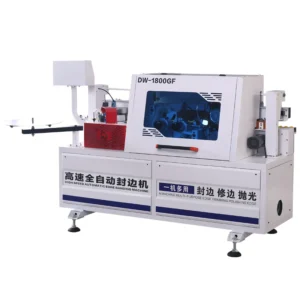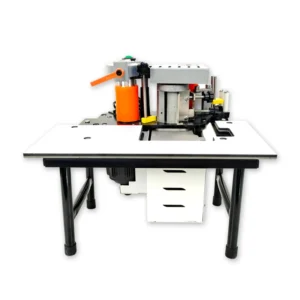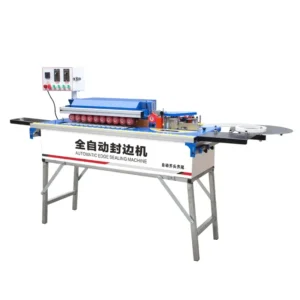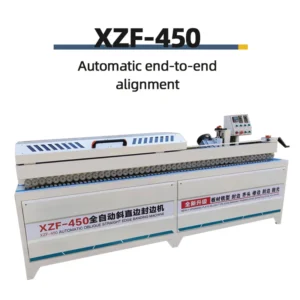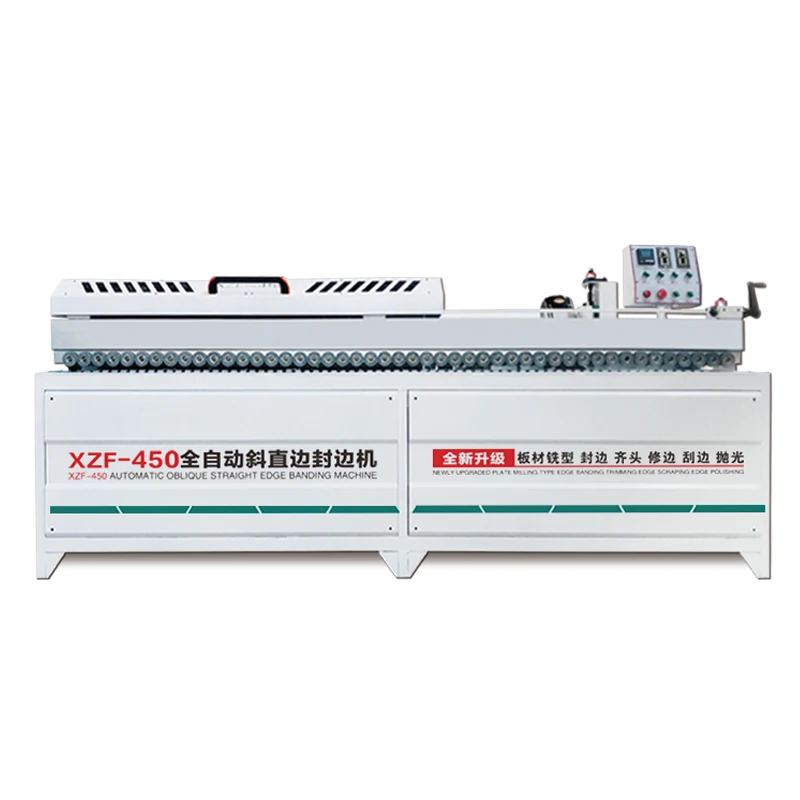
Edge banding machine
Click to enlarge
ISO 9001
CE Certified
OEM / ODM
12-Mo Warranty
Edge banding machine
Multifunctional Automatic Edge Banding Machine for Wood Panel – Process Guide
<p><strong>XZF-450 Automatic Edge Banding Machine, 9.5KW, 380V/415V</strong> — seven-function workflow covering pre-milling, 30/45/60 degree gluing, trimming, scraping and polishing for MDF, plywood and particleboard substrates.</p> <ul> <li>4KW pre-milling station ensures clean edges before gluing, improving adhesion across mixed panel materials</li> <li>0.3–3MM edge banding thickness with 0–12M/min feed speed and 4000ml glue pot for sustained runs</li> <li>Scraping and polishing stages eliminate visible glue lines for assembly-ready output</li> </ul> <p>Engineer-led configuration with voltage and language customization confirmed before production, backed by four-stage QC and pre-shipment test records.</p>
100+
Countries
MOQ 1
Unit
15-25 Days
Lead Time
380V
4KW Pre-Milling
Edge Banding Machine
Furniture Factory
MDF Panel
Process Guide
XZF-450
- Full OEM/ODM support -- custom logo, voltage (110V-440V), multilingual panels
- ISO 9001 & CE certified, 5 national patents, 60 professional engineers
- 12-month warranty, remote technical support & spare parts service
- Professional export packaging, customs clearance support, on-time delivery
Four-stage QC with pre-shipment verification — the XZF-450 woodworking process edge banding machine undergoes incoming material, in-process, finished product, and pre-shipment checks to ensure consistent edge quality across substrates before it leaves the factory floor.
Technical Specifications
| Parameter | Value |
|---|---|
| Model | XZF-450 |
| Product Type | Automatic Edge Banding Machine |
| Total Power | 9.5 kW |
| Voltage | 380V / 415V |
| Pre-milled Motor | 4 kW |
| Trimming Power | 2.2 kW × 2 |
| Polishing Power | 0.4 kW × 2 |
| Edge Power / Speed | 0.16 kW / 0–12 m/min |
| Transmission Power / Speed | 180 W / 0–12 m/min |
| Vacuum Power | 550 W |
| Edge Banding Height | 0–50 mm |
| Edge Banding Thickness | 0.3–3 mm |
| Minimum Sheet Length | 30 cm |
| Minimum Sheet Width | 15 cm |
| Glue Pot Capacity | 4000 ml |
| Air Source Pressure | 0.5–0.7 MPa |
| Standard Features | Plate milling, 30/45/60 degree edge banding, trimming, scraping, polishing, high-power vacuuming |
| Product Size | 300 × 65 × 135 cm |
| Product Weight | 430 kg |
Application Suitability
| Application | Material or Output |
|---|---|
| Custom cabinet panel edge finishing | MDF, melamine-faced board, particleboard |
| Wardrobe and shelving component banding | Plywood, blockboard with PVC or veneer strips |
| Furniture factory single-pass processing | Solid wood board, polymer door panels |
| Mixed-substrate production environments | MDF, plywood, particleboard, blockboard in rotation |
Why Visible Glue Lines Keep Appearing on Certain Substrates
The XZF-450 woodworking process edge banding machine addresses inconsistent glue lines through a dedicated scraping and polishing sequence after trimming.
I once configured a pre-milling edge bander for a cabinet manufacturer using standard MDF test panels. When their actual production switched to moisture-resistant particleboard, the glue line became visible on every piece, and the entire parameter set needed recalibration. That half-month delay taught me that substrate behaviour at the gluing station determines downstream assembly quality more than any single motor specification. [NEED_CITE: substrate density variation and hot-melt adhesive bonding behaviour]
Different panel cores absorb heat from the glue pot at different rates. Particleboard with higher resin content cools the adhesive faster than standard MDF, meaning the pressure roller must engage at a precise moment. Without a scraping station following the trimmers, residual adhesive film remains on the panel surface, creating the visible line that fails quality inspection at the assembly bench.
How Substrate Density Changes the Gluing Window
The 4 kW pre-milling motor on the XZF-450 removes a thin layer from the panel edge before the glue roller applies adhesive, exposing a fresh surface that bonds predictably regardless of whether the board is MDF or high-density particleboard. This step matters because melamine-faced panels often have a compressed surface layer that repels hot-melt adhesive if left un-milled. When the woodworking process edge banding machine prepares the edge correctly, the 4000 ml glue pot maintains a stable thermal mass through sustained runs, reducing temperature fluctuation that causes intermittent bonding failures.
Managing Edge Thickness Across PVC, Veneer, and Melamine Strips
The 0.3–3 mm edge banding thickness range covers the three strip families that most furniture factories rotate through daily. PVC at 2 mm requires different trimming pressure than 0.5 mm melamine, and the dual 2.2 kW trimming motors handle both without manual speed adjustment between batches. Veneer strips sit in the middle of that range and demand careful scraping to avoid tearing the wood grain, which is where the dedicated scraping station between trimming and polishing prevents surface damage that sanding alone cannot correct. [NEED_CITE: edge banding material behaviour under mechanical trimming]
Reading the Specification Sheet Against Your Production Reality
Feed speed on this woodworking process edge banding machine reaches 12 m/min, which suits batch production where panel sizes change frequently and operators need time to load and inspect each piece. The 30 cm minimum sheet length and 15 cm minimum width accommodate the small offcut panels common in custom cabinet work, where nesting software produces irregular remnants that larger machines cannot grip. The 550 W vacuum system extracts trim waste at the source, preventing PVC and melamine chips from accumulating on the conveyor belt and scratching subsequent panels. Air source pressure between 0.5 and 0.7 MPa drives the pneumatic cylinders that position the pressure roller and engage the trimming units, so confirming compressor capacity before installation avoids intermittent cylinder hesitation during production.
What Happens When Voltage Is Confirmed After Shipment
A 380V machine arriving at a workshop wired for 415V three-phase supply will run, but the pre-milling motor and trimming motors draw higher current than designed, shortening bearing life and tripping thermal overloads during extended runs. [NEED_CITE: industrial voltage tolerance and motor winding stress] The air pressure requirement of 0.5–0.7 MPa also depends on the local compressor being correctly sized; an undersized compressor causes the pneumatic pressure roller to lose contact with the panel mid-cycle, producing partial bonding that only shows up when the assembler tries to join two edged panels. These issues do not appear during a brief factory demonstration but emerge within the first week of production volume.
What This Machine Actually Delivers
The seven-function workflow — pre-milling, 30/45/60 degree gluing, end trimming, rough trimming, scraping, polishing, and dust extraction — runs in a single pass, so panels move from raw cut to finished edge without secondary handling. In-house manufacturing with a proprietary cutting mechanism achieves verified edge tolerance that you can measure on the test panels before the machine ships. Voltage configuration from 380V to 415V is confirmed during the quotation stage, not discovered at unpacking. The operation manual arrives in the language your operators actually read, and the factory test record documents performance on your specific substrate and edge material combination. Engineer-led configuration means the proposal accounts for your panel mix and daily volume rather than defaulting to a standard package.
Documentation & Verification
- CE declaration of conformity specific to the XZF-450 automatic edge banding machine
- Factory test record run on your panel thickness and edge material before dispatch
- Electrical schematic confirming 380V/415V wiring and breaker ratings
- Operation and maintenance manual in the agreed operator language
- Spare parts list with part numbers for trimming blades, scraper blades, and glue roller
Installation, Commissioning & Support
- Floor space of 300 × 65 cm plus operator clearance on both infeed and outfeed sides
- Dedicated 380V/415V three-phase circuit rated for the 9.5 kW total power draw
- Machine arrives fully assembled; level the frame and connect air supply at 0.5–0.7 MPa
- First-run calibration sets glue pot temperature, feed speed, and trimming depth for your substrate
- Trimming blade and scraper blade replacement intervals documented in the maintenance schedule
- Pneumatic cylinder inspection and vacuum filter cleaning as part of weekly maintenance routine
What to Include in Your Inquiry
Share the specific panel materials you process most frequently, including thickness range and whether you use moisture-resistant or standard-grade cores. Confirm your workshop voltage and frequency so the electrical system matches local supply before production begins. If you run multiple edge banding materials in a single shift, list the strip types and thicknesses so the trimming and scraping stations are set up for quick changeover. Mention whether you need a sample processing test on your own panels before final acceptance.
Frequently Asked Questions
Q: How does the pre-milling station affect edge quality on different substrates?
A: The 4 kW pre-milling motor removes the compressed surface layer from panel edges before gluing. On MDF this exposes a uniform fibre surface for consistent adhesive absorption. On particleboard it levels the uneven core that hot-melt glue cannot bridge alone. On plywood it trplies any splintered veneer edges left by the panel saw, giving the pressure roller a flat surface to bond against.
Q: What glue type works with the 4000 ml glue pot on this machine?
A: The glue pot is designed for standard EVA hot-melt adhesive pellets commonly used in furniture edge banding. The 4000 ml capacity supports sustained production runs without frequent refilling, maintaining a stable thermal mass that keeps adhesive viscosity consistent. For PUR adhesive or low-temperature formulations, confirm compatibility during the configuration stage before ordering.
Q: Can the machine handle angled edge profiles beyond straight banding?
A: Yes. The XZF-450 supports 30, 45, and 60 degree edge banding in addition to standard straight-edge application. This covers bevelled cabinet door edges and angled shelving components. The pressure roller and trimming units adjust to each angle, and the scraping and polishing stations follow the same contour to deliver a consistent finish across all profile types.
Q: How do the scraping and polishing stages remove visible glue lines?
A: After the dual trimming motors cut the excess edge strip flush with the panel surface, the scraping station removes the thin adhesive film that trimming leaves behind. The polishing station then buffs the edge to a smooth finish. This two-step sequence is what eliminates the visible glue line that causes rejection at the assembly bench, particularly on light-coloured melamine and high-gloss PVC surfaces.
Q: What feed speed and air pressure are needed for consistent edge quality?
A: Feed speed is adjustable from 0 to 12 m/min depending on panel size and operator loading pace. Air source pressure must be maintained between 0.5 and 0.7 MPa to ensure the pneumatic cylinders hold the pressure roller firmly against the panel throughout the gluing zone. A stable compressor supply prevents intermittent bonding failures that appear only during sustained production runs.
Technical Specifications
| Parameter | Value |
|---|---|
| Product Name | Multifunctional Automatic Edge Banding Machine for Wood Panel – Process Guide |
| Category | Edge banding machine |
| Voltage Options | 110V / 220V / 380V / 440V (customizable) |
| Frequency | 50Hz / 60Hz (customizable) |
| Certification | ISO 9001, CE |
| MOQ | 1 Unit |
| Lead Time | 15-25 Working Days |
| Warranty | 12 Months |
| OEM / ODM | Available -- logo, color, panel language |
* Detailed technical specifications vary by model. Please contact us with your specific requirements for a complete datasheet.
Shipping & Export
-
Export Packaging
Heavy-duty wooden crate with foam padding and moisture protection
-
Shipping Methods
Sea freight (FCL/LCL), air freight, express -- we support all methods
-
Customs Support
Full documentation: CO, commercial invoice, packing list, HS code assistance
-
Port of Loading
Tianjin / Qingdao port, China -- 20 years export experience
OEM / ODM Services
-
Logo & Branding
Custom logo printing, color scheme, and nameplate engraving
-
Voltage Configuration
110V / 220V / 380V / 440V, 50Hz / 60Hz -- any region supported
-
Multilingual Panels
Control panels in English, Spanish, French, Arabic and more
-
Custom Specifications
Modified dimensions, accessories, or feature sets on request
Get a Quote
Request Product Inquiry
Fill in your details and we'll respond within 24 hours with pricing and availability.
Direct Contact
How It Works
-
1
Confirm requirements & budget
Tell us your factory scale and processing needs
-
2
Receive recommendation & quote
We match the right machine with full specs
-
3
Negotiate & place order
OEM terms, voltage, payment and delivery
-
4
Production & QC inspection
Multi-stage quality control by 60 engineers
-
5
Export packaging & shipment
Professional packing, customs clearance
-
6
After-sales support
12-month warranty, remote tech support
You May Also Like