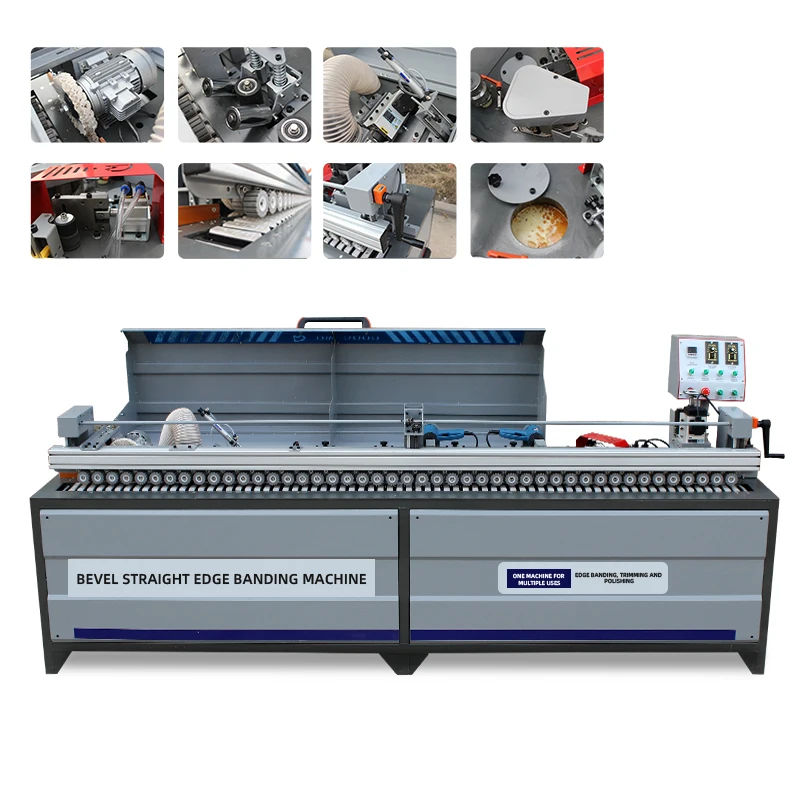
Edge banding machine
Click to enlarge
ISO 9001
CE Certified
OEM / ODM
12-Mo Warranty
Edge banding machine
Automatic Edge Banding Machine for MDF Furniture – Industrial Application
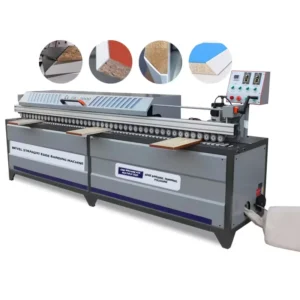
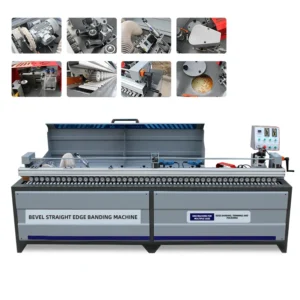
<p><strong>DW3000 Automatic Edge Banding Machine with 45° Bevel and Straight Edge, 11KW, 0–12 m/min Feed Speed</strong> — engineered for MDF, particleboard and plywood panel furniture production.</p> <ul> <li>Double heat guns (2.2 kW × 2) and 8 adjustable oblique pressure wheel groups ensure consistent glue adhesion on both straight and 45° bevel edges, directly affecting downstream assembly fit.</li> <li>Spindle trimming motors and flexible edge scraper deliver clean edge finishes across 0.3–3 mm banding thickness.</li> </ul> <p>Backed by four-stage QC with pre-shipment verification, engineer-led configuration within 24 hours, and voltage/language customization as standard.</p>
100+
Countries
MOQ 1
Unit
15-25 Days
Lead Time
11KW Motor
380V
45° Bevel Edge Banding
DW3000
Edge Banding Machine
Furniture Factory
MDF Panel
Process And Application
- Full OEM/ODM support -- custom logo, voltage (110V-440V), multilingual panels
- ISO 9001 & CE certified, 5 national patents, 60 professional engineers
- 12-month warranty, remote technical support & spare parts service
- Professional export packaging, customs clearance support, on-time delivery
Dual heating and 8-group pressure control — The DW3000 handles both straight and 45° bevel edge banding in one pass, reducing visible glue lines on MDF, particleboard, and plywood substrates that otherwise fail downstream assembly fit checks.
Technical Specifications
| Parameter | Value |
|---|---|
| Model | DW3000 |
| Product Type | Automatic Edge Banding Machine with 45° Bevel and Straight Edge |
| Total Power | 11 kW |
| Voltage and Frequency | 380V / 415V (50Hz or 60Hz — basis to be confirmed) |
| Feed Speed | 0–12 m/min |
| Minimum Panel Length | 30 cm |
| Minimum Panel Width | 15 cm |
| Edge Banding Height | 0–50 mm |
| Edge Banding Thickness | 0.3–3 mm |
| Pre-milling Motor | 2.2 kW |
| Heating Power | 2.2 kW × 2 (double heat gun design) |
| Trimming Motor | 2.2 kW × 2 (spindle trimming motors) |
| Polishing Motor | 0.4 kW × 2 |
| Vacuum Power | 550 W |
| Glue Pot Capacity | 4000 ml |
| Air Source Pressure | 0.5–0.7 MPa |
| Oblique Pressure Wheels | 8 groups, adjustable from 30° to 90° |
| Feeding Belt | Double cylinder feeding belt |
| Overall Dimensions (L×W×H) | 299 × 65 × 130 cm |
| Net Weight | 430 kg |
| Language Options | Chinese and English standard; Spanish, French, and other languages available on request |
| Plug Options | EU / USA / AU / UK (basis to be confirmed for target market) |
| Key Features | Pre-milling, 30–90° edge banding, trimming, scraping, polishing, high-power vacuuming |
Application Suitability
| Application | Material or Output |
|---|---|
| Custom cabinet door production | MDF and particleboard with PVC or veneer edge banding, 45° bevel profile |
| Drawer front edge finishing | Plywood panels with 0.3–3 mm melamine or ABS banding, straight edge |
| Wardrobe panel processing | MDF and particleboard up to 50 mm banding height, mixed straight and bevel runs |
| Small-batch furniture manufacturing | Solid wood panels with veneer banding, frequent changeover between panel widths |
Why the Language on the Control Panel Matters More Than You Think
Operator confusion on day one stalls the entire commissioning timeline.
I have seen fully functional edge banding machines sit idle for days at project sites across Dubai and Riyadh because the control panel displayed English or Chinese text that the local operators could not read. The woodworking edge banding machine process and application depends heavily on correct temperature, feed speed, and pressure settings — all adjusted through that panel. When an operator misreads a parameter label, the glue line suffers before anyone realizes the root cause. [NEED_CITE: control panel language requirements in industrial equipment import regulations]
How Substrate Density Affects Glue Activation
MDF, particleboard, and plywood each absorb heat differently at the glue interface. The double heat gun design on this unit — rated at 2.2 kW per gun — addresses that variability by maintaining consistent thermal input across both straight and 45° bevel edges. Particleboard with its porous structure demands sustained heat to activate adhesive fully, while MDF’s denser fiber composition requires controlled temperature to prevent over-penetration. This woodworking edge banding machine process and application relies on thermal consistency to produce clean glue lines regardless of substrate.
Bevel Edge Pressure Distribution Across Varying Angles
When applying edge banding to a 45° bevel, the contact surface between the pressure wheel and the banding material shifts compared to a straight edge. The 8 groups of oblique pressure wheels, adjustable from 30° to 90°, allow the machine to maintain even pressure along the entire bevel face. Without this adjustability, the banding may bond unevenly — strong at the top edge but peeling at the bottom corner. [NEED_CITE: edge banding adhesion standards for bevel profiles in furniture manufacturing]
Interpreting Feed Speed Against Banding Thickness
The 0–12 m/min feed speed range interacts directly with the 0.3–3 mm banding thickness capacity. Thicker PVC or ABS banding at 2–3 mm requires slower feed rates so the glue has adequate open time before the pressure wheels engage. The pre-milling station at 2.2 kW prepares the panel edge by removing saw marks and ensuring a flat bonding surface — a step that becomes critical when running thicker banding on particleboard where edge porosity varies. The trimming motors at 2.2 kW each then remove the excess banding flush with the panel surface, followed by the flexible edge scraper that cleans residual adhesive before polishing. This sequence determines whether the finished edge passes visual inspection or shows visible glue lines under workshop lighting.
What Happens When Voltage and Frequency Are Assumed
I have watched machines arrive at job sites in the Middle East only to discover the local supply runs at 60Hz while the machine was built for 50Hz — or the voltage sits at 415V when 380V was specified. The motors spin at the wrong speed, the heat guns undershoot target temperature, and the glue never activates properly. The woodworking edge banding machine process and application fails at the most basic level before the operator even loads a panel. Confirming frequency and voltage with the local electrical contractor before placing the order prevents this entirely. [NEED_CITE: voltage and frequency standards by export market]
Why In-House Manufacturing Depth Matters for This Machine Class
The DW3000 carries proprietary cutting mechanism patents that hold tolerance during pre-milling and trimming — verified through the four-stage QC covering incoming material, in-process checks, finished product inspection, and pre-shipment verification. Voltage, language, and plug configuration are customized as standard rather than treated as afterthoughts. An engineer-led configuration review ensures the machine matches your actual panel thickness range and banding material before the quotation is issued. Factory test records on your specific substrate are available before dispatch, so you see real edge quality — not catalog claims — before the crate leaves the floor.
Documentation & Verification
- CE declaration of conformity specific to the edge banding machine category
- ISO 9001 certificate covering manufacturing quality management processes
- Machine specification sheet confirming voltage, frequency, and plug configuration
- Electrical schematic with wiring diagram matching your local supply standard
- Factory test record on your panel material and banding thickness before dispatch
- Operation and maintenance manual in the language your operators actually read
Installation, Commissioning & Support
- Requires a dedicated 380V/415V circuit rated for 11 kW continuous draw with proper grounding
- Floor space of approximately 300 × 65 cm plus operator clearance on the infeed and outfeed sides
- Machine ships assembled; position and level on the workshop floor using adjustable feet
- First-run commissioning includes glue pot temperature calibration and pressure wheel angle setting
- Operator training covers panel loading, banding thickness adjustment, and scraper blade replacement
- Spare parts list includes scraper blades, polishing wheels, and pressure wheel bearings
Preparing Your Inquiry
To move forward, share the panel materials you run most often — MDF, particleboard, plywood, or solid wood — along with the edge banding type and thickness range. Confirm your workshop’s supply voltage and frequency so the motor and heating specifications match from day one. Let us know whether your operators need the control panel in a language beyond Chinese or English, and whether you want to send sample panels for a processing test before committing to production volumes.
Frequently Asked Questions
Q: How can I verify edge banding quality on my specific substrate before ordering?
A: Send sample panels of your actual MDF, particleboard, or plywood along with the edge banding material you plan to use. The factory runs a processing test on this woodworking edge banding machine process and application, then ships the finished samples back so you can inspect glue line visibility, trimming accuracy, and polish quality under your own workshop lighting before any purchase commitment.
Q: What glue and banding materials work with the double heat gun system?
A: The 4400 W combined heating capacity handles standard EVA hot-melt adhesives with PVC, ABS, melamine, and wood veneer banding from 0.3 to 3 mm thick. PUR adhesive systems require different glue pot specifications not included in this configuration. Confirm your preferred adhesive type during the inquiry stage so the heating parameters are matched correctly.
Q: How does the 45° bevel station affect downstream panel assembly?
A: The adjustable oblique pressure wheels maintain even bonding force along the bevel face, preventing gaps that would show after assembly. Spindle trimming motors cut the banding flush at the bevel angle, so mating panels meet without interference. Inconsistent bevel edge quality typically reveals itself as misaligned joints during cabinet box assembly.
Q: What electrical details must I confirm for my local installation?
A: Verify whether your workshop supply is 380V or 415V, and whether the frequency is 50Hz or 60Hz. Confirm the plug type required — EU, USA, AU, or UK — or specify if a hardwired connection is preferred. Getting these details wrong means the motors and heat guns operate outside their design range from the moment you power on.
Q: Can I visit the factory to see the machine run before shipping?
A: Factory visits are welcomed at any stage. You can watch the woodworking edge banding machine process and application run on your panel samples, inspect the four-stage QC documentation, and verify the control panel language before the machine is crated. Remote video test runs are also available if travel is not practical.
Technical Specifications
| Parameter | Value |
|---|---|
| Product Name | Automatic Edge Banding Machine for MDF Furniture – Industrial Application |
| Category | Edge banding machine |
| Voltage Options | 110V / 220V / 380V / 440V (customizable) |
| Frequency | 50Hz / 60Hz (customizable) |
| Certification | ISO 9001, CE |
| MOQ | 1 Unit |
| Lead Time | 15-25 Working Days |
| Warranty | 12 Months |
| OEM / ODM | Available -- logo, color, panel language |
* Detailed technical specifications vary by model. Please contact us with your specific requirements for a complete datasheet.
Shipping & Export
-
Export Packaging
Heavy-duty wooden crate with foam padding and moisture protection
-
Shipping Methods
Sea freight (FCL/LCL), air freight, express -- we support all methods
-
Customs Support
Full documentation: CO, commercial invoice, packing list, HS code assistance
-
Port of Loading
Tianjin / Qingdao port, China -- 20 years export experience
OEM / ODM Services
-
Logo & Branding
Custom logo printing, color scheme, and nameplate engraving
-
Voltage Configuration
110V / 220V / 380V / 440V, 50Hz / 60Hz -- any region supported
-
Multilingual Panels
Control panels in English, Spanish, French, Arabic and more
-
Custom Specifications
Modified dimensions, accessories, or feature sets on request
Get a Quote
Request Product Inquiry
Fill in your details and we'll respond within 24 hours with pricing and availability.
Direct Contact
How It Works
-
1
Confirm requirements & budget
Tell us your factory scale and processing needs
-
2
Receive recommendation & quote
We match the right machine with full specs
-
3
Negotiate & place order
OEM terms, voltage, payment and delivery
-
4
Production & QC inspection
Multi-stage quality control by 60 engineers
-
5
Export packaging & shipment
Professional packing, customs clearance
-
6
After-sales support
12-month warranty, remote tech support
You May Also Like