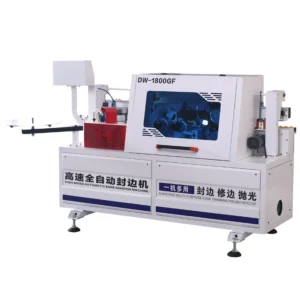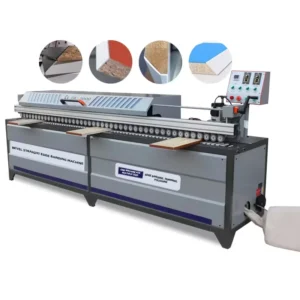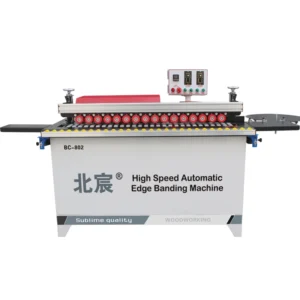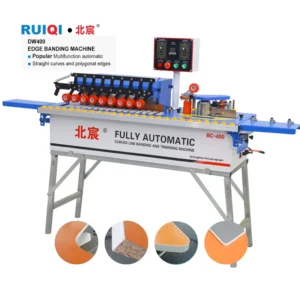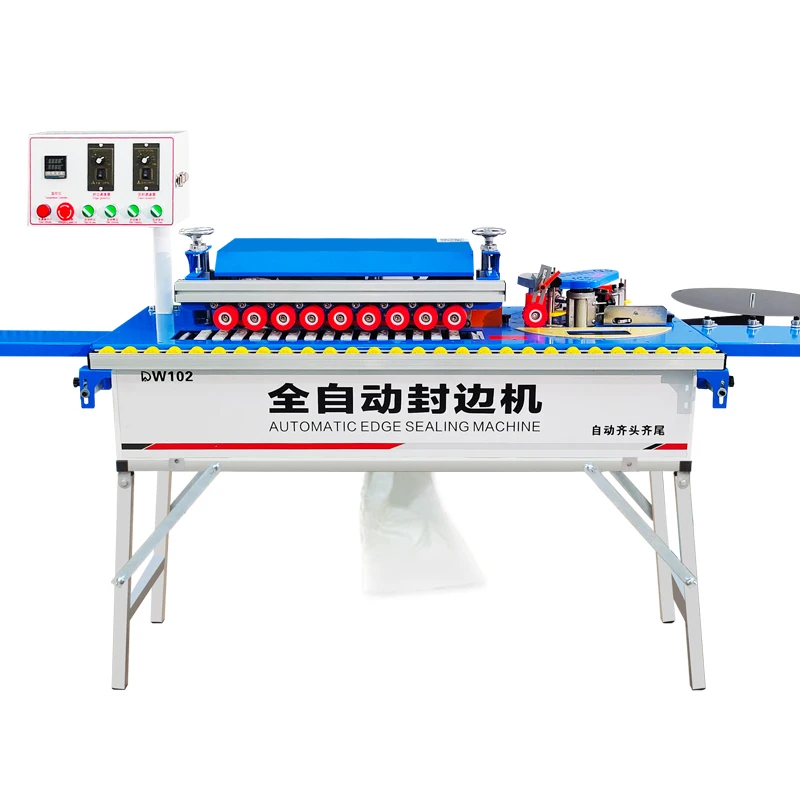
Edge banding machine
Click to enlarge
ISO 9001
CE Certified
OEM / ODM
12-Mo Warranty
Edge banding machine
DW102 Automatic Edge Banding Machine for Furniture Woodwork – Process Guide
<p><strong>DW102 Automatic Edge Banding Machine, 0.3–3MM thickness, 0–50MM height range</strong> — delivers integrated gluing, automatic head and tail cutting, trimming, and polishing in a single pass for MDF, plywood, and particleboard substrates. Edge finish quality directly affects downstream assembly fit, and the 1200W vacuum system controls dust at the trimming station to prevent surface contamination. Straight and curved profiles are handled within the same setup.</p> <ul> <li>Verify edge sealing behavior on your actual substrate with a factory test record before ordering.</li> </ul>
100+
Countries
MOQ 1
Unit
15-25 Days
Lead Time
Automatic Head And Tail Cutting
DW102
Edge Banding Machine
Furniture Production
MDF Panel
Process Guide
Vacuum System
- Full OEM/ODM support -- custom logo, voltage (110V-440V), multilingual panels
- ISO 9001 & CE certified, 5 national patents, 60 professional engineers
- 12-month warranty, remote technical support & spare parts service
- Professional export packaging, customs clearance support, on-time delivery
Precision cutting mechanism — proprietary trimming design holds tight tolerances across MDF and plywood edge profiles on the DW102.
Technical Specifications
| Parameter | Value |
|---|---|
| Model | DW102 |
| Product Type | Automatic Edge Banding Machine |
| Total Power | 3800W |
| Voltage Options | 220V / 380V / customizable |
| Edge Banding Height | 0–50MM |
| Edge Banding Thickness | 0.3–3MM |
| Minimum Sheet Length | 25CM |
| Minimum Sheet Width | 5CM |
| Trimming Power | 650W × 2 |
| Polishing Power | 180W × 2 |
| Vacuum Power | 1200W |
| Glue Pot Capacity | 1000ml |
| Air Source Pressure | 0.5–0.8Mpa |
| Transmission Power | 60W |
| Edge Power | 20W |
| Product Size | 128 × 47 × 69CM |
| Product Weight | 75KG |
| Assembly State | Fully assembled (source value — verify against manufacturer catalog) |
| Control Panel Language | Chinese, English, Spanish, or custom |
| Plug Options | EU, USA, AU, UK |
| Key Features | Curved and straight edge banding, edge trimming, polishing, automatic head and tail cutting, integrated vacuum |
Application Suitability
| Application | Material or Output |
|---|---|
| Cabinet panel edge finishing | MDF and particleboard with PVC or melamine banding |
| Custom furniture visible edges | Plywood and blockboard with veneer banding |
| Polymer door profiling | Curved and straight edge contours on polymer substrates |
| Medium-volume workshop runs | Mixed panel materials requiring frequent banding changeover |
| Joinery and millwork components | Solid wood panels with thin veneer or thick PVC edges |
Why Visible Glue Lines Keep Showing Up on MDF Panels
Substrate density and glue temperature mismatch is the most common cause, not the machine itself.
When a production manager sees inconsistent glue lines across different board types, the instinct is to blame the edge banding machine woodworking process or the adhesive. In my years configuring machines for cabinet shops across Shandong, I have found the issue usually traces back to running the same glue pot temperature on low-density particleboard and high-density MDF without adjustment. MDF absorbs heat differently, and if the glue is too cool by the time it contacts a dense substrate, you get a thick, visible seam. If it is too hot on particleboard, the adhesive soaks into the core and starves the joint [NEED_CITE: thermal conductivity differences between MDF and particleboard during hot-melt application]. The DW102 carries a 1000ml glue pot that holds temperature across batch runs, but the operator still needs to set the correct starting point for the material in the feed bed.
How Substrate Choice Changes the Trimming Behaviour
MDF cuts cleanly under the DW102’s dual 650W trimming heads, producing a smooth edge that the polishing wheels finish without extra passes. Plywood behaves differently — the alternating grain layers can cause micro-chipping if the trimming cutters are set for MDF hardness. Operators switching between these two materials within the same shift should expect to adjust the trimming depth rather than running one setting all day.
Edge Banding Material and Thickness Interaction
The 0.3–3MM thickness range covers most PVC, melamine, and veneer banding used in furniture production. Thin veneer at 0.3MM demands careful polishing pressure — too aggressive and you burn through the face. Thicker PVC at 3MM requires the automatic head and tail cutters to work harder, especially on curved profiles where the banding tends to lift at the ends before the glue sets [NEED_CITE: edge banding adhesion behaviour on curved vs straight panel profiles]. Production managers running a mix of banding materials should treat each changeover as a fresh setup, not a continuation of the previous batch.
What the Spec Sheet Numbers Actually Mean on the Shop Floor
The 0–50MM edge banding height range determines the panel thickness this machine can handle — standard 18MM cabinet stock sits comfortably in the middle, but thinner 5MM back panels and thicker 40MM worktop cores both push toward the extremes of the range. At the thin end, feed stability depends on the vacuum system’s 1200W suction holding the panel flat against the fence. At the thick end, the trimming heads need sufficient travel to reach the full edge depth. The 25CM minimum sheet length matters for small offcut processing — anything shorter risks jamming the feed chain. Voltage flexibility between 220V and 380V means the DW102 can be wired to match whatever the workshop already has, but the frequency must also be confirmed — a 50Hz motor on a 60Hz supply runs faster and hotter than designed, which shortens bearing life on the trimming spindles [NEED_CITE: motor frequency mismatch effects on woodworking spindle bearings]. The 75KG weight keeps the frame stable during trimming vibration without requiring a bolted-down foundation, which matters for workshops that rearrange their layout as production needs change.
What Happens When the Machine Spec Does Not Match the Material
Buying a machine rated for thin PVC and then feeding it 3MM veneer banding daily leads to premature cutter wear and edge lift on curved sections. I have seen workshops run polymer door profiles on equipment never intended for curved edge work, and the result is banding that peels within weeks of installation. The operator blames the glue, the glue supplier blames the primer, and nobody looks at whether the head and tail cutters were ever designed to follow a radius [NEED_CITE: edge banding failure modes on curved panel profiles in furniture assembly]. Matching the machine capability to the actual material mix prevents these downstream quality complaints that surface only after the product reaches the customer.
What Sets This Configuration Apart for Process-Focused Buyers
In-house manufacturing with patented cutting mechanisms means the trimming geometry is designed specifically for the feed speed and panel range of this product family, not adapted from a generic catalogue. The four-stage QC process includes pre-shipment verification with sample panels, so the edge finish you see in the test report is what arrives on your floor. Voltage and language customization is treated as standard configuration, not an expensive add-on — the control panel arrives in the language your operators read, which matters when they need to adjust glue temperature mid-shift. The full product range from entry-level to full-function within one family means a workshop can add capacity later without learning an entirely different control system or retraining maintenance staff on unfamiliar components.
Documentation & Verification
- Factory test record on your specific panel thickness and banding material before dispatch
- Electrical schematic confirming voltage, frequency, and plug type matched to your facility
- Machine specification sheet listing all station powers and working range limits
- Operation manual in the agreed language covering glue pot temperature adjustment per substrate
- Spare parts list with trimming cutter and polishing wheel part numbers for reorder
Installation, Commissioning & Support
- 128 × 47 × 69CM footprint requires a level floor section with clearance on both feed and discharge sides
- 3800W total power draw needs a dedicated circuit — confirm amperage with your electrician before delivery
- Fully assembled arrival means no structural bolting, but air supply at 0.5–0.8Mpa must be connected
- First-run commissioning includes setting glue temperature for your specific MDF or particleboard grade
- Trimming and polishing station adjustment training for operators switching between PVC and veneer banding
- Spare trimming blades and polishing wheels shipped with the machine for immediate replacement stock
Before You Request a Quote
Tell us the panel materials you run most often — MDF, particleboard, plywood, or a mix — along with the typical thickness range and the banding material and thickness you plan to use. Confirm your workshop voltage and frequency so the motor and heating elements are wound correctly. If you process curved profiles on polymer doors or rounded cabinet components, note the minimum radius so we can verify the head and tail cutting behaviour before the order goes to production.
Frequently Asked Questions
Q: How does substrate type affect glue application and trimming on the DW102?
A: MDF, plywood, and particleboard each absorb heat differently from the 1000ml glue pot. MDF holds heat longer, producing a consistent bond line. Particleboard absorbs glue quickly, requiring slightly higher pot temperature to avoid a starved joint. Plywood trimming needs adjusted cutter depth because alternating grain layers chip more easily than uniform MDF under the dual 650W trimming heads.
Q: Which edge banding materials work within the 0.3–3MM thickness range?
A: The DW102 handles PVC, melamine, and veneer banding within that range. Thin 0.3MM veneer requires gentle polishing pressure to avoid burn-through on the 180W polishing wheels. Thicker 3MM PVC demands more from the automatic head and tail cutters, particularly on curved profiles where banding rigidity resists the cut before the adhesive fully sets.
Q: How does automatic head and tail cutting affect curved edge sealing?
A: On curved profiles, banding tends to lift at the leading and trailing edges before the glue cools. The automatic cutters on the DW102 shear the banding flush at both ends in a single pass, which reduces the chance of end-grain lifting that causes peeling after assembly. Straight edges are less affected, but curved polymer door components benefit noticeably from this function.
Q: What glue temperature settings work for different panel thicknesses in the 0–50MM range?
A: Standard 18MM cabinet panels run well at typical EVA hot-melt temperatures. Thinner 5MM back panels need slightly lower temperature to prevent glue bleed-through the substrate. Thicker panels around 35–40MM absorb more heat from the glue bead, so a modest increase in pot temperature compensates. Operators should run test pieces when switching thickness ranges rather than assuming one setting covers the full 0–50MM span.
Technical Specifications
| Parameter | Value |
|---|---|
| Product Name | DW102 Automatic Edge Banding Machine for Furniture Woodwork – Process Guide |
| Category | Edge banding machine |
| Voltage Options | 110V / 220V / 380V / 440V (customizable) |
| Frequency | 50Hz / 60Hz (customizable) |
| Certification | ISO 9001, CE |
| MOQ | 1 Unit |
| Lead Time | 15-25 Working Days |
| Warranty | 12 Months |
| OEM / ODM | Available -- logo, color, panel language |
* Detailed technical specifications vary by model. Please contact us with your specific requirements for a complete datasheet.
Shipping & Export
-
Export Packaging
Heavy-duty wooden crate with foam padding and moisture protection
-
Shipping Methods
Sea freight (FCL/LCL), air freight, express -- we support all methods
-
Customs Support
Full documentation: CO, commercial invoice, packing list, HS code assistance
-
Port of Loading
Tianjin / Qingdao port, China -- 20 years export experience
OEM / ODM Services
-
Logo & Branding
Custom logo printing, color scheme, and nameplate engraving
-
Voltage Configuration
110V / 220V / 380V / 440V, 50Hz / 60Hz -- any region supported
-
Multilingual Panels
Control panels in English, Spanish, French, Arabic and more
-
Custom Specifications
Modified dimensions, accessories, or feature sets on request
Get a Quote
Request Product Inquiry
Fill in your details and we'll respond within 24 hours with pricing and availability.
Direct Contact
How It Works
-
1
Confirm requirements & budget
Tell us your factory scale and processing needs
-
2
Receive recommendation & quote
We match the right machine with full specs
-
3
Negotiate & place order
OEM terms, voltage, payment and delivery
-
4
Production & QC inspection
Multi-stage quality control by 60 engineers
-
5
Export packaging & shipment
Professional packing, customs clearance
-
6
After-sales support
12-month warranty, remote tech support
You May Also Like