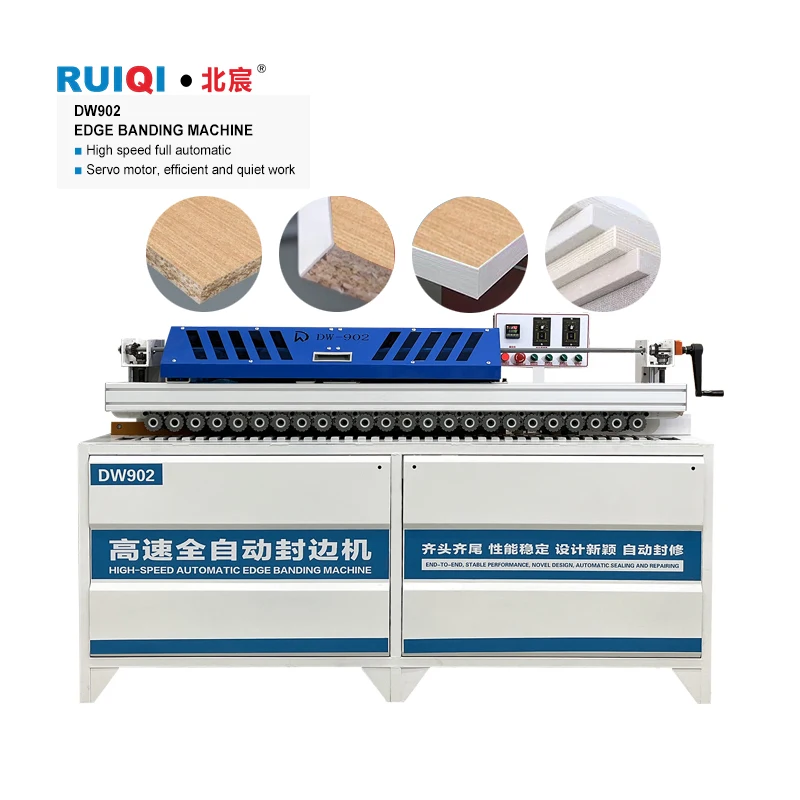
Edge banding machine
Click to enlarge
ISO 9001
CE Certified
OEM / ODM
12-Mo Warranty
Edge banding machine
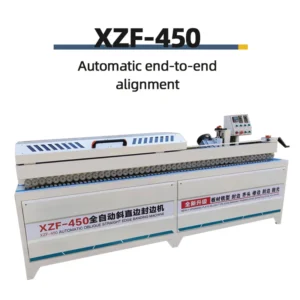
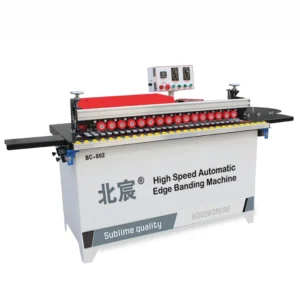
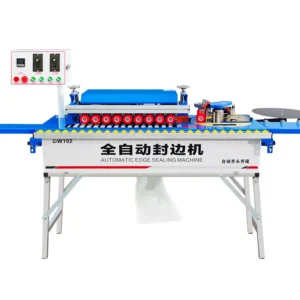
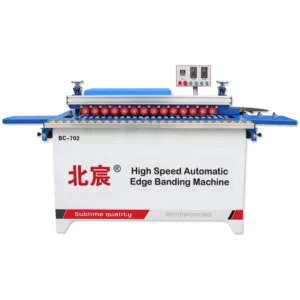
DW902 Automatic Edge Banding Machine for MDF Particleboard Plywood – Process Quality and Edge Finishing
<p><strong>DW902 Automatic Edge Banding Machine, 4000W, 0.3-3mm Banding Thickness, 220V/380V</strong> — configured for consistent edge finishing across MDF, particleboard and plywood substrates.</p> <ul> <li>Oblique and straight dual-purpose design with 4-group pressure wheels ensures uniform band adhesion on both flat and contoured edges</li> <li>Double hot air glue activation paired with trimming, polishing and scraping delivers clean finishes without visible glue lines in one pass</li> <li>Edge banding height up to 5cm with minimum sheet dimensions of 25×10cm accommodates cabinet panels and custom furniture components</li> </ul> <p>Engineer-led configuration with formal quotation within 24 hours, including voltage confirmation and factory test records for your specific substrate and banding material combination.</p>
100+
Countries
MOQ 1
Unit
15-25 Days
Lead Time
380V
Double Hot Air
DW902
Edge Banding Machine
MDF Panel
Plywood Edge Finishing
Process Quality
- Full OEM/ODM support -- custom logo, voltage (110V-440V), multilingual panels
- ISO 9001 & CE certified, 5 national patents, 60 professional engineers
- 12-month warranty, remote technical support & spare parts service
- Professional export packaging, customs clearance support, on-time delivery
Four-Stage QC with Pre-Shipment Verification — Every DW902 unit undergoes factory test records on your specific panel thickness and banding material before it leaves the floor.
Technical Specifications
| Parameter | Value |
|---|---|
| Model | DW902 |
| Product Type | Automatic Edge Banding Machine |
| Total Power | 4000W |
| Voltage | 220V / 380V / customization |
| Edge Banding Thickness Range | 0.3–3 mm |
| Edge Banding Height | 50 mm |
| Minimum Sheet Length | 250 mm |
| Minimum Sheet Width | 100 mm |
| Trimming Motors | 800W × 2, 24000 r/min |
| Polishing Motors | 380W × 2 |
| Glue Pot Capacity | 4000 ml |
| Air Source Pressure | 0.5–0.8 MPa |
| Vacuum Power | 550W |
| Machine Dimensions | 175 × 87 × 112 cm |
| Machine Weight | 240 kg |
| Key Features | Oblique and straight dual-purpose edge banding, double hot air design, feeding auxiliary slide plate, 4 groups of oblique pressure wheels, double row pressing wheels |
Application Suitability
| Application | Material or Output |
|---|---|
| Custom cabinet door production | MDF and particleboard with PVC edge banding |
| Plywood shelving and carcass panels | Wood veneer and melamine banding up to 3 mm |
| Curved and shaped furniture components | Oblique edge banding on solid wood and ecological board |
| Home decoration joinery | Mixed substrate runs requiring quick changeover between straight and angled profiles |
Why Glue Line Visibility Ruins an Otherwise Perfect Panel Run
The substrate determines the glue behaviour, not the other way around.
I spent years on the assembly floor before moving into field support, and the most common call I get is not about a broken machine — it is about a visible glue seam that appeared only after the customer switched board supplier. Particleboard made from recycled stock absorbs glue unevenly. Plywood with resin-heavy veneers resists adhesion entirely. The woodworking edge banding process automatic machine you choose must compensate for these differences at the point of contact, not rely on a single temperature setting and hope for the best. The DW902 addresses this through its double hot air system, which pre-heats both the panel edge and the banding strip before they meet the glue roller, giving you a wider operating window across porous and non-porous substrates alike. [NEED_CITE: substrate porosity and hot-melt adhesion behaviour in panel processing]
Dual-Purpose Oblique and Straight Banding in a Single Pass
Workshops that produce both flat cabinet panels and shaped furniture components often run two separate machines or accept compromised edge quality on curved sections. The DW902 integrates oblique and straight edge banding within one feed path, using four groups of oblique pressure wheels to maintain consistent band-to-panel contact regardless of profile geometry. This means the same woodworking edge banding process automatic machine handles your 90-degree carcass edges and your radiused door profiles without reconfiguration downtime.
Hot Air Activation Across Mixed Substrate Batches
The double hot air design directs heated airflow onto both the panel edge and the incoming banding strip simultaneously. On MDF, which tends to absorb glue quickly, the pre-heated surface keeps the adhesive in a workable state long enough for the pressure wheels to seat the strip fully. On plywood or moisture-resistant particleboard, where surface resins can repel standard glue application, the additional thermal energy improves wetting and bond strength. This dual-activation approach is what allows the machine to handle the material variety that a typical custom furniture factory processes in a single shift. [NEED_CITE: thermal activation requirements for EVA hot-melt adhesives on engineered wood panels]
Reading the Spec Sheet Against Your Actual Production Needs
The 0.3–3 mm banding thickness range covers PVC, wood veneer, and melamine strips, but each material demands different trimming and polishing behaviour. The twin trimming motors at 800W and 24000 r/min provide the spindle speed needed for clean cuts on brittle melamine without chipping, while still holding up under the lateral load of 3 mm PVC. The 4000 ml glue pot capacity supports sustained production runs without frequent refill stops, though the actual interval depends on your banding width and feed speed. The 550W vacuum system at the trimming station captures the bulk of swarf before it reaches the polishing wheels, which matters because embedded trimming debris on the polishing buff will score your finished edge — a defect that typically shows up only under the customer’s kitchen downlights.
When the Wrong Configuration Reaches Your Workshop
A machine arrives wired for 380V three-phase, and your facility runs 220V single-phase. The control panel labels are in a language your operators cannot read, so they bypass the glue temperature alarm and run the line cold. Trimming motors stall on 3 mm PVC because the specification sheet listed peak power, not continuous rated output. These are not manufacturing defects — they are configuration failures that originate in the quotation stage. I have visited workshops where a brand-new edge bander sat idle for weeks because nobody confirmed the air source pressure requirement against the compressor already on site. [NEED_CITE: machinery commissioning failures linked to voltage and utility mismatch in export markets]
What Backs This Machine Beyond the Brochure
In-house manufacturing with patented cutting mechanisms means the trimming and scraping stations are designed and assembled under one roof, not sourced as third-party add-ons. Voltage configuration from 220V to 380V and beyond is confirmed at the quotation stage, so the motor winding and control transformer match your local supply before the machine ships. The four-stage quality control sequence — incoming material, in-process assembly, finished product, and pre-shipment verification — includes a test run on your specified panel and banding combination, documented in the factory test record. Multilingual control panels and operation manuals are standard options, not premium extras, which means your operators can read the glue temperature setpoints on day one. Engineer-led configuration recommendations are delivered within 24 hours of receiving your substrate samples and production requirements.
Documentation & Verification
- CE declaration of conformity covering the DW902 edge banding machine assembly
- Electrical schematic confirming your specified voltage and motor winding configuration
- Factory test record on your panel thickness and banding material before dispatch
- Operation and maintenance manual in your agreed language with illustrated troubleshooting
- Spare parts list identifying consumable trimming cutters and polishing buffs by part number
Installation, Commissioning & Support
- Floor space of approximately 175 × 87 cm with clearance for the feeding auxiliary slide plate
- Dedicated electrical circuit matching confirmed voltage and 4000W total draw
- Compressed air supply at 0.5–0.8 MPa with inline moisture trap for the glue pot and pneumatic cylinders
- Initial glue temperature calibration on your specific MDF or particleboard substrate during commissioning
- Trimming and scraping alignment verified against your 0.3–3 mm banding thickness range
- Vacuum extraction ducting connected to the 550W collection port for trimming swarf removal
Before You Request a Quotation
Tell us the substrate types you run most often — whether that is standard MDF, moisture-resistant particleboard, or mixed plywood batches — and the banding materials and thicknesses you stock. Confirm your facility voltage and frequency, the language your operators need on the control panel, and whether your production includes curved or oblique profiles alongside standard straight edges. If you are integrating this machine into an existing line, share the feed height and throughput of your upstream panel saw so we can match the configuration. We can run your sample panels through a factory test before the machine ships, so you see the edge quality on your own material before committing.
Frequently Asked Questions
Q: How does substrate type affect glue temperature and feed speed on this machine?
A: MDF absorbs heat and adhesive quickly, so the double hot air system runs at a higher temperature to keep the glue workable. Recycled particleboard with uneven density requires slower feed speed so the pressure wheels maintain full contact. Plywood with resin-rich veneers needs more pre-heating to achieve adequate wetting. We set baseline parameters during the factory test on your actual board samples.
Q: What banding materials work within the 0.3–3 mm thickness range?
A: PVC, wood veneer, and melamine strips all fall within this range. Thinner veneer around 0.3 mm needs careful trimming motor speed control to avoid tear-out, while 3 mm PVC demands rigid pressure wheel seating. The 24000 r/min trimming spindles and four-group oblique pressure wheels handle both extremes within a single pass.
Q: How does the double hot air design reduce visible glue lines on porous substrates?
A: By pre-heating both the panel edge and the banding strip before they contact the glue roller, the adhesive stays fluid longer and penetrates the substrate surface evenly. This prevents the starved glue joints that cause banding lift on porous particleboard. The effect is most noticeable on recycled-stock boards where absorption rates vary across the panel face.
Q: How should this machine be paired with upstream and downstream equipment?
A: The minimum sheet dimensions of 250 mm length and 100 mm width determine your panel saw cut accuracy requirements. Downstream, the trimmed and scraped edge quality from the DW902 is ready for hinge boring or assembly without secondary sanding. Share your existing line feed heights and conveyor speeds so we can match the DW902 feed rate to your throughput.
Technical Specifications
| Parameter | Value |
|---|---|
| Product Name | DW902 Automatic Edge Banding Machine for MDF Particleboard Plywood – Process Quality and Edge Finishing |
| Category | Edge banding machine |
| Voltage Options | 110V / 220V / 380V / 440V (customizable) |
| Frequency | 50Hz / 60Hz (customizable) |
| Certification | ISO 9001, CE |
| MOQ | 1 Unit |
| Lead Time | 15-25 Working Days |
| Warranty | 12 Months |
| OEM / ODM | Available -- logo, color, panel language |
* Detailed technical specifications vary by model. Please contact us with your specific requirements for a complete datasheet.
Shipping & Export
-
Export Packaging
Heavy-duty wooden crate with foam padding and moisture protection
-
Shipping Methods
Sea freight (FCL/LCL), air freight, express -- we support all methods
-
Customs Support
Full documentation: CO, commercial invoice, packing list, HS code assistance
-
Port of Loading
Tianjin / Qingdao port, China -- 20 years export experience
OEM / ODM Services
-
Logo & Branding
Custom logo printing, color scheme, and nameplate engraving
-
Voltage Configuration
110V / 220V / 380V / 440V, 50Hz / 60Hz -- any region supported
-
Multilingual Panels
Control panels in English, Spanish, French, Arabic and more
-
Custom Specifications
Modified dimensions, accessories, or feature sets on request
Get a Quote
Request Product Inquiry
Fill in your details and we'll respond within 24 hours with pricing and availability.
Direct Contact
How It Works
-
1
Confirm requirements & budget
Tell us your factory scale and processing needs
-
2
Receive recommendation & quote
We match the right machine with full specs
-
3
Negotiate & place order
OEM terms, voltage, payment and delivery
-
4
Production & QC inspection
Multi-stage quality control by 60 engineers
-
5
Export packaging & shipment
Professional packing, customs clearance
-
6
After-sales support
12-month warranty, remote tech support
You May Also Like