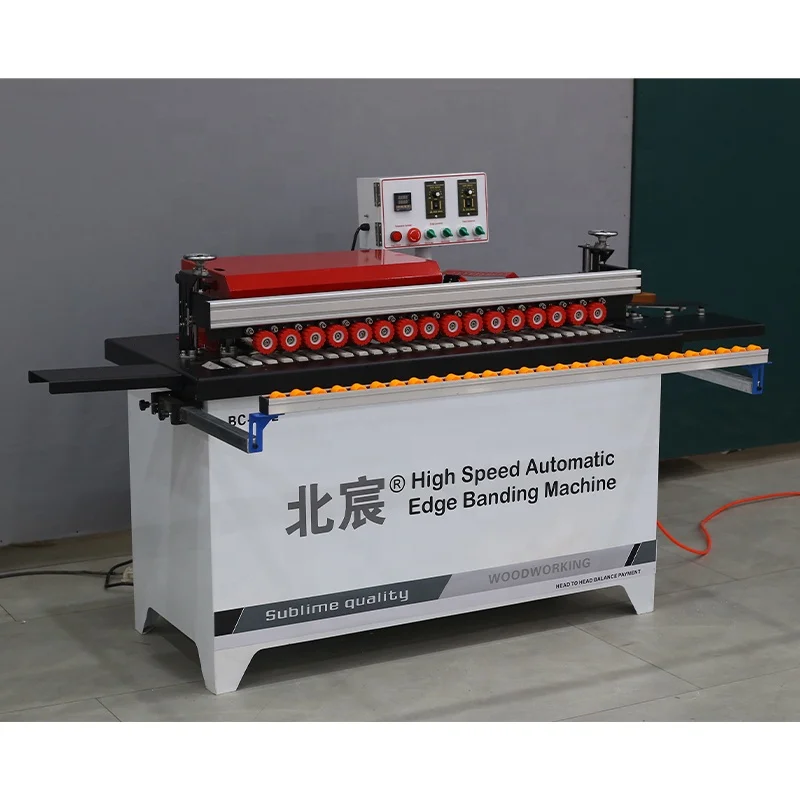
Edge banding machine
Click to enlarge
ISO 9001
CE Certified
OEM / ODM
12-Mo Warranty
Edge banding machine
Edge Banding Machine DW802 with Trimming Function – Process and Application Guide
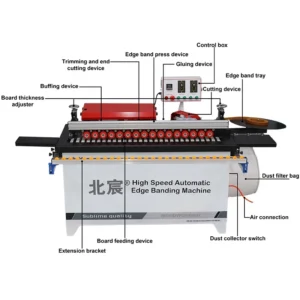
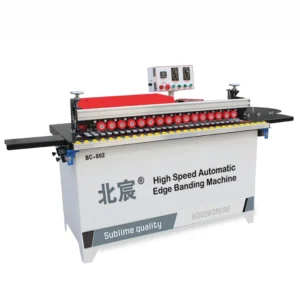
<p><strong>DW802 Automatic Edge Banding Machine, 4200W, 0.3–3mm Edge Thickness, 4000ml Glue Pot</strong> — delivers a complete gluing, trimming and polishing workflow for straight edges on MDF, particleboard and plywood substrates.</p> <ul> <li>Dual 800W trimming and dual 180W polishing stations ensure clean edge removal and surface refinement across mixed material batches</li> <li>Integrated 1200W vacuum system extracts chips at the trimming stage, keeping the work area clear for consistent output</li> </ul> <p>Sample processing tests on your specific substrate confirm glue line quality before shipment, backed by four-stage QC and pre-shipment verification.</p>
100+
Countries
MOQ 1
Unit
15-25 Days
Lead Time
Automatic Trimming
CE Certified
DW802
Edge Banding Machine
Furniture Factory
MDF Panel
Process Verified
- Full OEM/ODM support -- custom logo, voltage (110V-440V), multilingual panels
- ISO 9001 & CE certified, 5 national patents, 60 professional engineers
- 12-month warranty, remote technical support & spare parts service
- Professional export packaging, customs clearance support, on-time delivery
Engineer-Led Configuration — every DW802 setup starts with your substrate data, not a catalog default, ensuring the edge banding machine woodworking process matches your actual material behavior.
Technical Specifications
| Parameter | Value |
|---|---|
| Model | DW802 |
| Product Type | Automatic Edge Banding Machine |
| Total Power | 4200 W |
| Voltage | 220V / 380V / customizable (frequency to be confirmed: 50Hz or 60Hz) |
| Edge Banding Height | 0–50 mm |
| Edge Banding Thickness | 0.3–3 mm |
| Minimum Sheet Length | 25 cm |
| Minimum Sheet Width | 10 cm |
| Glue Pot Capacity | 4000 ml |
| Trimming Power | 800 W × 2 stations |
| Polishing Power | 180 W × 2 stations |
| Vacuum Power | 1200 W |
| Edge Power | 140 W |
| Transmission Power | 140 W |
| Air Source Pressure | 0.4–0.8 MPa |
| Product Size (L×W×H) | 130 × 60 × 95 cm |
| Net Weight | 135 kg |
| Control Panel Languages | Chinese, English standard; Spanish and others customizable |
| Assembly State | Fully assembled |
| Certification | CE |
Application Suitability
| Application | Material or Output |
|---|---|
| Custom cabinet door edge sealing | MDF with PVC edge banding (0.4–2 mm) |
| Particleboard wardrobe panel finishing | Particleboard with melamine or veneer banding |
| Plywood furniture straight-edge sealing | Plywood panels with solid wood or PVC strips |
| Home decoration built-in joinery | Ecological board with pre-glued veneer tape |
| Small-batch mixed-substrate production runs | Alternating MDF, particleboard and plywood within one shift |
Why Substrate Identity Must Come Before the Quotation
The edge banding machine woodworking process only produces clean edges when the machine is tuned to your exact board density and moisture content.
I learned this in a workshop outside Lagos, where the customer ordered based on a test run on our standard MDF sample. When the machine arrived, their daily stock was locally sourced recycled particleboard with high moisture and rough core structure. The DW802 ran the same parameters, and the glue lines showed through every cabinet door — an entire batch returned for rework. Visible glue seams on porous substrates are rarely a machine fault; they are a configuration mismatch that could have been caught with one pre-shipment sample test [NEED_CITE: substrate moisture and edge adhesion failure correlation in tropical climates].
How Glue Application Interacts with Board Porosity
The 4000 ml glue pot on the DW802 supports continuous multi-panel sealing cycles without frequent refills, but capacity alone does not guarantee edge quality. On dense MDF, a thin, even glue film bonds the PVC or veneer tape cleanly, and the dual trimming stations remove excess without tearing. On open-pore particleboard or recycled core stock, the same film thickness may be absorbed unevenly, leaving starved zones along the edge. The edge banding machine woodworking process on this model requires the operator to adjust feed parameters and glue temperature based on the substrate’s absorption rate — something only a sample test on your actual board inventory can validate.
Trimming and Polishing: What the Dual Stations Actually Do
The two 800 W trimming units handle top and bottom edge removal in a single pass, which matters when you run 0.3 mm veneer one hour and 3 mm PVC the next. Thicker banding requires more aggressive trimming force, and having independent stations means each cutter can be set for a specific material thickness without compromise. Downstream, the dual 180 W polishing stations refine the trimmed edge surface, removing any micro-scorch or adhesive residue left by the cutters. On plywood, where the edge grain alternates between hard and soft layers, this two-stage polishing sequence prevents the uneven gloss that makes a panel look hand-finished rather than factory-finished [NEED_CITE: edge trimming quality standards for laminated panel furniture].
Reading the Spec Sheet Against Your Production Reality
The DW802’s edge banding thickness range of 0.3–3 mm covers most PVC, melamine and veneer tapes used in cabinet and furniture production, but the minimum sheet dimensions — 25 cm length and 10 cm width — define what small off-cuts the machine can physically grip. If your nesting software produces narrow drawer side panels below that width, they will need manual edge finishing or a different feed configuration. The 1200 W vacuum system extracts chips and dust at the trimming stage, which is essential when running MDF: fine MDF dust, if not captured, settles back onto the freshly glued edge and weakens the bond on subsequent panels. The air pressure requirement of 0.4–0.8 MPa must be stable; pressure drops below 0.4 MPa cause the trimming cutters to hesitate, producing the kind of chatter marks that only show up under angled warehouse lighting.
The Hidden Cost of Skipping Voltage and Language Confirmation
Machines quoted without confirming local voltage and frequency arrive at the workshop and refuse to start — or worse, run at reduced torque and produce inconsistent trimming cuts. In regions with 60 Hz supply, a motor calibrated for 50 Hz runs faster than intended, altering feed behavior and glue application timing. Similarly, a control panel displaying only in a language the operator cannot read stalls commissioning for days while someone translates each parameter label. These are not engineering failures; they are communication gaps that the inquiry stage should eliminate [NEED_CITE: voltage and frequency mismatch consequences in exported industrial machinery].
What This Supplier Configuration Brings to Your Line
The DW802 sits within a full product family that scales from entry-level to full-function pre-milling models, so a workshop adding panel processing capacity can expand without changing supplier or retraining operators on a different control interface. Voltage and control panel language are treated as standard customization points, not special requests, which means the machine that arrives matches the facility’s electrical infrastructure and the operator’s working language from day one. Every unit passes a four-stage quality control sequence — incoming material, in-process, finished product and pre-shipment verification — with a factory test record generated on the customer’s specified panel thickness range before the crate is sealed. Engineer-led configuration recommendations come with a formal quotation, and sample processing tests on the buyer’s actual substrate are available before order commitment.
Documentation & Verification
- CE declaration of conformity for the DW802 edge banding unit
- Factory test record run on your specified panel thickness and banding material
- Electrical schematic with confirmed voltage and frequency for your facility
- Operation and maintenance manual delivered in your agreed language
- Spare parts list with trimming cutter and polishing pad part numbers
- Packing photographs and customs documentation support for your destination port
Installation, Commissioning & Support
- Requires a dedicated circuit matching the confirmed voltage at 4200 W total draw
- Arrives fully assembled; only dust extraction hose and air line connection needed on site
- Compressed air supply must hold stable between 0.4 and 0.8 MPa at the machine inlet
- First-run parameter tuning on your actual substrate and banding stock during commissioning
- Trimming cutter and polishing pad replacement intervals documented in the manual
- Compact 130 × 60 × 95 cm footprint fits standard workshop bay without floor reinforcement
What to Include in Your Inquiry
Provide the specific board types and thicknesses you run most frequently, along with the edge banding materials and thickness range in your current inventory. Confirm your facility’s voltage and frequency so the electrical configuration is locked before production begins. If your operators work in a language other than Chinese or English, state this upfront so the control panel labeling is prepared accordingly. Mention whether you need a sample processing test on your own substrate before committing to the order.
Frequently Asked Questions
Q: How does substrate type affect glue adhesion and trimming quality on the DW802?
A: Dense MDF accepts a thin, uniform glue film and trims cleanly. Open-pore particleboard absorbs glue unevenly, sometimes leaving visible seams unless feed speed and temperature are adjusted. Plywood’s alternating hard and soft edge layers require careful polishing setup to avoid uneven gloss. A pre-shipment sample test on your exact board stock is the only reliable way to confirm the result.
Q: Which edge banding materials fall within the 0.3–3 mm thickness range?
A: PVC, melamine and natural veneer tapes all sit within this range. Thin 0.3 mm melamine requires light trimming pressure to avoid chipping, while 2–3 mm PVC demands full trimming force and extended polishing. Changing between materials within a shift is possible, but each switch requires cutter and pressure adjustments that operators should be trained to perform.
Q: How long can the 4000 ml glue pot run before needing a refill?
A: Run length depends on panel edge length per cycle, banding width and glue film thickness setting. For standard cabinet door panels with 0.4 mm PVC, the pot supports multiple continuous panels before topping up is necessary. High-volume shops running long panels with thick glue application should plan a mid-shift refill to maintain consistent bond strength throughout the batch.
Q: What happens if air pressure drops below 0.4 MPa during operation?
A: The pneumatic cylinders that control trimming cutter engagement and banding pressure rely on stable air supply. Below 0.4 MPa, cutters may not fully engage, producing incomplete trims and chatter marks along the edge. A dedicated regulator with a pressure gauge at the machine inlet allows operators to catch drops before they affect panel quality.
Q: Can the control panel be set to the operator’s native language?
A: Chinese and English are standard. Spanish and other languages are available as customization options. Confirming the required language at the inquiry stage ensures the panel arrives labeled correctly, avoiding commissioning delays caused by operators unable to read parameter settings during the critical first production runs.
Technical Specifications
| Parameter | Value |
|---|---|
| Product Name | Edge Banding Machine DW802 with Trimming Function – Process and Application Guide |
| Category | Edge banding machine |
| Voltage Options | 110V / 220V / 380V / 440V (customizable) |
| Frequency | 50Hz / 60Hz (customizable) |
| Certification | ISO 9001, CE |
| MOQ | 1 Unit |
| Lead Time | 15-25 Working Days |
| Warranty | 12 Months |
| OEM / ODM | Available -- logo, color, panel language |
* Detailed technical specifications vary by model. Please contact us with your specific requirements for a complete datasheet.
Shipping & Export
-
Export Packaging
Heavy-duty wooden crate with foam padding and moisture protection
-
Shipping Methods
Sea freight (FCL/LCL), air freight, express -- we support all methods
-
Customs Support
Full documentation: CO, commercial invoice, packing list, HS code assistance
-
Port of Loading
Tianjin / Qingdao port, China -- 20 years export experience
OEM / ODM Services
-
Logo & Branding
Custom logo printing, color scheme, and nameplate engraving
-
Voltage Configuration
110V / 220V / 380V / 440V, 50Hz / 60Hz -- any region supported
-
Multilingual Panels
Control panels in English, Spanish, French, Arabic and more
-
Custom Specifications
Modified dimensions, accessories, or feature sets on request
Get a Quote
Request Product Inquiry
Fill in your details and we'll respond within 24 hours with pricing and availability.
Direct Contact
How It Works
-
1
Confirm requirements & budget
Tell us your factory scale and processing needs
-
2
Receive recommendation & quote
We match the right machine with full specs
-
3
Negotiate & place order
OEM terms, voltage, payment and delivery
-
4
Production & QC inspection
Multi-stage quality control by 60 engineers
-
5
Export packaging & shipment
Professional packing, customs clearance
-
6
After-sales support
12-month warranty, remote tech support
You May Also Like