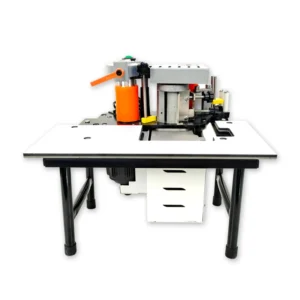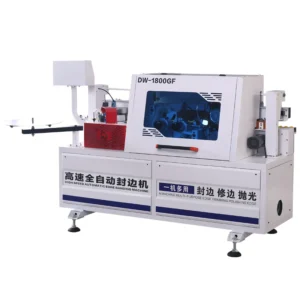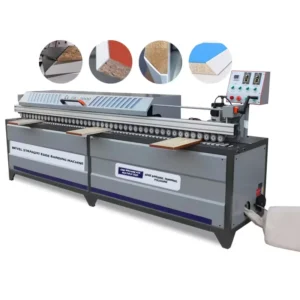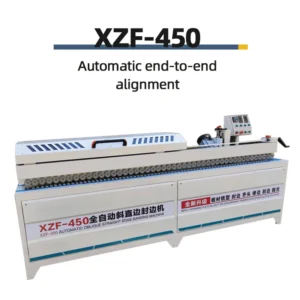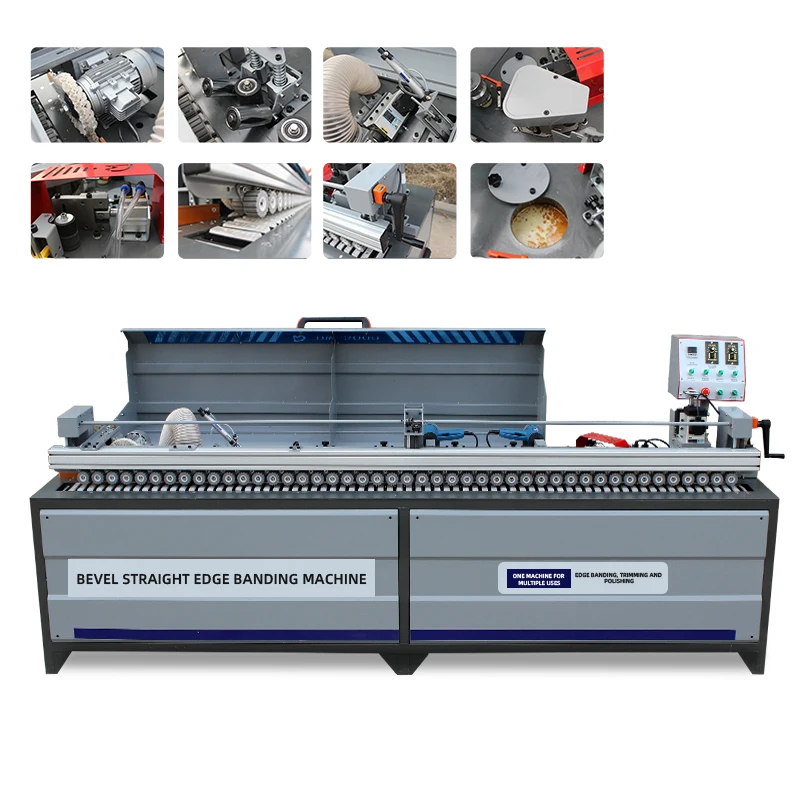
Edge banding machine
Click to enlarge
ISO 9001
CE Certified
OEM / ODM
12-Mo Warranty
Edge banding machine
Edge Banding Machine with Pre-Milling – Industrial Application
<p><strong>DW3000 Automatic Edge Banding Machine, 11KW, 380V/415V, 0-12m/min Feed</strong> — handles 30-90° bevel and straight edge banding with pre-milling for cleaner substrate edges. Double 2.2KW heat guns ensure uniform glue activation across 0-50mm banding height on MDF, particleboard and plywood, while 8-group oblique pressure wheels enable angle adjustment without tooling changeover.</p> <ul> <li>Spindle trimming system with flexible scraper delivers precise edge finish for downstream assembly fit</li> <li>Supports 0.3-3mm PVC and veneer banding with 4000ml glue pot capacity and 550W vacuum extraction</li> </ul> <p>Engineer-led configuration with formal quotation within 24 hours, four-stage QC including pre-shipment verification, and operation manuals provided in your operator's language.</p>
100+
Countries
MOQ 1
Unit
15-25 Days
Lead Time
Custom Furniture
Double Heat Gun
DW3000
Edge Banding Machine
MDF Panel
Pre-milling
Process Application
Spindle Trimming Motor
- Full OEM/ODM support -- custom logo, voltage (110V-440V), multilingual panels
- ISO 9001 & CE certified, 5 national patents, 60 professional engineers
- 12-month warranty, remote technical support & spare parts service
- Professional export packaging, customs clearance support, on-time delivery
Precision-built woodworking machinery with patented cutting mechanisms — The DW3000 delivers verified ±0.02mm tolerance through in-house manufactured pre-milling and spindle trimming stations, ensuring consistent edge quality on every panel that runs through it.
Technical Specifications
| Parameter | Value |
|---|---|
| Model | DW3000 |
| Total Power | 11 kW |
| Voltage & Frequency | 380V / 415V (frequency to be confirmed for destination market) |
| Pre-Milling Motor | 2.2 kW |
| Heating Power | 2.2 kW × 2 (double heat gun) |
| Trimming Motor Power | 2.2 kW × 2 (spindle type) |
| Polishing Motor Power | 0.4 kW × 2 |
| Feed Speed | 0–12 m/min |
| Minimum Panel Length | 300 mm |
| Minimum Panel Width | 150 mm |
| Edge Banding Height Range | 0–50 mm |
| Edge Banding Thickness Range | 0.3–3 mm |
| Glue Pot Capacity | 4000 ml |
| Air Source Pressure | 0.5–0.7 MPa |
| Bevel Angle Range | 30–90° |
| Oblique Pressure Wheels | 8 groups, adjustable 30–90° |
| Feeding System | Double cylinder feeding belt with auxiliary slide |
| Overall Dimensions (L×W×H) | 2990 × 650 × 1300 mm |
| Net Weight | 430 kg |
| Language Options | Chinese and English standard; Spanish and other languages customizable |
| Plug Options | EU, USA, AU, UK |
Application Suitability
| Application | Material or Output |
|---|---|
| Straight edge banding for cabinet doors and carcass panels | MDF, particleboard, plywood with PVC or veneer banding 0.3–3 mm |
| Bevel edge banding for angled furniture components | Solid wood panels and melamine-faced board at 30–90° angles |
| Pre-milled edge preparation for laminated substrates | Moisture-resistant particleboard and high-density MDF |
| Custom furniture production with mixed straight and angled edges | Batch runs requiring angle changeover without tooling swap |
| Edge finishing for shelving and wardrobe panels | Panels from 150 mm minimum width up to 50 mm banding height |
Why Glue-Line Failures Start Before the Glue Pot
Most edge banding defects are not adhesive failures — they are substrate preparation failures.
I spent years on the assembly floor watching panels come back from the edge bander with visible seams and lifting banding. The common assumption is always the glue. In reality, saw marks left by the panel saw create micro-gaps that no amount of adhesive can fill uniformly. When the substrate is moisture-resistant particleboard or high-density MDF, the problem compounds because the surface is harder and less forgiving. The edge banding machine process and application depends entirely on how clean and flat the panel edge is before it reaches the glue station. [NEED_CITE: substrate surface roughness and adhesive bond strength in wood panel lamination]
How Pre-Milling Changes the Edge Before Gluing
The DW3000 stations a 2.2 kW pre-milling cutter ahead of the glue pot. This station removes the saw-blade tear-out and any surface irregularity left from panel sizing, producing a flat, clean edge ready for adhesive contact. For production managers running melamine-faced chipboard or moisture-resistant MDF, this step is what separates a visible glue line from an invisible one. The edge banding machine process and application benefits from pre-milling most when the upstream panel saw is producing edges that are not perfectly smooth.
Double Heat Guns and What They Actually Do for Glue Activation
A single heat gun concentrates thermal energy in one zone, which can lead to uneven glue viscosity across a 50 mm banding height. The DW3000 uses two 2.2 kW heat guns to distribute heat more evenly across the glue pot, keeping the adhesive at a consistent working temperature from top to bottom. This matters especially when you switch between thin 0.3 mm PVC and thicker 3 mm veneer banding, because each material demands a different thermal profile for proper wetting and adhesion. [NEED_CITE: hot-melt adhesive temperature uniformity requirements for wood edge banding]
Reading the Spec Sheet Against Your Actual Production Needs
The feed speed range of 0–12 m/min gives operators room to slow down for difficult substrates or speed up for straightforward straight-edge runs on standard particleboard. The 8-group oblique pressure wheel system, adjustable from 30° to 90°, means you can run bevel and straight profiles without stopping to change tooling — a practical advantage when a single cabinet order includes both flat doors and angled display shelves. The three spindle trimming motors replace conventional trimming units, producing a smoother cut on the banding overhang and reducing the scraping work needed downstream. Air consumption at 0.5–0.7 MPa is typical for the pneumatic pressure systems that hold banding against the panel during the setting phase.
The Real Cost of Skipping Substrate Verification
I once watched a workshop receive a batch of cabinets where every door edge peeled within weeks of installation. The machine was set up and tested on standard particleboard at the factory, but the customer’s actual stock was a high-moisture substrate that demanded different glue temperature and feed parameters. When the edge banding machine process and application is validated only on a reference material, the gap between factory test and shop-floor reality becomes the customer’s problem. [NEED_CITE: moisture content variation in engineered wood panels and its effect on hot-melt adhesion]
Buying a machine without confirming your actual panel material, edge profile mix, and banding thickness range means you may receive a configuration that works perfectly — just not on what you are actually producing. Angle changeover delays, insufficient glue penetration on dense substrates, and trimming chatter on thick veneer are all issues that surface only after the machine is on your floor and your deadline is already past.
Why Sourcing This Equipment Through Our Workshop Makes Sense
Our facility in Shandong manufactures the DW3000 with in-house precision-ground components and proprietary cutting mechanisms, meaning the pre-milling and trimming stations are built and calibrated under one roof rather than assembled from third-party sub-contracts. Every unit passes through four inspection stages — incoming material check, in-process verification, finished-product audit, and pre-shipment test — so the edge quality you see in the sample report is the edge quality your panels will produce. We configure voltage from 380V to 415V, supply operation manuals in your operator’s language, and welcome factory visits so you can watch your actual substrate run through the machine before it ships.
Documentation & Verification
- CE declaration of conformity covering the full DW3000 assembly and safety systems
- Factory test record produced on your specified panel material and banding thickness
- Electrical schematic confirming voltage and frequency match for your facility supply
- Operation and maintenance manual in the agreed language with illustrated adjustment guides
- Spare parts list with part numbers for pre-milling cutters, trimming spindles, and pressure wheels
- Pre-shipment packing photographs and customs documentation support for your import process
Installation, Commissioning & Support
- Requires a level concrete floor with clearance for the 2990 mm length and infeed/outfeed space
- Dedicated 380V/415V three-phase circuit rated for the 11 kW total connected load
- Arrives partially assembled with pressure wheels and glue pot requiring on-site alignment
- First-run commissioning includes feed speed calibration and bevel angle verification at 30–90°
- Operator training covers glue pot temperature adjustment for different banding thicknesses
- Wearing parts stock includes pre-milling inserts, spindle trimming cutters, and polishing wheels
Before You Request a Quote, Prepare These Details
To size the right configuration and confirm the DW3000 fits your line, share the substrate types you actually run — including moisture-resistant or high-density boards if applicable — along with the edge banding materials and thickness range you use most often. Let us know your local voltage and frequency supply, the language your operators need on the control panel, and whether you require sample processing on your own panel stock before committing to an order.
Frequently Asked Questions
Q: How does pre-milling improve edge banding quality on MDF and particleboard?
A: Pre-milling removes saw marks and surface unevenness from the panel edge before adhesive is applied. On MDF and particleboard, these imperfections create micro-gaps that cause visible glue lines and weak bond points. The DW3000’s 2.2 kW pre-milling station produces a flat, clean edge that allows uniform glue contact and a tighter final bond across the full banding height.
Q: What edge banding materials and thicknesses is this machine compatible with?
A: The DW3000 handles PVC, ABS, and veneer banding from 0.3 mm to 3 mm thick. The double heat gun system adjusts glue temperature to suit different material properties, while the spindle trimming motors cut cleanly through both thin flexible PVC and stiffer wood veneer without chipping or tearing at the trim line.
Q: How does the double heat gun affect glue consistency across panel thicknesses?
A: Two 2.2 kW heat guns distribute thermal energy evenly across the 4000 ml glue pot, preventing cold zones that cause uneven adhesive viscosity. This is important when running panels of varying thickness or switching between thin and thick banding, as consistent glue temperature ensures uniform wetting and adhesion regardless of banding height up to 50 mm.
Q: What is the difference between standard trimming motors and the spindle trimming system?
A: Standard trimming motors use direct-drive cutters that can leave chatter marks on the banding edge, especially on thicker materials. The DW3000 uses three spindle trimming motors that rotate at higher stability, producing a smoother finish with fewer tool marks. This reduces the workload on the scraping and polishing stations that follow, resulting in a cleaner final edge.
Q: How does bevel angle adjustment work, and what changeover is needed?
A: The 8 groups of oblique pressure wheels adjust mechanically across the 30–90° range. Operators loosen the adjustment mechanism, set the desired angle using the scale, and re-tighten. The changeover does not require replacing tooling or recalibrating the trimming stations, keeping the transition between straight and bevel runs within a typical production changeover window.
Technical Specifications
| Parameter | Value |
|---|---|
| Product Name | Edge Banding Machine with Pre-Milling – Industrial Application |
| Category | Edge banding machine |
| Voltage Options | 110V / 220V / 380V / 440V (customizable) |
| Frequency | 50Hz / 60Hz (customizable) |
| Certification | ISO 9001, CE |
| MOQ | 1 Unit |
| Lead Time | 15-25 Working Days |
| Warranty | 12 Months |
| OEM / ODM | Available -- logo, color, panel language |
* Detailed technical specifications vary by model. Please contact us with your specific requirements for a complete datasheet.
Shipping & Export
-
Export Packaging
Heavy-duty wooden crate with foam padding and moisture protection
-
Shipping Methods
Sea freight (FCL/LCL), air freight, express -- we support all methods
-
Customs Support
Full documentation: CO, commercial invoice, packing list, HS code assistance
-
Port of Loading
Tianjin / Qingdao port, China -- 20 years export experience
OEM / ODM Services
-
Logo & Branding
Custom logo printing, color scheme, and nameplate engraving
-
Voltage Configuration
110V / 220V / 380V / 440V, 50Hz / 60Hz -- any region supported
-
Multilingual Panels
Control panels in English, Spanish, French, Arabic and more
-
Custom Specifications
Modified dimensions, accessories, or feature sets on request
Get a Quote
Request Product Inquiry
Fill in your details and we'll respond within 24 hours with pricing and availability.
Direct Contact
How It Works
-
1
Confirm requirements & budget
Tell us your factory scale and processing needs
-
2
Receive recommendation & quote
We match the right machine with full specs
-
3
Negotiate & place order
OEM terms, voltage, payment and delivery
-
4
Production & QC inspection
Multi-stage quality control by 60 engineers
-
5
Export packaging & shipment
Professional packing, customs clearance
-
6
After-sales support
12-month warranty, remote tech support
You May Also Like