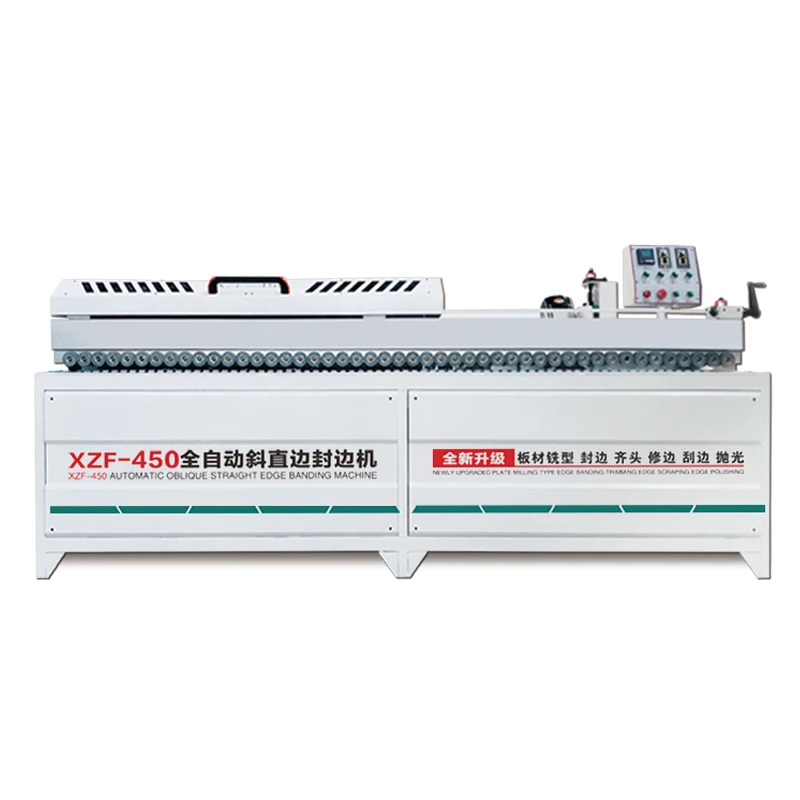
Edge banding machine
Click to enlarge
ISO 9001
CE Certified
OEM / ODM
12-Mo Warranty
Edge banding machine
Industrial Application 45 Degree Bevel Edge Banding Machine – XZF450
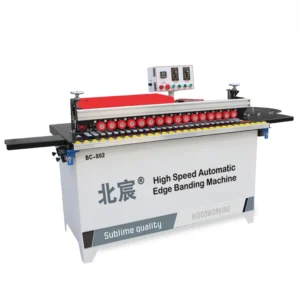
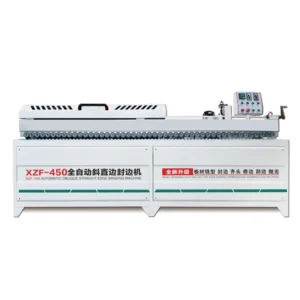
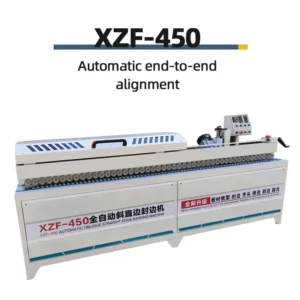
<p><strong>XZF-450 45 Degree Bevel Edge Banding Machine, 9.5KW, 0-12M/min Feed Speed, 0.3-3MM Edge Thickness</strong> — configured for the complete edge finishing sequence from pre-milling through polishing. The 4KW pre-milling station removes saw marks on MDF and particleboard before glue application, while 30°/45°/60°/90° multi-angle capability supports bevel-edge furniture designs with precise trimming and scraping at each angle.</p> <ul> <li>Dual 2.2KW trimming motors deliver clean end-cuts on banding materials up to 3MM without chipping</li> <li>Adjustable feed speed allows process tuning for porous and sealed substrates</li> </ul> <p>Backed by proprietary cutting mechanisms with verified tolerance, four-stage quality control, and engineer-led configuration recommendations for your specific production requirements.</p>
100+
Countries
MOQ 1
Unit
15-25 Days
Lead Time
0-12M/min Feed Speed
45 Degree Bevel
Edge Banding Machine
MDF Panel
Plywood Edge Banding
Pre-Milling Station
Process Application
XZF450
- Full OEM/ODM support -- custom logo, voltage (110V-440V), multilingual panels
- ISO 9001 & CE certified, 5 national patents, 60 professional engineers
- 12-month warranty, remote technical support & spare parts service
- Professional export packaging, customs clearance support, on-time delivery
Voltage-Customized Process Engineering — Every XZF450 quotation we issue confirms local phase, frequency and control-panel language before production starts, eliminating the three-week commissioning delay I once watched a cabinet maker suffer when an unverified 380V unit arrived at a 415V facility.
Technical Specifications
| Parameter | Value |
|---|---|
| Model | XZF450 |
| Product Type | 45 Degree Bevel Edge Banding Machine |
| Total Installed Power | 9.5 kW |
| Pre-milling Motor | 4 kW |
| Edge Banding Power / Speed | 0.16 kW / 0–12 m/min |
| Transmission Power / Speed | 180 W / 0–12 m/min |
| Trimming Power | 2.2 kW × 2 |
| Polishing Power | 0.4 kW × 2 |
| Vacuum Power | 550 W |
| Voltage | 380V / 415V (basis not stated in source — confirm frequency and phase) |
| Feed Speed | 0–12 m/min |
| Edge Banding Thickness Range | 0.3–3 mm |
| Edge Banding Height Range | 0–50 mm |
| Minimum Sheet Length | 300 mm |
| Minimum Sheet Width | 150 mm |
| Glue Pot Capacity | 4000 ml |
| Air Source Pressure | 0.5–0.7 MPa |
| Machine Dimensions | 3000 × 650 × 1350 mm |
| Machine Weight | 430 kg |
| Bevel Angle Options | 30° / 45° / 60° / 90° |
| Standard Process Stations | Pre-milling, edge banding, trimming, scraping, polishing, high-power vacuuming |
| Control Language Options | Chinese, English (customizable to Spanish or other languages per FAQ) |
| Plug Options | EU, USA, AU, UK |
Application Suitability
| Application | Material or Output |
|---|---|
| Cabinet door and carcass edge finishing | MDF, melamine-faced particleboard, plywood |
| Custom furniture bevel-edge panels | Blockboard, solid wood panels with 45° profile |
| Polymer door and panel edge wrapping | Polymer composite sheets, PVC edge banding |
| Large-batch panel processing for furniture factories | MDF, particleboard, plywood with 0.3–3 mm PVC, melamine or veneer banding |
Why Substrate Surface Quality Determines Edge Seam Visibility
The pre-milling station must remove saw marks before the glue roller contacts the panel edge, or no amount of downstream trimming will hide the seam.
When MDF or particleboard panels are cut on a sliding table saw, the scoring blade leaves micro-ridges along the edge. Those ridges create air pockets under the edge banding, producing visible glue lines that worsen after laminating or painting. The woodworking process edge banding machine addresses this with a dedicated 4 kW pre-milling cutter that takes a shallow pass across the panel edge, exposing a fresh, flat surface [NEED_CITE: effect of pre-milling on glue-line visibility in MDF edge banding]. I have walked into workshops where operators blamed the hot-melt adhesive for poor bond lines, when the real problem was a worn scoring blade upstream and no pre-milling station to compensate. The XZF450’s pre-milling motor is sized to handle the abrasive density of MDF without deflection, which matters when you are running 18 mm boards through a full shift.
How Pre-Milling Interacts with Glue Temperature and Banding Material
Different banding materials demand different glue temperatures, and the pre-milled surface must stay clean long enough for the glue roller to make contact. PVC banding at 0.4 mm typically runs with EVA hot-melt around 180–200 °C, while veneer banding at 1–2 mm requires a cooler glue pot to prevent scorching the wood grain. The 4000 ml glue pot on this woodworking process edge banding machine provides thermal mass that holds temperature steady across consecutive panels, reducing the cold-start rejection rate that smaller pots produce during the first ten minutes of a shift [NEED_CITE: hot-melt adhesive temperature stability requirements for veneer edge banding]. When switching from PVC to veneer mid-shift, the operator must adjust both the glue pot thermostat and the pressure roller setting — a step that the operation manual should document with substrate-specific parameter charts.
Tracking Bevel Angles Through the Full Process Chain
Applying edge banding to a 45° bevel is mechanically straightforward; trimming and scraping that same bevel without creating a visible step-off at the panel joint is where most edge banders of this class struggle. The XZF450 handles 30°, 45°, 60° and 90° profiles through a shared trimming and scraping sequence, meaning the cutter geometry must track the angle change across both stations simultaneously. On a custom cabinet run with alternating 90° and 45° panels, the operator needs to verify that the trimming cutters engage at the correct depth for each angle, otherwise the scraper leaves a lip that shows up as a shadow line under LED lighting [NEED_CITE: tolerance requirements for bevel edge banding in custom cabinet assembly]. Feed speed selection also shifts with bevel angle — slower feed on a 45° profile gives the trimming cutter more engagement time per millimeter of travel, reducing chatter on end-grain surfaces where plywood veneers are most prone to splintering.
Reading the Spec Sheet Against Your Actual Panel Stock
The 0–12 m/min feed speed range covers both careful single-panel work and continuous production runs, but the useful speed for your workshop depends on board thickness and edge banding material. Running 25 mm particleboard with 2 mm PVC banding at maximum feed speed risks incomplete trimming passes, because the 2.2 kW × 2 trimming motors need adequate engagement time to shear the material cleanly. The minimum sheet width of 150 mm means narrow drawer sides and shelf brackets fall within the machine’s capability, but panels shorter than 300 mm will not engage the feed chain properly and must be processed on a manual edge bander instead. The 0.5–0.7 MPa air pressure requirement feeds the pneumatic pressure rollers and scraper actuators, so your workshop compressor must sustain that range at the machine’s air consumption rate — a detail often overlooked when buyers focus only on electrical supply [NEED_CITE: compressed air sizing for pneumatic edge banding machinery]. The 550 W vacuum extraction port connects to your central dust collection system, and its placement downstream of the trimming stations captures the bulk of PVC and wood-fiber swarf before it settles on the glue pot.
What Happens When Process Parameters Are Guessed Instead of Set
I once visited a joinery workshop where the operator ran all substrates at the same feed speed and glue temperature, regardless of whether the panel was sealed melamine or raw MDF. The result was predictable: MDF edges absorbed the glue before it bonded to the banding, producing peeling failures that were blamed on the adhesive supplier. Porous substrates need slower feed speeds to allow glue penetration into the fiber structure, while sealed melamine surfaces benefit from faster feed to prevent the hot-melt from cooling before the pressure roller engages. Without substrate-specific parameter charts in the operation manual, every shift starts with trial-and-error on the first panel, generating waste and delaying the production schedule. The cost is not just material — it is the assembly-line downtime downstream when panels arrive at the drilling station with delaminated edges that fail the quality check.
Why Procurement From a Process-Oriented Manufacturer Matters
In-house manufacturing with patented cutting mechanisms means the pre-milling and trimming stations are designed as a coordinated system, not sourced as independent modules bolted together. Four-stage quality control with pre-shipment verification catches tolerance drift before the machine leaves the factory floor, which is critical when the 45° bevel trimming accuracy depends on sub-millimeter alignment across three consecutive stations. Engineer-led configuration recommendations within 24 hours mean your voltage, frequency, control language and plug type are confirmed before production begins — not discovered as a problem when the crate is opened on-site. Factory test records generated on your specified substrate and banding material provide a baseline you can verify against, rather than relying on generic demonstration samples that do not reflect your actual production conditions.
Documentation & Verification
- CE declaration of conformity covering the XZF450’s electrical and mechanical safety requirements
- Machine specification sheet listing exact trimming station configuration and bevel angle tracking capability
- Electrical schematic with confirmed voltage, phase and frequency matching your facility supply
- Factory test record produced on your panel thickness and banding material combination
- Operation and maintenance manual with substrate-specific parameter charts in your agreed language
- Spare parts list identifying wear items for the pre-milling cutter, trimming blades and scraper units
Installation, Commissioning & Support
- Dedicated 380V/415V circuit with verified phase rotation before connecting the 9.5 kW total load
- Floor space of 3000 × 650 mm plus operator clearance on feed and discharge sides
- Compressed air supply sustaining 0.5–0.7 MPa at the machine inlet during continuous operation
- First-run parameter setting on your actual panel stock with engineer guidance via video or on-site visit
- Training on bevel angle changeover procedure covering trimming depth and scraper adjustment
- Spare trimming blades and pre-milling cutters stocked for initial consumable replacement cycle
What We Need From Your Inquiry
Share the substrate types, panel thickness range and edge banding materials you process most frequently so we can configure the glue pot temperature range and trimming cutter geometry accordingly. Confirm your facility voltage, phase, frequency and preferred control-panel language to prevent commissioning delays. If your production includes bevel-edge designs, specify the angle and banding thickness so we can prepare a factory test on matching material before shipment.
Frequently Asked Questions
Q: How does pre-milling change edge quality on MDF compared to plywood?
A: MDF edges are uniformly fibrous, so pre-milling produces a consistently flat surface that accepts glue evenly. Plywood edges expose alternating grain directions and voids between plies, which pre-milling smooths but cannot fully eliminate. On plywood, pre-milling reduces the worst ridges, but the operator may still need to adjust pressure roller force to compensate for density variation across the ply layers.
Q: Which glue and banding combinations work with the XZF450?
A: The machine handles EVA hot-melt adhesive with PVC, melamine and veneer banding from 0.3 to 3 mm thickness. PUR adhesive compatibility depends on the glue pot specification — confirm with our engineering team before ordering if your workshop uses PUR. Each material combination requires different pot temperature and pressure roller settings, documented in the substrate-specific parameter charts supplied with your manual.
Q: How do I verify trimming accuracy on 45° bevel edges?
A: Run a test panel with your chosen banding material, then measure the gap between the banding surface and the panel face at multiple points along the edge using a feeler gauge. Consistent readings across the full panel length confirm the trimming and scraping stations are tracking the bevel angle correctly. Any variation exceeding your assembly tolerance indicates cutter alignment adjustment is needed.
Q: How does feed speed affect bond strength on porous MDF versus sealed melamine?
A: On porous MDF, slower feed speed allows the hot-melt adhesive more contact time to penetrate the fiber structure, producing a stronger mechanical bond. On sealed melamine, faster feed prevents the adhesive from cooling before the pressure roller engages, since the sealed surface does not absorb heat or glue. The 0–12 m/min range covers both conditions when the operator selects speed based on substrate type.
Q: What assembly problems does inconsistent edge banding cause downstream?
A: Visible glue lines and uneven trimming create shadow lines at panel joints that show under direct lighting, requiring rework or rejection at the finishing stage. Bevel edges with step-offs prevent tight-fitting mitre joints in cabinet assembly, forcing the joiner to hand-trim each panel. Consistent process parameters across the pre-milling, trimming and scraping stations eliminate these downstream failures at the source.
Technical Specifications
| Parameter | Value |
|---|---|
| Product Name | Industrial Application 45 Degree Bevel Edge Banding Machine – XZF450 |
| Category | Edge banding machine |
| Voltage Options | 110V / 220V / 380V / 440V (customizable) |
| Frequency | 50Hz / 60Hz (customizable) |
| Certification | ISO 9001, CE |
| MOQ | 1 Unit |
| Lead Time | 15-25 Working Days |
| Warranty | 12 Months |
| OEM / ODM | Available -- logo, color, panel language |
* Detailed technical specifications vary by model. Please contact us with your specific requirements for a complete datasheet.
Shipping & Export
-
Export Packaging
Heavy-duty wooden crate with foam padding and moisture protection
-
Shipping Methods
Sea freight (FCL/LCL), air freight, express -- we support all methods
-
Customs Support
Full documentation: CO, commercial invoice, packing list, HS code assistance
-
Port of Loading
Tianjin / Qingdao port, China -- 20 years export experience
OEM / ODM Services
-
Logo & Branding
Custom logo printing, color scheme, and nameplate engraving
-
Voltage Configuration
110V / 220V / 380V / 440V, 50Hz / 60Hz -- any region supported
-
Multilingual Panels
Control panels in English, Spanish, French, Arabic and more
-
Custom Specifications
Modified dimensions, accessories, or feature sets on request
Get a Quote
Request Product Inquiry
Fill in your details and we'll respond within 24 hours with pricing and availability.
Direct Contact
How It Works
-
1
Confirm requirements & budget
Tell us your factory scale and processing needs
-
2
Receive recommendation & quote
We match the right machine with full specs
-
3
Negotiate & place order
OEM terms, voltage, payment and delivery
-
4
Production & QC inspection
Multi-stage quality control by 60 engineers
-
5
Export packaging & shipment
Professional packing, customs clearance
-
6
After-sales support
12-month warranty, remote tech support
You May Also Like