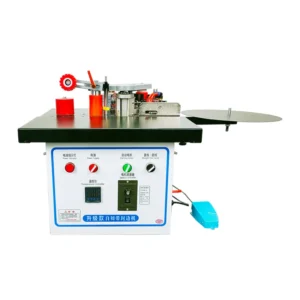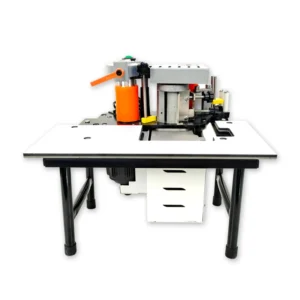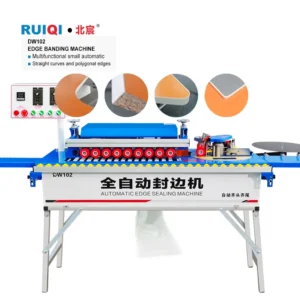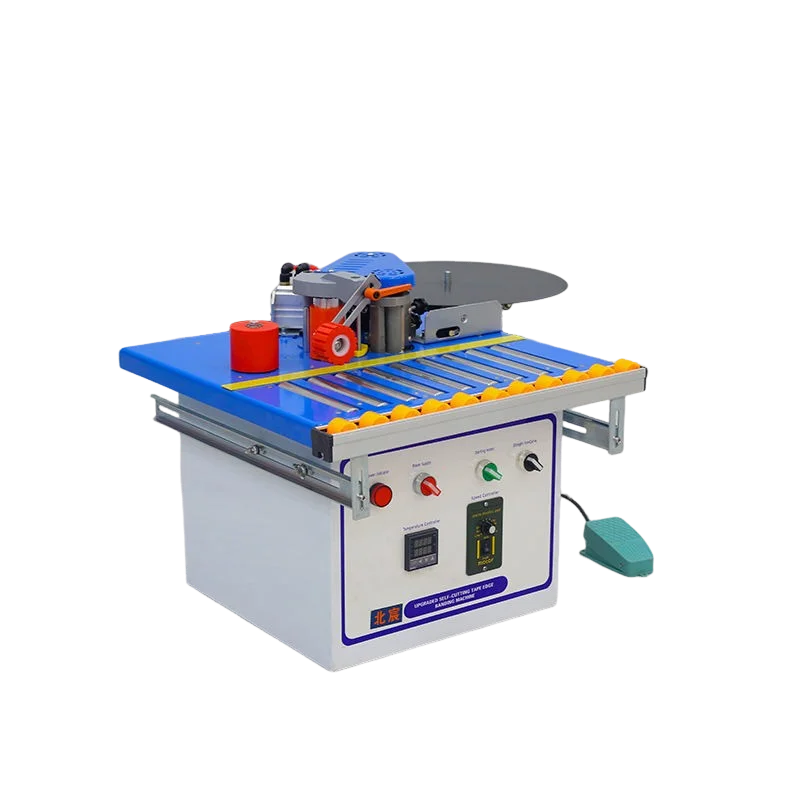
Edge banding machine
Click to enlarge
ISO 9001
CE Certified
OEM / ODM
12-Mo Warranty
Edge banding machine
Small Workshop Mini Edge Bander for Curved and Straight Edge Banding
<p><strong>Mini Tabletop Edge Bander</strong>, 1000W, Curved & Straight, 0.3-3mm Banding Thickness — delivers controlled roller-fed edge sealing for workshops moving from hand-applied banding to machine-assisted production.</p> <ul> <li>Handles MDF, plywood, particleboard and solid wood with 0-50mm edge height range</li> <li>1000ml glue pot supports continuous small-batch runs; 0.5-0.8Mpa air requirement fits standard workshop compressors</li> <li>220V/380V customization available with multilingual operation manual</li> </ul>
100+
Countries
MOQ 1
Unit
15-25 Days
Lead Time
220V
Curved And Straight Edge Banding
Edge Banding Machine
Manual Control
Mini Portable Edge Bander
Process And Application
Small Workshop
ST-70
- Full OEM/ODM support -- custom logo, voltage (110V-440V), multilingual panels
- ISO 9001 & CE certified, 5 national patents, 60 professional engineers
- 12-month warranty, remote technical support & spare parts service
- Professional export packaging, customs clearance support, on-time delivery
Precision-Verified Edge Sealing — Every tabletop unit undergoes pre-shipment voltage matching and functional testing before leaving the Shandong facility, ensuring your workshop receives a machine ready to run on day one.
Technical Specifications
| Parameter | Value |
|---|---|
| Product Type | Manual Tabletop Edge Banding Machine |
| Total Power | 1000W |
| Voltage | 220V / 380V / customization |
| Feed Speed | 0-6 m/min (basis not stated in source) |
| Edge Banding Height Range | 0-50 mm |
| Edge Banding Thickness Range | 0.3-3 mm |
| Minimum Sheet Length | 25 cm |
| Minimum Sheet Width | 3 cm |
| Glue Pot Capacity | 1000 ml |
| Edge Trimming Power | 20W |
| Air Source Pressure | 0.5-0.8 MPa |
| Control Type | Manual control |
| Assembly State | Tabletop portable unit |
| Product Dimensions | 50 × 50 × 47 cm |
| Net Weight | 23 kg |
| Standard Features | Curved and straight edge banding |
| Certification | CE |
Application Suitability
| Application | Material or Output |
|---|---|
| Cabinet and shelf edge sealing in small workshops | MDF and particleboard panels with PVC or melamine banding |
| Furniture repair and on-site modification | Ecological board and plywood with wood veneer edges |
| Prototype and sample production runs | Solid wood panels requiring both curved and straight profiles |
| Home decoration custom joinery | Narrow stock down to 3 cm width on ecological board substrates |
Why the Voltage Question Must Come Before the Machine Ships
Confirming your local voltage and frequency before production prevents a three-week standstill on your workshop floor.
I have seen a compact edge bander sit idle in a customer’s shop because the unit arrived wired for a supply standard that did not match the local grid. The operator had the panels cut, the banding material staged, and a delivery deadline approaching — but no amount of troubleshooting could change the transformer inside a sealed enclosure. The workshop lost nearly a full month before a retrofit brought the machine online [NEED_CITE: voltage and frequency standards by export market]. With a manual tabletop edge banding machine serving small workshops and home-based operations, downtime hits harder because there is rarely a second machine to absorb the backlog. This edge banding machine process and application guide starts with that conversation because everything else depends on it.
Substrate Behavior and Glue Selection for Hand-Fed Edging
Small-batch joinery introduces material variety that full automatic lines rarely encounter in a single shift. This unit handles MDF, particleboard, plywood, solid wood panels, and ecological board, each presenting a different surface porosity and glue absorption rate. The 1000 ml glue pot holds enough adhesive for continuous short runs without frequent refilling, which matters when a craftsman is switching between cabinet sides and narrow shelf stock. Operator control over feed pace allows adjustment when moving from dense particleboard to more absorbent MDF, maintaining consistent glue transfer across the edge banding machine process and application range.
Curved and Straight Profiles in One Compact Setup
Workshops producing custom furniture routinely encounter radiused cabinet doors, rounded shelf corners, and contoured desktop edges alongside standard straight runs. This machine addresses both profiles from a single tabletop station, eliminating the need for a dedicated curved-edge unit. The manual feed approach lets the operator slow down through tight radii to maintain banding contact, then accelerate through straight sections. For a small operation where floor space limits the number of stations, this dual capability defines the practical edge banding machine process and application scope of the workshop [NEED_CITE: edge banding quality standards for custom furniture substrates].
Reading the Specifications Against Real Workshop Conditions
The 0.3-3 mm banding thickness range covers PVC, melamine, and wood veneer — the three materials a small furniture maker is most likely to stock. Selecting thickness outside this window risks either insufficient glue penetration on thin veneer or inadequate roller pressure on heavy PVC. The 0-50 mm edge height range accommodates standard panel thicknesses from thin shelf stock up to thicker cabinet sides, but panels exceeding that height will not seat properly against the guide fence. Air pressure at 0.5-0.8 MPa aligns with standard workshop compressors; undersized compressors cause inconsistent glue flow and uneven banding adhesion. The 0-6 m/min feed speed, noted with basis not stated in source, should be confirmed against your specific material type and thickness before relying on it for scheduling [NEED_CITE: pneumatic supply requirements for woodworking machinery].
What Happens When Configuration Gets Overlooked
Buying a compact edge bander without verifying voltage compatibility, air supply adequacy, and control panel language creates problems that surface only after the crate is opened. A unit wired for the wrong frequency can run but overheat within hours, damaging the glue pot heating element. An operator facing an unfamiliar control language will guess at temperature settings, producing inconsistent adhesion that is blamed on the machine rather than the setup. These failures are entirely preventable with a structured pre-shipment checklist [NEED_CITE: common commissioning failures in imported woodworking equipment].
Why Source This Machine Through Our Shandong Facility
In-house manufacturing means the same team that assembles your tabletop edge bander also runs the pre-shipment test on your specified panel material. Voltage customization from 110V to 440V is configured at the wiring stage, not adapted through external transformers that add failure points. The four-stage quality check covers incoming components through final dispatch verification, catching tolerance drift before it reaches your dock. An engineer reviews your workshop profile — panel types, daily volume, available compressor capacity — and confirms configuration before production begins. Formal quotation with verified specifications arrives within 24 hours, and factory visits are open for buyers who want to see the assembly floor.
Documentation & Verification
- CE declaration of conformity covering this tabletop edge banding unit
- Machine specification sheet confirming your voltage and frequency requirement
- Factory test record run on your specified panel thickness and banding material
- Electrical schematic matching the as-built wiring configuration
- Operation and maintenance manual in your agreed language
- Spare parts list with glue pot, roller, and trimming blade part numbers
Installation, Commissioning & Support
- Requires a stable bench surface supporting 23 kg with clear access on all sides for the 50 × 50 × 47 cm footprint
- Dedicated circuit matching confirmed voltage, separate from compressor supply to avoid voltage drop during startup
- Arrives fully assembled as a tabletop unit requiring only air hose connection and power-up verification
- First-run glue temperature calibration performed with operator present via remote guidance if needed
- Replacement glue pot and edge trimming blade included in initial spare parts package
- Daily glue pot cleaning and weekly roller inspection maintain consistent banding adhesion quality
Before You Send the Inquiry
Provide your primary panel materials and thicknesses, the edge banding types you plan to run, and your local voltage and frequency standard so the quotation reflects a machine configured for your grid. If you work with curved profiles regularly, note the typical radii you encounter so feed speed expectations are realistic. Let us know your available compressor output to confirm the air supply meets the 0.5-0.8 MPa requirement.
Frequently Asked Questions
Q: What substrate materials and edge banding types work with this machine’s glue system?
A: The unit handles MDF, particleboard, plywood, solid wood, and ecological board with PVC, melamine, or wood veneer banding in the 0.3-3 mm thickness range. Glue pot temperature should be adjusted when switching between materials to maintain proper adhesion without excessive squeeze-out on porous substrates.
Q: How does curved edge banding differ from straight edge application on this unit?
A: Curved profiles require the operator to reduce feed pace and maintain consistent pressure against the guide roller to prevent banding lift at the radius. Straight edges can be fed at a steadier pace. Both profiles use the same glue application system with no tooling changeover between curved and straight work.
Q: What minimum compressor specification is needed for the 0.5-0.8 MPa air requirement?
A: Your compressor must deliver stable pressure within the 0.5-0.8 MPa range at the machine inlet, accounting for pressure drop across the hose length. A compressor rated below this threshold will cause inconsistent glue flow and uneven banding adhesion during continuous operation.
Q: Can this machine handle daily volume in a small custom furniture workshop?
A: The manual feed speed and 1000 ml glue pot capacity suit repair work, sample making, and small-batch production where panel variety is high and volume per run is moderate. Workshops running high-volume repetitive panel runs should evaluate automated feed models to match throughput demands.
Q: What is the upgrade path when production volume exceeds manual feed capacity?
A: When daily output consistently exceeds what manual feeding supports, moving to a semi-automatic or full-function edge bander within the same product family allows transition without changing supplier. The tabletop unit can remain in the workshop for repair and prototype work alongside the higher-capacity machine.
Technical Specifications
| Parameter | Value |
|---|---|
| Product Name | Small Workshop Mini Edge Bander for Curved and Straight Edge Banding |
| Category | Edge banding machine |
| Voltage Options | 110V / 220V / 380V / 440V (customizable) |
| Frequency | 50Hz / 60Hz (customizable) |
| Certification | ISO 9001, CE |
| MOQ | 1 Unit |
| Lead Time | 15-25 Working Days |
| Warranty | 12 Months |
| OEM / ODM | Available -- logo, color, panel language |
* Detailed technical specifications vary by model. Please contact us with your specific requirements for a complete datasheet.
Shipping & Export
-
Export Packaging
Heavy-duty wooden crate with foam padding and moisture protection
-
Shipping Methods
Sea freight (FCL/LCL), air freight, express -- we support all methods
-
Customs Support
Full documentation: CO, commercial invoice, packing list, HS code assistance
-
Port of Loading
Tianjin / Qingdao port, China -- 20 years export experience
OEM / ODM Services
-
Logo & Branding
Custom logo printing, color scheme, and nameplate engraving
-
Voltage Configuration
110V / 220V / 380V / 440V, 50Hz / 60Hz -- any region supported
-
Multilingual Panels
Control panels in English, Spanish, French, Arabic and more
-
Custom Specifications
Modified dimensions, accessories, or feature sets on request
Get a Quote
Request Product Inquiry
Fill in your details and we'll respond within 24 hours with pricing and availability.
Direct Contact
How It Works
-
1
Confirm requirements & budget
Tell us your factory scale and processing needs
-
2
Receive recommendation & quote
We match the right machine with full specs
-
3
Negotiate & place order
OEM terms, voltage, payment and delivery
-
4
Production & QC inspection
Multi-stage quality control by 60 engineers
-
5
Export packaging & shipment
Professional packing, customs clearance
-
6
After-sales support
12-month warranty, remote tech support
You May Also Like