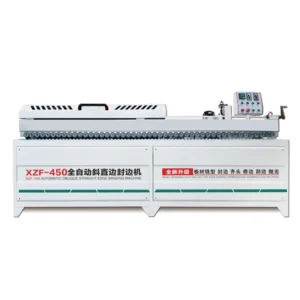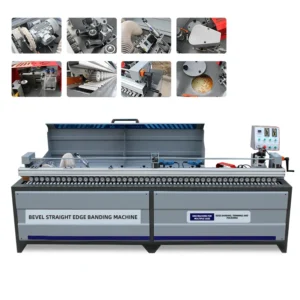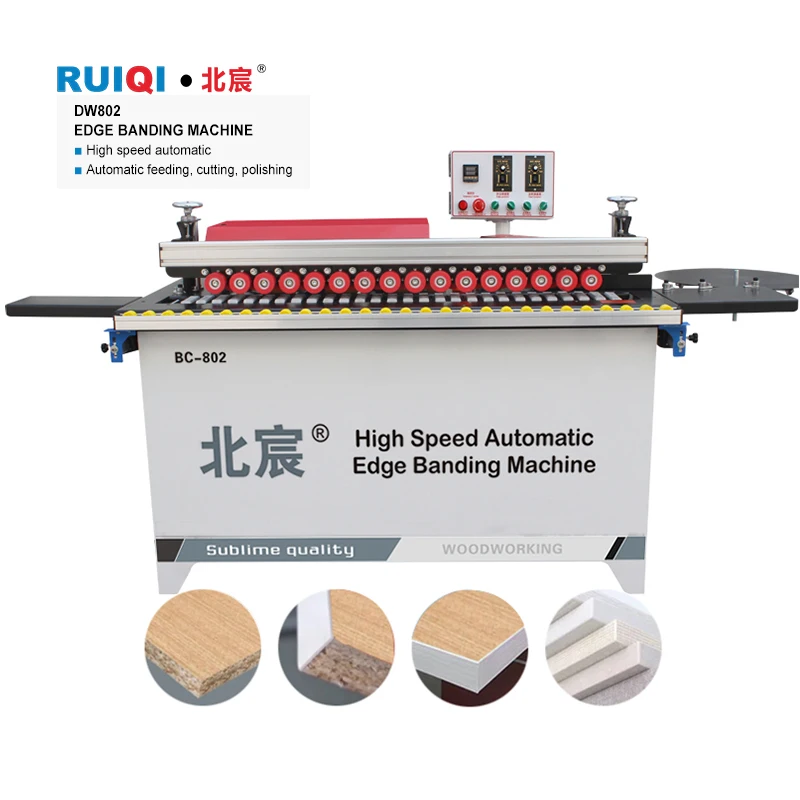
Edge banding machine
Click to enlarge
ISO 9001
CE Certified
OEM / ODM
12-Mo Warranty
Edge banding machine
Automatic Edge Banding Machine 45 Degrees for Furniture Facades | Factory Supply
<p><strong>DW802 Automatic Edge Banding Machine, 4200W, 0.3–3mm Edge Thickness</strong> — designed for consistent edge finishing on MDF, particleboard and plywood substrates.</p> <ul> <li>0–50mm panel height and 250mm minimum sheet length suit cabinet doors and furniture facades</li> <li>Dual 800W trimming motors with integrated vacuum hold-down reduce chipping and visible glue lines</li> <li>4000ml glue pot supports continuous multi-panel runs across PVC and veneer materials</li> </ul> <p>Backed by four-stage QC with pre-shipment verification, engineer-led configuration within 24 hours, and voltage customization from 110V to 440V for your facility.</p>
100+
Countries
MOQ 1
Unit
15-25 Days
Lead Time
4000ml Glue Pot
DW802
Edge Banding Machine
Furniture Facade
MDF Panel
Process And Application
Vacuum Hold Down
- Full OEM/ODM support -- custom logo, voltage (110V-440V), multilingual panels
- ISO 9001 & CE certified, 5 national patents, 60 professional engineers
- 12-month warranty, remote technical support & spare parts service
- Professional export packaging, customs clearance support, on-time delivery
Voltage and frequency verification as standard — every DW802 unit undergoes electrical supply confirmation matched to the buyer’s local grid before production begins, eliminating the commissioning delays caused by mismatched power configurations.
Technical Specifications
| Parameter | Value |
|---|---|
| Model | DW802 |
| Product Type | Automatic Edge Banding Machine |
| Total Power | 4200W |
| Voltage & Frequency | 220V/380V/customization (frequency to be confirmed per market) |
| Edge Banding Height | 0–50mm |
| Edge Banding Thickness | 0.3–3mm |
| Minimum Sheet Length | 250mm |
| Minimum Sheet Width | 100mm |
| Edge Trimming Motor Power | 800W × 2 |
| Polishing Motor Power | 180W × 2 |
| Vacuum Power | 1200W |
| Air Source Pressure | 0.4–0.8 MPa |
| Glue Pot Capacity | 4000ml |
| Overall Dimensions (L×W×H) | 1300 × 600 × 950 mm |
| Net Weight | 135 kg |
| Key Features | Edge banding, trimming, polishing, automatic head and tail cutting, vacuum hold-down, multilingual control panel options |
Application Suitability
| Application | Material or Output |
|---|---|
| Custom cabinet door edge finishing | PVC and melamine edge banding on MDF and particleboard substrates |
| Furniture facade production | Veneer and PVC strips on melamine-faced chipboard panels |
| Small-batch panel processing | Mixed material runs across plywood, ecological board and solid wood |
| Joinery workshop automation | Transition from manual edge application to semi-automated line processing |
Why Voltage Must Be Settled Before the Quotation Is Signed
Confirming local voltage and frequency eliminates the most preventable cause of commissioning failure on imported woodworking machinery.
The automatic edge banding machine process and application depends entirely on stable electrical supply from day one. I have watched production lines sit idle for weeks because a machine wired for 380V/50Hz arrived at a facility running three-phase 440V/60Hz. The control cabinet trips immediately, the glue pot never reaches temperature, and the trimming motors run outside their rated speed range — all problems that surface only when the machine is uncrated and powered on [NEED_CITE: voltage and frequency standards by export market]. The cost of a transformer and the lost production time far outweigh the five minutes it takes to specify electrical requirements before an order is placed.
How Substrate Choice Changes the Edge Banding Process
MDF, particleboard and plywood each behave differently when edge banding is applied. MDF offers a dense, uniform edge that accepts glue evenly, while particleboard requires careful pressure control to prevent the porous surface from absorbing adhesive too quickly. The DW802’s 4000ml glue pot maintains consistent thermal mass across extended runs, which matters when switching between substrates mid-shift. Plywood introduces grain variation along the edge, making the dual 800W trimming motors necessary for clean cuts without splintering at the head and tail positions.
Glue Line Visibility and What Controls It
Visible glue lines on finished cabinet doors usually trace back to three factors: uneven adhesive application, insufficient trimming pressure, or polishing wheels that smear rather than remove excess residue. This automatic edge banding machine addresses each point through integrated stations that run in sequence. The vacuum hold-down system keeps panels flat against the feed track, preventing the slight lift that causes glue gaps at the leading edge of thinner boards [NEED_CITE: common edge banding defect causes in panel furniture production]. When edge banding thickness ranges from 0.3mm melamine to 3mm PVC, the trimming and polishing stages must adapt to different material stiffness levels without manual recalibration between panels.
Reading the Specifications Against Your Production Requirements
The 0–50mm edge banding height range covers standard cabinet panel thicknesses from 16mm through 40mm worktops, meaning most furniture production falls within the machine’s working envelope without requiring tooling changes. The 0.4–0.8 MPa air source pressure requirement is typical for pneumatic clamping and trimming actuators, but workshops should verify compressor capacity before installation since undersized air supply causes intermittent trimming faults. The 250mm minimum sheet length and 100mm minimum width define the smallest offcut the machine can process, which matters for custom furniture operations that run small drawer sides and narrow filler strips. At 4200W total power, the DW802 draws within the capacity of standard single-phase 220V circuits in many markets, though three-phase 380V configuration distributes load more evenly across the trimming and vacuum motors [NEED_CITE: CE machinery directive requirements for industrial equipment].
The Hidden Cost of Skipping Configuration Checks
Ordering a machine without matching it to your actual panel sizes, edge materials and electrical supply creates problems that compound through production. Panels shorter than the minimum length jam at the infeed, while PVC edge banding thicker than 3mm overloads the trimming cutters and leaves rough edges that fail downstream quality inspection. A control panel in a language the operator cannot read delays commissioning and forces technicians to rely on trial-and-error settings [NEED_CITE: operator interface language requirements for exported machinery]. These issues are not manufacturing defects — they are configuration mismatches that could have been resolved during the quotation stage.
What Manufacturing Depth Means for Your Order
Patented cutting mechanisms in the trimming stations produce verified tolerances rather than claimed specifications that disappear under production conditions. The four-stage quality control process covers incoming material inspection through pre-shipment verification, so the machine you receive matches the test records generated at the factory. Voltage customization from 110V to 440V is built into the production workflow rather than handled as a post-build modification. Engineer-led configuration review means the specification sheet is confirmed against your actual panel materials and edge banding types before manufacturing starts, not after. Factory visits are welcomed so buyers can inspect component sourcing and assembly standards directly on the production floor.
Documentation & Verification
- CE declaration of conformity matched to DW802 machine category
- Factory test record processed on your specific panel thickness and edge material
- Electrical schematic confirming configured voltage and frequency for your facility
- Operation and maintenance manual supplied in the agreed operator language
- Pre-shipment verification photographs showing edge finish quality on sample panels
Installation, Commissioning & Support
- Requires level floor surface with 1300 × 600 mm footprint clearance plus operator access space
- Dedicated electrical circuit matching confirmed voltage and frequency specification
- Arrives partially assembled with trimming and polishing stations pre-aligned at factory
- First-run parameter setting includes glue temperature calibration for your edge banding material
- Spare parts list covers trimming cutters, polishing wheels and vacuum seals
What We Need to Prepare an Accurate Configuration
Share the panel materials you run most frequently — MDF, particleboard, plywood or a mix — along with the edge banding types and thicknesses you plan to use. Confirm your facility’s voltage and frequency so the electrical configuration matches your supply before production begins. Let us know if operators require a control panel language beyond Chinese or English so the interface is configured accordingly.
Frequently Asked Questions
Q: How does edge banding quality differ across MDF, particleboard and plywood substrates on this machine?
A: MDF produces the cleanest edge due to its uniform density, while particleboard requires the dual 800W trimming motors to cut through the composite structure without chipping. Plywood edges vary with grain direction, making the integrated polishing stage important for removing residual glue and smoothing the trimmed surface across all three substrate types.
Q: What glue type and temperature settings are recommended for PVC vs. veneer edge banding materials?
A: PVC edge banding typically uses EVA hot-melt adhesive at temperatures between 180°C and 200°C, while natural veneer requires lower temperatures to prevent moisture loss and cracking. The 4000ml glue pot maintains stable thermal mass, and the specific temperature for your material combination is set during factory testing before shipment.
Q: How do I confirm voltage and frequency compatibility with my local electrical supply before ordering?
A: Provide your facility’s phase configuration, voltage and frequency during the inquiry stage. The DW802 supports 220V/380V and custom configurations. The electrical schematic and voltage confirmation document are issued with the quotation so you can verify compatibility with your local electrician before production begins.
Q: Can the control panel language be customised for operators who do not read Chinese or English?
A: Custom language options are available on request beyond the standard Chinese and English interface. Specify the required language during configuration so the control panel is programmed and tested before the machine leaves the factory, avoiding commissioning delays at your facility.
Q: What sample processing tests are available before shipment to verify edge finish quality on my panels?
A: You can send sample panels and your preferred edge banding material to the factory for processing tests. The resulting edge-banded samples and pre-shipment verification photographs demonstrate trimming accuracy and glue line quality on your actual substrate before the machine is dispatched.
Technical Specifications
| Parameter | Value |
|---|---|
| Product Name | Automatic Edge Banding Machine 45 Degrees for Furniture Facades | Factory Supply |
| Category | Edge banding machine |
| Voltage Options | 110V / 220V / 380V / 440V (customizable) |
| Frequency | 50Hz / 60Hz (customizable) |
| Certification | ISO 9001, CE |
| MOQ | 1 Unit |
| Lead Time | 15-25 Working Days |
| Warranty | 12 Months |
| OEM / ODM | Available -- logo, color, panel language |
* Detailed technical specifications vary by model. Please contact us with your specific requirements for a complete datasheet.
Shipping & Export
-
Export Packaging
Heavy-duty wooden crate with foam padding and moisture protection
-
Shipping Methods
Sea freight (FCL/LCL), air freight, express -- we support all methods
-
Customs Support
Full documentation: CO, commercial invoice, packing list, HS code assistance
-
Port of Loading
Tianjin / Qingdao port, China -- 20 years export experience
OEM / ODM Services
-
Logo & Branding
Custom logo printing, color scheme, and nameplate engraving
-
Voltage Configuration
110V / 220V / 380V / 440V, 50Hz / 60Hz -- any region supported
-
Multilingual Panels
Control panels in English, Spanish, French, Arabic and more
-
Custom Specifications
Modified dimensions, accessories, or feature sets on request
Get a Quote
Request Product Inquiry
Fill in your details and we'll respond within 24 hours with pricing and availability.
Direct Contact
How It Works
-
1
Confirm requirements & budget
Tell us your factory scale and processing needs
-
2
Receive recommendation & quote
We match the right machine with full specs
-
3
Negotiate & place order
OEM terms, voltage, payment and delivery
-
4
Production & QC inspection
Multi-stage quality control by 60 engineers
-
5
Export packaging & shipment
Professional packing, customs clearance
-
6
After-sales support
12-month warranty, remote tech support
You May Also Like