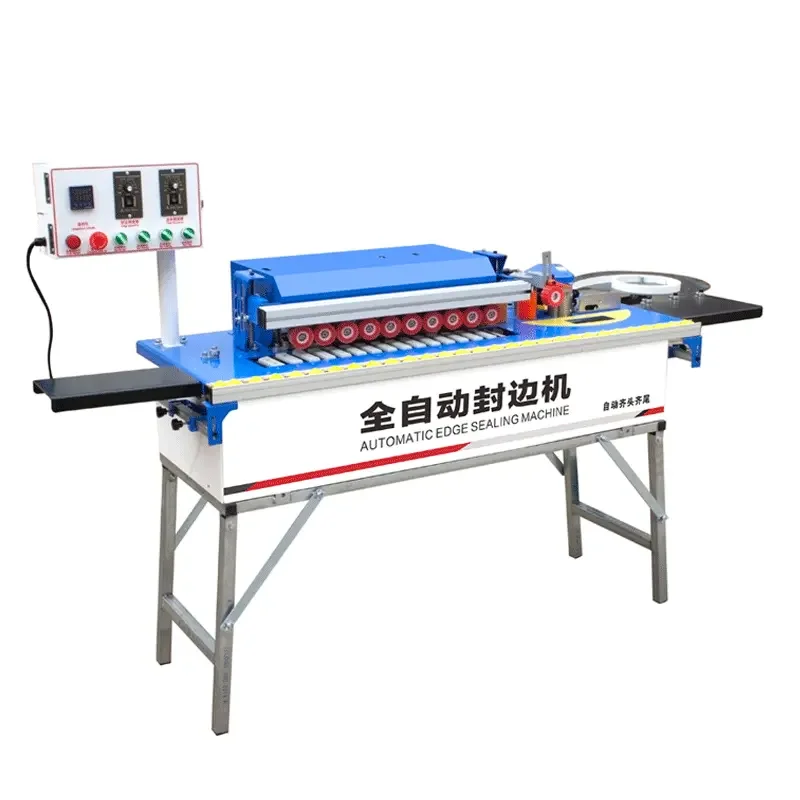
Edge banding machine
Click to enlarge
ISO 9001
CE Certified
OEM / ODM
12-Mo Warranty
Edge banding machine
DW102 Edge Banding Machine for MDF Panel – Process Guide
<p><strong>DW102 Automatic Edge Banding Machine, 0.3–3mm Banding Thickness, 3800W</strong> — engineered for MDF, particleboard, plywood, and polymer panel processing with integrated trimming, polishing, and vacuum hold-down.</p> <ul> <li>Supports straight and curved edge profiles across mixed substrate batches, maintaining consistent glue line quality and adhesion through the 1000ml glue pot</li> <li>Automatic head-and-tail cutting paired with dual 650W trimming stations reduces manual variability, directly improving downstream assembly tolerances</li> <li>220V/380V customization available with confirmed voltage-frequency matching before shipment</li> </ul> <p>Backed by four-stage QC with pre-shipment verification, engineer-led configuration within 24 hours, and operation manuals provided in your required language.</p>
100+
Countries
MOQ 1
Unit
15-25 Days
Lead Time
Automatic Edge Banding
DW102
Edge Banding Machine
Furniture Factory
MDF Panel
Process Guide
Vacuum Hold Down
- Full OEM/ODM support -- custom logo, voltage (110V-440V), multilingual panels
- ISO 9001 & CE certified, 5 national patents, 60 professional engineers
- 12-month warranty, remote technical support & spare parts service
- Professional export packaging, customs clearance support, on-time delivery
Precision-Glue Edge Integrity — verified on your exact MDF and PVC combination before the crate is nailed shut.
Technical Specifications
| Parameter | Value |
|---|---|
| Model | DW102 |
| Product Type | Automatic Edge Banding Machine |
| Total Power | 3800W |
| Voltage & Frequency | 220V / 380V / customizable (frequency to be confirmed) |
| Overall Dimensions (L×W×H) | 128 × 47 × 69 cm |
| Net Weight | 75 kg |
| Minimum Panel Length | 25 cm |
| Minimum Panel Width | 5 cm |
| Edge Banding Height Range | 0–50 mm |
| Edge Banding Thickness Range | 0.3–3 mm |
| Edge Trimming Power | 650W × 2 |
| Polishing Power | 180W × 2 |
| Vacuum Power | 1200W |
| Glue Pot Capacity | 1000 ml |
| Air Supply Requirement | 0.5–0.8 MPa |
| Feed Speed | (basis to be confirmed) |
| Trimming Stations | Edge trimming + polishing, automatic head and tail cutting |
| Key Features | Curved and straight edge banding, vacuum hold-down, automatic head and tail cutting |
| Language Options | Chinese and English standard; other languages customizable |
Application Suitability
| Application | Material or Output |
|---|---|
| Cabinet door panel edge finishing | MDF and particleboard with PVC or melamine banding |
| Custom furniture curved edge sealing | Plywood profiles with veneer or thin PVC strips |
| Polymer door panel production | PVC and composite polymer substrates |
| Workshop-scale batch edge processing | Mixed MDF, blockboard, and particleboard runs |
Why Visible Glue Lines Keep Appearing Across Different Substrates
Glue adhesion varies by substrate density, and the edge banding machine woodworking process must be tuned to each material before the first production panel runs.
I once flew to a customer’s factory because every panel coming off their line showed hairline glue seams. They had switched from the PVC strip we tested on sample to a thicker acrylic banding their local supplier offered at a discount. The glue temperature, feed rate, and pressure settings were all calibrated for the original material — and none of them matched the new one. Two days on-site resetting every station, and the line finally held. That kind of mismatch is avoidable if you force a material trial before shipping [NEED_CITE: substrate-specific adhesive behaviour in panel edge banding].
The DW102 addresses this through its adjustable glue pot and the vacuum hold-down that keeps panels flat against the fence during trimming. When MDF and particleboard run back-to-back in the same batch, the difference in surface porosity changes how the adhesive wets out. Having the ability to adjust glue application and confirm trim quality on each substrate before a full run matters more than chasing a higher feed speed.
How the Glue and Trimming Sequence Handles Material Variation
The 1000 ml glue pot on the DW102 supports continuous runs through a typical batch without stopping for refills, which matters when you are working through mixed MDF and plywood orders. The glue must stay within a narrow temperature window throughout the run — if it cools between panels, the wetting behaviour changes and the bond line thickens. This edge banding machine woodworking process keeps the adhesive at a stable viscosity by minimising idle gaps between panels.
The automatic head-and-tail cutting removes one of the most common sources of visible defects: the manual snip at each panel end. Operators trimming by hand leave slight overhangs or dig into the banding, and those marks show up immediately during assembly when panels meet at a corner joint.
Vacuum Hold-Down on Curved Profiles
Straight edges are forgiving. Curved profiles are where edge banding machines reveal their limitations. The DW102’s vacuum hold-down system clamps the panel against the reference fence, preventing the slight lateral drift that causes the trimming cutter to leave a ridge or undercut the banding [NEED_CITE: vacuum clamping effect on curved panel edge finish].
For cabinet makers running shaped door fronts or radius panels, this means the edge trim follows the contour consistently rather than skating across the curve. The two 180W polishing wheels then smooth the trimmed edge to a uniform finish, removing the micro-scratches left by the trimming cutters.
Reading the Specs Against Your Actual Production Needs
The edge banding thickness range of 0.3–3 mm covers the three most common banding families in furniture production: thin melamine, standard PVC, and thicker veneer strips. If your product range includes both budget melamine-faced shelving and premium veneer-fronted cabinets, this single machine handles the crossover without a changeover in tooling.
The 0–50 mm edge banding height range effectively sets your maximum panel thickness. For standard 18 mm MDF cabinet components this leaves comfortable headroom, but if you process 40 mm blockboard worktops, you are approaching the upper limit and should confirm trim station clearance. The 650W × 2 trimming motors provide enough torque for clean cuts through PVC and veneer without chattering, which directly affects the edge finish you see under LED lighting on the finished furniture [NEED_CITE: trimming motor power and edge surface quality correlation].
The overall footprint of 128 × 47 × 69 cm keeps the machine within reach of a single operator working at the infeed, and the 75 kg weight means it can be repositioned within a workshop without specialised lifting equipment.
What Happens When the Machine and the Material Do Not Match
I have watched a workshop buy a machine based on the lowest quote, then spend weeks fighting glue lines on their specific board stock. The edge quality looked fine on the supplier’s test panel — which was a different density MDF from what the workshop actually purchased locally. By the time the problem surfaced, the machine was already crated and shipped.
If you process both particleboard and MDF in the same week, the difference in surface absorption means the same glue temperature will produce a starved joint on one and a squeeze-out mess on the other. Running without verifying these settings against your actual materials leads to rework, rejected panels, and assembly gaps that your customer sees when the doors do not close square [NEED_CITE: panel substrate density effect on adhesive bond line].
Why Sourcing This Machine Here Makes Sense for Your Workshop
Every DW102 leaves the factory only after a test run on the buyer’s actual board and banding sample. You ship us the material; we run it, record it, and send you the video and test pieces before the machine is packed.
Voltage and frequency are confirmed against your facility supply before production begins — no discovering a mismatch when the electrician arrives for commissioning. The control panel language is set to your operator’s preference so the first day of production is not spent guessing what each button does.
The four-stage quality check covers incoming components, in-process assembly, finished function, and a final pre-shipment verification on your specified material. Patented cutting mechanisms maintain trim tolerance that you can measure on the test pieces we send you, not just take on trust.
Documentation & Verification
- Factory test record on your specific MDF or particleboard and banding combination before dispatch
- Electrical schematic confirming voltage and frequency matched to your facility supply
- Operation and maintenance manual in your operator’s language with illustrated spare parts list
- CE declaration of conformity covering the complete machine assembly
- Packing photographs showing crate condition and component securing before collection
Installation, Commissioning & Support
- Confirm 220V or 380V dedicated circuit with correct breaker rating for the 3800W total load before delivery
- Allow floor space of approximately 150 × 70 cm around the 128 × 47 cm footprint for operator access and panel staging
- Connect compressed air supply at 0.5–0.8 MPa with a dryer inline to protect the vacuum and pneumatic systems
- First-run calibration includes glue pot temperature mapping to your specific banding material and substrate
- Operator training covers curved and straight profile setup, head-and-tail cutter adjustment, and daily glue pot cleaning
Preparing Your Enquiry
To give you a configuration that runs your actual production from day one, share the panel materials and thicknesses you process most often, along with the edge banding type and thickness you source locally. Let us know your facility voltage and frequency, and whether your operators need the control interface in a language beyond Chinese or English. If you are running both straight and curved profiles, send us a drawing or sample so we can confirm the vacuum hold-down covers your contour range.
Frequently Asked Questions
Q: How does glue consistency vary when switching between MDF, particleboard, and plywood?
A: Each substrate absorbs heat and adhesive differently. MDF’s dense surface requires higher glue temperature for proper wetting, while particleboard’s porous face can absorb adhesive too quickly, leaving a starved joint. The DW102’s adjustable glue pot lets you set the correct temperature for each material. We recommend running test panels on every substrate you plan to process before committing to a production batch.
Q: Which banding materials work within the 0.3–3 mm thickness range?
A: This range covers thin melamine paper edges, standard PVC and ABS strips used in cabinet production, and natural veneer banding. Thicker acrylic or solid wood lipping falls outside this specification. Before ordering, send us samples of your actual banding stock so we can confirm feed path clearance and trimming cutter suitability for your specific material.
Q: Does vacuum hold-down actually improve edge quality on curved panels?
A: Yes. On curved profiles, the panel tends to drift laterally as it passes through the trimming station, causing the cutter to leave ridges or undercut the banding. The vacuum system on the DW102 clamps the panel firmly against the reference fence, keeping the trim consistent around the contour. This is especially noticeable on radius cabinet doors and shaped shelving.
Q: How does the edge quality from this machine affect panel assembly downstream?
A: Poorly trimmed edges create visible gaps when panels meet at corner joints, and inconsistent banding thickness throws off hinge alignment and drawer runner positioning. The DW102’s automatic head-and-tail cutting and dual trimming stations produce square, flush edges that maintain assembly tolerances. We verify this on your sample panels before the machine ships.
Technical Specifications
| Parameter | Value |
|---|---|
| Product Name | DW102 Edge Banding Machine for MDF Panel – Process Guide |
| Category | Edge banding machine |
| Voltage Options | 110V / 220V / 380V / 440V (customizable) |
| Frequency | 50Hz / 60Hz (customizable) |
| Certification | ISO 9001, CE |
| MOQ | 1 Unit |
| Lead Time | 15-25 Working Days |
| Warranty | 12 Months |
| OEM / ODM | Available -- logo, color, panel language |
* Detailed technical specifications vary by model. Please contact us with your specific requirements for a complete datasheet.
Shipping & Export
-
Export Packaging
Heavy-duty wooden crate with foam padding and moisture protection
-
Shipping Methods
Sea freight (FCL/LCL), air freight, express -- we support all methods
-
Customs Support
Full documentation: CO, commercial invoice, packing list, HS code assistance
-
Port of Loading
Tianjin / Qingdao port, China -- 20 years export experience
OEM / ODM Services
-
Logo & Branding
Custom logo printing, color scheme, and nameplate engraving
-
Voltage Configuration
110V / 220V / 380V / 440V, 50Hz / 60Hz -- any region supported
-
Multilingual Panels
Control panels in English, Spanish, French, Arabic and more
-
Custom Specifications
Modified dimensions, accessories, or feature sets on request
Get a Quote
Request Product Inquiry
Fill in your details and we'll respond within 24 hours with pricing and availability.
Direct Contact
How It Works
-
1
Confirm requirements & budget
Tell us your factory scale and processing needs
-
2
Receive recommendation & quote
We match the right machine with full specs
-
3
Negotiate & place order
OEM terms, voltage, payment and delivery
-
4
Production & QC inspection
Multi-stage quality control by 60 engineers
-
5
Export packaging & shipment
Professional packing, customs clearance
-
6
After-sales support
12-month warranty, remote tech support
You May Also Like