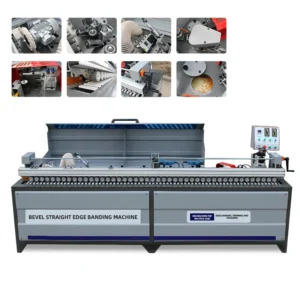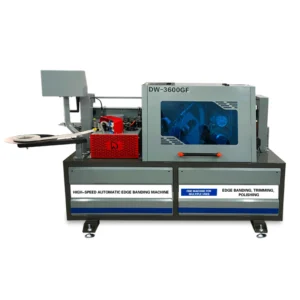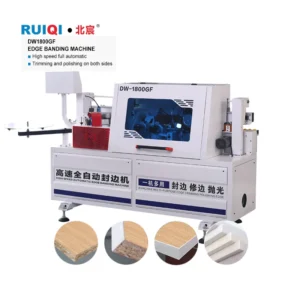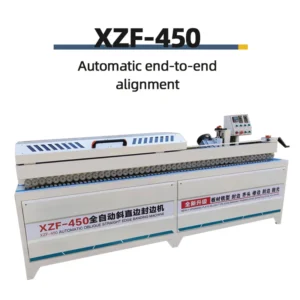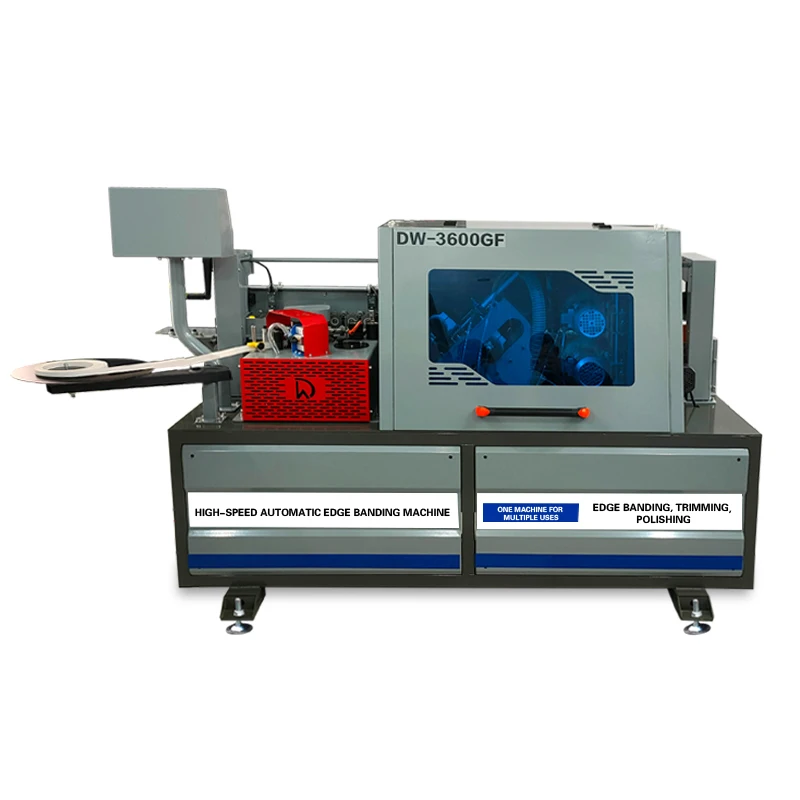
Edge banding machine
Click to enlarge
ISO 9001
CE Certified
OEM / ODM
12-Mo Warranty
Edge banding machine
Industrial Application Automatic Edge Bander for PVC MDF Wood
<p><strong>DW-3600GF Automatic Edge Banding Machine, 380V, 4.9 kW, 0–14 m/min feed speed</strong> — delivers straight edge banding for MDF, plywood and particleboard with 0.3–3 mm band thickness capacity.</p> <ul> <li>Trimming motors at 24000 r/min ensure clean PVC and veneer edge finishes, directly supporting tight downstream assembly tolerances.</li> <li>Standard process sequence covers gluing, trimming, scraping and polishing — each station affecting visible edge quality on custom furniture panels.</li> </ul> <p>Engineer-led configuration with formal quotation within 24 hours, backed by four-stage QC and pre-shipment factory test records.</p>
100+
Countries
MOQ 1
Unit
15-25 Days
Lead Time
14 m/min Feed Speed
380V
Cabinet Workshop
DW-3600GF
Edge Bander
Process Application
PVC MDF
- Full OEM/ODM support -- custom logo, voltage (110V-440V), multilingual panels
- ISO 9001 & CE certified, 5 national patents, 60 professional engineers
- 12-month warranty, remote technical support & spare parts service
- Professional export packaging, customs clearance support, on-time delivery
Process-Matched Configuration — Every DW-3600GF leaving the workshop is tested on the buyer’s actual substrate and edge band material before crate-up, so glue temperature and feed rate are set to your production reality, not our factory floor.
Technical Specifications
| Parameter | Value |
|---|---|
| Model | DW-3600GF |
| Product Type | Automatic Edge Banding Machine |
| Voltage & Frequency | 380V three-phase four-wire |
| Total Power | 4.9 kW |
| Edge Banding Type | Straight edge banding |
| Overall Dimensions (L×W×H) | 2200×650×1250 mm |
| Net Weight | 320 kg |
| Edge Band Height Range | 0–50 mm |
| Edge Band Thickness Range | 0.3–3 mm |
| Minimum Plate Length | 200 mm |
| Feed Speed | 0–14 m/min |
| Edge Banding Motor | 160 W |
| Transmission Motor | 180 W |
| Trimming Motor | 800 W × 2, 24000 r/min |
| Polishing Motor | 400 W × 2 |
| Air Pressure Requirement | 0.4–0.6 MPa |
| Standard Functions | Gluing, trimming, front and rear trimming, scraping, polishing, vacuuming |
| Language Options | Chinese and English (customizable to other languages on request) |
| Plug Options | EU, USA, AU, UK |
Application Suitability
| Application | Material or Output |
|---|---|
| Cabinet door and drawer front edge finishing | MDF and plywood with PVC edge banding |
| Wardrobe and shelving panel edging | Particleboard with 0.4–2 mm PVC strips |
| Solid wood furniture visible-edge treatment | Solid wood panels with veneer edge banding up to 3 mm |
| Small-batch custom furniture production | Mixed substrates in workshops processing panels down to 200 mm length |
| Batch panel edging for mid-volume cabinet makers | MDF, plywood and particleboard at feed speeds up to 14 m/min |
Why Visible Glue Lines Keep Coming Back on Some Substrates
The edge banding machine process and application outcome depends more on glue-to-substrate matching than on any single station’s motor rating.
I have watched a batch of MDF cabinet doors come off the line with clean, invisible joints in the morning, then see the same machine leave stringy glue lines on particleboard after lunch — nothing changed except the board density and pore structure. The substrate absorbs heat from the glue pot at different rates, and if feed speed is not adjusted accordingly, the adhesive either skins over before bonding or squeezes out past the trimming station. That is a process-level mismatch, not a machine defect, but the operator standing at the outfeed sees only the result [NEED_CITE: substrate thermal conductivity differences between MDF and particleboard during hot-melt edge banding].
Gluing Station Behaviour Across MDF, Plywood and Particleboard
The gluing station on the DW-3600GF applies hot-melt adhesive to the panel edge as the board passes through at a controlled feed speed. MDF, being dense and low-porosity, holds the adhesive film on the surface long enough for the PVC strip to bond under pressure. Particleboard, with its open fibre structure, draws heat away faster, so the same edge banding machine process and application setup that works on MDF may leave a starved glue line on particleboard unless the operator slows the feed or raises the glue pot temperature within the adhesive manufacturer’s tolerance window.
Trimming at 24000 r/min — What It Means for PVC and Veneer
The two trimming motors each run at 24000 r/min, which keeps the cutter edge moving fast enough to shear PVC cleanly rather than tearing it. Thin 0.3 mm PVC relies on that speed to avoid micro-chipping at the cut point, while thicker veneer up to 3 mm demands the same rotational speed to prevent fibre pull-out on the visible face. When the trimming station encounters a transition from PVC to veneer in the same production run, the operator adjusts the cutter infeed rather than the spindle speed, preserving the edge banding machine process and application consistency across material changes [NEED_CITE: cutter speed requirements for clean trimming of PVC versus wood veneer edge banding].
Reading the Specs Through a Production Manager’s Eyes
The 0–14 m/min feed speed range is not just a throughput number — it is the primary dial for matching glue open time to board length and substrate type. Shorter panels near the 200 mm minimum length need a slower feed so the glue has time to wet the edge before the pressure roller engages. The 0.4–0.6 MPa air pressure requirement feeds the pneumatic cylinders that control roller pressure at each station; if the shop compressor cannot hold that range consistently, the scraping and polishing stations will leave uneven contact marks. The total power draw of 4.9 kW means this machine can run on a standard workshop circuit without requiring a dedicated high-capacity breaker, which matters when you are fitting it into an existing production floor alongside sliding table saws and boring machines.
What Happens When the Machine Is Set Up for the Wrong Material
A cabinet maker who configures the line for standard 0.4 mm PVC and then switches to 2 mm solid wood veneer without adjusting glue temperature, roller pressure and trimming infeed will see adhesive squeeze-out on the panel face and torn fibres at the trim point. The downstream assembly crew then discovers panels that will not sit flush in the carcass because the uneven edge band adds thickness variation the hinge boring machine cannot compensate for. That rework cost lands on the production manager, not the machine supplier [NEED_CITE: downstream assembly tolerance impact from edge banding thickness variation].
What We Build Into Every Order Beyond the Crate
The DW-3600GF ships with a factory test record run on the specific panel thickness and edge band material the buyer confirmed during quotation, so the operator starts with known-good parameters rather than guessing. Voltage is built to the destination market — 380V three-phase is standard, but the winding configuration is verified against the buyer’s local supply before the electrical panel is closed. The operation and maintenance manual is produced in the agreed language so the operator can read the troubleshooting section without translation delays. The patented cutting mechanism inside the trimming station is built and inspected in-house, meaning replacement cutter geometry stays consistent across production batches.
Documentation & Verification
- Machine specification sheet listing every station motor rating and feed speed range
- Electrical schematic confirming voltage and plug type for the destination country
- Factory test record showing actual edge finish on buyer-specified panel and banding material
- Operation and maintenance manual in the agreed language covering daily station adjustments
- Spare parts list with cutter and roller wear-item part numbers for local sourcing
Installation, Commissioning & Support
- Requires a level concrete floor supporting the 320 kg net weight without vibration transfer to adjacent saws
- 380V three-phase four-wire supply on a dedicated 16 A circuit matching the 4.9 kW total power draw
- Arrives fully assembled; operator connects air supply at 0.4–0.6 MPa and runs first test panel
- First-day commissioning covers glue pot temperature mapping to the buyer’s specific PVC or veneer stock
- Trimming cutters and polishing wheels included in the spare parts kit for routine replacement cycles
Before We Quote — What We Need From You
Send us the substrate types you run most often — MDF, plywood, particleboard or solid wood — along with the edge banding material and thickness range you intend to use. Tell us your local voltage and frequency so the electrical panel is wound correctly before crating. If you have existing upstream saws or downstream boring machines, share their feed height and throughput so we confirm the DW-3600GF fits the line without a bottleneck.
Frequently Asked Questions
Q: How does the gluing station behave differently on MDF versus particleboard?
A: MDF holds heat on its dense surface, giving the hot-melt adhesive longer open time for bonding. Particleboard draws heat into its open fibre structure faster, which can starve the glue line if feed speed is not reduced. We set the initial parameters during factory testing on your actual substrate so the operator starts with a proven baseline.
Q: What edge banding materials and thicknesses does this machine handle reliably?
A: The DW-3600GF covers PVC and veneer edge banding from 0.3 mm to 3 mm thickness, with a band height range of 0–50 mm. Thin PVC benefits from the 24000 r/min trimming speed for clean cuts, while thicker veneer requires adjusted cutter infeed to prevent fibre pull-out on the visible face.
Q: How does feed speed affect glue adhesion and trimming finish?
A: Higher feed speeds reduce the time the adhesive has to wet the panel edge before the pressure roller engages, which can weaken the bond on porous substrates. Slower speeds improve adhesion but reduce throughput. The 0–14 m/min range lets the operator balance bond strength against daily output requirements.
Q: What air supply setup is needed for consistent scraping and polishing?
A: The machine requires a stable 0.4–0.6 MPa supply to drive the pneumatic cylinders controlling roller pressure at each station. An undersized compressor or long hose run with pressure drop will cause uneven scraping contact and visible polishing marks. We recommend a dedicated regulator mounted within two metres of the machine inlet.
Q: How do I verify edge finish quality before committing to full production volume?
A: Request a factory test record run on your specific panel material and edge band thickness. We process sample panels through all six stations — gluing, trimming, front and rear trimming, scraping, polishing and vacuuming — and ship the output with the machine so you can inspect joint quality and edge profile before the first production shift.
Technical Specifications
| Parameter | Value |
|---|---|
| Product Name | Industrial Application Automatic Edge Bander for PVC MDF Wood |
| Category | Edge banding machine |
| Voltage Options | 110V / 220V / 380V / 440V (customizable) |
| Frequency | 50Hz / 60Hz (customizable) |
| Certification | ISO 9001, CE |
| MOQ | 1 Unit |
| Lead Time | 15-25 Working Days |
| Warranty | 12 Months |
| OEM / ODM | Available -- logo, color, panel language |
* Detailed technical specifications vary by model. Please contact us with your specific requirements for a complete datasheet.
Shipping & Export
-
Export Packaging
Heavy-duty wooden crate with foam padding and moisture protection
-
Shipping Methods
Sea freight (FCL/LCL), air freight, express -- we support all methods
-
Customs Support
Full documentation: CO, commercial invoice, packing list, HS code assistance
-
Port of Loading
Tianjin / Qingdao port, China -- 20 years export experience
OEM / ODM Services
-
Logo & Branding
Custom logo printing, color scheme, and nameplate engraving
-
Voltage Configuration
110V / 220V / 380V / 440V, 50Hz / 60Hz -- any region supported
-
Multilingual Panels
Control panels in English, Spanish, French, Arabic and more
-
Custom Specifications
Modified dimensions, accessories, or feature sets on request
Get a Quote
Request Product Inquiry
Fill in your details and we'll respond within 24 hours with pricing and availability.
Direct Contact
How It Works
-
1
Confirm requirements & budget
Tell us your factory scale and processing needs
-
2
Receive recommendation & quote
We match the right machine with full specs
-
3
Negotiate & place order
OEM terms, voltage, payment and delivery
-
4
Production & QC inspection
Multi-stage quality control by 60 engineers
-
5
Export packaging & shipment
Professional packing, customs clearance
-
6
After-sales support
12-month warranty, remote tech support
You May Also Like