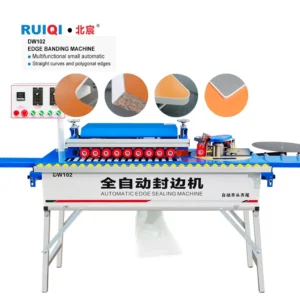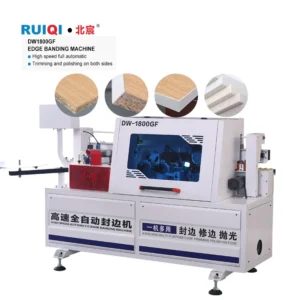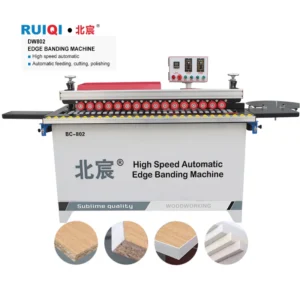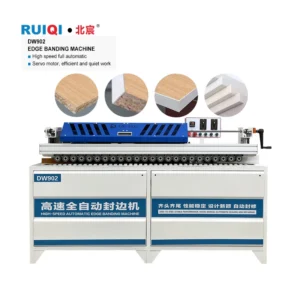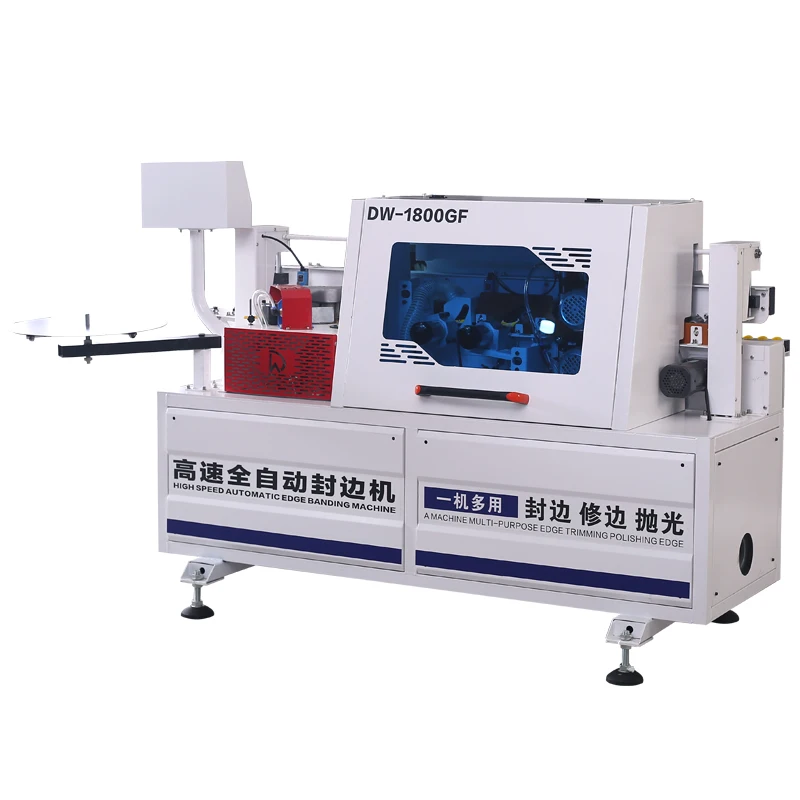
Edge banding machine
Click to enlarge
ISO 9001
CE Certified
OEM / ODM
12-Mo Warranty
Edge banding machine
Wood Machines Automatic Bander for MDF and Plywood – Factory Supply
<p><strong>DW1800 Automatic Edge Banding Machine, 4.9KW, 0-14M/min Feed Speed</strong> — delivers double-sided gluing, top/bottom trimming and flexible scraping in one automated pass. Feed speed adjusts from 0–14 m/min to match glue cure behaviour on MDF, plywood and particleboard, while profile tracking rounds all four corners for clean, assembly-ready edges across 0.3–3 mm banding thickness. - Sample processing test on your actual substrate available before order to verify edge quality and adhesion.</p>
100+
Countries
MOQ 1
Unit
15-25 Days
Lead Time
Automatic Edge Banding Machine
Double-Sided Gluing
DW1800
MDF Panel
Plywood Edge Banding
Process And Application
Profile Tracking
- Full OEM/ODM support -- custom logo, voltage (110V-440V), multilingual panels
- ISO 9001 & CE certified, 5 national patents, 60 professional engineers
- 12-month warranty, remote technical support & spare parts service
- Professional export packaging, customs clearance support, on-time delivery
Double-Sided Gluing Precision — the DW1800 applies adhesive to both panel edge and banding strip, verified through pre-shipment sample tests on your actual substrate before configuration is locked in.
Technical Specifications
| Parameter | Value |
|---|---|
| Model | DW1800 |
| Product Type | Automatic Edge Banding Machine |
| Total Power | 4.9 kW |
| Voltage Options | 380V / 220V / 415V (frequency to confirm) |
| Feed Speed | 0–14 m/min (adjustable) |
| Edge Banding Thickness Range | 0.3–3 mm |
| Edge Banding Height Range | 0–50 mm |
| Minimum Sheet Dimensions | 200 mm length × 100 mm width |
| Glue Pot Capacity | 4000 ml |
| Trimming Power / Speed | 800 W × 2 / 24,000 r/min |
| Polishing Power | 380 W × 2 |
| Vacuum Power | 550 W |
| Air Source Pressure | 0.4–0.6 MPa |
| Overall Dimensions (L×W×H) | 220 × 65 × 125 cm |
| Net Weight | 320 kg |
| Standard Functions | Double-sided gluing, front & rear alignment, top & bottom trimming, flexible edge scraping, top & bottom polishing, dust suction |
| Control Language | Chinese and English standard; other languages customizable |
| Plug Options | EU, USA, AU, UK |
Application Suitability
| Application | Material or Output |
|---|---|
| Custom cabinet door edge finishing | MDF and particleboard panels with PVC or melamine banding |
| Plywood shelving and carcass production | Plywood sheets with veneer or ABS edge strips |
| Small-batch furniture components | Solid wood panels and organic glass plates |
| Mixed-substrate workshop runs | Alternating MDF, particleboard and PVC board batches |
| Joinery scaling from manual to machine | Panels requiring single-pass gluing through polishing |
Why Glue Lines Appear on Some Boards but Not Others
Substrate density determines how much adhesive the panel edge absorbs, and a fixed glue setting will always favour one material over another.
In workshops running mixed batches, the woodworking edge banding process and application changes every time a different board enters the feed. Particleboard from one region can be noticeably less dense than MDF from the next pallet, pulling more glue into the core and leaving a visible starved joint on the surface. I have watched entire door batches get rejected because the glue pot was set for MDF while the operator was feeding low-density chipboard [NEED_CITE: substrate density variation in panel board manufacturing]. The DW1800 addresses this through its double-sided gluing system, which coats both the panel edge and the back of the banding strip, compensating for uneven absorption across materials.
How the Woodworking Edge Banding Process and Application Changes Across Substrates
MDF edges are dense and smooth, accepting a thin, even glue film that bonds quickly under pressure. Particleboard edges, by contrast, are porous and uneven; the double-sided gluing system on the DW1800 ensures sufficient adhesive reaches both surfaces to form a continuous bond line. Plywood presents a different challenge entirely — the alternating grain layers create micro-gaps that demand a slightly thicker glue application at the trimming stage to prevent edge lift during downstream handling.
Tracking Corners Without Tearing the Banding
Profile tracking rounds all four corners of the panel in one pass, following the panel contour rather than cutting a fixed radius. This matters when the woodworking edge banding process and application involves thin PVC banding on 18 mm particleboard — a rigid corner cut would tear the strip or leave a sharp arris that chips during assembly. The tracking mechanism adjusts cutter engagement as the panel corner passes, producing a smooth transition that is safe to handle immediately after polishing.
Reading the Specifications for What They Mean on the Floor
The 0–14 m/min feed speed range is not simply a throughput number; it directly controls how long adhesive stays under pressure before trimming begins. Slower feed on porous particleboard allows the glue to penetrate and set before the trimming station arrives, while faster feed on dense MDF prevents adhesive from cooling too much and becoming brittle. The 24,000 r/min trimming speed produces a clean shear cut on PVC banding up to 3 mm thick without chatter marks, and the 800 W motors per trimming unit maintain RPM under load when processing hardwood veneer strips. Air pressure between 0.4 and 0.6 MPa drives the pneumatic tracking and scraping cylinders — pressure below this range causes inconsistent corner rounding, while excessive pressure accelerates seal wear [NEED_CITE: pneumatic pressure requirements for edge banding machinery]. The 4000 ml glue pot capacity supports continuous runs through a typical batch without mid-job refills, and the integrated dust suction at 550 W captures trimming waste before it contaminates the polishing wheels.
What Happens When Voltage Is an Afterthought
A machine wired for 380V three-phase arriving at a workshop with only 220V single-phase supply does not just fail to start — it can damage the glue pot heater and trimming motors before the fault is identified [NEED_CITE: voltage mismatch damage in imported industrial machinery]. Control panels displaying only Chinese characters delay commissioning while operators attempt to interpret parameter screens through translation apps, often setting incorrect trimming depths or feed speeds. When machines are selected individually without considering the existing line’s feed height or throughput rhythm, bottlenecking appears within the first week of production.
Why This Configuration Suits Your Workshop
Engineers review your panel material samples and processing volume before recommending the DW1800 configuration, with a formal quotation issued within 24 hours. The double-sided gluing and profile tracking functions come standard rather than as costly add-ons, meaning a growing workshop does not need to replace the machine as edge quality requirements tighten. Voltage is confirmed and matched to your local supply before production begins, and the control panel language is set to your operator’s preference. A four-stage quality check covers incoming components, in-process assembly, finished unit testing, and a pre-shipment verification run on your specified panel material. Factory visits are welcomed at any stage so you can observe the build process and run your own test pieces.
Documentation & Verification
- CE declaration of conformity covering the DW1800 automatic edge banding machine
- ISO 9001 certificate for the manufacturing quality management system
- Machine specification sheet confirming all DW1800 parameters and voltage setting
- Electrical schematic with confirmed voltage and plug type for your facility
- Operation and maintenance manual in your agreed language with spare parts list
- Factory test record showing edge quality results on your panel material sample
Installation, Commissioning & Support
- Floor space of approximately 220 × 65 cm required, plus operator clearance on the feed and exit sides
- Dedicated circuit matching confirmed voltage (380V/220V/415V) with appropriate breaker rating for 4.9 kW total load
- Machine arrives assembled; connect power, air supply at 0.4–0.6 MPa, and dust extraction ducting
- First-run commissioning includes glue temperature calibration and trimming depth adjustment on your panel stock
- Operator training covers feed speed selection, glue pot refilling, and profile tracking adjustment
- Spare trimming blades, polishing wheels, and scraper inserts included for initial consumable replacement cycle
Before You Request a Quote
Send a sample of the panel material you process most frequently — including the specific brand and thickness — so we can run it through the DW1800 and return edge quality photographs with the quotation. Confirm your workshop’s voltage and frequency supply, the control panel language your operators need, and whether your existing dust extraction system can accommodate the 550 W vacuum connection. If you are planning a full line rather than a single machine, share your current feed height and daily panel volume so the DW1800 can be positioned correctly within the workflow.
Frequently Asked Questions
Q: How does glue application differ between MDF, particleboard and plywood on the DW1800?
A: MDF edges are dense and require a thin glue film, while particleboard absorbs more adhesive due to its porous structure. The double-sided gluing system coats both the panel edge and the banding strip, ensuring sufficient adhesive on porous substrates without oversaturating MDF. Plywood’s layered grain demands slightly more glue to fill micro-gaps between veneer plies.
Q: What edge banding materials work within the 0.3–3 mm thickness range?
A: The DW1800 handles PVC, ABS, melamine, and wood veneer strips across the full 0.3–3 mm range. Thin PVC around 0.4 mm is common for cabinet carcass work, while 2–3 mm ABS is typical for exposed furniture edges requiring impact resistance. Veneer strips up to 3 mm can be processed with adjusted trimming parameters.
Q: How does profile tracking affect corner quality on panels of different thickness?
A: Profile tracking follows the actual panel corner rather than cutting a fixed radius, which prevents tearing on thin banding and leaves sharp arrises on thick stock. On 18 mm particleboard with 0.8 mm PVC, tracking produces a smooth rounded corner safe for handling. The mechanism adjusts automatically as panel thickness changes within the 0–50 mm height range.
Q: What are the minimum panel dimensions and how does feed speed affect edge finish?
A: The DW1800 accepts panels as small as 200 mm long and 100 mm wide. Slower feed speeds allow more adhesive penetration on porous particleboard, improving bond strength. Higher speeds suit dense MDF where glue sets quickly. The 0–14 m/min range lets operators match speed to the specific material and banding combination in each batch.
Q: Can the control panel language be customised for operators who do not read Chinese or English?
A: Yes. Chinese and English are standard, but the control interface can be configured in other languages before shipment. Specify your preferred language during the quotation stage so the correct firmware is loaded and tested during the pre-shipment verification run, avoiding commissioning delays on site.
Technical Specifications
| Parameter | Value |
|---|---|
| Product Name | Wood Machines Automatic Bander for MDF and Plywood – Factory Supply |
| Category | Edge banding machine |
| Voltage Options | 110V / 220V / 380V / 440V (customizable) |
| Frequency | 50Hz / 60Hz (customizable) |
| Certification | ISO 9001, CE |
| MOQ | 1 Unit |
| Lead Time | 15-25 Working Days |
| Warranty | 12 Months |
| OEM / ODM | Available -- logo, color, panel language |
* Detailed technical specifications vary by model. Please contact us with your specific requirements for a complete datasheet.
Shipping & Export
-
Export Packaging
Heavy-duty wooden crate with foam padding and moisture protection
-
Shipping Methods
Sea freight (FCL/LCL), air freight, express -- we support all methods
-
Customs Support
Full documentation: CO, commercial invoice, packing list, HS code assistance
-
Port of Loading
Tianjin / Qingdao port, China -- 20 years export experience
OEM / ODM Services
-
Logo & Branding
Custom logo printing, color scheme, and nameplate engraving
-
Voltage Configuration
110V / 220V / 380V / 440V, 50Hz / 60Hz -- any region supported
-
Multilingual Panels
Control panels in English, Spanish, French, Arabic and more
-
Custom Specifications
Modified dimensions, accessories, or feature sets on request
Get a Quote
Request Product Inquiry
Fill in your details and we'll respond within 24 hours with pricing and availability.
Direct Contact
How It Works
-
1
Confirm requirements & budget
Tell us your factory scale and processing needs
-
2
Receive recommendation & quote
We match the right machine with full specs
-
3
Negotiate & place order
OEM terms, voltage, payment and delivery
-
4
Production & QC inspection
Multi-stage quality control by 60 engineers
-
5
Export packaging & shipment
Professional packing, customs clearance
-
6
After-sales support
12-month warranty, remote tech support
You May Also Like