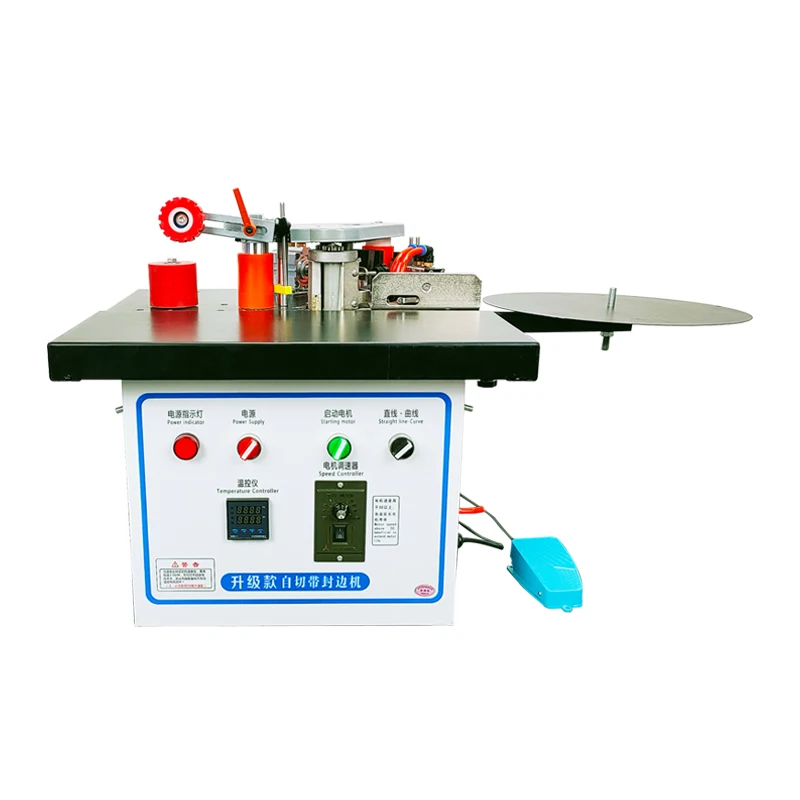
Edge banding machine
Click to enlarge
ISO 9001
CE Certified
OEM / ODM
12-Mo Warranty
Edge banding machine
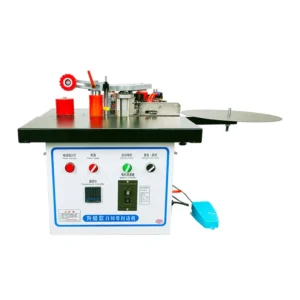
ST-50 Portable Edge Banding Machine for MDF Board – Small Workshop
<p><strong>ST-50 Portable Edge Banding Machine, 1000W, 0.3–3mm Edge Thickness, 0–50mm Banding Height</strong> — handles curved and straight edge sealing on MDF, plywood and particleboard within a compact tabletop footprint. The 1000ml glue pot supports sustained manual runs, while 0.5–0.8 MPa air supply keeps banding pressure consistent across substrates commonly used in small workshop joinery. Backed by four-stage QC with pre-shipment verification and voltage customization from 110V to 440V.</p>
100+
Countries
MOQ 1
Unit
15-25 Days
Lead Time
| 思维过程 | |---| | **Gate 检查**: identifier = ST-50
edge quality
glue and banding material selection
非空 → 继续。 | | **语言与标题一致**: 标题为英文 → 输出英文
首字母大写。 | | **目标站角色**: ruiqiwoodwork.com → PROCESS AND APPLICATION → Emphasis: substrate behaviour
- Full OEM/ODM support -- custom logo, voltage (110V-440V), multilingual panels
- ISO 9001 & CE certified, 5 national patents, 60 professional engineers
- 12-month warranty, remote technical support & spare parts service
- Professional export packaging, customs clearance support, on-time delivery
Glue Pot Control at the Workbench — The ST-50 portable edge banding machine process application demonstrates how a 1000 ml glue reservoir and adjustable banding height manage adhesion consistency on MDF and plywood without a full automatic line.
Technical Specifications
| Parameter | Value |
|---|---|
| Model | ST-50 |
| Product Type | Portable Edge Banding Machine |
| Rated Power | 1000W |
| Edge Trimming Power | 20W |
| Voltage & Frequency | 220V/380V/customization (frequency 50/60Hz to be confirmed) |
| Control System | Manual operation with control panel |
| Language Options | Chinese + English (default); Spanish, French or other on request |
| Overall Dimensions (L×W×H) | 50×50×47 cm |
| Net Weight | 22 kg |
| Glue Pot Capacity | 1000 ml |
| Edge Banding Thickness Range | 0.3–3 mm |
| Edge Banding Height Range | 0–50 mm |
| Minimum Sheet Length | 25 cm |
| Minimum Sheet Width | 3 cm |
| Air Supply Requirement | 0.5–0.8 MPa |
| Assembly State | Fully assembled, portable tabletop unit |
| Standard Features | Curved and straight edge banding |
| Trimming Stations | Manual trimming |
Application Suitability
| Application | Material or Output |
|---|---|
| Custom MDF cabinet and shelving edge sealing | MDF panels with PVC or melamine tape |
| On-site furniture repair and re-banding | Installed cabinetry requiring portable curved and straight edge finishing |
| Small-scale plywood joinery | Plywood and ecological board for interior decoration projects |
| Particleboard component finishing | Particleboard with veneer or PVC edge banding |
Why the Voltage Question Should Come Before the Price
Confirming local voltage and frequency is the single most important step before any portable edge banding machine process application leaves the factory.
A compact unit like this seems straightforward until it arrives at a workshop running a different supply standard. I once saw a shipment stall for weeks because a small bander was configured for one voltage while the buyer’s shop operated on another, requiring a locally sourced transformer before commissioning could even begin [NEED_CITE: voltage and frequency standards by export market]. For a portable edge banding machine, this is especially frustrating because the unit is ready to work the moment it is unpacked — except it cannot be plugged in.
Substrate Behaviour and Glue Adhesion
The portable edge banding machine process application differs significantly depending on whether you are sealing MDF, plywood, or particleboard. MDF has a smooth, uniform surface that generally accepts hot-melt glue with minimal preparation. Plywood, with its exposed grain and occasional surface irregularities, demands a slightly higher glue temperature and firm, consistent pressure during application. Particleboard sits between the two — porous enough to absorb glue readily, but prone to chipping on the exposed core if the edge is not clean before banding. Understanding these substrate differences is where operators achieve consistent results rather than fighting visible glue lines.
Curved and Straight Profiles in One Setup
Joinery workshops producing shaped cabinet doors alongside straight shelving units benefit from the ST-50’s dual-profile capability. Switching between a curved door panel and a straight shelf edge requires no fixture change — the operator simply adjusts the workpiece angle against the guide. This flexibility is essential for small-scale custom furniture production where batch sizes are small and profile variety is high. The 1000 ml glue pot sustains a continuous run across mixed profiles without frequent refill interruptions, keeping workflow rhythm intact throughout a production session [NEED_CITE: edge banding material compatibility with hot-melt adhesives].
What the Numbers Mean for Your Workbench
The 0.3–3 mm edge banding thickness range covers the PVC, melamine, and veneer tapes most commonly specified for furniture and interior fit-out. Thicker PVC bands at the upper end require adequate glue coverage and steady feed pressure to prevent lifting at the edges, particularly on particleboard. The 0–50 mm banding height range accommodates standard panel thicknesses from thin 3 mm backs to 50 mm solid wood worktops. The 1000W rated power is sufficient to maintain stable glue pot temperature through sustained manual runs, while the 0.5–0.8 MPa air supply requirement means the workshop compressor must be factored into installation planning. Manual trimming at 20W handles the excess band removal, but operators should expect to finish corners by hand for the cleanest result.
When the Wrong Specification Costs More Than the Machine
A portable unit ordered without verifying air supply compatibility often sits idle until a compressor is sourced — a delay that compounds when the workshop has committed delivery dates to its own clients. Language on the control panel matters equally; an operator who cannot read the interface will hesitate during temperature adjustments, leading to inconsistent glue application and rework [NEED_CITE: machinery operator interface language standards]. These are not catastrophic failures but quiet, compounding inefficiencies that erode the productivity a small workshop needs from its equipment.
Why Procurement Rigour Matters Here
In-house manufacturing with patented cutting mechanisms means edge quality can be verified before the unit ships. Voltage, language, and specification customization are treated as standard configuration steps rather than special requests. A four-stage QC process with pre-shipment verification catches tolerance and electrical discrepancies before packing. Engineer-led configuration recommendations, with formal quotation within the next working day, ensure the specification matches the workshop’s actual supply and workflow conditions. Factory visits are available for buyers who want to see sample processing on their own panel materials before committing to an order.
Documentation & Verification
- CE declaration of conformity applicable to portable woodworking equipment
- Machine specification sheet confirming voltage and frequency for your workshop
- Factory test record on your specified panel thickness and edge banding material
- Operation and maintenance manual in the agreed operator language
- Spare parts list covering glue pot elements and trimming components
- Packing photographs documenting unit condition before dispatch
Installation, Commissioning & Support
- Place the 50×50×47 cm unit on a stable workbench capable of supporting 22 kg plus workpiece weight
- Connect to a dedicated circuit matching confirmed voltage and frequency before first power-on
- Supply compressed air at 0.5–0.8 MPa from a clean, regulated compressor line
- Run initial glue pot heat cycle and verify temperature stability before applying banding to production panels
- Perform sample curved and straight edge tests on your actual MDF or plywood stock
- Confirm manual trimming operation and review daily glue pot cleaning procedure
Preparing Your Enquiry
To configure the ST-50 correctly for your workshop, share your primary panel material and typical thickness range, the edge banding tape type and thickness you use most often, and your local voltage and frequency supply. Specify the language your operators need on the control panel and whether you intend to process curved profiles alongside straight edges. If you have specific adhesion concerns on a particular substrate, request a sample processing test before shipment.
Frequently Asked Questions
Q: What glue types are compatible with the ST-50 glue pot, and how does substrate choice affect adhesion quality?
A: The 1000 ml glue pot handles standard hot-melt EVA adhesives used with PVC, melamine, and veneer edge banding tapes. MDF typically achieves strong adhesion with standard temperature settings due to its smooth surface. Plywood may require slightly elevated temperature for adequate bond strength on its textured grain. Particleboard absorbs glue readily but requires clean, chip-free edges to prevent lifting.
Q: How does edge banding thickness affect glue temperature and feed pressure on different panel materials?
A: Thicker bands within the 0.3–3 mm range demand higher glue volume and firmer, more consistent feed pressure during application. Thin 0.3 mm veneer tape requires lower temperature to prevent scorching. PVC at 2 mm or above benefits from sustained heat across the full contact surface. Adjusting pressure and temperature for each combination avoids both insufficient adhesion and excess squeeze-out.
Q: Can the ST-50 produce consistent results on both curved cabinet doors and straight shelving edges in one run?
A: Yes. The ST-50 handles both curved and straight profiles without fixture changes. The operator adjusts workpiece angle against the guide for curved sections and feeds straight sections normally. The 1000 ml glue pot capacity supports mixed-profile runs without refill interruptions, maintaining consistent temperature and glue flow throughout the session.
Q: What surface preparation is needed on MDF versus plywood before applying PVC edge banding?
A: MDF generally requires only a clean, dust-free edge for reliable PVC adhesion. Plywood edges should be sanded smooth to remove loose grain fibres and surface irregularities that could create uneven glue contact. Both materials benefit from compressed air cleaning immediately before banding to remove residual dust that contributes to visible glue lines.
Q: How does this portable unit fit into a workflow that may later expand to a semi-automatic edge bander?
A: The ST-50 serves as a capable production tool for low-volume custom work and on-site repair while establishing your workshop’s edge banding processes. When volume grows, the same glue types, banding materials, and operator skills transfer directly to semi-automatic or full-function machines, making the transition a capacity step rather than a retraining exercise.
Technical Specifications
| Parameter | Value |
|---|---|
| Product Name | ST-50 Portable Edge Banding Machine for MDF Board – Small Workshop |
| Category | Edge banding machine |
| Voltage Options | 110V / 220V / 380V / 440V (customizable) |
| Frequency | 50Hz / 60Hz (customizable) |
| Certification | ISO 9001, CE |
| MOQ | 1 Unit |
| Lead Time | 15-25 Working Days |
| Warranty | 12 Months |
| OEM / ODM | Available -- logo, color, panel language |
* Detailed technical specifications vary by model. Please contact us with your specific requirements for a complete datasheet.
Shipping & Export
-
Export Packaging
Heavy-duty wooden crate with foam padding and moisture protection
-
Shipping Methods
Sea freight (FCL/LCL), air freight, express -- we support all methods
-
Customs Support
Full documentation: CO, commercial invoice, packing list, HS code assistance
-
Port of Loading
Tianjin / Qingdao port, China -- 20 years export experience
OEM / ODM Services
-
Logo & Branding
Custom logo printing, color scheme, and nameplate engraving
-
Voltage Configuration
110V / 220V / 380V / 440V, 50Hz / 60Hz -- any region supported
-
Multilingual Panels
Control panels in English, Spanish, French, Arabic and more
-
Custom Specifications
Modified dimensions, accessories, or feature sets on request
Get a Quote
Request Product Inquiry
Fill in your details and we'll respond within 24 hours with pricing and availability.
Direct Contact
How It Works
-
1
Confirm requirements & budget
Tell us your factory scale and processing needs
-
2
Receive recommendation & quote
We match the right machine with full specs
-
3
Negotiate & place order
OEM terms, voltage, payment and delivery
-
4
Production & QC inspection
Multi-stage quality control by 60 engineers
-
5
Export packaging & shipment
Professional packing, customs clearance
-
6
After-sales support
12-month warranty, remote tech support
You May Also Like