Edge banding machine
Click to enlarge
ISO 9001
CE Certified
OEM / ODM
12-Mo Warranty
Edge banding machine
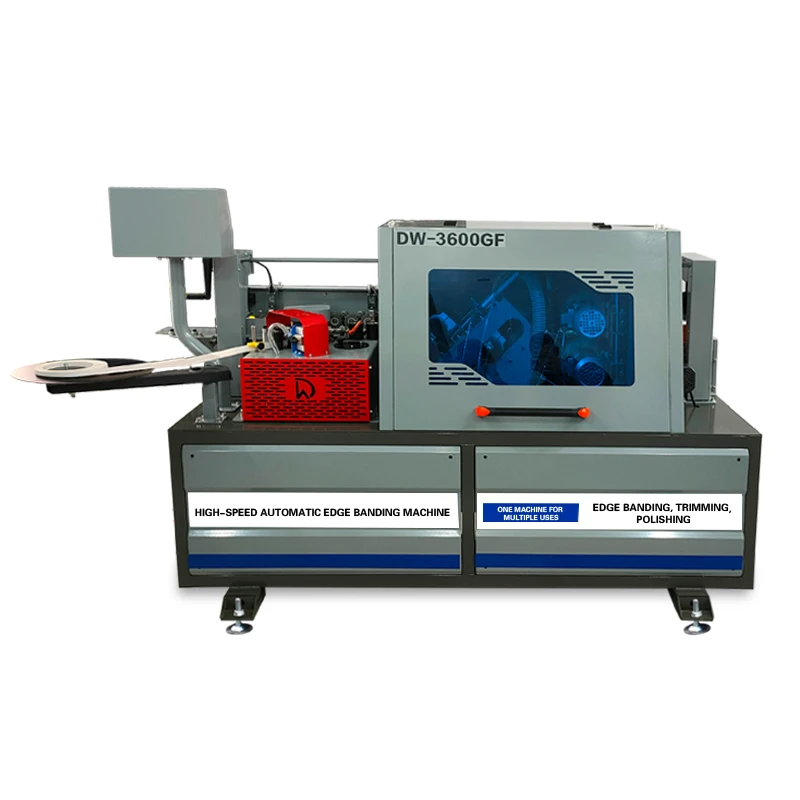
DW-3600 Full Automatic Edge Bander Furniture Machinery Woodworking Edge Banding Machine
<p><strong>DW-3600GF Automatic Edge Bander, 380V, 4.9 kW Total Power, 0.3–3mm Edge Band Thickness</strong> — delivers a six-station process chain from gluing through polishing, with 24,000 r/min trimming motors controlling edge smoothness and chipping on MDF, particleboard and plywood substrates. Feed speed adjusts from 0–14 m/min to balance glue curing time against throughput for different panel materials.</p> <ul> <li>Each process station is independently powered, allowing parameter tuning when switching between PVC and veneer banding</li> <li>Supported by pre-shipment testing records and sample edge finish verification across your specified substrate range</li> </ul>
100+
Countries
MOQ 1
Unit
15-25 Days
Lead Time
380V Three-phase
Automatic Feeding
DW-3600GF
Edge Banding Machine
Furniture Factory
MDF Panel
Plywood Edge Banding
Process And Application
- Full OEM/ODM support -- custom logo, voltage (110V-440V), multilingual panels
- ISO 9001 & CE certified, 5 national patents, 60 professional engineers
- 12-month warranty, remote technical support & spare parts service
- Professional export packaging, customs clearance support, on-time delivery
Precision-ground trimming assemblies — Verified through a four-stage QC process covering incoming material, in-process machining, and pre-shipment test runs on your actual panel substrates.
Technical Specifications
| Parameter | Value |
|---|---|
| Model | DW-3600GF |
| Product Type | Automatic Edge Banding Machine |
| Voltage & Frequency | 380V, three-phase four-wire (confirm 50Hz/60Hz requirement) |
| Total Power | 4.9 kW |
| Equipment Footprint | 2200 × 650 × 1250 mm |
| Total Weight | 320 kg |
| Edge Banding Type | Straight edge banding |
| Edge Band Height Range | 0–50 mm |
| Edge Band Thickness Range | 0.3–3 mm |
| Minimum Panel Length | 200 mm |
| Feed Speed | 0–14 m/min (basis not stated in source) |
| Transmission Power | 180 W |
| Trimming Power | 800 W × 2, 24000 r/min |
| Polishing Power | 400 W × 2 |
| Air Pressure Requirement | 0.4–0.6 MPa |
| Standard Functions | Gluing, trimming, front and rear trimming, scraping, polishing, vacuuming |
| Language Options | Chinese and English (other languages available on request) |
| Plug Options | EU / USA / AU / UK |
| Assembly State | Fully assembled |
Application Suitability
| Application | Material or Output |
|---|---|
| Custom furniture and cabinet panel edge banding | MDF, particleboard, plywood straight-edge processing |
| PVC and veneer edge banding application | 0.3–3 mm PVC strips and thin wood veneer rolls |
| Small to medium workshop transition | Upgrading from manual edge finishing to automated straight-line processing |
Why Glue Line Visibility Varies Across Substrates
The edge banding machine woodworking process produces inconsistent results across MDF, particleboard, and plywood when glue pot temperature, feed rate, and trimming speed are not tuned to the specific substrate density and resin content.
Particleboard with high internal resin content absorbs heat differently than MDF, meaning a fixed glue temperature setting will starve the glue joint on one material while flooding it on another. I have seen edge banders of this class fail in humid workshops simply because the operator never adjusted the feed speed to account for longer open time requirements. The visible glue line that appears three days after installation is rarely a machine defect — it is a process parameter that was never matched to the actual board chemistry [NEED_CITE: substrate thermal conductivity and hot melt adhesive wetting behaviour].
How the Six-Station Sequence Controls Edge Quality
The DW-3600GF routes each panel through gluing, trimming, front and rear trimming, scraping, polishing, and vacuuming in a single pass. Each station has independent power allocation, so the edge banding machine woodworking process can be adjusted at the trimming stage without disturbing the glue application parameters set upstream. This separation matters when switching between rigid PVC and flexible veneer, since each material demands a different trimming approach.
Feed Speed as a Process Variable, Not Just a Throughput Dial
Running at the upper end of the 0–14 m/min range works for stable MDF substrates where the hot melt adhesive sets predictably. Particleboard with variable density requires a slower feed to maintain consistent glue transfer and edge contact pressure. The transmission system at 180 W is sized for steady, continuous feeding rather than rapid acceleration, which keeps the panel registration stable through each station.
Reading the Specs That Directly Affect Edge Finish
The dual trimming motors at 800 W each and 24,000 r/min are the most consequential numbers on this machine. That spindle speed determines how cleanly the trimming cutter shears the PVC or veneer edge — lower speeds tend to tear rather than cut, leaving micro-fractures visible under direct light. The 0.3–3 mm edge band thickness range covers most furniture-grade PVC and veneer rolls, but the scraper and polishing stations must be adjusted when moving between those extremes. Polishing motors at 400 W × 2 remove residual adhesive haze without rounding the freshly trimmed edge, provided the cotton buffing wheels are replaced before they become loaded with glue residue [NEED_CITE: polishing wheel maintenance intervals for hot melt adhesive removal].
The Cost of Skipping the Substrate Test Run
Shipping a machine configured for MDF into a workshop that primarily runs high-resin particleboard results in delamination complaints within the first week. Operators blame the glue, then the edge banding supplier, before considering that the glue pot temperature was never validated against their specific board stock. Production halts while parameters are reverse-engineered on the shop floor, costing more in lost output than a pre-shipment sample test would have required [NEED_CITE: typical production line downtime costs in furniture panel processing].
What This Factory Builds Into Every Unit
In-house manufacturing means the trimming spindle housings are precision-ground on-site, not sourced from a third-party catalog. The four-stage QC protocol runs from incoming material inspection through pre-shipment verification on actual panel stock, so the DW-3600GF is tested under conditions that approximate your production environment. Voltage configuration is confirmed before the machine leaves the floor — a 380V unit built for 50Hz will not arrive at a 60Hz facility with mismatched motor ratings. Engineer-led configuration means the quotation specifies which stations to activate for your substrate mix rather than shipping a default setup that requires field modification.
Documentation & Verification
- Factory test record on your panel thickness and substrate type before dispatch
- Electrical schematic confirming 380V three-phase wiring and motor ratings
- Operation and maintenance manual in your specified language
- Spare parts list with trimming cutter and polishing wheel specifications
- CE declaration of conformity for machinery directive compliance
- Packing photographs documenting assembly state prior to crating
Installation, Commissioning & Support
- Requires 2200 × 650 mm clear floor space with level concrete substrate
- Dedicated 380V three-phase circuit with capacity exceeding 4.9 kW total draw
- Arrives fully assembled in wooden crate — no on-site mechanical assembly needed
- Connect compressed air at 0.4–0.6 MPa and verify all six pneumatic actuators
- Initial trimming and scraping adjustment calibrated to your sample panels
- Trimming cutters and polishing wheels included as first-set consumables
Before You Request a Quotation
Share the specific board types you run — MDF, particleboard, plywood, or a mix — along with the edge banding materials you stock in PVC or veneer. Confirm your facility voltage and frequency so the motor configuration matches your supply. If you are integrating the DW-3600GF with an existing panel saw or boring machine, provide the feed height and panel dimensions so we can verify compatibility at the infeed and outfeed transitions.
Frequently Asked Questions
Q: How do MDF, particleboard, and plywood differ in edge banding process requirements?
A: MDF is thermally uniform, allowing standard glue pot settings and faster feed speeds. Particleboard with high resin content absorbs heat unevenly, requiring lower feed rates and slightly higher glue temperature to achieve full wetting. Plywood has exposed grain cavities that demand more glue volume and careful scraping to avoid tearing the veneer edge during trimming.
Q: What trimming adjustments are needed when switching between 0.3 mm PVC and 3 mm veneer?
A: Thin PVC at 0.3 mm requires lighter trimming pressure and sharper cutters to prevent edge curl. Thick veneer at 3 mm demands slower feed speed through the trimming station and adjusted scraper angle to follow the natural grain without splintering. Polishing wheel pressure must also be reduced for veneer to avoid burning the wood surface.
Q: How can I prevent voltage mismatch or unreadable control panels on delivery?
A: Specify your facility voltage, frequency, and preferred plug type at the quotation stage so the electrical system is built to match. Confirm the operator language for the control panel and manual before production begins. The factory provides an electrical schematic and voltage confirmation document with every shipment for your electrician to verify before first power-on.
Q: How does this edge bander integrate with upstream and downstream equipment?
A: The DW-3600GF accepts panels from a sliding table saw or panel saw at standard furniture panel heights. Feed speed is adjustable to match the output rhythm of your cutting station. Downstream, the finished panels move to hinge boring or multi-boring machines — verify that the minimum 200 mm panel length covers your smallest cabinet component dimensions.
Q: What parameters should I check first when glue lines become visible or trimming leaves edge chips?
A: Start with glue pot temperature and confirm it matches the adhesive manufacturer’s specification for your substrate. Check feed speed next — running too fast reduces glue open time and contact pressure. For trimming chips, inspect cutter sharpness and verify the 24,000 r/min spindle is reaching full speed under load, then adjust scraper angle to match the edge band material thickness.
Technical Specifications
| Parameter | Value |
|---|---|
| Product Name | DW-3600 Full Automatic Edge Bander Furniture Machinery Woodworking Edge Banding Machine |
| Category | Edge banding machine |
| Voltage Options | 110V / 220V / 380V / 440V (customizable) |
| Frequency | 50Hz / 60Hz (customizable) |
| Certification | ISO 9001, CE |
| MOQ | 1 Unit |
| Lead Time | 15-25 Working Days |
| Warranty | 12 Months |
| OEM / ODM | Available -- logo, color, panel language |
* Detailed technical specifications vary by model. Please contact us with your specific requirements for a complete datasheet.
Shipping & Export
-
Export Packaging
Heavy-duty wooden crate with foam padding and moisture protection
-
Shipping Methods
Sea freight (FCL/LCL), air freight, express -- we support all methods
-
Customs Support
Full documentation: CO, commercial invoice, packing list, HS code assistance
-
Port of Loading
Tianjin / Qingdao port, China -- 20 years export experience
OEM / ODM Services
-
Logo & Branding
Custom logo printing, color scheme, and nameplate engraving
-
Voltage Configuration
110V / 220V / 380V / 440V, 50Hz / 60Hz -- any region supported
-
Multilingual Panels
Control panels in English, Spanish, French, Arabic and more
-
Custom Specifications
Modified dimensions, accessories, or feature sets on request
Get a Quote
Request Product Inquiry
Fill in your details and we'll respond within 24 hours with pricing and availability.
Direct Contact
How It Works
-
1
Confirm requirements & budget
Tell us your factory scale and processing needs
-
2
Receive recommendation & quote
We match the right machine with full specs
-
3
Negotiate & place order
OEM terms, voltage, payment and delivery
-
4
Production & QC inspection
Multi-stage quality control by 60 engineers
-
5
Export packaging & shipment
Professional packing, customs clearance
-
6
After-sales support
12-month warranty, remote tech support
You May Also Like